

A sexual harassment retaliation lawyer helps when reporting misconduct costs you your job, your schedule, or your standing at work. In real life, 72% of workers who experienced workplace sex harassment faced some form of retaliation after complaining, and 36% of those retaliated against were fired, so retaliation is the rule, not the exception.
A Mississippi receptionist once reports a supervisor's comments, then gets a written warning, loses a project she was handling, and hears her hours may be cut. That pattern is painful, but it's familiar.
By Nick Norris, Attorney
Last updated: August 5, 2026
Reviewed by Nick Norris
When Reporting Harassment Costs Your Job
A Mississippi employee speaks up about a supervisor's conduct, thinking the company will handle it. Within days, she gets a written warning she never saw coming, she's pulled off a visible assignment, and her manager hints that her hours are about to shrink. That kind of response feels personal because it is personal.
Retaliation rarely looks like a dramatic scene. More often, it arrives as a paper trail that starts right after the complaint, and that timing matters in a legal case.
The National Women's Law Center's review of TIME'S UP Legal Defense Fund data found that 72% of workers who experienced workplace sex harassment faced some form of retaliation after complaining, and 36% of those retaliated against were fired. The same data showed other forms of punishment too, including poor evaluations, tighter scrutiny, and threats. Those numbers matter because they show why a worker can do the right thing and still end up paying the highest price.
Practical rule: if the workplace gets worse right after you report harassment, don't assume it's just bad luck. Write down what changed, when it changed, and who made it happen.
That's especially important in Mississippi, because the state does not have a human rights commission. Workers here usually have to move through the federal system directly, which means the evidence has to be organized early and the legal theory has to be clear from the start.
A sexual harassment retaliation lawyer focuses on the complaint, the response, and the link between them. That link is where many cases are won or lost.
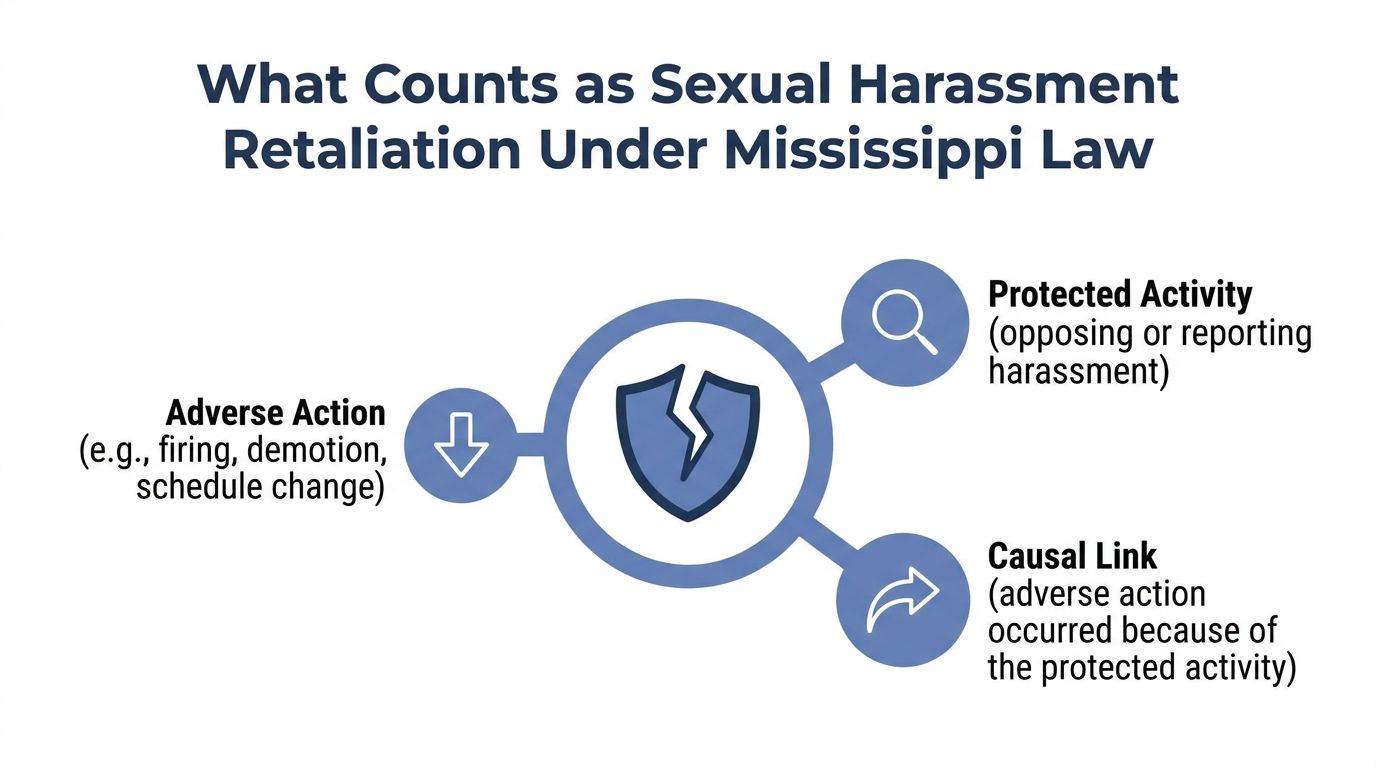
What Counts as Sexual Harassment Retaliation Under Mississippi Law
Retaliation is not limited to firing someone. In plain English, it means the employer took an adverse action because the worker opposed harassment or took part in a harassment investigation. In Mississippi, that usually means the claim runs through federal law, especially Title VII, because there isn't a state human rights commission handling these workplace complaints.
The three parts that usually decide the case
A viable claim normally turns on three pieces, and each one has to fit.
Protected activity comes first. That can mean a formal EEOC charge, but it can also mean informal opposition, like telling a supervisor the conduct has to stop or reporting it to HR. A lot of workers miss that point and think only a formal filing counts.
Adverse action is next. That can include firing, demotion, schedule changes, negative evaluations, threats, heightened scrutiny, or other treatment that would deter a reasonable worker from speaking up. The law looks at substance, not just labels.
Causal connection is the hardest piece. The worker has to show the adverse action happened because of the complaint, not because of some unrelated reason the employer later invents. That's why lawyers spend so much time on timing, supervisor comments, and whether the company followed its normal procedures.
Why causation is the real fight
Employers often say the worker was written up for performance, attendance, or restructuring. The legal response is to compare the employer's explanation to the timeline and the paper record.
If the complaint came first and the punishment came right after, the gap in time becomes evidence, especially when the employer can't show consistent treatment of other workers.
For a plain-language breakdown of how workers prove the underlying harassment itself, see how to prove sexual harassment. The retaliation issue sits on top of that foundation, but the proof questions are different.
Common Retaliation Scenarios Mississippi Workers Face
A worker in Hattiesburg reports sexual comments from a supervisor and, before the week ends, gets reassigned to a less desirable shift. The employer may never say, “This is retaliation,” but the effect is the same. Pay drops, childcare gets harder, and the worker is pushed toward quitting.
In Southaven, a warehouse employee files an EEOC charge and then receives a sudden negative performance review that does not match the feedback he had been getting before. That kind of paper trail can matter more than a fast termination, because it gives the employer something to point to later. A lawyer looks at whether the review reflects a real problem or a story built after the complaint.
In Biloxi, a healthcare worker is told she could be fired, or even dragged into legal trouble, if she talks to anyone about her complaint. That warning is meant to shut the door on the report, and silence is often the ultimate objective.
The National Bureau of Economic Research study cited in the verified data found that retaliation shows up more often in sexual-harassment charges than in other kinds of charges. That pattern matters because it shows how often the complaint and the backlash travel together, which is why these cases are so closely tied in practice.
Lower-visibility retaliation is still retaliation
A termination is easy to spot. A quieter case can be just as damaging, because the worker has to live with the pressure day after day.
Common examples include:
- Schedule changes: a shift move that makes childcare or transportation impossible.
- Heightened scrutiny: a supervisor suddenly documenting every mistake.
- Defamation threats: pressure designed to keep the worker from talking.
- Reputational harm: comments that poison relationships with coworkers or future employers.
Each of these can matter under the law if it would deter a reasonable worker from speaking up again. The proof often sits in places people overlook at first, such as text messages, calendars, and the timing of each decision after the complaint. For a plain-language explanation of the deadline rules that often shape these cases, see the harassment limitations guide. For a practical way to organize the facts, I often tell clients to look at the four key ingredients for legal contracts, because clear dates, clear terms, and clear proof matter in a retaliation file too.
Preserving Evidence and Meeting Filing Deadlines
A retaliation case often rises or falls on what the worker saved while the dispute was still unfolding. Memory shifts. Managers change their explanation. Coworkers may remember only part of what happened. Emails, messages, performance notes, and calendar entries are steadier than anyone's recollection.
Mississippi workers also run into a problem that many people miss on the first visit. Our state is one of the two without a state human rights commission, so there is no local agency standing by to receive a broad discrimination complaint the way some workers expect. That makes the federal deadlines and the paper trail even more important, because the record has to do the work that a state agency might otherwise help organize.
For practical drafting help on organizing a complaint or demand package, I often tell clients to look at resources that explain the four key ingredients for legal contracts from SendItFax. The same habits matter here, clear terms, clear dates, clear proof of what was said, and clear evidence of who sent it.
What to save right away
Start with the records that show the timeline.
- Emails and messages: save complaint emails, HR replies, supervisor texts, and Slack or Teams messages.
- Performance documents: keep reviews, written warnings, attendance notes, and any coaching forms.
- Witness information: write down names, job titles, and how each person fits the story.
- Digital backups: screenshot messages before they disappear and save them in more than one place.
The deadline clock matters from the moment the employer acts on the complaint. For many workers, that means the safest move is to preserve everything first and sort out the legal deadline second. For Mississippi workers trying to understand that timing in context, the harassment limitations guide is a useful companion resource.
A simple first-30-days approach
- Write the timeline: list each incident, the dates, the people involved, and what changed after the complaint.
- Preserve the paper trail: save everything before an account is locked, edited, or deleted.
- Identify witnesses: ask who saw the harassment, the complaint, or the punishment.
- Track the employer's explanation: if they claim restructuring or performance, compare that story with the records.
- Talk to a lawyer early: before you resign, sign anything, or send a message that can be taken out of context.
The reason this sequence works is simple. Employers defend retaliation claims by pointing to some other reason for their actions, and the three-part causation chain is often the make-or-break issue. A worker has to connect protected reporting, a harmful response, and the link between the two. A clean timeline, supported by records made close to the event, gives that chain structure instead of guesswork.
What a Sexual Harassment Retaliation Lawyer Does
A sexual harassment retaliation lawyer does much more than file papers. The job starts with sorting out whether the facts fit protected activity, adverse action, and causation, then building the record in a way that a federal agency, an employer, and, if needed, a court can follow.
The EEOC's FY 2018 to FY 2021 sexual-harassment data is a good reason to take retaliation seriously. The agency received 27,291 sexual-harassment charges, 43.5% of those charges were filed together with a retaliation allegation, and the EEOC recovered nearly $300 million for individuals with sexual-harassment claims, benefiting 8,147 people. In FY 2021, sexual-harassment resolutions rose to 10% of all resolutions, and 28.6% of those resolutions were favorable to workers. Those numbers show why retaliation can affect settlement value and case outcome.
From intake to resolution
At the intake stage, the lawyer listens for timing, witnesses, and the exact words used by managers. Then comes the investigation, which usually means collecting emails, texts, policies, handbooks, reviews, and witness details.
From there, many cases move through a demand letter and negotiation. If the facts fit, the lawyer files an EEOC charge and manages the administrative process. If the case doesn't resolve, the lawyer prepares for federal litigation and, where necessary, appeal.
Mississippi workers also need to know the fee structure before they sign anything. Employment cases here commonly use contingency fees in the 40% to 50% range, and the percentage can increase depending on the stage of the case, the risk, and whether the matter goes through appeal or extended litigation.
A lawyer who knows federal employment practice can spot pretext faster than someone who only settles cases. That matters when the employer's stated reason sounds polished but doesn't match the record.
Mississippi does not have a state human rights commission, so there's no local agency path comparable to what workers may hear about elsewhere. That makes experienced federal representation especially important, because the administrative record often shapes everything that follows.

Before a lawyer ever sends a demand, the case has to make sense on paper. The investigation has to answer one question clearly, why did the punishment follow the complaint?
First Steps for Mississippi Workers Facing Retaliation
A retaliation case often starts with a simple moment, a supervisor changes tone, a shift disappears, or a complaint suddenly turns into discipline. The first job is to capture that turn while the details are still fresh.
Write down dates, times, locations, witnesses, and the exact words used. Those notes matter because they turn a vague memory into a timeline a lawyer, a judge, or an agency can follow.
Then save every email, text, message, performance note, and personnel document you can lawfully access. If the company uses an internal system, take screenshots before the material is edited, moved, or removed.
What to do before things escalate
A worker who is still on the job should think carefully before sending an angry message or confronting a supervisor alone. A short call to an employment lawyer can prevent a mistake that gives the employer a side issue to argue about later.
If you are unsure what must stay private, client confidentiality vs privilege helps explain how legal conversations are protected and where those protections matter.
Mississippi workers also need one correction that often gets missed. Filing a workers' compensation claim does not create a separate retaliation pathway in Mississippi. The retaliation rules tied to harassment and discrimination focus on protected complaints under federal law, not on the workers' compensation claim itself.
That distinction matters because the legal theory has to fit the facts. A workers' compensation case may still matter for another purpose, but it is not the same as a sexual harassment retaliation claim. The retaliation claim still has to show the protected complaint about harassment or discrimination, the employer's adverse response, and the link between the two.
That link is the part that often decides the case. The complaint has to come first, the employer's action has to come after it, and the reason for the punishment has to connect back to the complaint in a way that makes sense on the record.
Possible remedies can include back pay, front pay, compensatory damages, reinstatement, and attorney's fees, depending on the facts and the legal posture of the case. The process can also be slow and draining, so it helps to expect a waiting period and to prepare for the pressure that comes with it.
A Mississippi worker who wants more context on retaliation representation can also review this workplace retaliation lawyer overview for a related explanation of how these cases are evaluated.
Choosing the Right Attorney and Taking Action
The right lawyer in a sexual harassment retaliation case should know how to litigate federal employment claims, not just negotiate quick exits. Ask whether the lawyer has handled EEOC charges, retaliation investigations, and appeals, because those are the stages where weak cases get exposed and strong ones get built.
A good first consultation should feel focused and practical. You should leave with a clearer view of the protected activity, the adverse action, the causation issue, and the records still missing from your file.
What to ask before you hire anyone
- Experience with federal claims: ask whether the lawyer regularly handles Title VII retaliation cases.
- Strategy for causation: ask how they plan to prove the punishment followed the complaint.
- Communication style: ask how often you'll get updates and who will answer your questions.
- Fee terms: ask whether the contingency fee starts at 40% or 50%, and whether it can increase if the case becomes more complex.
For a Mississippi worker, accessibility matters too. You want someone who will explain the process in plain English and keep the case moving without making you feel rushed or ignored.
If you want another useful overview of retaliation representation, this workplace retaliation lawyer resource provides a related framework for understanding how these cases are evaluated.
Nick Norris, P.A. represents Mississippi workers in employment disputes statewide, including harassment and retaliation matters. If you need a case evaluation, call 601-641-4897 and visit Nick Norris, P.A. to get started.
Nick Norris, P.A. helps Mississippi workers protect their rights when reporting harassment leads to discipline, threats, or termination. If you're dealing with retaliation after speaking up, reach out for a focused case evaluation and get clear guidance on your next step.
Leave a Reply