
MS Workplace Discrimination Lawyers: Free Consultation
You may be sitting in your car after a shift, staring at a termination email, a write-up, or a text from your supervisor, trying to decide whether what happened was illegal or just unfair. A lot of Mississippi workers wait in that moment because they don't want to overreact, and they don't want to call a lawyer unless they already know they have a strong case.
That hesitation is understandable. It's also risky.
A free consultation with a Mississippi employment lawyer usually isn't about jumping straight into a lawsuit. It's about getting clarity while the facts are still fresh, the documents still exist, and your options haven't narrowed. In these consultations, the first question usually isn't "How much is this case worth?" It's whether your situation fits a legal claim at all, whether the claim is timely, and what evidence exists.
Your First Step Toward Clarity in a Difficult Situation
Individuals searching for workplace discrimination lawyers free consultation aren't looking for theory. They want an answer to a plain question. "What happened to me, and what can I do about it?"
In practice, that first call is a triage step. A consultation often helps identify the legal theory, check filing deadlines, and sort out the right path. It also helps answer a harder truth. The evidence threshold is often higher than people expect, even when the treatment felt plainly wrong. That's consistent with the way consumer-facing legal guidance describes the initial screening process at For The People.
Mississippi workers often come in with facts that feel tangled. Maybe a supervisor made comments tied to race, sex, age, disability, religion, or pregnancy. Maybe HR ignored a complaint. Maybe the firing happened after leave, after a request for accommodation, or after you reported harassment. A lawyer's job in the consultation is to separate emotion from legal elements without dismissing either one.
Practical rule: A free consultation should give you a clearer picture of the issue, even if the answer is that the case needs more proof or may not be viable.
That matters because Mississippi doesn't have a state human rights commission handling most workplace discrimination claims. For many workers, the federal route is the route. If you wait too long, the legal problem can shift from "Did discrimination happen?" to "Is there still a claim that can be filed?"
A good consultation doesn't promise what can't be promised. It should help you understand where your facts fit, what records matter, what deadlines may control, and whether your next move should be preserving evidence, filing an agency charge, negotiating, or stepping back because the facts don't support a legal claim.
Finding Mississippi Lawyers Who Offer Free Consultations
If you're looking for a lawyer in Mississippi, don't start with broad searches for "wrongful termination lawyer" and stop there. Many lawyers handle a little bit of everything. You need someone who works on the employee side of employment law, not just a general litigator who occasionally sees a workplace case.
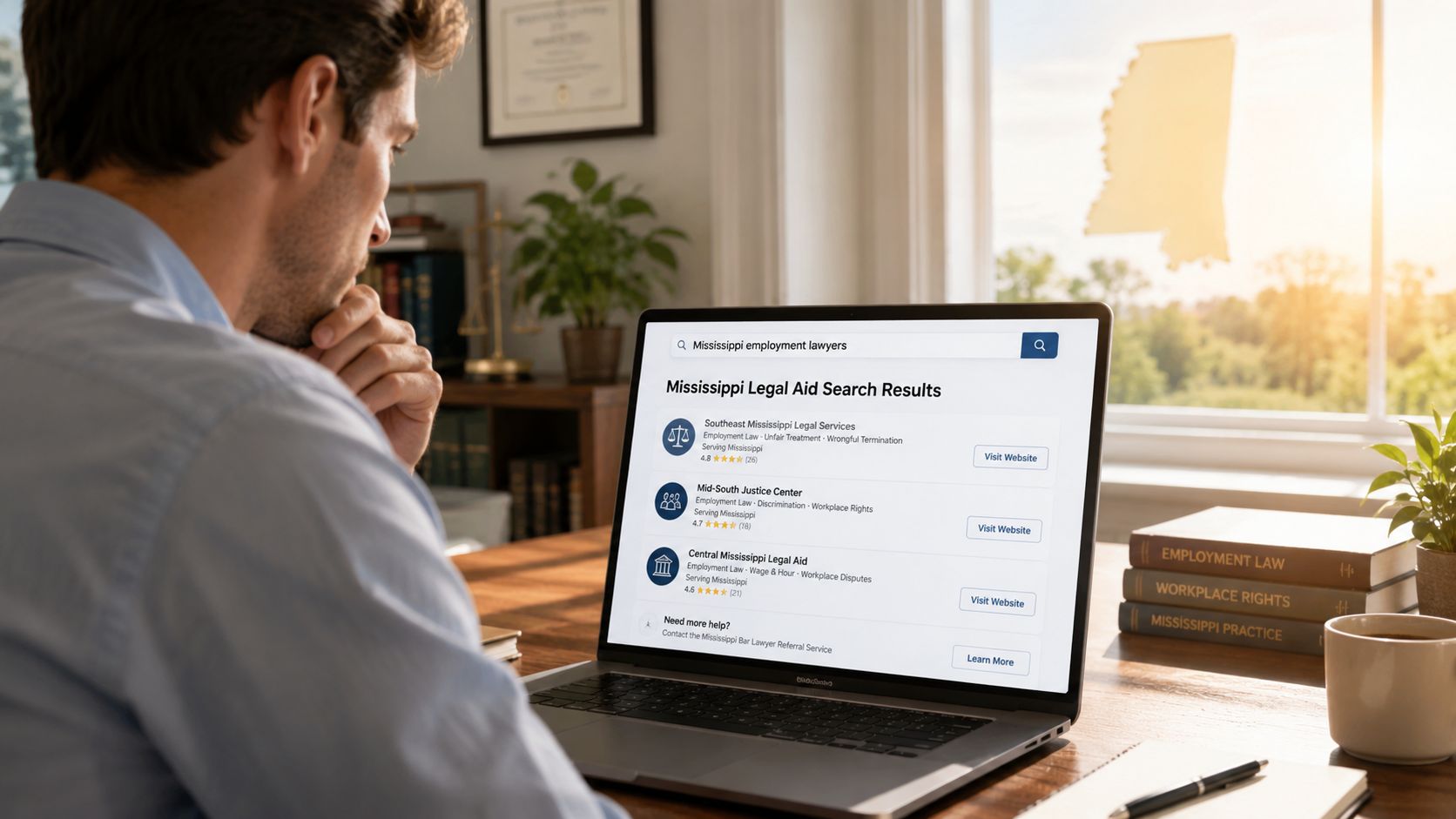
What to look for on a lawyer's website
A useful website usually tells you, quickly, whether the lawyer handles employee claims involving discrimination, harassment, retaliation, unpaid wages, leave issues, or federal workplace statutes. If the site talks mostly about business defense, insurance matters, criminal law, divorces, and personal injury all in one place, keep looking.
Check for signs the lawyer regularly handles matters such as:
- EEOC charges and federal employment claims
- Discrimination and harassment matters
- Retaliation claims tied to protected activity
- FMLA, WARN, USERRA, or wage-and-hour cases
- Employee-side representation, not only employer defense
You can also review the lawyer's bar profile and compare what you find against practical guidance on vetting law firm websites, including whether the site clearly explains services and audience, such as in Netco Design LLC's marketing guide. Marketing alone doesn't prove skill, but confusion on the website often signals confusion in intake.
For a Mississippi-specific overview of the search process, this article on how to find an employment lawyer is a useful starting point.
Why speed matters in Mississippi
One reason lawyers offer free consultations in this area is that federal discrimination claims often must be filed with the EEOC within 180 days, though that can extend to 300 days in some areas. That timing issue is one reason early screening matters, as explained in this discussion of discrimination-lawyer consultations at Working Now and Then.
For Mississippi workers, that urgency is practical, not academic. There usually isn't a state agency alternative doing the initial heavy lifting for you. If you're near a deadline, a short consultation can be the difference between preserving an option and losing one.
A quick screening checklist
Before you book the call, ask yourself:
| Question | Why it matters |
|---|---|
| Does the lawyer represent employees? | Some firms mainly defend employers. |
| Does the site mention EEOC or federal employment claims? | That often signals actual workplace-law focus. |
| Can you explain your timeline in a few minutes? | Intake staff and lawyers need a clear sequence. |
| Are you contacting them promptly? | Delay can shrink your options fast. |
If a lawyer or intake team can't tell from your first description what kind of claim they're evaluating, your facts may still be viable, but you should expect follow-up questions and a close look at timing.
How to Prepare for Your Free Consultation
Preparation changes the quality of the consultation. The better organized you are, the easier it is for the lawyer to spot what matters and what doesn't.
A lawyer screening a workplace case usually focuses on a chronology, the specific adverse action, the protected category or protected activity involved, and whether there is corroborating evidence such as emails or witness names. Guidance aimed at employment-law intake makes that point clearly, and it also warns that missing the filing deadline is often the most damaging mistake, as described by Lipsky Lowe.
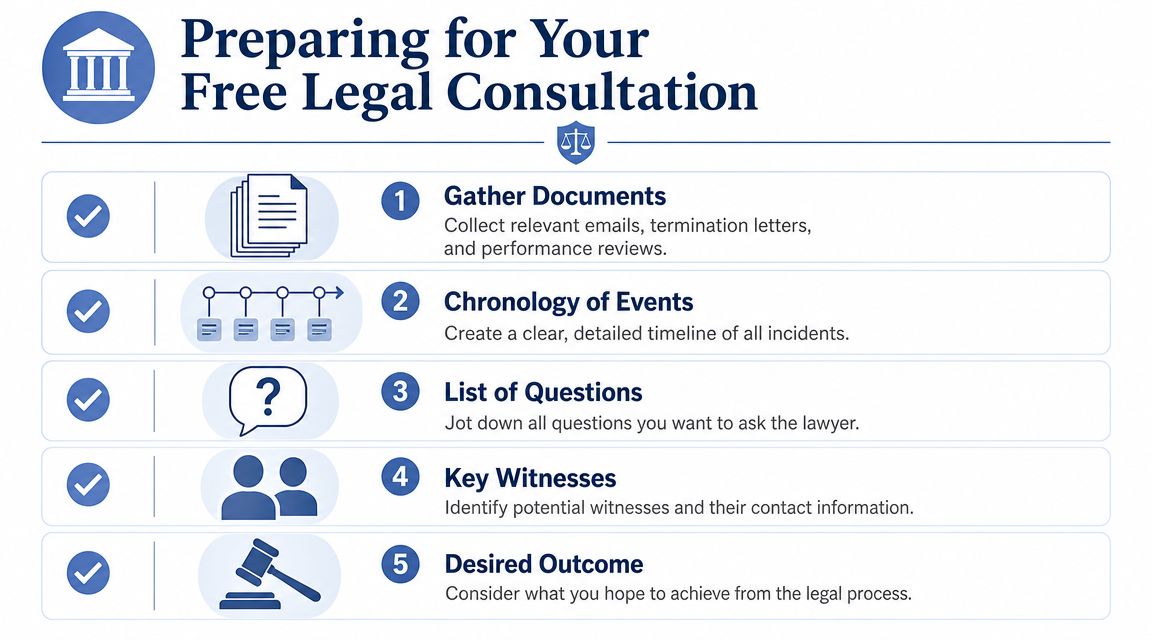
Build a timeline before you call
Don't start with everything your supervisor ever did wrong. Start with the sequence.
Write down the major events in order. Keep it simple and dated if you can. If you don't know the exact date, estimate the week or month.
Include things like:
- The first incident that made you think discrimination or harassment was happening
- Any complaint to HR or management
- Any request for leave or accommodation
- The adverse action, such as firing, demotion, reduced hours, discipline, or a denied promotion
- What happened right after, including replacement, changes in treatment, or loss of pay
This piece on how to prepare for your first talk with an employment lawyer can help you organize that first conversation efficiently.
Gather documents that actually help
Bring documents that show what happened, when it happened, and who knew about it. Lawyers don't need a box of random paperwork. They need the records that connect your story to proof.
The most useful materials often include:
- Emails and texts that mention complaints, discipline, leave, accommodations, or discriminatory remarks
- Termination letters or write-ups
- Performance reviews, especially if they changed suddenly
- Pay records or schedules if hours or compensation changed
- Employee handbook policies
- Names of witnesses who saw events or heard comments
If you still work there, be careful. Don't take documents you're not allowed to take, and don't access systems you're not authorized to use. Preserve what you lawfully already have.
Here's a short explainer before the next part:
Know what the lawyer is trying to identify
The consultation gets more productive when you can answer three core questions clearly:
What happened to you?
Focus on actions, dates, and decision-makers.Why do you believe it was illegal?
Tie your answer to a protected trait, protected activity, leave issue, pay issue, or other legal right.What proof exists besides your own belief?
This can include documents, comparators, witnesses, timing, or prior complaints.
The strongest intake summaries are usually short, chronological, and document-backed. Long emotional narratives often hide the key facts instead of highlighting them.
Questions worth asking in the consultation
Use the consultation to get practical answers. Good questions include:
- What claim do my facts fit best?
- What deadline worries you most?
- What documents should I preserve right now?
- Do the facts point more toward discrimination, retaliation, leave interference, or a wage claim?
- What would make the case stronger or weaker?
- What happens next if you don't take the case?
You don't need to sound like a lawyer. You do need to be organized enough that the lawyer can make a real assessment.
Understanding Your Potential Legal Claims in Mississippi
In Mississippi, many workers use the word "discrimination" to describe any unfair treatment at work. That's normal. Legally, though, the better claim may turn out to be something else.
A consultation often reveals that the strongest issue isn't classic discrimination at all, but retaliation, FMLA interference, or a wage violation. That is especially important in an at-will state like Mississippi, where employees sometimes assume they have no rights unless the employer said something openly biased. Legal guidance discussing consultation triage in at-will settings makes the same point at Bogin, Munns & Munns.
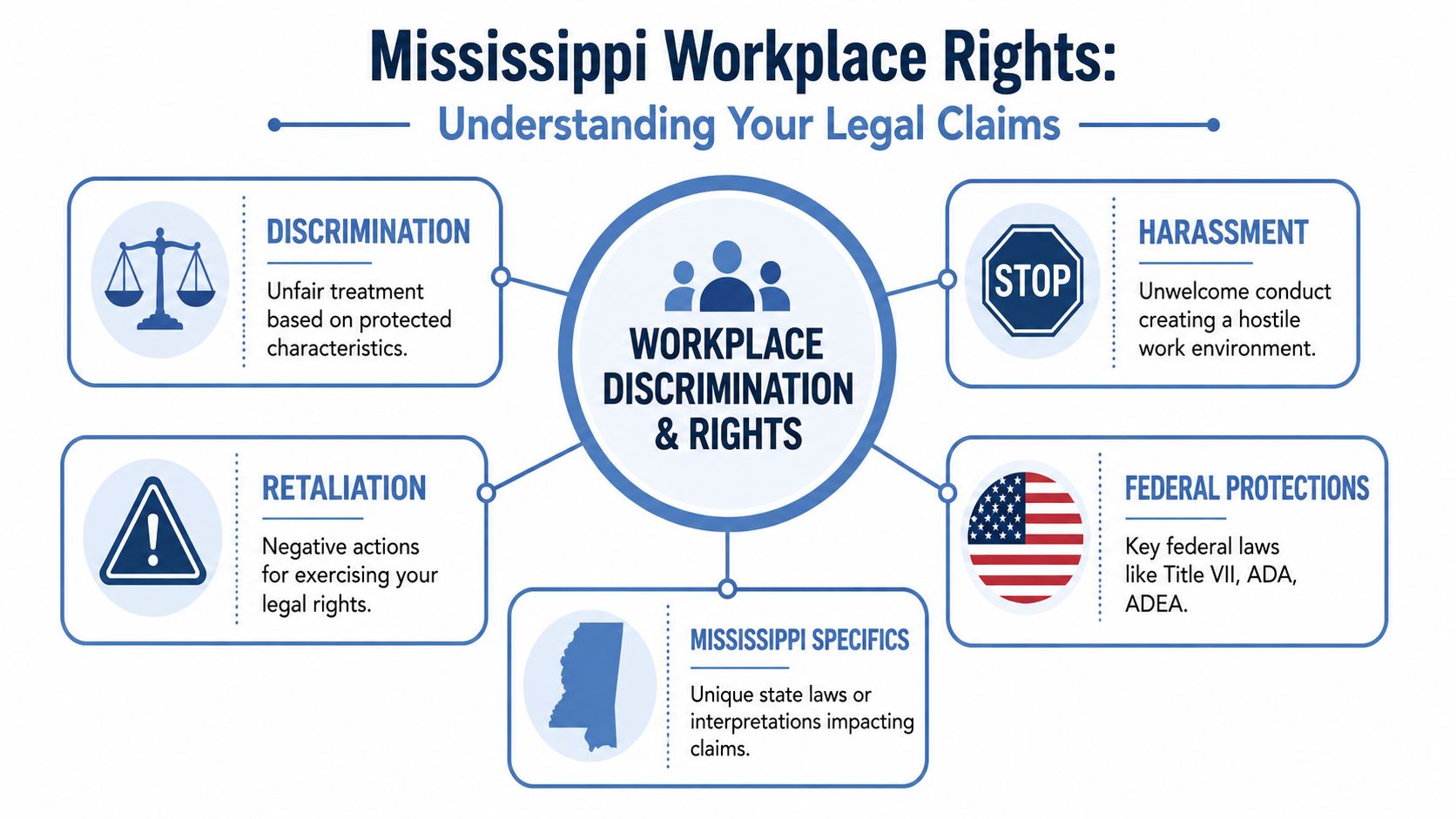
What counts as discrimination
A discrimination claim usually focuses on adverse treatment tied to a protected characteristic. Under federal law, that can involve race, color, religion, sex, national origin, age, or disability. The legal framework for modern workplace discrimination expanded significantly after the Civil Rights Act of 1964, especially Title VII, and later with the Age Discrimination in Employment Act of 1967, the Americans with Disabilities Act of 1990, and the Supreme Court's June 15, 2020 decision recognizing Title VII protection for LGBTQ+ workers, as summarized by Fuchsberg Law.
That history matters in Mississippi because federal law often does most of the work in these cases.
Claims people often miss
A worker may say, "I was fired because my boss didn't like me after I complained." That may be closer to retaliation than discrimination.
Another worker may say, "They punished me after I took time off for a serious health condition." That may be an FMLA issue.
Another may say, "They kept changing my paycheck and never paid all my hours." That may point toward a wage-and-hour problem, even if the workplace also felt discriminatory.
A consultation should sort among these possibilities instead of forcing every story into one label. For a fuller discussion of how these theories can overlap, see this overview of discrimination employment cases.
Mississippi-specific limits people should know
Mississippi is an at-will employment state. That means an employer can often fire an employee for a bad reason, a mistaken reason, or no stated reason at all. But an employer still can't violate federal employment laws.
It also means workers sometimes expect the law to cover conduct that it doesn't. Not every rude supervisor creates a claim. Not every unfair write-up proves discrimination. And under the constraints you've asked me to follow for Mississippi-focused guidance here, a retaliation claim for filing a workers' compensation claim isn't something to assume exists under Mississippi law.
A lawyer's value in the first meeting often comes from diagnosis. The legal label attached to your facts may be different from the label you've been using in your head.
If your case moves forward into sworn testimony later, understanding how records get used can help. This guide to deposition transcripts offers a practical look at how testimony is captured and reviewed.
Inside the Consultation What to Expect and How to Evaluate the Lawyer
A good consultation usually feels part conversation, part stress test. You tell the story. The lawyer checks whether the facts support liability and damages.
That distinction matters. A lawyer may believe you were treated badly and still decline the case because the proof is thin, the damages are limited, or the paper trail cuts the wrong way. Employment-law screening guidance makes that point directly. For a contingency case, the attorney usually needs objective proof such as comparators, timing, or documented complaints, not only a sincere sense of unfairness, as discussed by Punchwork Law.

What the lawyer is listening for
During the meeting, the lawyer is usually asking questions beneath your answers:
| What you say | What the lawyer is evaluating |
|---|---|
| "My manager started treating me differently" | Was there a legally protected reason, or only workplace conflict? |
| "I complained and then got fired" | Is there a clear timeline showing protected activity followed by adverse action? |
| "It's all in emails" | Do the emails actually prove motive, notice, or inconsistency? |
| "Other employees were treated better" | Are those comparators truly similarly situated? |
How to evaluate the lawyer
The consultation is also your chance to evaluate counsel. Pay attention to whether the lawyer:
- Listens for facts, not drama. You want someone patient, but also disciplined.
- Explains the weak points. If a lawyer only tells you what you want to hear, be cautious.
- Knows Mississippi practice realities. In this area, that includes federal procedure, EEOC process, and how at-will employment affects analysis.
- Discusses fees plainly. In Mississippi, contingency fees often fall in the 40% to 50% range. Ask what the fee covers, what costs are separate, and what happens if the case doesn't recover.
- Tells you what to do next, even if the answer is "preserve records and wait" or "this may not be the right claim"
Nick Norris, P.A. is one Mississippi option for employees seeking consultation on discrimination, retaliation, wage, FMLA, WARN, and related workplace claims, and the office states that it offers an initial consultation for qualifying matters.
The lawyer doesn't need to agree with every part of your perspective. You need the lawyer to understand the facts, spot the legal issue, and give you an honest assessment.
Deciding Your Next Steps After the Consultation
If the lawyer agrees to take the case, the next step is usually formalizing the representation and starting a focused evidence process. That may involve preserving documents, refining the timeline, identifying witnesses, and preparing the appropriate agency filing if one is required.
If the lawyer declines, don't assume that automatically means nothing illegal happened. Lawyers decline cases for many reasons. Sometimes the issue is timing. Sometimes it's proof. Sometimes the firm has a conflict or can't take on another matter. Ask why.
A useful response after a decline might sound like this:
- If the issue is timing, ask whether any immediate filing option still exists.
- If the issue is proof, ask what evidence would have mattered.
- If the issue is fit, ask whether your facts sound more like another kind of employment claim.
- If the issue is capacity, consider a second opinion quickly.
The point of a free consultation isn't only to hear yes or no. It's to replace uncertainty with information you can act on. In Mississippi employment cases, that alone can be valuable. You may leave with representation. You may leave with a clearer understanding that the claim is weak. Either outcome is better than guessing while deadlines run and documents disappear.
If you're dealing with discrimination, harassment, retaliation, unpaid wages, leave problems, or a firing that doesn't sit right, Nick Norris, P.A. represents Mississippi employees in workplace matters and provides a place to start with a practical conversation about your facts, your timing, and your options.
This article has been reviewed for legal accuracy by Nick Norris. For employment law matters in Mississippi, consult with an attorney licensed to practice in your state.
Leave a Reply