

Legal Employment Law Advice for Mississippi Workers
You may be dealing with this right now. Your supervisor starts treating you differently after you report harassment. HR says they'll “look into it,” but nothing changes. Your schedule gets worse, your write-ups start, and you're still showing up to work every day wondering whether you have rights or whether Mississippi's at-will rule means your employer can do whatever it wants.
Here's the blunt answer. At-will employment in Mississippi is real, and it's harsh. But it does not give employers a free pass to discriminate, retaliate for protected complaints, deny qualifying federal leave, or cheat workers out of wages and overtime. The problem is that many Mississippi employees wait too long, document too little, and rely on state protections that don't exist here.
Mississippi also does not have a state human rights commission to catch these cases for you. That means many workplace claims in Mississippi go straight into federal channels or fail because the worker didn't move quickly enough. Good legal employment law advice in Mississippi starts with that reality, not with false comfort.
Understanding Your Rights in an At-Will State
Mississippi is an employment-at-will state. That means an employer can usually fire you for a bad reason, a mistaken reason, or no stated reason at all. It also means you can quit without notice. If that sounds one-sided, that's because it often is.
But “at will” does not mean “anything goes.”
If your employer fires you because of race, sex, disability, religion, national origin, age when the law applies, protected leave, military service, or protected complaints about wage theft or discrimination, that is a different issue. Those cases are not really about unfairness alone. They are about whether a federal law limits what your employer can do.
If you need a deeper baseline on that doctrine, read this explanation of employment at will in Mississippi.
What at-will does and does not mean
A lot of workers make one of two mistakes:
- First mistake: assuming every unfair act is illegal.
- Second mistake: assuming nothing is illegal unless you were fired.
Both are wrong.
A manager can be rude, petty, dishonest, or inconsistent without breaking employment law. On the other hand, an employer can violate federal law before termination happens. Demotion, write-ups, schedule changes, denied accommodations, unpaid overtime, and retaliation after a complaint can all matter.
Practical rule: In Mississippi, stop asking only “Was this unfair?” Start asking “What law protects me, and does it apply to this employer?”
Why federal law matters more in Mississippi
Mississippi workers often need to look to federal remedies first because state-level enforcement options are limited. That changes how you should think about your problem. You are not just collecting proof that your boss acted badly. You are collecting proof that your situation fits a specific federal claim.
That means details matter:
- Dates matter because deadlines can expire fast.
- Employer size matters because some laws only apply to certain employers.
- Your exact words matter because an informal complaint can become protected activity.
- Your resignation message matters because a careless text can damage a claim.
If you're still employed, that's often the best time to get legal employment law advice. You still have access to your records, your timeline is fresh, and you have not accidentally boxed yourself in with an emotional resignation or a vague complaint.
Federal Laws That Protect Mississippi Workers
You report harassment to HR on Monday. By Friday, your schedule changes, your supervisor starts writing you up, and someone tells you Mississippi is an at-will state so your employer can do whatever it wants.
That advice is wrong.
Mississippi workers often do not have a state agency or state-law claim to fall back on for workplace discrimination. In many cases, primary protection comes from federal law, and the right law depends on the kind of harm, the employer's size, and whether you acted before a deadline expired.
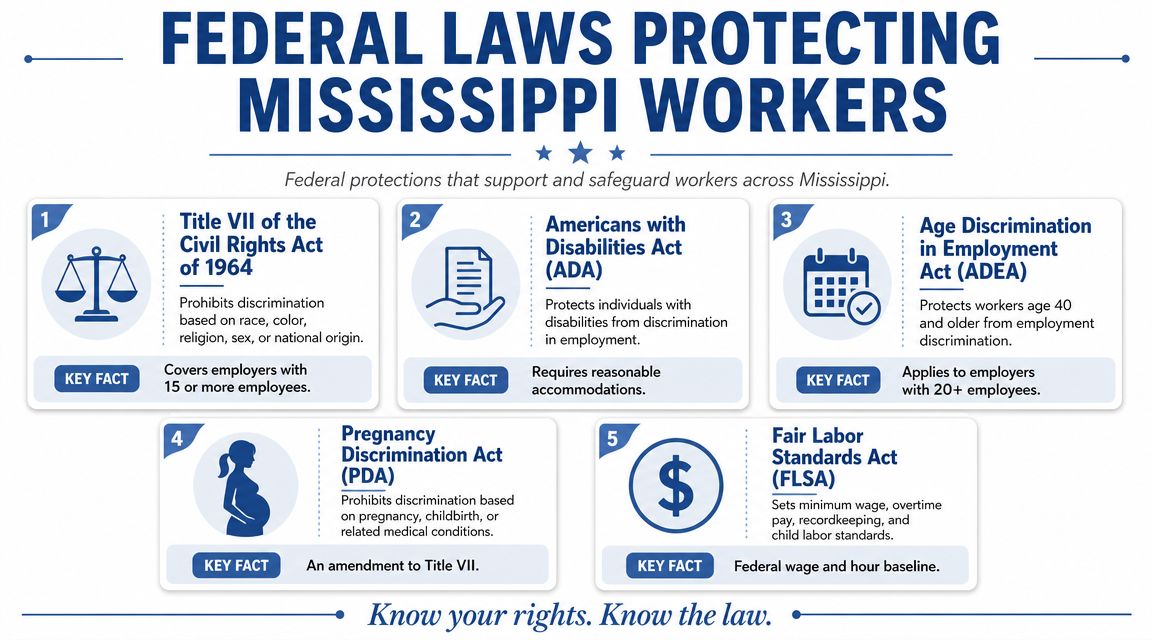
The core federal laws Mississippi workers rely on
| Law | What it generally covers | Why it matters in Mississippi |
|---|---|---|
| Title VII | Discrimination based on race, color, religion, sex, and national origin | This is a primary federal tool for discrimination, harassment, and retaliation claims |
| ADA | Disability discrimination and reasonable accommodations | It applies when an employer ignores medical restrictions, refuses accommodations, or punishes an employee for asking |
| ADEA | Age discrimination against workers 40 and older | It covers employers with 20 or more employees, so headcount can decide whether the claim exists |
| FMLA | Job-protected leave for qualifying medical and family reasons | It generally applies to employers with 50 or more employees, which rules some Mississippi workers in and others out |
| FLSA | Minimum wage and overtime requirements | It often matters in unpaid wages, off-the-clock work, and misclassification cases |
| WARN Act | Advance notice for certain plant closings and mass layoffs | It generally applies only to larger employers, usually those with 100 or more employees |
You can review those federal coverage rules directly through the U.S. Department of Labor pages for the Family and Medical Leave Act, the Age Discrimination in Employment Act, and the Worker Adjustment and Retraining Notification Act.
How these laws show up on the job
Title VII and the ADA do a lot of the work for Mississippi employees because state remedies are limited. If you are being singled out because of race, sex, religion, national origin, or disability, those laws may apply. If you complained and the employer cut your hours, increased scrutiny, or started building a paper trail against you, retaliation may be the claim that matters most.
The ADA also protects the accommodation process itself. If you tell your employer about a medical limitation and ask for a reasonable adjustment, pay attention to what happens next. Save the doctor's note, the emails, the texts, and the denial. In Mississippi, workers often lose good federal claims because they waited too long to document a bad process.
Employer size can end the analysis fast. ADEA, FMLA, and WARN Act claims all have coverage thresholds. That is one reason legal advice early in the problem is so important. You need to know whether the employer is large enough, whether the law covers your position, and whether another federal claim fits better.
Mississippi workers need the right filing path
Federal rights are only useful if you use the right process. Discrimination and retaliation claims often require an EEOC charge before you can sue, and a sloppy charge can leave out the facts your case depends on. If that is the issue you are facing, read about the EEOC investigation process for Mississippi workers before you file anything.
One more Mississippi-specific point matters here. State law does not fill every gap. For example, workers often assume there is a state retaliation claim for every unfair response to an injury report or complaint. Many times, there is not. That is why you need to match your facts to the correct federal law instead of relying on general ideas about fairness.
Identifying Common Illegal Workplace Issues
Not every bad workplace is an illegal workplace. That's the hard truth.
A supervisor can play favorites. A company can make foolish decisions. A manager can dislike you personally. None of that automatically creates a legal claim. Good legal employment law advice cuts through that noise and looks for concrete legal red flags.
Discrimination and harassment red flags
You should pay attention when the treatment connects to a protected category. That might look like:
- Promotion decisions that track bias: you keep getting passed over while less-qualified workers outside your protected group advance.
- Harassment tied to who you are: slurs, sexual comments, disability mockery, religious hostility, or repeated degrading remarks tied to a protected trait.
- Unequal discipline: your employer suddenly enforces rules against you but ignores the same conduct by others.
Harassment is not just about a few offensive comments. It becomes legally important when the conduct is unwelcome, tied to a protected characteristic, and severe or persistent enough to affect the conditions of employment.
Retaliation often hides behind “performance”
Retaliation cases are common because employers rarely announce retaliation out loud. They reframe it.
You complain to HR. Then the “coaching” starts. Your evaluation drops. You get moved, isolated, written up, or pushed onto a performance plan. Employers often try to create a paper trail after the complaint. That doesn't always mean the paper trail is legitimate.
If you want a broader list of claim types, review what you can sue your employer for in Mississippi.
A sudden performance problem right after a protected complaint deserves scrutiny. Don't dismiss that pattern as coincidence.
There is one Mississippi-specific point you need to hear clearly. Mississippi does not provide a retaliation claim for filing a workers' compensation claim. Many workers assume that kind of retaliation is automatically covered. In Mississippi, you should not build your expectations around a claim that isn't there.
Wage theft is often disguised as “salary”
Many Mississippi workers get cheated on overtime and don't realize it because the employer put them on a salary and called them “management.”
That label is not enough. Under the Fair Labor Standards Act, being salaried does not automatically make you exempt from overtime. To be exempt, the worker generally must meet both a salary threshold and a duties test for executive, administrative, or professional roles. If the worker was misclassified, the employer can face liability for unpaid overtime at 1.5 times the regular rate, as explained in this FLSA exemption discussion.
Here are common wage-and-hour warning signs:
- You supervise almost no one but the company calls you exempt.
- You spend most of your day doing the same hands-on work as hourly staff.
- You work off the clock before opening, after closing, or from home.
- Your time records are changed or rounded in a way that always seems to hurt you.
What is not enough by itself
Some problems feel unfair but may not support a legal claim without more:
| Workplace problem | Illegal by itself? | What makes it legally stronger |
|---|---|---|
| Boss is rude or humiliating | Usually no | Link to discrimination, harassment, or retaliation |
| You were fired without warning | Usually no in Mississippi | Evidence of discrimination, protected leave interference, or retaliation |
| Company plays favorites | Usually no | Protected-trait bias or retaliatory motive |
| You filed workers' comp and were treated badly | Not a standalone retaliation claim under Mississippi law | Other federal protections may still matter depending on facts |
That distinction matters. It saves you from chasing the wrong theory and helps you focus on the evidence that counts.
Deciding When to Contact an Employment Lawyer
You report discrimination on Monday. By Friday, your supervisor is suddenly documenting every minor mistake, cutting your hours, or pushing you out of meetings. In Mississippi, that is the moment to get legal advice. Waiting for the company to fix it usually gives the company more time to build its version of the story.
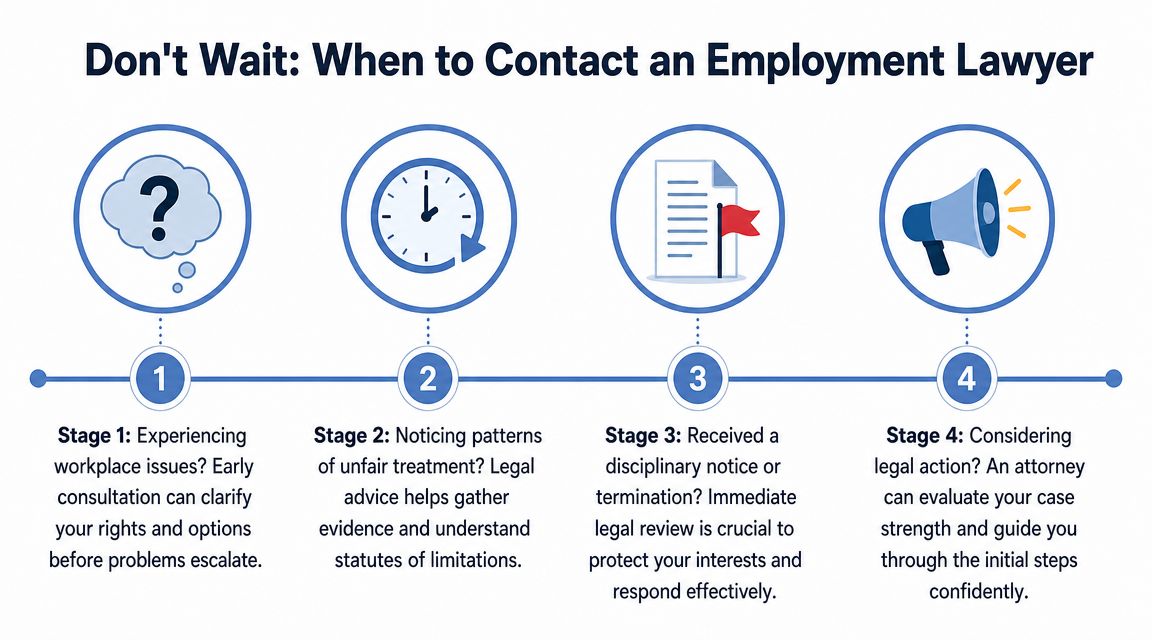
A lot of workers assume they need to be fired before calling a lawyer. That is wrong. Some of the best employment cases are shaped while the worker is still employed, still has access to documents, and still has a chance to avoid preventable mistakes.
That matters even more in Mississippi. State law leaves workers with fewer direct remedies than people expect, and there is no state human rights commission to step in and sort this out for you. Many claims run through federal law and federal agencies instead. As noted in this worker-rights guidance on discrimination and retaliation, protected activity can include informal complaints, accommodation requests, and wage complaints before any formal charge is filed.
Call while you still have choices
Get legal advice promptly if any of these things are happening:
- You complained about discrimination, harassment, or unpaid wages, and discipline started soon after
- You asked for a medical accommodation, and management responded by isolating you or pressuring you to quit
- You requested leave for a serious health or family issue, and the company denied it or treated you like a problem
- Your pay changed, your title changed, or the company suddenly says you are exempt from overtime
- You are being pushed to resign instead of being fired
- HR wants you to sign a statement, resignation letter, severance paper, or write-up you do not fully understand
Those are decision points. A short consultation can help you protect your evidence, choose your words carefully, and avoid handing the employer an avoidable defense.
Keep your communications private. Do not email a lawyer from your work account. Do not store case notes on a company device. If you want a plain-English refresher on communication boundaries, this essential privilege rules guide is a useful companion read.
Deadlines cut off claims fast
Employment deadlines are strict. They do not care that you were stressed, busy, or hoping HR would come around. For many Mississippi workers, federal discrimination claims must be filed with the EEOC within 180 days, because Mississippi does not have a state agency that extends that deadline to 300 days, as the EEOC explains in its charge filing time limits.
That deadline is one reason I tell workers to call early. Another is simpler. Early advice helps you avoid self-inflicted damage, such as resigning too soon, signing a bad severance agreement, deleting messages, or making a complaint that is emotionally satisfying but legally muddy.
Here is the practical rule:
| Situation | Why timing matters |
|---|---|
| You are still working and trouble just started | You can preserve texts, emails, schedules, and witness names before they disappear |
| You are about to complain internally | The wording of that complaint may later define your retaliation claim |
| You were disciplined right after speaking up | Close timing often becomes important proof |
| You were fired or forced out recently | Filing windows and evidence problems start immediately |
This video gives a helpful overview of when legal help becomes necessary in workplace disputes.
My recommendation
Call before you quit. Call before you sign. Call soon after any complaint, leave request, accommodation request, pay dispute, or sudden discipline.
Every unfair situation is not an illegal one. Mississippi workers need clear advice early because the state gives them fewer standalone protections than many people assume. A quick legal review can tell you whether you have a real claim, which federal remedy fits the facts, and what to do next.
How to Prepare for Your First Legal Consultation
You sit down for the call, and the lawyer asks three basic questions: What happened, when did it happen, and what proof do you have? If your answer is a jumble of screenshots, half-remembered dates, and missing documents, the meeting slows down fast. Good preparation gives your lawyer something useful to evaluate, especially in Mississippi, where workers often need to move quickly toward federal remedies because state-law options are narrower than people expect.
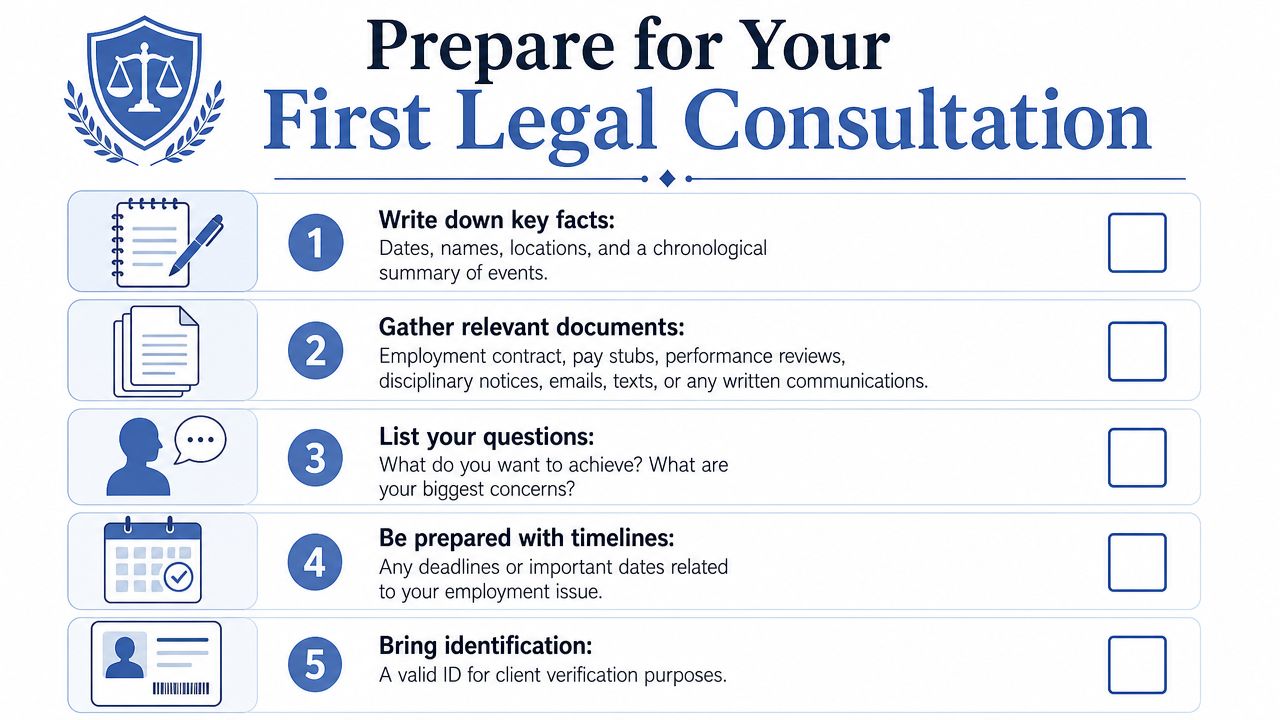
Build a simple timeline
Start with a straight chronology. Keep it factual. Leave out speeches, theories, and long side stories.
Include:
- When the problem started
- Who was involved
- What you reported, requested, or refused to do
- How the company responded
- Any write-ups, pay changes, leave denials, or schedule changes
- The date of termination or resignation, if that happened
If you do not know an exact date, give your best estimate and label it that way. Accuracy matters more than drama.
Write it like someone reading it may need to compare your timeline to emails, payroll records, and personnel notes.
Gather documents before the meeting
Bring records that show what happened, not just how you felt about it. A strong consultation usually turns on ordinary paperwork.
Useful documents often include:
- Pay stubs and time records
- Offer letters, contracts, and handbooks
- Performance reviews
- Disciplinary notices
- Emails, texts, and HR complaints
- Leave paperwork or medical accommodation requests
- Termination paperwork or severance documents
Do not alter messages, crop screenshots in a misleading way, or print only the parts that help you. A lawyer needs the full record, including bad facts. That is how you get honest advice.
If you want a simple way to collect forms and background details before the meeting, tools built for client intake for agencies can help you organize everything in one place.
Know what you want the lawyer to help you do
Say what outcome matters to you. Some workers want unpaid wages. Some want to keep their job and stop the retaliation. Some want a severance agreement reviewed before they sign it. Some want to know whether a charge should be filed with a federal agency because Mississippi does not offer the extra state-level process people often assume exists elsewhere.
Be clear about your goal.
Ask questions like these:
- What legal claim fits these facts, if any?
- Which deadline matters first?
- What evidence should I preserve right now?
- Do I need to keep reporting this problem internally?
- Would resigning hurt my position?
Deadlines can be short in employment cases. For some federal discrimination claims, workers in Mississippi may need to act within 180 days because the state does not have its own fair employment agency to extend that period. Show up ready to talk about dates, documents, and your goal, and your first consultation will be far more useful.
The Legal Process with Nick Norris PA
You report harassment, ask for medical leave, or complain about unpaid overtime. A week later, your hours are cut or your job is gone. In Mississippi, workers often assume state law will step in. Often, it will not. The legal process usually starts by figuring out whether federal law covers what happened and whether there is still time to act.
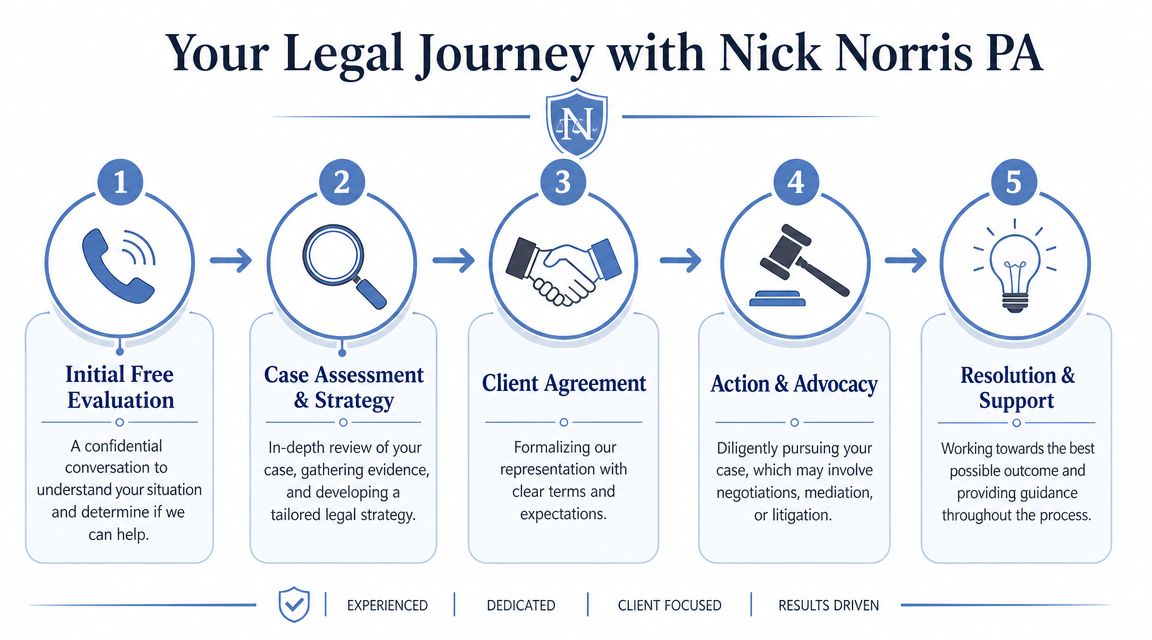
What happens first
The first job is to test the case against the law, not against your sense of fairness. Those are not always the same thing.
A lawyer will usually start with four questions:
- What exactly happened, and when?
- Which law might apply?
- Is the employer covered by that law?
- What proof exists right now?
That early review matters because federal employment claims often turn on threshold rules. Some laws apply only to employers of a certain size. Others protect only specific kinds of complaints or conduct. In Mississippi, that screening step matters even more because workers do not have the extra state agency process people in some other states rely on.
What representation usually involves
If the facts support a claim, representation may involve reviewing records, identifying the strongest legal theory, preparing an agency charge, communicating with the employer, negotiating a resolution, or filing suit.
Good employment advice is plainspoken. If the wage claim looks strong but the discrimination claim does not, you should hear that immediately. If the facts are troubling but the evidence is weak, you need to know that before you spend time and money chasing the wrong claim.
The right strategy depends on proof, deadlines, and the remedy that fits your situation.
Fees should also be discussed early. Ask how the lawyer charges, what costs may come up, and whether the representation is hourly, contingency-based, or limited to a specific task such as reviewing a severance agreement or drafting an agency charge. Get that in writing.
Where Nick Norris, P.A. fits
Nick Norris, P.A. represents Mississippi workers in employee-side employment matters involving discrimination, retaliation, unpaid wages, leave issues, and wrongful termination claims tied to federal law. The work typically begins with a direct evaluation of the facts, the available evidence, and the deadline that matters most.
That approach serves Mississippi workers well. This state gives employers broad room under at-will employment, and it does not offer some state-level remedies workers expect to find. A clear legal analysis helps separate a bad workplace from an unlawful one, and it helps workers act before the federal process closes off their options.
Taking the First Step to Protect Your Rights
Mississippi workers need clear eyes about the law. This state is at-will. State-level protections are limited. Some claims people assume exist here do not. But that is not the end of the story.
Federal law still protects Mississippi employees from discrimination, certain forms of retaliation, qualifying leave violations, wage theft, and other unlawful workplace conduct. The key is knowing the difference between a bad job and an illegal one, then acting before the evidence disappears and the deadlines run out.
If you're still working and documenting problems, don't assume it's too early. If you've already been fired, don't assume it's too late. The right time to get legal employment law advice is usually the moment you realize the problem may involve a protected right, not the moment the situation becomes unbearable.
If you're a Mississippi worker dealing with discrimination, harassment, retaliation, unpaid overtime, leave problems, or a wrongful termination issue tied to federal law, contact Nick Norris, P.A. for a confidential consultation about your situation and your options.
This article has been reviewed for legal accuracy by Nick Norris. For employment law matters in Mississippi, consult with an attorney licensed to practice in your state.
Leave a Reply