

Family Medical Leave Act Lawsuits: Protect Your Rights
A lot of Mississippi workers find out they may have an FMLA problem only after the damage starts. You miss work to care for a parent, deal with your own serious health condition, or take approved leave and come back to a write-up, a demotion, or a termination meeting. At that point, the question usually isn't academic. It's whether your employer crossed a legal line and what you can do next.
The Family and Medical Leave Act is a federal law. In Mississippi, that matters. There's no state human rights commission to step in and handle employment claims at the state level, and when an FMLA dispute turns into litigation, the path runs through federal law and federal procedure. That makes timing, documentation, and claim strategy especially important for Mississippi employees.
Understanding Your Rights Under the FMLA
If you've been told your absence “counts against you” even though it involved a serious medical issue, your concern is legitimate. The FMLA exists to protect eligible employees when family or medical needs force them away from work. In practical terms, it's the law that often stands between a worker and a wrongful loss of employment after a health crisis at home or at work.
In Mississippi, employees often assume there must be a state office that handles this kind of dispute. There isn't. That means your rights still exist, but enforcing them usually requires careful use of federal processes and, in many cases, a federal lawsuit. If you're trying to understand the basics first, this overview of employee rights under the FMLA is a useful starting point.
What the FMLA is meant to do
The FMLA is designed to protect your job when a qualifying family or medical event interrupts your ability to work. The law commonly comes up when an employee needs leave for a serious health condition, to care for a close family member with a serious health condition, or in other protected circumstances recognized by federal law.
What matters in real life is how the law works at the moment you ask for leave. Employers have duties. Employees have duties too. Problems usually start when one side treats the leave issue casually and the other side assumes everything will work itself out.
Practical rule: If your employer knew enough to understand that a serious medical issue was involved, the conversation may already have legal significance, even if nobody used the letters FMLA in the first discussion.
Why FMLA lawsuits are common
FMLA disputes aren't rare technical fights. They've become a regular part of employment litigation. Federal court filings jumped from 291 in 2012 to 1,108 in 2014, according to this discussion of the rise in FMLA litigation. That surge shows two things. Employees are willing to enforce these rights, and employers, including smaller employers in Mississippi, can face serious exposure when they mishandle leave.
That doesn't mean every unfair workplace event is an FMLA case. It does mean that when discipline, denial of leave, or termination follows a medical situation, you shouldn't dismiss it as “just company policy.”
Interference vs Retaliation What Is Your Claim
A common Mississippi FMLA case starts like this. An employee asks for leave after a serious medical issue, misses work, tries to follow the company's process, and then gets hit from two directions at once. HR treats the leave as a problem attendance issue, and management starts building a paper trail for discipline or termination.
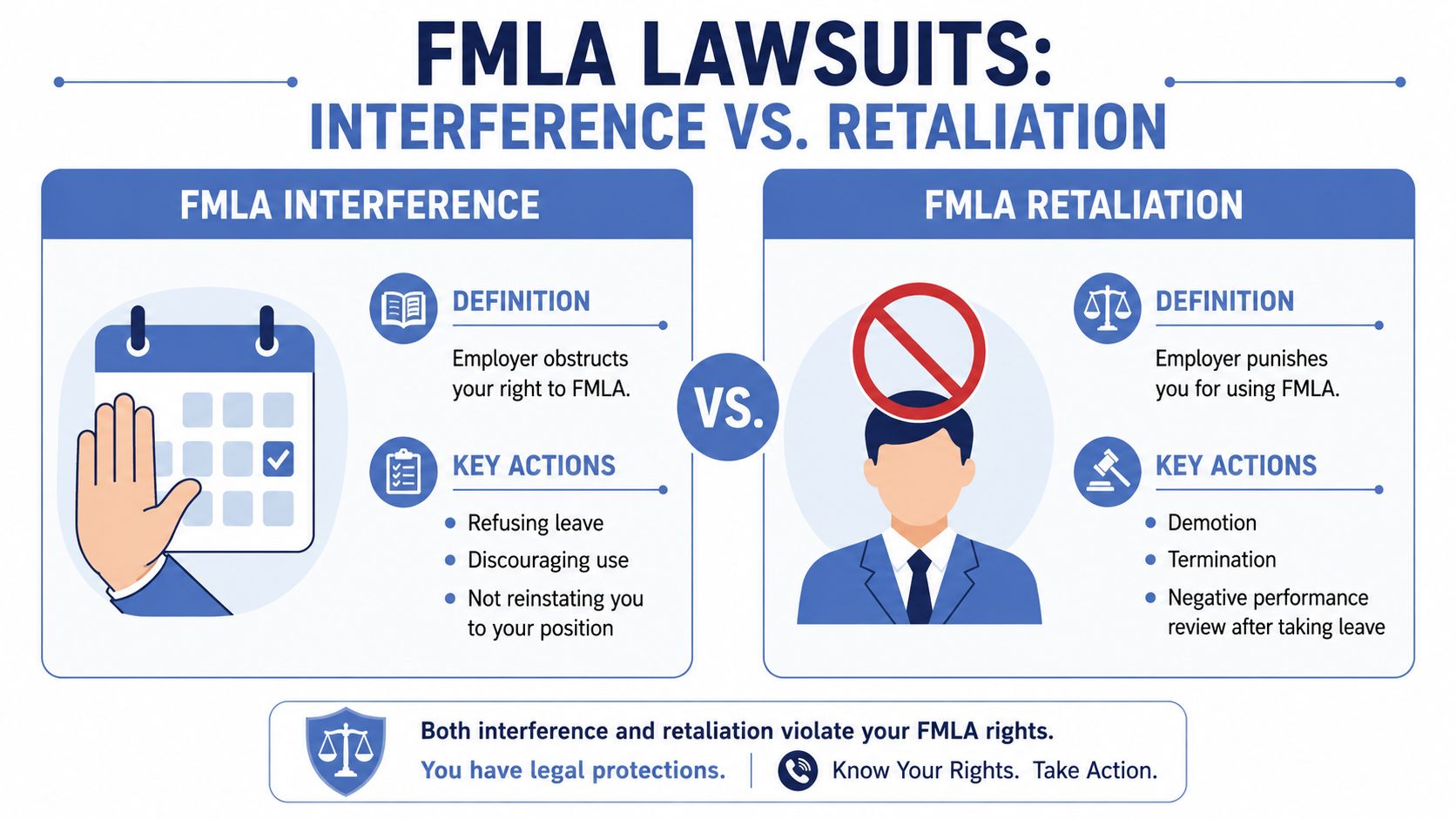
That fact pattern can support two different FMLA claims. Interference focuses on whether the employer denied or limited leave rights. Retaliation focuses on whether the employer punished you for asking for leave or taking it. In many cases, both claims need to be examined from the start, especially in Mississippi, where FMLA cases are handled in federal court and there is no state agency process to sort out the theory for you first.
Interference means your leave rights were blocked
An interference claim usually asks a straightforward question. Were you entitled to FMLA protection, and did the employer deny, restrict, or mishandle that protection?
That can happen in several ways. An employer may refuse to treat a qualifying medical absence as FMLA leave. A supervisor may discourage an employee from applying. HR may count protected absences under a no-fault attendance policy. An employee may return from leave and find that restoration to the same or an equivalent position never really happened.
The practical advantage of an interference claim is that motive is not always the main fight. The focus is often on what the employer did, what notice it had, and whether the employee lost a right the statute protects.
Retaliation means the employer punished protected leave activity
Retaliation claims are different because they usually turn on intent. The employer says the firing, write-up, demotion, or reassignment had a legitimate reason. The employee says the stated reason is a cover for punishment tied to leave.
Common retaliation patterns include:
- Termination after leave close in time to the request, absence, or return
- Demotion or reassignment that reduces pay, status, schedule, or opportunity
- New discipline that appears only after protected leave activity
- Negative evaluations that do not match the employee's earlier record
Retaliation cases often rise or fall on timing, inconsistent explanations, and whether the employer followed its own policies. Anyone trying to understand how to prove retaliation at work should pay close attention to those details, because FMLA retaliation claims often use the same kinds of proof.
Why the distinction matters in Mississippi
In Mississippi, this classification is more than legal vocabulary. It affects case strategy early.
Mississippi does not have a state human rights commission handling FMLA claims. There is no state-level administrative track that screens the case, gathers records, or frames the dispute before suit. FMLA cases are federal claims, so they are brought in federal court. That means the complaint needs to identify the right legal theory, the right facts, and the right timeline at the outset.
A worker may say, “I was fired for taking leave.” That may be true, but a lawyer still has to separate what happened before the leave was approved, during the leave process, and after the leave was used. Federal judges look closely at those distinctions.
A side by side view
| Claim type | Core issue | Common example |
|---|---|---|
| Interference | You were denied or limited FMLA rights | HR rejects qualifying leave or counts it as unexcused |
| Retaliation | You were punished for requesting or using FMLA leave | You return from leave and get fired or demoted |
Some cases clearly fit one category. Many do not.
I often see situations where the employer first mishandles the leave request, then later claims the employee was terminated for attendance, performance, or “business needs.” In a Mississippi federal case, that usually means looking at both interference and retaliation instead of forcing the facts into only one box.
Building Your Case Key Evidence and Legal Elements
A strong FMLA case usually comes from routine records, not dramatic moments. The documents that matter are often the ones people overlook at first: the text to a supervisor, the HR email, the pay stub showing missed wages, the write-up that appeared right after leave was requested.
In Mississippi, that proof matters even more because these claims are handled in federal court, without a state human rights commission building an administrative record first. There is no state agency process that interviews witnesses, gathers employer paperwork, or narrows the issues before suit. If the records are missing when the case starts, the employee is already behind.
The legal elements in plain English
Before filing, the facts need to support the basic legal elements. The usual questions are straightforward.
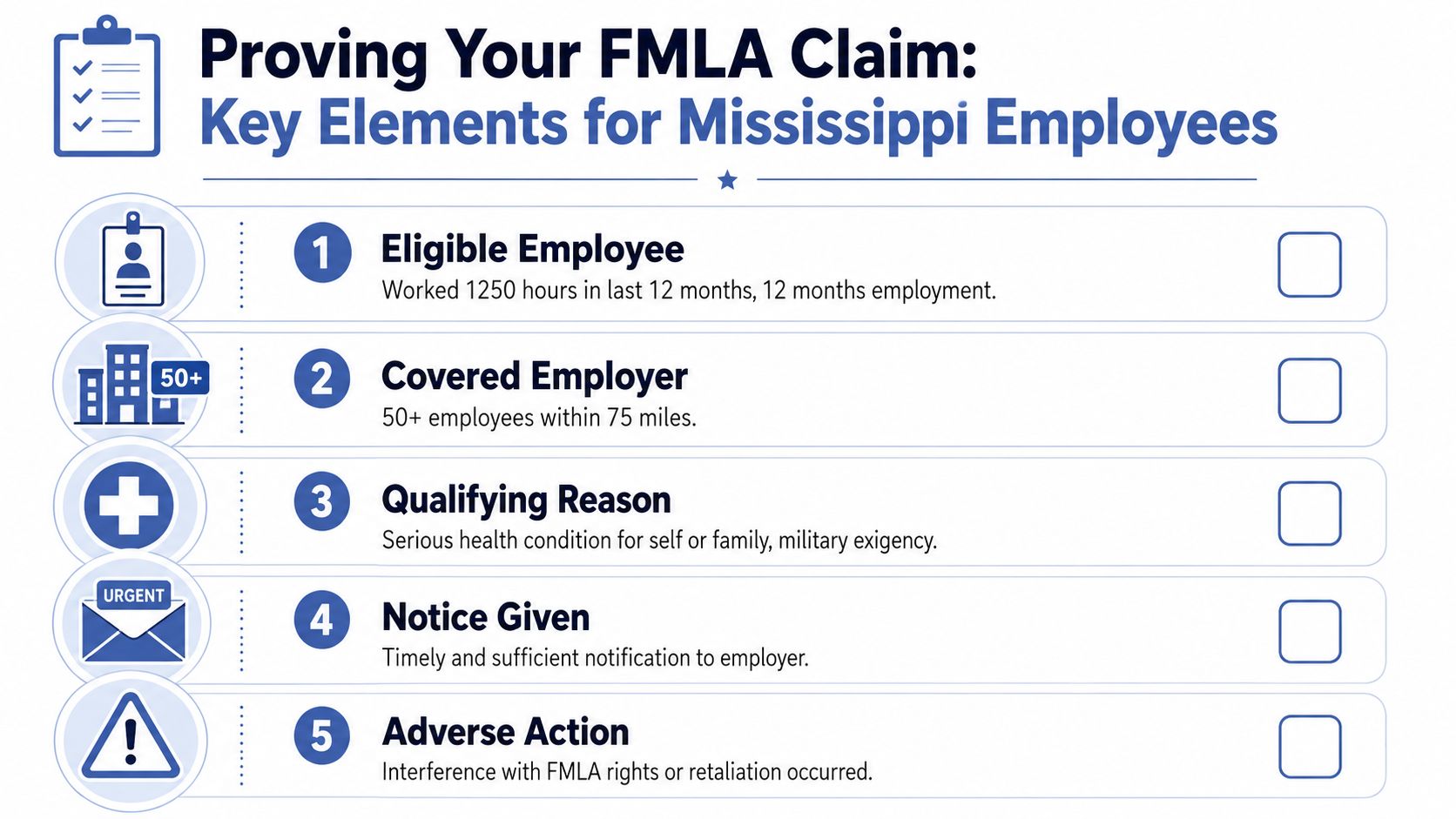
Was the employee eligible for FMLA protection? Was the employer covered by the statute? Did the medical condition or family situation qualify? Did the employee give enough information to put the employer on notice? Did the employer deny leave, fail to restore the employee to the job, or punish the employee for asking for or using protected leave?
Eligibility usually turns on three practical points:
- Length of employment: The employee generally must have worked for the employer for at least 12 months.
- Hours worked: The employee generally must have worked at least 1,250 hours during the prior 12 months.
- Worksite coverage: The employer generally must have enough employees within the required geographic range for the law to apply.
Notice issues are often where employers and employees tell very different stories. An employee does not always have to say “I need FMLA leave” to trigger the employer's duties. But the employee usually must give enough information for the employer to understand that the absence may be for a qualifying reason. From there, timing matters. HR paperwork, follow-up requests, and how quickly the employer responded can become central exhibits.
What to start gathering now
People often wait too long to collect records. That is a mistake.
Start with what you already control, and save it in a personal location, not only on a work phone or company laptop.
- Leave communications: Emails, text messages, portal submissions, handwritten notes, and messages to supervisors about the condition or need for time off.
- FMLA paperwork: Eligibility notices, designation notices, certification forms, recertification requests, denial letters, and return-to-work paperwork.
- Medical support: Doctor's notes, appointment records, discharge paperwork, and documents showing when the condition began and how long treatment lasted.
- Job history: Performance reviews from before and after the leave request, disciplinary notices, attendance records, and corrective-action documents.
- Pay and benefits records: Pay stubs, benefit deductions, bonus records, and proof of lost time from work.
- Witness information: Names of coworkers, HR staff, or managers who heard the conversations or handled the paperwork.
Retaliation cases often rise or fall on timing, shifting explanations, and whether the employer treated similar conduct differently before the leave issue came up. This guide on how to prove retaliation at work explains the kinds of proof that often matter when motive is disputed.
Here's a practical explainer that walks through the topic from another angle:
What usually hurts a case
The most common damage is self-inflicted. Employees delete texts, return company devices before saving messages, or assume HR will keep everything. Sometimes they wait months before writing down the sequence of events, and by then the details are blurry.
Employers usually have more access to records than workers do. That is the practical reality. A claimant who preserves dates, screenshots, names, and exact wording early is in a much stronger position once the case reaches federal court.
Write out a timeline while the facts are fresh. Include dates, names, who received each message, what was said, and what happened next.
The Clock Is Ticking FMLA Deadlines and Filing Steps
FMLA timing rules are unforgiving. A strong claim can still fail if it's filed too late. That's why workers should treat these cases like a clock that started running before they called a lawyer.
The deadline that controls the case
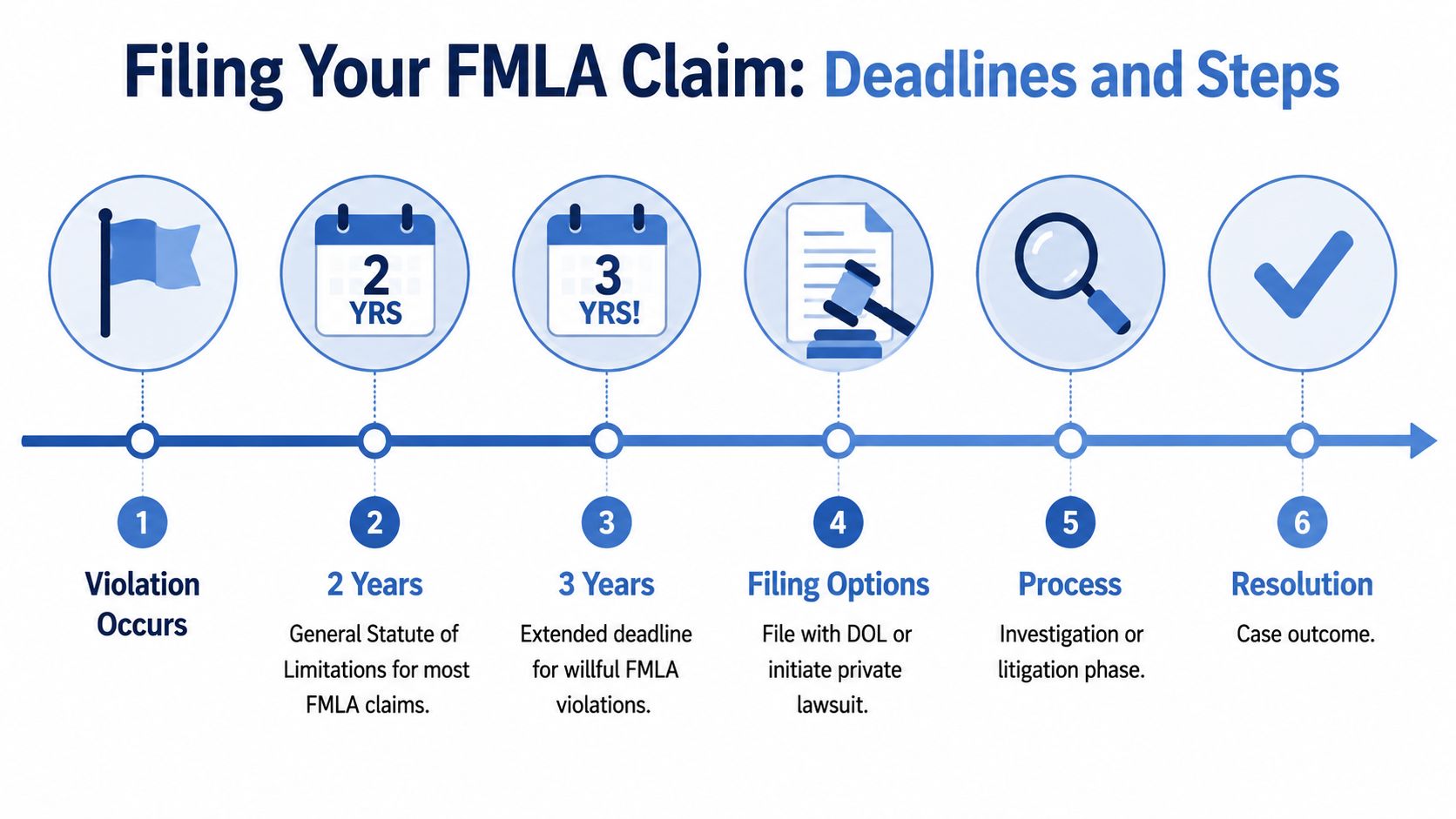
Under federal law, FMLA lawsuits must be filed within two years of the last violation, or three years if the violation was willful. An employee can file a complaint with the Department of Labor, but that only pauses the limitations clock while the agency is actively pursuing the matter, as explained in this primer on FMLA filing deadlines and DOL interaction.
The phrase “last violation” matters. In practice, that may be the termination, refusal to reinstate, or another final adverse action tied to the leave issue.
Why the Mississippi process is narrower
Mississippi workers don't have a state administrative system for FMLA claims. There's no state human rights commission route for this problem, and this article doesn't discuss filing FMLA lawsuits in state court because that is not the path to focus on here. For Mississippi workers dealing with FMLA claims, the meaningful litigation path is federal.
That shapes strategy from the start. Your records need to support a federal claim. Your deadlines need to be tracked as federal deadlines. Your lawyer needs to think in terms of federal pleading, federal evidence, and federal court procedure.
Common filing paths
A worker facing an FMLA dispute generally considers two possible starting points:
Department of Labor complaint
This may prompt an investigation and, in some situations, recovery efforts.Private federal lawsuit
This is often the direct enforcement tool when the dispute involves termination, retaliation, denial of leave, or meaningful wage loss.
The right path depends on the facts, the urgency, and what evidence already exists. Sometimes an agency complaint makes sense. Sometimes waiting on that process creates unnecessary risk if the limitations period is getting tight.
Don't assume that opening an agency file solves the deadline problem. The timing question needs to be checked against the exact facts of your case.
Remedies and Damages in a Successful FMLA Claim
The obvious question is what a successful case can recover. The answer depends on the facts, but FMLA remedies can include both money and non-monetary relief. In some cases, the wage loss starts small and the larger exposure comes from what happened after the leave violation.
What recovery can include
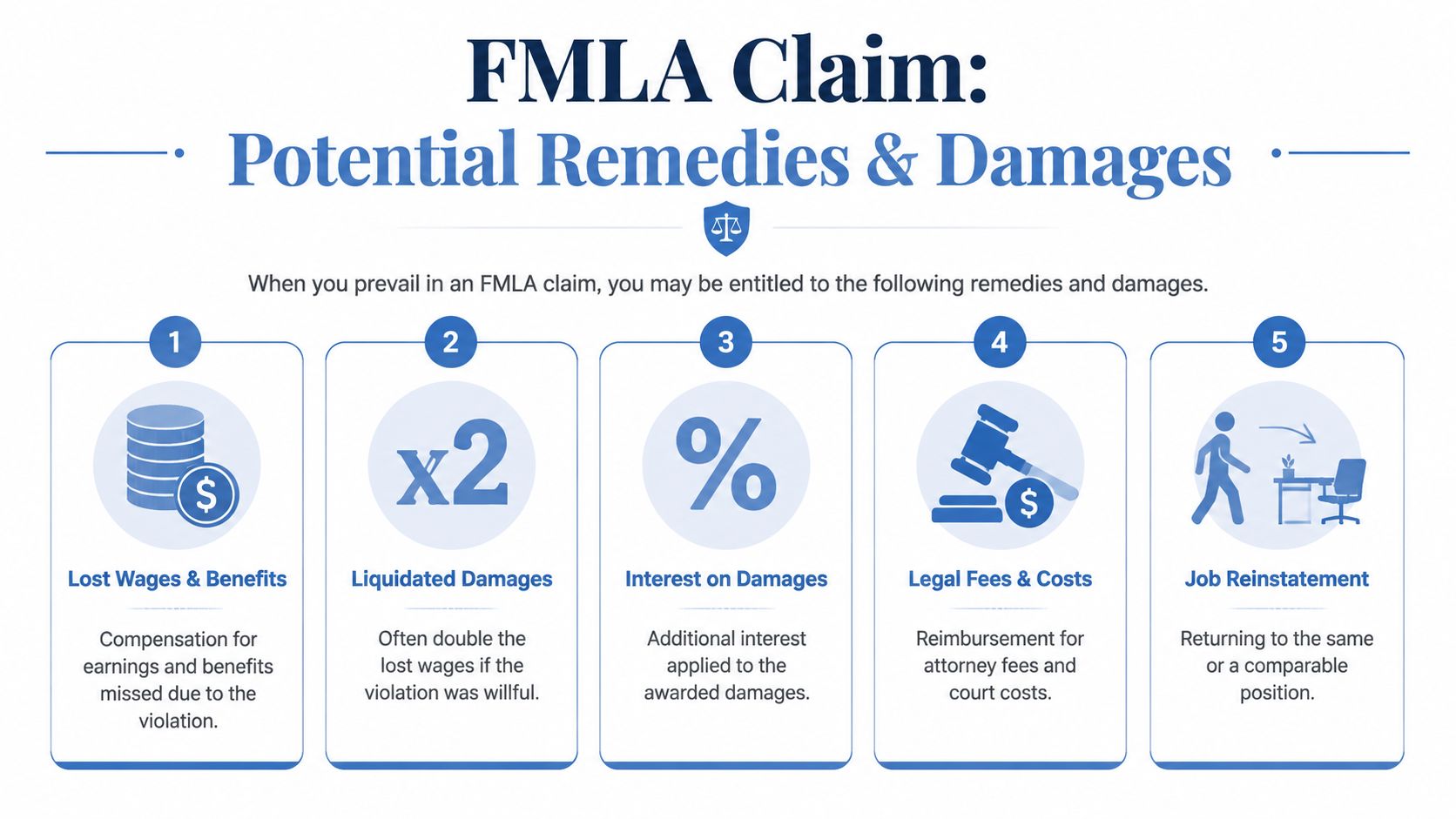
A successful FMLA claim may involve several categories of relief:
- Back pay and benefits for wages and employment benefits lost because of the violation
- Front pay when reinstatement isn't workable and future lost earnings need to be addressed
- Liquidated damages that can significantly increase the employer's exposure
- Attorney fees and court costs when the employee prevails
- Reinstatement or equivalent placement in the right case
The financial stakes can be substantial. In FY 2025, the Department of Labor reported recovering over $1 billion in back wages for FMLA violations, and one private jury verdict exceeded $1.3 million, including about $19,800 in back pay, over $300,000 in front pay, more than $200,000 in liquidated damages, and nearly $606,000 in attorney fees and costs, according to this discussion of the cost of FMLA mismanagement.
Why the numbers can grow quickly
A worker may focus on the missed paycheck that started the dispute. The legal system looks more broadly. If the FMLA violation leads to job loss, delayed reemployment, lost benefits, or long-term income disruption, the value of the case can move far beyond the initial absence.
For lawyers and clients evaluating damages, it can help to look at frameworks from other litigation contexts too. This guide for personal injury attorneys discusses how damages are analyzed and documented, which can be useful when thinking about how different categories of harm are developed and presented, even though FMLA damages follow their own legal rules.
What doesn't work
Workers sometimes hurt settlement discussions by guessing at a case value too early or by treating every bad workplace experience as compensable under the FMLA. The better approach is narrower. Tie each category of damages to a document, a date, and a legal theory.
Employer Defenses and Unique Mississippi FMLA Rules
Employers rarely admit an FMLA violation outright. Most defend these cases by arguing that the leave request didn't qualify, the employee wasn't eligible, the notice was inadequate, or the discipline would have happened anyway.
Defenses you should expect
Some of the most common employer arguments are straightforward:
| Employer defense | What it means in practice |
|---|---|
| You weren't eligible | The employer disputes length of service, hours worked, or worksite coverage |
| The reason wasn't qualifying | The employer argues the medical issue didn't meet FMLA standards |
| You didn't give enough notice | The employer says it didn't receive enough information to recognize the need for protected leave |
| The decision was unrelated | The employer claims performance, misconduct, layoff, or policy issues drove the action |
Those defenses aren't automatic winners. But they do mean your records need to be organized around specifics, not general unfairness.
Mississippi rules that change strategy
Mississippi does not operate a state human rights commission for employment claims. That means workers who believe their federal rights under laws like the FMLA or ADA were violated must proceed through a federal agency such as the EEOC or pursue a lawsuit in federal court, as noted in this Mississippi employment claim discussion.
That absence of a state commission changes how cases are prepared. There's less room for confusion about where to start, but there's also less room for delay. Mississippi workers often need to think early about preserving proof for a federal case instead of expecting a state-level process to sort things out first.
Another point causes confusion in injury-related employment disputes. Mississippi does not provide a standalone retaliation claim solely because an employee filed a workers' compensation claim. If a worker is fired after a workplace injury, that fact alone doesn't create a Mississippi workers' compensation retaliation lawsuit. Sometimes the viable claim instead comes from overlapping federal law, including the FMLA or ADA, depending on what happened and why.
A workplace injury case and an FMLA case are not the same thing. Sometimes they overlap. Sometimes they don't. The legal theory has to match the facts.
How an Employment Lawyer Can Help Your FMLA Claim
You ask for leave to care for a parent or recover from surgery. A few weeks later, your schedule changes, your write-ups start, or your job disappears. At that point, the legal question is not just whether the employer acted unfairly. The question is whether the facts fit a federal FMLA claim, another federal claim, or both.
That distinction matters even more in Mississippi. Because Mississippi has no state human rights commission for employment cases, there is no parallel state process to sort out an FMLA dispute first. These cases are built with federal court in mind from the start. A lawyer helps shape the claim that way early, before emails disappear, memories fade, or the employer locks the story into a paper record.
A good first step is a blunt case assessment. Does the employer meet the FMLA coverage rules? Was the leave request protected? Is the stronger theory interference, retaliation, an ADA accommodation failure, or a combination? Those are not academic labels. They affect what evidence matters, what defenses to expect, and how the case should be prepared for a Mississippi federal judge.
The legal work is practical. Organize the leave paperwork. Match the dates of absences, certifications, discipline, and termination. Compare the employer's stated reason with the attendance records, internal messages, and witness accounts. In many cases, the value of counsel is not dramatic courtroom work at the beginning. It is getting the theory right and building a record that can survive summary judgment.
Many workers also need a direct answer about cost. Employment lawyers often handle plaintiff-side FMLA cases on a contingency fee, which usually means the fee is paid from any recovery rather than through ongoing hourly bills. Case expenses, filing strategy, and settlement timing still matter, so those terms need to be discussed clearly at the outset.
If you want a broader explanation of what an employment lawyer does in workplace cases, that resource gives useful context. In Mississippi, firms such as Nick Norris, P.A. represent employees in federal employment disputes, including FMLA matters, by evaluating claims, handling negotiations, and litigating when necessary.
If you are dealing with denied leave, discipline, or termination after a serious medical or family event, do not assume your employer will fix it internally. Nick Norris, P.A. represents Mississippi employees in federal employment matters and can evaluate whether your facts support an FMLA claim, a related retaliation claim, or another federal workplace case.
This article has been reviewed for legal accuracy by Nick Norris. For employment law matters in Mississippi, consult with an attorney licensed to practice in your state.
Leave a Reply