

Employment Law Plaintiff in MS: A Worker’s Guide
You're probably reading this because something at work went sideways and your employer is acting like you have no options. Maybe you reported harassment and suddenly your schedule changed. Maybe you asked for leave and got pushed out. Maybe you were fired after speaking up about discrimination, unpaid overtime, or military service issues.
In Mississippi, that confusion gets worse fast because the path is not intuitive. Mississippi does not have a human rights commission. That means workers here usually don't get a state-level agency path for discrimination claims. The process is mostly federal, and if you miss a step early, you can wreck a good case before it starts.
That's why the label employment law plaintiff matters. It's just the legal term for the worker bringing the claim. If you've been harmed at work and you're taking formal action to enforce your rights, that's you. Not because you're litigious. Because you're trying to stop an employer from getting away with conduct the law forbids.
Am I an Employment Law Plaintiff
A common Mississippi story goes like this. You've worked hard, kept your head down, and tried to solve problems internally. Then your supervisor starts treating you differently after you complain. Your reviews shift. Your hours get cut. You get written up for things everyone else gets away with. At some point, you stop asking, “Is this fair?” and start asking, “Is this legal?”
That's when you may be an employment law plaintiff.
You don't become one only after filing a lawsuit. You become one when your job problem moves from workplace frustration into a legal claim. That can mean discrimination, harassment, retaliation, unpaid wages, leave violations, or unlawful termination under federal law. If you're trying to understand whether your facts fit a claim, a practical starting point is this guide on what you can sue your employer for in Mississippi.
What that term really means
A plaintiff is the person asking the legal system for a remedy. In employment law, that usually means a worker saying an employer violated a workplace law and caused real harm.
That harm might include:
- Lost pay
- Lost benefits
- Career damage
- Emotional distress
- Job loss after protected activity
You don't need to know every rule on day one. You do need to start thinking clearly about records, timelines, and proof. Even support staff can matter early. If you're trying to get organized before meeting counsel, services focused on employment law paralegal support can help explain how case files, documents, and timelines are typically assembled.
The biggest early mistake I see is workers waiting too long because they think they need perfect proof before they ask for legal help.
Signs you may have crossed into legal territory
If any of these sound familiar, stop treating this like an ordinary HR issue:
- Protected complaint followed by punishment. You reported discrimination, harassment, or wage issues, and management responded with discipline, isolation, or termination.
- Unequal treatment. You were treated worse than coworkers in similar situations because of a protected characteristic.
- Pay violations. You worked the hours but didn't get the wages the law requires.
- Leave interference. You needed legally protected leave and your employer blocked it or punished you for using it.
Your Rights as a Worker in Mississippi
Mississippi employers love to say you're an at-will employee. That part is often true. But many workers hear “at will” and wrongly assume it means an employer can fire them for any reason at all. That's not the law.
At-will employment means an employer can usually end the relationship without cause. It does not mean they can fire you for an illegal reason. If the actual reason is discrimination, unlawful retaliation, unpaid wage complaints covered by federal law, protected leave, or military service obligations, the at-will label doesn't save them.
What rights actually matter
If you're a Mississippi worker, your enforceable protections usually come from federal statutes, not a Mississippi civil rights agency. A good overview of that framework appears in this article on Mississippi employment law.
The workers who become employment law plaintiffs usually fall into these categories:
- Workers facing discrimination based on race, sex, religion, national origin, age, disability, or other federally protected status.
- Workers who complained about illegal conduct and got punished afterward.
- Workers denied pay required under wage and hour law.
- Workers denied leave or reemployment rights protected by federal law.
The workers' compensation retaliation trap
Here's one of the hardest truths about Mississippi employment law. Unlike most other states, Mississippi does not provide statutory protection against retaliation for employees who file workers' compensation claims, meaning an employer in Mississippi can legally terminate a worker for reporting a workplace injury without violating any state retaliation statute.
A lot of people assume that if they report a workplace injury, the law automatically protects their job. In Mississippi, that assumption can get you hurt twice. First on the job. Then in the termination meeting.
Practical rule: Don't confuse what feels unfair with what Mississippi state law actually prohibits. Those are not the same thing.
That's also why generic online advice is dangerous. Much of it assumes state remedies that Mississippi workers don't have. If you want broader reading about legal hiring and workplace trends, a legal industry blog can be useful background. But for your own claim, Mississippi-specific analysis matters more than general commentary.
What this means for you
Your rights exist, but the path is narrower and more technical here. Mississippi workers often need to think in federal terms from the start. That means protected activity, adverse action, comparators, deadlines, and documentary proof. If you wait for HR to “do the right thing,” you may lose time you can't get back.
Common Claims Filed by Mississippi Plaintiffs
Most Mississippi workers don't walk into a lawyer's office saying, “I have a Title VII claim” or “I have an FLSA issue.” They say, “My boss started treating me differently after I complained,” or “I worked the hours and didn't get paid.” The legal label comes later.
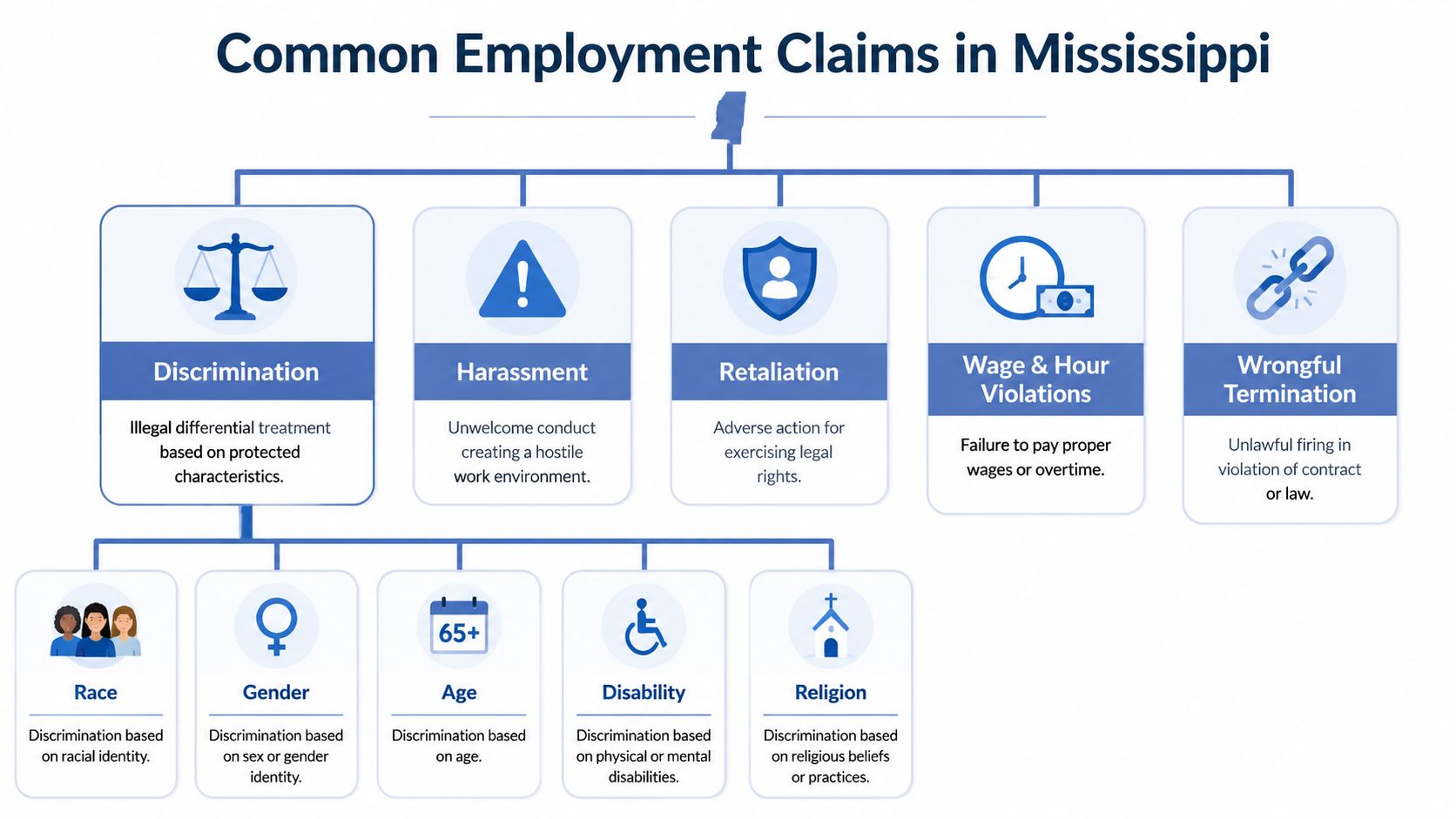
If you want a deeper look at one major category, this discussion of discrimination employment cases in Mississippi is a useful companion.
Discrimination
Discrimination claims usually involve a protected characteristic and a concrete job action. Firing, demotion, denial of promotion, discipline, pay disparity, or exclusion from opportunities can all matter.
Examples include:
- A qualified older employee gets replaced after repeated comments about needing “fresh energy.”
- A disabled employee asks for a reasonable adjustment and is pushed out instead.
- A Black employee gets disciplined for conduct that white coworkers regularly avoid punishment for.
Harassment
Harassment isn't just rude behavior. It becomes a legal problem when the conduct is based on a protected characteristic and is severe or pervasive enough to alter the conditions of employment.
That can include:
- Sexual harassment from supervisors or coworkers
- Racial harassment through slurs, jokes, or repeated targeting
- Religious harassment tied to beliefs, dress, or scheduling practices
Some workers think they need one explosive incident. Sometimes that happens. More often, the case is built from a pattern.
Retaliation
Retaliation claims are common because employers often react badly when workers speak up. The protected activity might be reporting discrimination, participating in an investigation, opposing harassment, or asserting rights under federal workplace laws.
A basic retaliation pattern looks like this:
- You complain or participate in protected activity.
- The employer knows about it.
- Something negative happens soon after.
- The employer claims it was unrelated.
That's where records become critical.
A retaliation case often turns less on what the employer says in public and more on what changed after you complained.
Wage and hour violations
A lot of strong cases involve money, not insults. If you were misclassified, denied overtime, forced to work off the clock, or shorted on wages, that can support a federal wage claim.
Common examples include:
- Hourly workers told to clock out and keep working
- Automatic meal deductions even when no break happened
- Salaried workers labeled “exempt” even though their duties don't fit the law
Leave and service-related claims
Some Mississippi workers have valid claims tied to leave, layoffs, or military service. Federal law may protect:
- Family and medical leave rights
- Advance notice rights in some layoff settings
- Reemployment rights for service members
Wrongful termination in Mississippi usually means illegal termination
People use the phrase “wrongful termination” loosely. In Mississippi employment law, the better question is this: what law did the employer violate when it fired you?
A firing isn't illegal just because it was harsh, unfair, or based on bad management. It becomes actionable when it ties back to a legal right.
How You Prove an Employment Law Case
A lot of workers think they need a confession email to win. They don't. Employers almost never write, “We're firing you because of your age,” or “We cut your hours because you complained.” Cases are usually proven through a mix of documents, timing, comparisons, and inconsistent explanations.

Direct proof and circumstantial proof
Direct evidence is rare. That's the obvious statement, recording, or writing that plainly shows illegal motive.
Circumstantial evidence is more common and often just as powerful. It includes patterns like shifting reasons for discipline, suspicious timing, stronger treatment of comparable coworkers, sudden papering of your file after a complaint, or a performance story that doesn't match your prior evaluations.
Here's the practical difference:
| Type of proof | What it looks like |
|---|---|
| Direct evidence | An explicit statement tying an employment action to a protected reason |
| Circumstantial evidence | Timing, comparators, emails, write-ups, policy violations, and inconsistent employer explanations |
How courts test the employer's excuse
Many discrimination and retaliation cases follow a burden-shifting framework. In plain English, it works like this:
- You show the basics of a claim. You belong to a protected group or engaged in protected activity, you suffered a negative job action, and the surrounding facts support an inference of illegality.
- The employer offers a reason. Usually it's performance, restructuring, attendance, attitude, or policy violation.
- You show pretext. That means the employer's stated reason isn't the actual reason, or at least doesn't hold up under scrutiny.
Pretext can show up in several ways:
- Changing explanations from one meeting to the next
- Uneven enforcement of the same rule
- Weak documentation that appeared only after a complaint
- Contradictions between internal records and the termination story
The video below gives more context on how workers should think about proof and case development.
Proving your damages takes work
Winning liability is only part of the job. You also have to prove what the violation cost you. For an employment law plaintiff to successfully prove economic damages, they must establish a clear link between the illegal act and lost earnings. Plaintiffs who use experts to calculate lost wages and benefits often recover significantly higher amounts than those who do not, as federal rules require damage calculations to be transparent and based on reliable methods.
That matters in real life. If you claim lost pay, you need records. If you claim lost benefits, you need numbers that can be supported. If the damage model is vague, the defense will attack it.
Build your case like someone else will try to tear it apart. Because they will.
The Mississippi Plaintiff Process Filing with the EEOC
For most discrimination, harassment, and retaliation claims in Mississippi, the first stop is not court. It's the EEOC. Because Mississippi lacks a state human rights commission, employment plaintiffs must almost exclusively file discrimination, harassment, and retaliation claims in federal court under federal statutes. State courts in Mississippi are generally not a viable option for these types of cases.
That point is mandatory. If your claim requires administrative exhaustion and you skip the EEOC process, you can lose on procedure before the judge ever considers the facts.

The deadline problem
The EEOC filing deadline is short, and workers miss it all the time. The most important deadline for many Mississippi discrimination claims is 180 days from the unlawful act. Do not assume HR review pauses it. It doesn't.
The procedural risk is often underestimated. Data from the National Employment Law Project (2024) shows that 34% of plaintiff cases are dismissed not on the merits, but because plaintiffs fail to exhaust administrative remedies properly. That's why the EEOC step has to be handled carefully.
What the EEOC process usually looks like
This is the ordinary sequence:
- You identify the claim. Not every bad workplace event belongs at the EEOC, but discrimination, harassment, and retaliation often do.
- You contact the EEOC. This starts the intake process.
- You prepare the charge carefully. Facts matter. Dates matter. Names matter.
- You file the formal Charge of Discrimination. This preserves the claim if done on time.
- The EEOC may investigate or offer mediation.
- You receive a Notice of Right to Sue. That letter is often what allows you to move forward in federal court.
Don't treat the EEOC charge like a rough draft. Defense lawyers will read it closely later.
Filing deadlines table
Here is the practical deadline Mississippi workers need to remember for EEOC-based claims:
| Claim Type | Filing Deadline with EEOC |
|---|---|
| Employment discrimination, harassment, and related retaliation claims in Mississippi | 180 days |
A hard reality about outcomes
Workers should also keep expectations grounded. Punitive awards make headlines, but they are rare in real cases. According to Nuddleman Law's discussion of punitive damages statistics, fewer than 1% of all employment jury verdicts result in punitive damages over $50,000, and only about 2 out of every 10,000 employment lawsuit filings in major markets like California result in a plaintiff being awarded punitive damages greater than $50,000. That article also notes that punitive damages are awarded in less than 5% of all civil jury trials and that plaintiffs win verdicts in jury trials at approximately 53% to 62% depending on claim type. The lesson is simple. Focus on building a provable claim, not chasing fantasy verdict numbers.
Actionable Checklist for Mississippi Employees
If you think your employer crossed the line, act like your file may someday land on a federal judge's desk. Waiting, venting, and hoping HR fixes it is not a strategy.
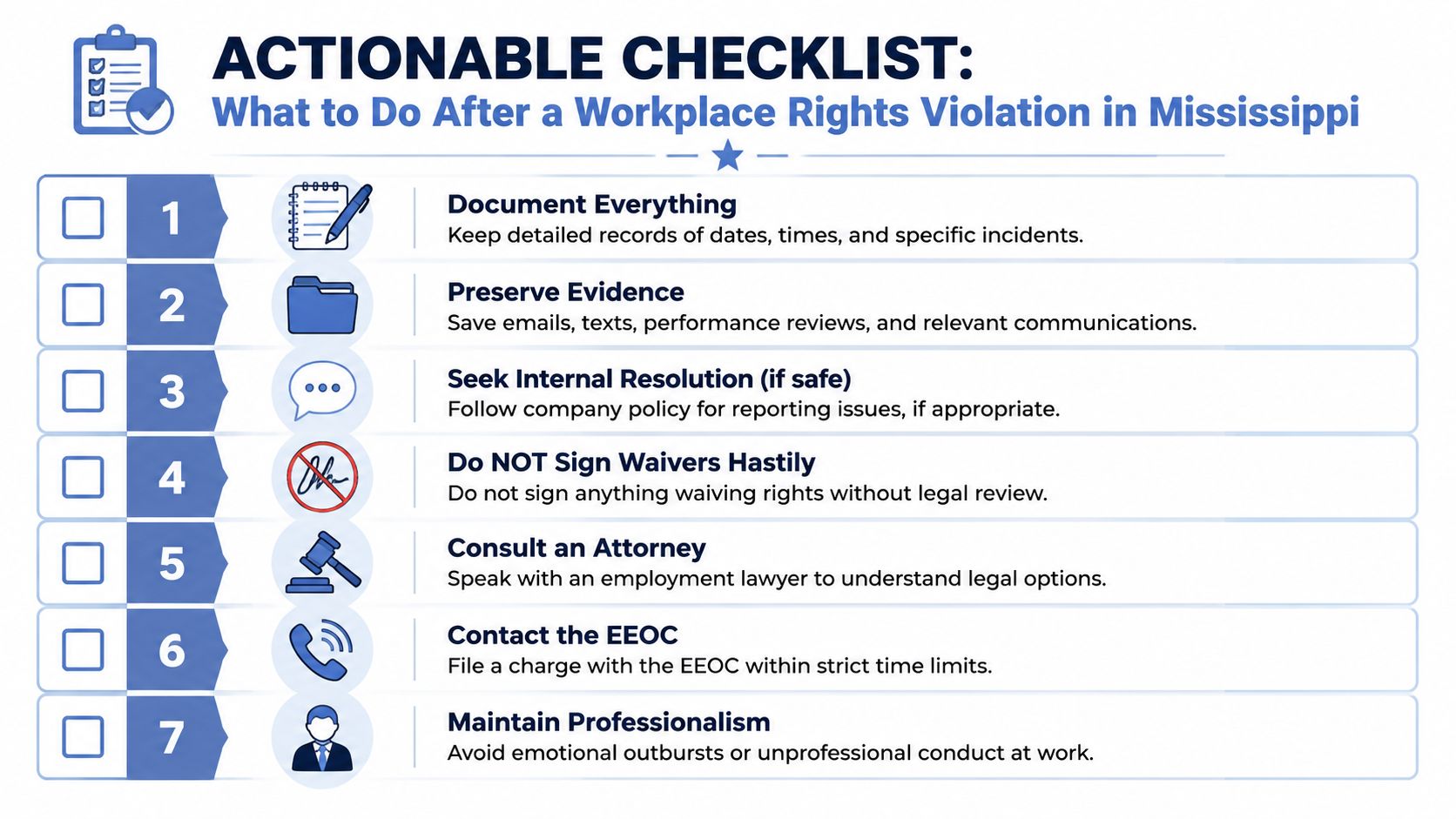
What to do right now
Document everything. Keep a private timeline with dates, names, witnesses, and what was said or done. Don't use a company laptop or company email for your personal notes.
Preserve evidence. Save relevant emails, texts, schedules, handbooks, write-ups, performance reviews, pay records, and leave paperwork. Don't alter anything.
Use internal reporting channels if it's safe. If the company has a complaint procedure, following it can help show you gave the employer notice. But use judgment. Some workplaces retaliate quickly.
Don't quit impulsively. Quitting may feel satisfying for one hour and create legal problems for months. If you're considering resignation, get advice first.
Watch the calendar. The EEOC deadline can expire while you're still hoping management will “look into it.”
Don't sign severance or waiver papers in a panic. Employers often put documents in front of workers right when they feel cornered.
Stay professional. Angry texts, ugly social media posts, and workplace outbursts can become defense exhibits.
What not to do
Some mistakes are predictable, and they cost people good claims:
- Don't rely on memory alone. Your timeline will blur faster than you think.
- Don't assume HR is neutral. HR protects the company first.
- Don't exaggerate facts. Strong cases don't need embellishment.
- Don't wait for perfect evidence. Early legal advice is often more valuable than late certainty.
If you want counsel that handles Mississippi worker-side claims involving discrimination, harassment, retaliation, FMLA, USERRA, or wage disputes, Nick Norris, P.A. is one available option for case evaluation and litigation guidance.
Frequently Asked Questions for Plaintiffs
How much does it cost to hire a Mississippi employment lawyer
In Mississippi employment law cases, the standard contingency fee arrangement typically ranges from 40% to 50% of the final settlement or judgment amount. That's the common structure because these cases are expensive, document-heavy, and risky. If there's no recovery, the fee structure may work very differently than an hourly arrangement.
Can my boss fire me for filing a discrimination claim
Federal law generally prohibits retaliation for protected complaints and EEOC participation. But don't confuse that with perfect real-world protection. Employers still retaliate. The difference is that retaliation itself may become part of the case if you document it properly.
Can my employer fire me for filing a workers' compensation claim in Mississippi
Under Mississippi law, there is no state retaliation claim for filing workers' compensation. That surprises people, but it's a critical Mississippi-specific reality.
What is my case worth
There's no honest flat answer. Value depends on liability, proof, credibility, lost pay, benefits, emotional distress evidence, mitigation issues, and whether the employer has defenses that hold up. Some cases are strong on wrongdoing and weak on damages. Others are the opposite.
Do I need a “smoking gun”
No. Many solid employment cases are proven through timing, documents, comparators, and weak employer explanations rather than direct admissions.
If you're a Mississippi worker dealing with discrimination, harassment, retaliation, unpaid wages, or leave violations, Nick Norris, P.A. handles employment claims for employees across the state. The firm can review the facts, assess the federal process that applies to your situation, and help you decide what to do before deadlines close in.
This article has been reviewed for legal accuracy by Nick Norris. For employment law matters in Mississippi, consult with an attorney licensed to practice in your state.
Leave a Reply