

What Can You Sue Your Employer For in Mississippi?
When you feel like you've been wronged at work, it’s easy to feel powerless. But knowing your rights is the first step to taking that power back. In Mississippi, you can absolutely sue your employer for illegal actions like discrimination, wrongful termination, harassment, retaliation, and wage theft. These protections come from powerful federal laws that serve as your primary line of defense.
Understanding Your Rights as a Mississippi Employee

Trying to figure out what you can sue your employer for can feel confusing, especially in an "at-will" employment state like Mississippi. The at-will doctrine generally means your employer can let you go for almost any reason—or even no reason at all—without facing legal trouble.
But that's not the whole story. "At-will" does not give employers a free pass to break the law. Federal laws act as a powerful shield, overriding the at-will rule when an employer’s actions are discriminatory, retaliatory, or illegal in other ways.
Why Federal Laws Are Your Lifeline
Here's a crucial point for Mississippi workers: Mississippi does not have its own state-level agency like a human rights commission to handle workplace complaints. This makes understanding your federal rights absolutely essential, as they are often the only path to justice.
You can't sue your boss just for being a jerk or for general "unfairness." The action has to violate a specific law. This is where federal protections come in—they are triggered when an employer’s decision is driven by an illegal motive.
So, what kinds of actions cross the line from unfair to unlawful? Here are some of the most common grounds for a lawsuit:
- Discrimination: When your employer makes decisions about hiring, firing, pay, or promotions based on your race, color, religion, sex, national origin, age (40 and older), or a disability.
- Harassment: When you're forced to endure unwelcome conduct based on a protected status (like race or sex) that is so severe it creates a hostile work environment.
- Wage and Hour Violations: This includes things like being paid less than the federal minimum wage or not receiving overtime pay for working more than 40 hours in a week.
- Retaliation: If your employer takes negative action against you—like firing, demoting, or cutting your hours—because you engaged in a legally protected activity, such as reporting harassment or filing a wage claim.
An "at-will" policy allows termination for a bad reason or no reason, but never for an illegal reason. Federal laws define what makes a reason illegal, creating critical exceptions that protect workers.
To give you a clearer picture, here’s a quick summary of the most frequent illegal actions and the laws that protect Mississippi workers.
Common Grounds for Suing Your Employer in Mississippi
| Illegal Action by Employer | Governing Federal Law | Who Is Protected? |
|---|---|---|
| Discrimination based on race, color, religion, sex, or national origin. | Title VII of the Civil Rights Act of 1964 | Employees at companies with 15+ workers. |
| Discrimination based on age. | Age Discrimination in Employment Act (ADEA) | Employees aged 40 and older at companies with 20+ workers. |
| Discrimination based on a disability. | Americans with Disabilities Act (ADA) | Qualified individuals with disabilities at companies with 15+ workers. |
| Unequal pay for equal work based on sex. | Equal Pay Act of 1963 (EPA) | Most employees. |
| Failure to pay minimum wage or overtime. | Fair Labor Standards Act (FLSA) | Most hourly and non-exempt salaried employees. |
| Firing an employee for reporting illegal activity. | Varies (e.g., Title VII, FLSA) | Employees who engage in legally protected activities. |
This table highlights the key federal "shields" available to you. Each law has specific rules and protects different groups of people, which is why getting expert advice is so important.
What Does This Mean for You?
This legal landscape means that even if a specific Mississippi state law doesn't exist to protect you, you can still hold your employer accountable in federal court. For instance, if you were fired right after turning 60 and replaced by a much younger employee, your case would be built on the federal Age Discrimination in Employment Act (ADEA).
The first, most important step is learning to tell the difference between treatment that is merely unfair and conduct that is truly illegal. If you suspect your employer has crossed that line, you need to know which federal law might apply and, just as critically, what you must do to preserve your claim.
For nearly all Mississippi workers, this means you can't just go straight to court. You must first file a formal charge with the federal Equal Employment Opportunity Commission (EEOC). This process has very strict deadlines, and missing them can mean losing your right to sue forever. An experienced employment lawyer can be your guide through this complex but necessary process.
Identifying Illegal Discrimination and Harassment

It’s a tough thing to hear, but not every unfair action at work is illegal. A demanding boss, a negative performance review, or being passed over for a project can feel deeply personal and unjust. But for the law to get involved, that treatment has to be motivated by prejudice against a legally protected part of who you are.
Federal law draws a clear line in the sand, creating what are known as "protected characteristics." An employer cannot legally make decisions about your job—hiring, firing, pay, promotions, or daily duties—based on your race, color, religion, sex, national origin, disability, or your age (if you're 40 or older).
What Is Unlawful Discrimination?
Think of these protected characteristics as guardrails. When an employer’s actions are based on one of them, they've crossed a legal boundary. For instance, if a 30-year-old employee and a 55-year-old employee both make a similar mistake, but only the older worker is fired, that’s a huge red flag for age discrimination. The problem isn't the mistake itself; it's the unequal consequence driven by age.
This kind of illegal treatment can be blatant, but it's often more subtle. It generally falls into two categories:
Disparate Treatment: This is the most direct form of discrimination. It's when a manager openly says they won't promote women into leadership or a company has an unwritten rule of not hiring people of a certain race. It's intentional and targeted.
Disparate Impact: This is trickier. It happens when a company policy looks fair on the surface but ends up harming a protected group more than others. A classic example is a physical strength test that isn't actually necessary for the job. Such a test could illegally filter out more women or people with certain disabilities than men.
Because Mississippi doesn't have a state-level agency to handle these claims, your case will rely on the power of these federal laws.
The core question is always: "Would this have happened to me if I were not a member of this protected group?" If the answer is no, you may have a valid claim for discrimination. You can explore a deeper analysis of evidence in our article on discrimination in employment cases.
Recognizing a Hostile Work Environment
Harassment is a type of discrimination that crosses the line into illegality when the conduct is so bad or so constant that it creates a "hostile work environment." We're not talking about a stray rude comment or an isolated incident. We're talking about a pattern of unwelcome behavior, based on a protected trait, that makes it nearly impossible for you to do your job.
Imagine someone enduring a daily barrage of offensive "jokes" or slurs about their religion or national origin. The behavior is pervasive, it's clearly unwelcome, and it fundamentally changes the conditions of their employment. That pattern is what transforms a difficult workplace into an illegally hostile one.
For conduct to legally qualify as a hostile work environment, it must be:
- Based on a protected characteristic (like your race, sex, or religion).
- Unwelcome and offensive to any reasonable person in your shoes.
- Severe or pervasive enough to poison the work atmosphere and change your job conditions.
Key Federal Laws That Protect You
Several foundational federal laws are the shield and sword for Mississippi workers facing discrimination and harassment. Each one targets a specific kind of illegal behavior.
Major Anti-Discrimination Laws
| Federal Law | What It Prohibits |
|---|---|
| Title VII of the Civil Rights Act | Discrimination based on race, color, religion, sex, and national origin. |
| Americans with Disabilities Act (ADA) | Discrimination against qualified individuals with disabilities. |
| Age Discrimination in Employment Act (ADEA) | Discrimination against employees who are 40 years of age or older. |
So, if you were passed over for a promotion that went to a younger, less-qualified person, the ADEA is the law that might protect you. If your employer refused to provide a simple, reasonable accommodation for a known disability, you’d look to the ADA. Knowing which law applies to your situation is the first crucial step in fighting back.
Wage Theft and Unpaid Overtime

You put in the hours, and you expect your paycheck to reflect that work. Simple, right? Unfortunately, wage theft—when an employer illegally withholds money you've earned—is a surprisingly common problem. The most important law on your side here is the federal Fair Labor Standards Act (FLSA).
This is the law that sets the ground rules for minimum wage and, crucially, for overtime. The FLSA is clear: if you’re a non-exempt employee, you must be paid 1.5 times your regular rate of pay for every hour you work over 40 in a workweek. When a company ignores this, they’re breaking the law, and you have the right to get that money back.
Common Ways Employers Steal Wages
Wage theft often isn't as blunt as a completely missing paycheck. It usually flies under the radar, disguised as company policy or hidden in confusing pay practices. This is why it’s so important to keep a close eye on your hours and pay stubs.
Here are some of the most common red flags to watch for:
- Misclassifying You as "Salaried Exempt": This is a big one. An employer might put you on a salary and give you a fancy title like "manager," but if you're still doing the same work as hourly employees, you might be misclassified. It’s your actual job duties—not your title—that determine if you’re owed overtime.
- Requiring Off-the-Clock Work: If you’ve ever been asked to work after clocking out, come in early to prep your station, or answer work emails at night without pay, that’s illegal. All time spent on work-related tasks must be paid time.
- Refusing to Pay Proper Overtime: Some employers just don't pay the time-and-a-half premium. They might try to average your hours over two weeks or just pay your regular rate for overtime hours. Both practices are illegal under the FLSA.
- Making Illegal Deductions: Your employer can't take money from your paycheck for things like uniforms, tools, or register shortages if it causes your hourly wage to dip below the federal minimum.
Your job title means very little when it comes to overtime law. The FLSA focuses on your actual job duties. An employer can't avoid paying overtime just by calling you a manager and giving you a salary.
Think about it this way: if you’re an "assistant manager" but spend 90% of your day stocking shelves and ringing up customers, there’s a good chance you've been misclassified to cheat you out of the overtime pay you’ve earned.
How You Can Afford to Fight Back
The thought of taking legal action can be daunting, especially when you’re already dealing with financial stress from unpaid wages. The good news is that most employment lawyers who handle these cases understand your situation.
They typically work on a contingency fee basis. This means you don't pay any legal fees upfront. The attorney only gets paid if they win your case, either through a settlement or a court verdict. Their fee is a percentage of what you recover, usually between 40-50%. This arrangement removes the financial risk for you and shows that the lawyer is confident in your claim.
While the rules for how to calculate overtime can vary by state, the core principle of keeping detailed records is universal. For a deeper dive into the process, check out our guide on how to sue for unpaid wages.
And these cases are getting results. In fiscal year 2024 alone, the EEOC secured a record $23.9 million for victims of discrimination, a 104% increase from the year before. This surge, detailed in the 2026 Employment Litigation Report, shows that holding employers accountable is more effective than ever.
Navigating Retaliation and Wrongful Termination
Getting fired is a gut-wrenching experience. To make matters worse, Mississippi is an "at-will" employment state, meaning your boss can fire you for a good reason, a bad reason, or no reason at all. But that power isn't unlimited.
What an employer absolutely cannot do is fire you for an illegal reason. When a termination is driven by something unlawful—like discriminating against you or punishing you for exercising your legal rights—it crosses into wrongful termination. And often, the strongest wrongful termination cases are built on retaliation.
Understanding Workplace Retaliation
So, what exactly is retaliation? Think of it as your employer punishing you for doing something the law specifically gives you the right to do. This "something" is called a protected activity.
Federal laws are very clear: it is illegal for your employer to take an adverse action against you because you stood up for your rights or the rights of a coworker. This legal shield is the bedrock of many employment lawsuits, ensuring you can report illegal behavior without fearing for your job.
An adverse action isn't just getting fired. It’s any negative step that would be enough to discourage a reasonable employee from making a complaint in the first place.
This could include things like:
- Getting fired or laid off
- Being demoted to a less important or lower-paying job
- Having your pay or hours slashed
- Being hit with a surprise negative performance review
- Getting moved to an undesirable shift or location
- Suddenly being excluded from meetings or projects you should be part of
The entire case hinges on the link between your action and your employer's reaction.
The heart of any retaliation claim is proving cause and effect. You engaged in a legally protected activity, and because of that, your employer took action against you.
Connecting the Dots: Protected Activity and Adverse Action
To build a solid retaliation case, you have to connect those dots. The closer the punishment comes to the protected action you took, the more suspicious it looks.
Let’s look at a few real-world examples to see how this plays out:
- Reporting Harassment: You go to HR with a formal complaint about your supervisor making inappropriate sexual comments. Two weeks later, you’re fired over a minor policy violation that other employees get away with all the time.
- Filing an EEOC Charge: You file an age discrimination charge with the Equal Employment Opportunity Commission (EEOC). Shortly after your employer is notified, you’re put on a "performance improvement plan" out of the blue, despite years of good reviews.
- Requesting FMLA Leave: You are eligible for and formally request FMLA leave for a serious surgery. A week after you return to work, you find your main duties have been permanently reassigned to someone else, effectively demoting you.
In every one of these scenarios, a protected legal right is followed quickly by a negative consequence. This timing is often the single most powerful piece of evidence you can have. To learn more about building your case, check out our guide on how to prove retaliation at work.
Whistleblower Protections
These same retaliation protections also cover whistleblowers—employees who report illegal conduct happening inside the company.
If you report your employer for breaking safety laws, committing financial fraud, or violating other regulations, the law protects you from being punished or fired for it. These laws exist to encourage people to speak up when they see wrongdoing that could hurt the public or other workers.
At the end of the day, while Mississippi's at-will doctrine gives employers a lot of freedom, it's not a blank check. Federal laws carve out critical protections for workers who stand up against illegal discrimination, harassment, safety violations, and more. If you were punished for doing the right thing, you might have a strong case for wrongful termination.
Essential Steps to Take Before You Sue
Thinking about suing your employer is a huge step. It’s stressful and you probably feel like you’re in over your head. But feeling overwhelmed won't help your case. What will help is taking the right steps, in the right order, to protect your rights and lay the groundwork for a successful claim.
Before you can even think about walking into a courtroom, you have to follow a very specific process. This isn't just good advice—it's a legal requirement, especially for workers in Mississippi who are relying on federal laws.
Gather and Organize Your Evidence
Your case is only as strong as your evidence. Period. Your memory can fade or get fuzzy under pressure, but documents don't lie. It’s time to become the best record-keeper you’ve ever been.
A word of warning: do not use your work computer or work email for this. Your access could be cut off at any second. Get into the habit of forwarding important emails to a personal account and taking screenshots of messages on company platforms.
Start collecting everything related to your job and the problems you're experiencing. This includes:
- Communications: Save every single email, text, or internal message with your boss, HR, or even coworkers that touches on the illegal treatment.
- Performance Reviews: Pull together all of your past evaluations. A history of positive reviews that suddenly turns negative can be incredibly powerful evidence.
- Pay Stubs: Gather all of them. They are essential for proving your pay rate and hours, which is critical for wage claims or proving retaliation.
- Personal Notes: Keep a private journal. After an incident happens, write down what occurred, who was there, the date, the time, and any witnesses. Be as detailed as possible.
What you're doing here is building a narrative—a timeline that connects your employer's illegal actions directly to the harm you've suffered.
Report the Issue Internally (If It Is Safe)
This might feel counterintuitive, but if your company has an HR department and you feel safe doing so, reporting the problem internally is often a smart legal move. When you follow the company’s own complaint process, you create an official record that you tried to fix the situation.
Make your report in writing. An email is perfect because it creates a timestamped paper trail. Stick to the facts, be professional, and point out any specific company policies that were broken.
Let’s be clear: HR’s job is to protect the company, not you. But by putting the company "on notice" about illegal behavior, you create a critical legal scenario. If they ignore your complaint or, worse, retaliate against you for it, your case just got a whole lot stronger.
That internal report can become a cornerstone of your case, proving the company knew about the issue and either did nothing or punished you for speaking up.
File a Charge with the EEOC
For nearly all Mississippi employees facing discrimination, harassment, or retaliation, this is the most critical, non-negotiable step. Before you can file a lawsuit in federal court, you must first file a formal complaint—called a "Charge of Discrimination"—with the Equal Employment Opportunity Commission (EEOC).
Think of the EEOC as the gatekeeper to the courthouse. Since Mississippi doesn’t have a state-level agency for these claims, the EEOC is your one and only path forward. You absolutely cannot skip this step.
The deadline is brutally strict. You have only 180 days from the date the last discriminatory act happened to file your charge. If you miss this deadline, your right to sue is almost certainly gone forever. This is why it is so important to contact a lawyer immediately.
Get Your "Notice of Right to Sue"
After you file your charge, the EEOC will investigate. Eventually, they will send you a document called a "Notice of Right to Sue." This letter is your official ticket to the courthouse. It doesn't mean the EEOC has ruled in your favor; it just certifies that you've completed the required administrative process and are now legally permitted to file your own lawsuit.
But be ready to move fast. Once you receive that notice, a new clock starts ticking—you typically have just 90 days to get your lawsuit filed in federal court.
Before filing, a good lawyer will also explore pre-litigation strategies, like sending a strong demand letter to your former employer. Some are even using new tools for things like AI-powered demand letters to make this process more effective. An experienced attorney will manage all these deadlines and procedures, giving you the best shot at justice.
Common Questions About Suing Your Employer
When you’ve been wronged at work, your head is probably swimming with questions. It’s a confusing and isolating experience, and it's natural to wonder about what happens next, how much it all costs, and what a realistic outcome looks like. Let's clear up some of the most common concerns Mississippi workers have when they consider taking legal action.
Before we dive in, this chart lays out the basic path you'll need to follow.
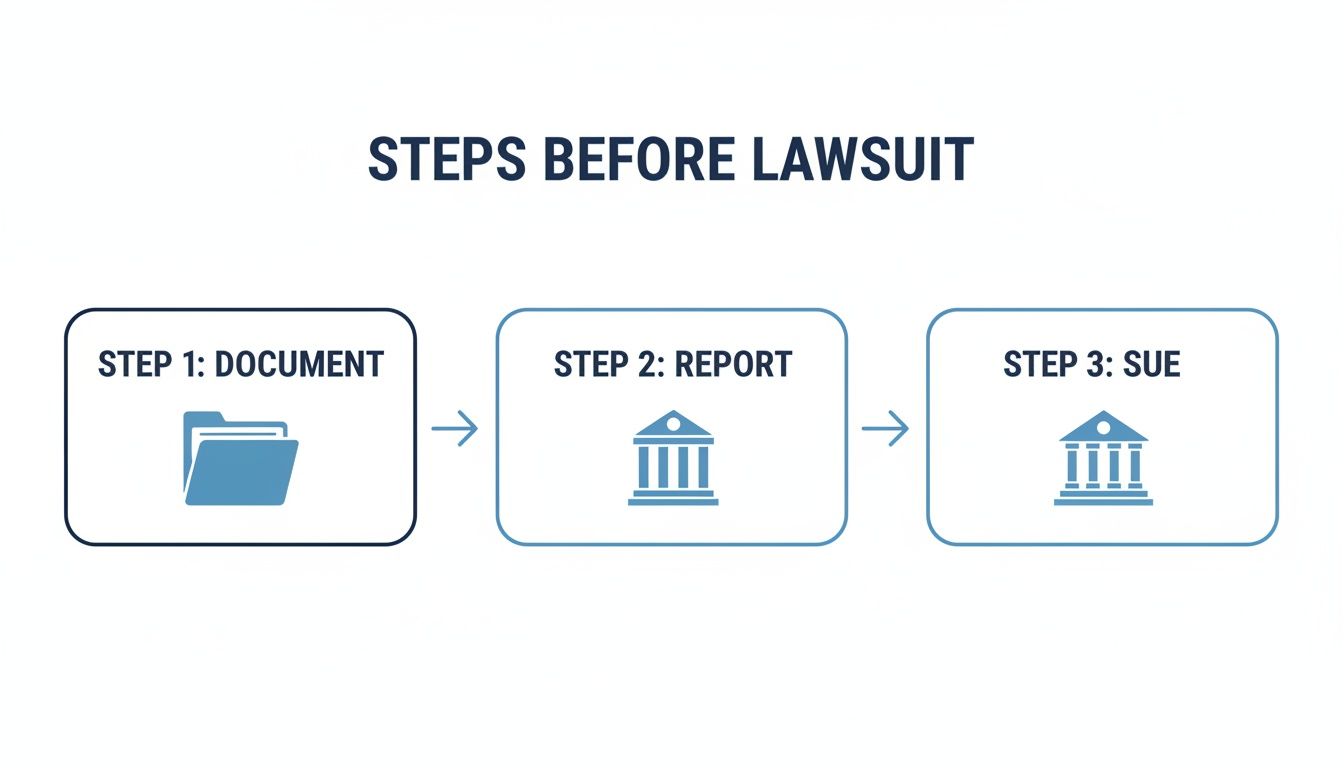
As you can see, a strong case is built block by block. It starts with careful documentation, moves to formal reporting, and only then can it lead to a lawsuit. Each step is essential.
How Much Does It Cost to Hire an Employment Lawyer?
This is often the first—and biggest—worry for people thinking about a lawsuit. The good news is that the fear of massive legal bills shouldn't stop you from getting the help you need.
Nearly all reputable employment attorneys work on a contingency fee basis. In simple terms, this means you pay nothing upfront. Your lawyer only gets paid if they win money for you, whether that comes from a settlement or a verdict in court.
The fee is just a percentage of your final recovery amount that you both agree on beforehand. In Mississippi, this is usually between 40% and 50%. This system is great because it means our goals are perfectly aligned with yours. We invest our own time and resources into fighting for you because we believe in your case and are motivated to get you the best possible result.
A contingency fee arrangement means you can get top-tier legal help without any financial risk. The law firm covers the costs of the fight, and if you don't win, you don't owe us a dime in attorney's fees.
On top of that, most firms offer a free and confidential consultation. This is your chance to share your story with a seasoned attorney, get a professional opinion on your claim's strength, and understand your options—all with no cost or commitment.
How Long Do I Have to File an Employment Lawsuit?
When it comes to employment claims, the clock is always ticking. Federal laws impose very strict deadlines, known as statutes of limitations. If you miss them, your right to sue could be gone forever.
It's critical to know which timeline applies to your situation:
- Discrimination, Harassment, and Retaliation: For claims under federal laws like Title VII, the ADA, or the ADEA, you have a very narrow window. You must file an official charge with the Equal Employment Opportunity Commission (EEOC) within 180 days of the last illegal incident.
- Wage and Hour Claims: If your employer didn't pay you minimum wage or overtime as required by the Fair Labor Standards Act (FLSA), you generally have two years from the violation to file. This can be extended to three years if you can prove the employer’s violation was willful.
Because Mississippi doesn't have its own state-level agency for these claims, the federal deadlines are the ones that matter. These deadlines approach incredibly fast, so it is vital to speak with an attorney as soon as you think something illegal has happened. Acting quickly is the only way to protect your right to seek justice.
What Compensation Can I Get from a Lawsuit?
Knowing what you're fighting for helps you make an informed decision. The money you can recover in a lawsuit—called "damages"—is meant to make you financially "whole" again and to hold the employer accountable for their illegal actions.
In federal employment cases, damages generally fall into these categories:
- Economic Damages: This is money to cover your direct financial losses. It includes back pay (lost wages and benefits from the time of the firing or demotion) and front pay (projected future earnings if getting your job back isn't practical).
- Non-Economic Damages: This compensates you for the human cost of the employer's actions—things like emotional distress, anxiety, and mental anguish.
- Punitive Damages: In cases where an employer's conduct was particularly malicious or reckless, a court can award punitive damages. These aren't to compensate you but to punish the company and deter others from doing the same.
- Attorney's Fees and Costs: If you win, the law often allows the court to order the employer to pay for your lawyer's fees and other litigation expenses.
While many cases are resolved through a private settlement, the possibility of winning these damages in court is what gives you leverage during those negotiations.
Can I Be Wrongfully Terminated in an At-Will State?
Yes, you absolutely can. This is one of the most common myths in employment law. Mississippi is an "at-will" employment state, but that doesn't give employers a free pass to break the law.
"At-will" simply means an employer can fire you for a good reason, a bad reason, or no reason at all—as long as the reason isn't ILLEGAL. Federal laws carve out huge exceptions to this rule.
For example, it is flat-out illegal to fire someone because of their race, gender, disability, age, or religion. It's also illegal to fire them for engaging in a protected activity, like reporting sexual harassment or filing a wage complaint. These powerful protections are the bedrock of most wrongful termination cases in Mississippi.
If you believe your rights as a Mississippi employee have been violated, you don't have to figure this out on your own. The dedicated team at Nick Norris, P.A. is here to provide the clear guidance and tough advocacy you need. Contact us today for a confidential consultation to understand your options and protect your livelihood.
This article has been reviewed for legal accuracy by Nick Norris. For employment law matters in Mississippi, consult with an attorney licensed to practice in your state.
Leave a Reply