

Quid Pro Quo vs Hostile Work Environment in Mississippi
You may be sitting at your desk right now wondering whether what happened was “bad management,” a one-off inappropriate comment, or something the law recognizes as sexual harassment. Maybe a supervisor hinted that being “more cooperative” would help your future at work. Maybe a coworker keeps making the office feel unsafe, crude, or humiliating. In a lot of Mississippi workplaces, people know something is wrong long before they know what to call it.
That confusion matters. Under federal employment law, quid pro quo harassment and a hostile work environment are both unlawful, but they are not the same claim. They involve different facts, different proof, and different practical problems. If you’re trying to figure out your options in Mississippi, understanding that difference can shape what evidence you save, whether internal reporting matters, and what your next step should be. For a broader starting point on conduct that may cross the line, this guide on what qualifies as workplace harassment is a useful companion.
Understanding Workplace Harassment Two Sides of the Same Coin
A common Mississippi scenario starts out blurry. A manager begins texting after hours. The messages turn personal. Then they turn suggestive. Soon after, your schedule changes, your duties shift, or a promotion suddenly disappears. In another workplace, no one ties the behavior to a direct job decision, but the constant comments, jokes, touching, or sexual remarks make it hard to walk through the door each morning.
Both situations can involve unlawful harassment. But they usually fall into different legal categories, and that distinction affects the strength and structure of the case.
Here’s the practical overview early, because this information is often sought quickly:
| Issue | Quid Pro Quo | Hostile Work Environment |
|---|---|---|
| Core idea | A job benefit or penalty is tied to sexual demands | Repeated or severe unwelcome conduct makes work abusive |
| Typical harasser | Someone with authority over job terms | A supervisor, coworker, client, or customer |
| Main proof | The link between the demand and a job action | The severity or frequency of the conduct and its effect |
| Common evidence | Texts, emails, schedule changes, demotion, firing, denied promotion | Witnesses, complaints, messages, photos, notes, repeated incidents |
| Employer defense issues | Often narrower when a supervisor used authority | Often turns on notice, reporting, and response |
Why Mississippi workers need to sort this out early
Mississippi employees don’t have the benefit of a state agency dedicated to handling these claims. That means the path is more federal, more procedural, and less forgiving of confusion. If you misread a quid pro quo case as “just a toxic workplace,” you may under-document the most important fact, which is the connection between the sexual demand and the job consequence.
The label isn’t just legal jargon. It tells you what facts matter most.
What usually goes wrong at the beginning
People often focus on the emotional impact first, which is understandable, but legal claims turn on specific facts. Who said what. Who had authority. What changed afterward. Whether the conduct was isolated, repeated, severe, or tied to a real employment decision.
That’s why the phrase quid pro quo vs hostile work environment isn’t just an academic comparison. In practice, it’s often the difference between a case built around one decisive event and a case built around a pattern.
What Is Quid Pro Quo Harassment

Quid pro quo means “this for that.” In workplace law, it refers to a person with authority making job benefits or job penalties turn on whether an employee submits to unwelcome sexual conduct.
Legal definition: Quid pro quo harassment happens when a supervisor or other authority figure links a tangible employment action to the acceptance or rejection of sexual demands. A single incident can be enough because the law focuses on the exchange itself, not a repeated pattern, as explained in this discussion of quid pro quo harassment versus hostile environment harassment.
The two facts that usually decide the issue
First, the harasser must have real workplace authority. That usually means a supervisor, manager, executive, or someone who can influence hiring, firing, promotions, pay, assignments, or discipline.
Second, there must be a tangible employment action connected to the demand or refusal. Think in terms of concrete decisions:
- Hiring or firing
- Promotion or demotion
- Pay changes
- Schedule or assignment changes that materially affect the job
- Threats tied to continued employment
If a supervisor says, “Go out with me and I’ll make sure you get the promotion,” that’s the classic form. If the message is less direct but the meaning is clear, the law can still treat it as quid pro quo.
Why one incident may be enough
This is one place where employees often second-guess themselves. They assume that because the conduct happened once, it can’t support a case. That’s not how quid pro quo works.
The issue isn’t repetition. The issue is the exchange. If a manager used job power to demand something sexual, and a job consequence followed or was threatened, one incident may be legally sufficient.
What evidence helps most
In these cases, details matter more than volume. A single text can be more important than a month of vague discomfort.
Look for evidence like:
- Written communications that suggest a tradeoff, even indirectly
- Calendar timing showing the demand came before a demotion, transfer, write-up, or denial of advancement
- Witnesses who heard the comment or saw the aftermath
- Personnel records showing sudden changes in evaluations, discipline, or assignments
- Your own notes made close in time to the event
A practical point. Employees sometimes delete embarrassing texts because they don’t want to relive them. Don’t. Preserve them exactly as they are. In a quid pro quo case, that record may be the clearest proof of the power abuse.
What Is a Hostile Work Environment
A hostile work environment is different. There’s no required tradeoff like “sleep with me and you’ll get promoted” or “refuse me and you’ll lose your job.” Instead, the workplace becomes intimidating, degrading, or abusive because of unwelcome conduct.
That conduct can be verbal, visual, digital, or physical. It can come from a supervisor, but it can also come from a coworker, a customer, or a client. That broader range of possible harassers is one of the first major differences in the quid pro quo vs hostile work environment analysis.
What severe or pervasive usually looks like
Hostile environment claims often involve a pattern. Repeated sexual jokes. Comments about your body. Explicit messages. Unwanted touching. Pornographic images. Ongoing humiliation in meetings. The legal phrase often cited is “severe or pervasive.”
That standard is frustrating because it sounds abstract. In real life, courts look at the whole setting, including the nature of the conduct, how often it happened, who did it, and how it affected your work.
One event can still qualify in the right case
Many hostile environment claims do involve repetition. EEOC data shows that 68% of complaints involve repeated incidents, but courts have also recognized that a single extremely egregious incident can be enough, such as an assault, according to this discussion of hostile work environment and quid pro quo standards.
Some employees wrongly assume they have no case because “it only happened once.” That can be a serious mistake when the incident was extreme.
Common examples people minimize
Employees often talk themselves out of reporting conduct because each act sounds “small” when isolated. But hostile environment cases are often built from accumulation.
- Verbal conduct: sexual remarks, repeated comments, humiliating nicknames, graphic jokes
- Non-verbal conduct: gestures, leering, explicit images, suggestive memes in work chats
- Physical conduct: blocking movement, touching, grabbing, cornering
- Digital conduct: repeated messages, after-hours harassment, group-thread humiliation
The practical question isn’t whether every incident, standing alone, looks lawsuit-worthy. It’s whether the conduct, taken together, changed your working conditions and made the workplace abusive.
Side-by-Side Comparison Quid Pro Quo vs Hostile Environment
The fastest way to understand these claims is to compare them where cases are won or lost.

The practical comparison
| Legal point | Quid Pro Quo | Hostile Environment |
|---|---|---|
| Who can commit it | Usually a supervisor or authority figure | Supervisor, coworker, customer, client, or contractor |
| What the conduct looks like | A demand, threat, or implied exchange tied to work consequences | Conduct that is severe or pervasive enough to make work hostile |
| What the employee must show | A link between sexual conduct and a tangible job action | A workplace altered by unwelcome conduct that is abusive or intimidating |
| Frequency | One incident may be enough | Often repeated, though a severe single act can qualify |
| Key evidence | Messages, decision timing, discipline records, promotion denial, termination papers | Pattern evidence, witnesses, screenshots, complaints, notes, HR reports |
Harasser identity changes the whole case
In quid pro quo cases, authority is central. If the person harassing you had no power over your job, the claim usually won’t fit that category. A coworker can be offensive, threatening, or relentless, but unless that person had authority to affect your employment terms, that tends to point away from quid pro quo and toward a hostile environment theory.
Hostile environment claims are wider. The law cares about the abusive conditions of the workplace, not just rank on the org chart.
For readers looking at how proof comes together in these cases, this article on how to prove sexual harassment gives a practical evidence-centered view.
A short visual summary can help if you’re sorting your own facts:
The conduct is different in kind, not just degree
Quid pro quo relates to the exercise of power. A person with workplace power uses that power as a bargaining chip or a threat. It can be explicit, but it often appears through implication, timing, and retaliation after refusal.
Hostile environment is about atmosphere and conditions. The conduct may not come with a direct threat at all. Instead, the abuse spreads through daily work life and makes the job harder, more dangerous, or humiliating.
Practical distinction: If the strongest fact in your story is a job decision tied to a sexual demand, think quid pro quo. If the strongest fact is that the workplace became intolerable because of ongoing or extreme conduct, think hostile environment.
The proof strategy changes with the claim
A quid pro quo case often turns on a narrow lane of evidence. One text thread. One denied promotion after one refusal. One supervisor with authority. That can make the story cleaner, but only if the tangible employment action is real and documentable.
A hostile environment case usually requires a broader record. You build it through repeated facts, witness accounts, saved messages, prior complaints, and evidence that the employer had a fair chance to stop it.
That’s why the same event can be part of both theories in some cases, but the strongest path depends on what you can prove.
The employer’s risk isn’t analyzed the same way
One of the most important legal differences is employer responsibility. In quid pro quo harassment involving a tangible employment action, the employer faces strict liability, meaning it is automatically liable regardless of knowledge or policy, as noted in the earlier source discussion. That single rule often changes the advantage of the case from the start.
Employer Liability The Critical Difference in Your Case
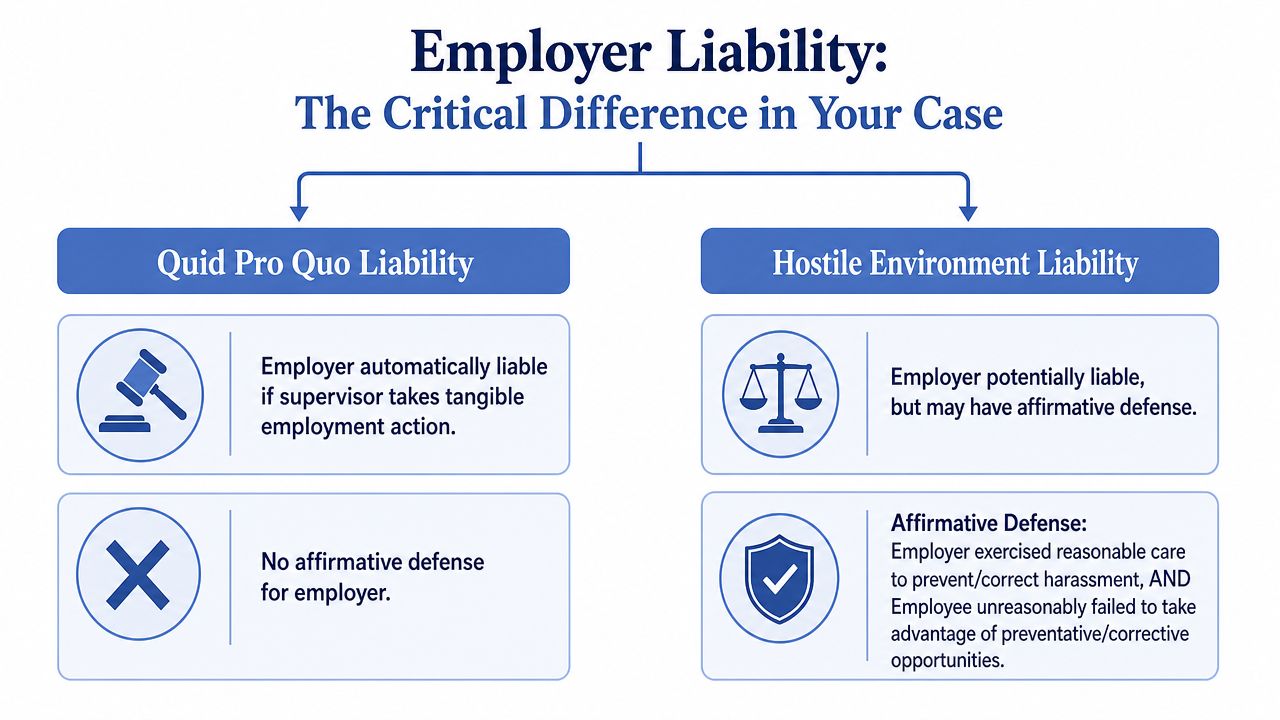
If you remember only one legal distinction, make it this one. Employer liability is often the hinge point between a claim that moves forward and a claim that stalls.
Quid pro quo cases are often more direct
When a supervisor uses company authority to carry out quid pro quo harassment and takes a tangible employment action, the employer’s liability is much more straightforward. The company usually can’t avoid responsibility by arguing it had a policy on paper or that upper management didn’t know what happened.
That doesn’t mean the case is automatic. You still have to prove the facts. But once those facts are established, the employer’s room to maneuver is much smaller.
Hostile environment cases often rise or fall on notice
Hostile work environment claims are harder in a different way. You usually have to show the employer knew or should have known about the harassment and failed to act. That requirement creates a practical burden many employees don’t anticipate.
Here is the hard reality. Recent EEOC data reveals that 54% of hostile environment cases were dismissed due to insufficient evidence of employer knowledge, while only 8% of quid pro quo cases faced similar dismissal, according to the same earlier source discussing hostile environment standards.
The question often becomes less about whether the conduct happened and more about whether the company had notice and failed to respond.
What this means for your evidence
If you may have a hostile environment claim, reporting history matters. So does every document showing the company had an opportunity to fix the problem.
Useful evidence includes:
- HR complaints in writing
- Emails to supervisors
- Screenshots of messages
- Witness names and contact information
- Handbook provisions showing the employer’s reporting process
- Follow-up records showing whether the company investigated or ignored the complaint
If the harasser is a coworker or customer, this proof can be the difference between an actionable case and one that gets dismissed for lack of employer notice.
What doesn’t work well
Waiting months to report, relying only on verbal complaints with no record, or assuming “everyone knew” without identifying who knew and when, can weaken a hostile environment case. So can resigning without preserving the communications that explain why.
On the other hand, over-reporting in a chaotic way can also muddy the record. A clean timeline is better than ten fragmented complaints with no dates or copies.
A practical lawyer’s view
In Mississippi employment cases, I’d much rather evaluate a hostile environment claim with documented internal reporting than one built only on memory. Memory matters, but documents usually carry more weight.
That’s also why workers should separate this subject from other workplace disputes. For example, Mississippi doesn’t provide a retaliation claim for filing a workers compensation claim. That issue is legally distinct from sexual harassment and shouldn’t distract from preserving the evidence that supports a Title VII harassment case.
What Mississippi Employees Should Do Next
Mississippi workers face a local reality that many national articles gloss over. Mississippi does not have a state-level human rights commission to adjudicate employment discrimination claims, meaning workers must pursue remedies through federal channels such as the EEOC or private federal litigation, as reflected by the state’s Mississippi civil rights and health directory information.
That affects timing, paperwork, and strategy from the beginning.

Start with documentation, not confrontation
You don’t need a perfect legal theory on day one. You do need a usable record.
- Write a timeline: include dates, locations, exact words if you remember them, witnesses, and what changed afterward.
- Save communications: texts, emails, chat messages, calendar invites, voicemails, and social media messages.
- Keep employment records: evaluations, write-ups, schedules, pay records, transfer notices, and policy manuals.
- Store copies safely: use a personal device or account if doing so doesn’t violate lawful workplace rules.
If the harassment has moved online, especially through social media, fake profiles, or public attacks, guidance on dealing with online employee harassment can help you think through preservation and response issues that overlap with workplace evidence.
Report internally if it is safe to do so
For many hostile environment claims, internal notice is part of the case. Use the employer’s handbook if one exists. Report to HR, a designated manager, or another channel the policy identifies.
Keep the report factual. Name the person, describe the conduct, give dates if you can, and ask for the conduct to stop. Then save a copy of the complaint and any response.
Put the complaint in writing if possible. A written report gives you a date, a recipient, and language the company can’t later deny receiving.
Don’t lose track of federal deadlines
Because Mississippi doesn’t have its own state commission for these claims, many workers need to think early about the EEOC process. Deadline problems can damage otherwise strong cases. This guide on the statute of limitations for harassment is worth reviewing as soon as you suspect the conduct may be unlawful.
The key practical point is simple. Don’t wait for the workplace to “settle down” before getting advice.
Know what legal representation usually looks like
Many employees worry they can’t afford help. In Mississippi employment cases, contingency fee arrangements are common, and the average contingency fee is 40-50%. That doesn’t mean every case is handled the same way, and fee contracts vary, but you should expect to ask direct questions about percentages, expenses, and how costs are handled if the case resolves early or late.
A consultation is also where the legal framing becomes clearer. A lawyer can help determine whether the facts fit quid pro quo, hostile environment, both, or neither. One Mississippi option for that kind of evaluation is Nick Norris, P.A., a practice that represents employees in harassment and discrimination matters under Mississippi and federal employment law.
What tends to help most
Some steps increase the value of a case because they increase credibility.
- Act promptly. Delays make records harder to find and memories harder to trust.
- Stay consistent. Tell the same factual story to HR, the EEOC, and your lawyer.
- Avoid editorializing. “He said X on this date” is stronger than “everyone was against me.”
- Preserve your work history. Good evaluations before the harassment can matter.
- Get legal advice before resigning if you can. Resignation may be understandable, but timing and documentation matter.
Mississippi employees are often navigating these problems without a state administrative system to catch mistakes early. That makes early organization even more important.
If you’re dealing with sexual harassment at work in Mississippi and need a practical assessment of whether the facts support a quid pro quo claim, a hostile work environment claim, or both, contact Nick Norris, P.A. to discuss your options under federal employment law and the steps that make the most difference early in the case.
This article has been reviewed for legal accuracy by Nick Norris. For employment law matters in Mississippi, consult with an attorney licensed to practice in your state.
Leave a Reply