
You may be dealing with this right now and not even calling it harassment yet. A supervisor keeps making comments about your body, your age, your accent, your pregnancy, your disability, or your religion. A coworker drops “jokes” in Slack or Teams and everyone pretends it's harmless. You speak up once, and suddenly your schedule changes, your manager gets colder, or you stop getting included.
That's not a personality conflict. That's a workplace problem.
In Mississippi, workers need to understand two things at the same time. First, a safe workplace is supposed to have real prevention measures, not a policy buried in a handbook nobody follows. Second, your legal options are narrower here than many people realize. Mississippi does not have a human rights commission, and private-sector workers usually have to rely on federal law and the EEOC process. That means you need to spot failures early, document them, and act before time runs out.
What a Strong Anti-Harassment Policy Looks Like
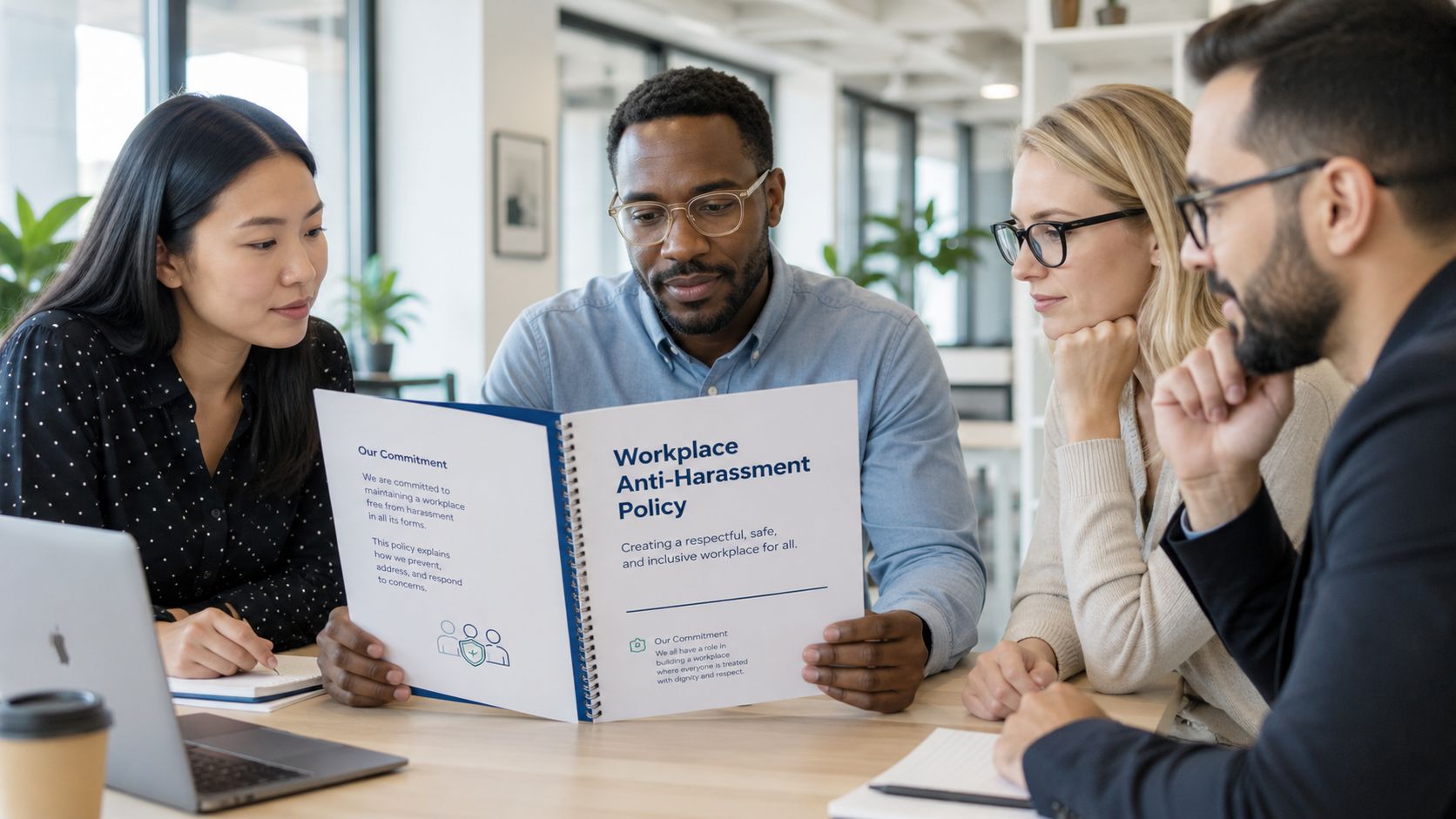
A real anti-harassment policy is easy to find, easy to read, and impossible to misunderstand. If your employer hides it in legal jargon or only pulls it out after someone complains, that's a bad sign.
A strong policy defines harassment broadly enough to match everyday experience. It shouldn't just mention sexual harassment. It should also address harassment based on race, color, religion, sex, pregnancy, national origin, age, disability, and other protected traits. If the policy acts like harassment only counts when someone makes a crude sexual comment, it's already behind.
What you should see in the handbook
Look for these features:
- Clear definitions: The policy should explain what prohibited conduct looks like in plain English.
- Real examples: It should name things employees encounter, such as repeated comments, slurs, mocking accents, unwanted touching, sexual remarks, exclusion, and degrading “jokes.”
- Coverage for digital conduct: A policy that ignores email, text messages, Slack, Teams, Zoom, and group chats is outdated.
- Universal application: It should apply to everyone, including managers, executives, temporary workers, and interns.
- Multiple reporting paths: You shouldn't be forced to complain only to the very person causing the problem.
- Anti-retaliation language: The employer should say plainly that punishment for reporting is prohibited.
One major gap shows up over and over. Workplace harassment prevention often focuses almost entirely on sexual harassment and ignores digital abuse. But digital and virtual harassment saw a 45% increase in reported incidents between 2023 and 2025, and the EEOC's 2024 guidance explicitly requires training on virtual harassment, as explained in this discussion of modern workplace harassment prevention. For Mississippi workers in remote or hybrid jobs, that matters. Harassment doesn't become less harmful because it happens through a screen.
What a policy should say without hiding the ball
A solid policy should make these points unmistakable:
| Policy feature | What it means for you |
|---|---|
| No tolerance for harassment | The company says the rule applies even when the harasser is productive, popular, or senior |
| Prompt response | Complaints are addressed quickly, not left to rot |
| Fair investigation | The employer gathers facts instead of protecting insiders |
| Confidential handling | Information is shared only with people who need it |
| Corrective action | Violations lead to consequences that fit the conduct |
Practical rule: If the policy reads well but nobody believes management will enforce it, the policy is paper armor.
The strongest policies also describe subtle misconduct. Harassment often starts with comments people are told to “brush off.” Repeated nicknames, mocking someone's hair, making assumptions about a worker's age or immigration status, or sexual comments framed as banter can all be warning signs. A policy worth anything names those behaviors before they escalate.
Effective Training That Prevents Harassment
Annual training can be useless. A lot of it is.
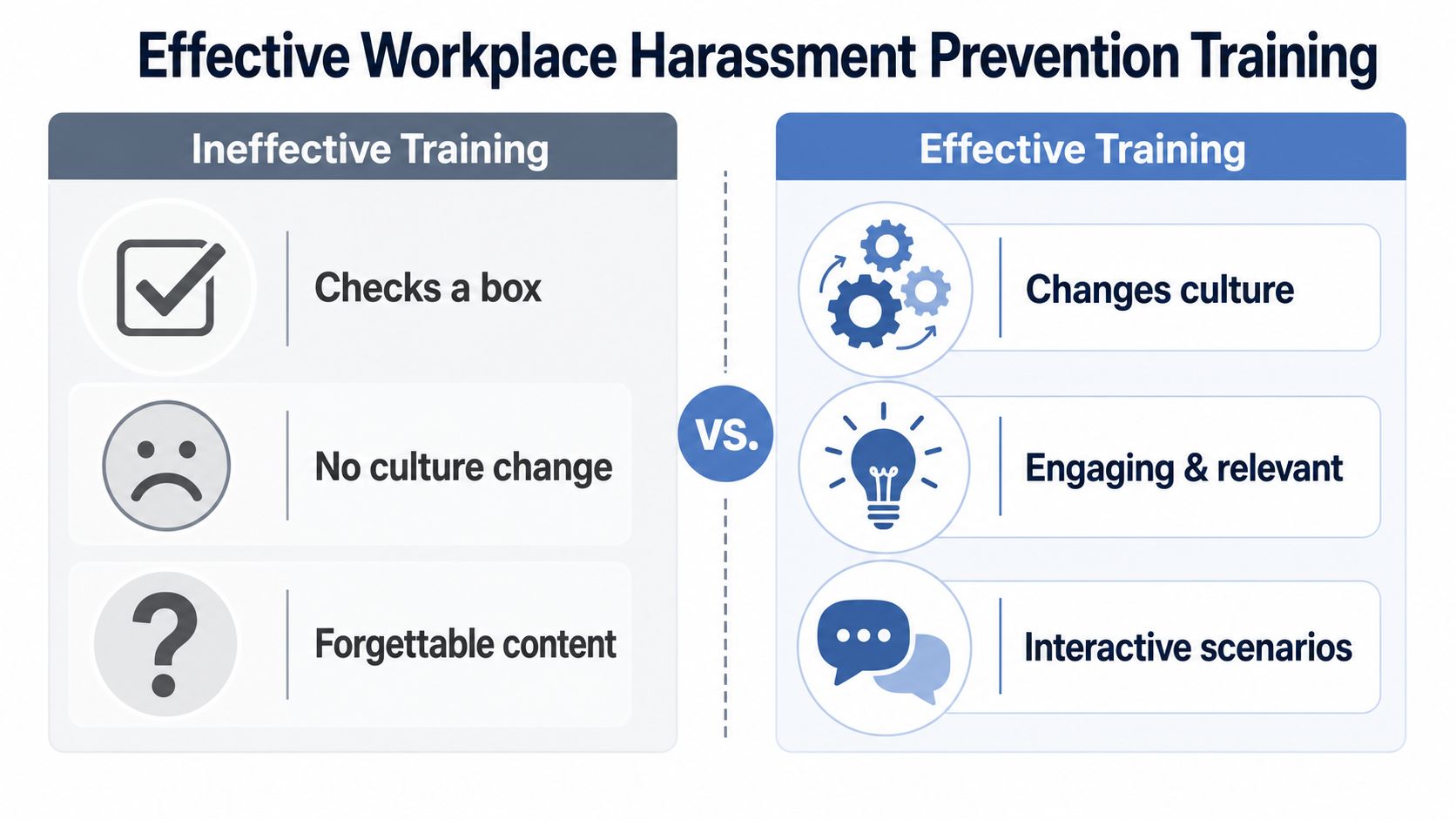
If your employer sits everyone in front of a generic slideshow, makes them click “next” ten times, and calls that workplace harassment prevention, don't confuse that with safety. Checkbox training protects the company's file cabinet. It doesn't protect workers.
The training that actually matters
The EEOC found that a stronger approach combines workplace civility training with bystander intervention training, and that these methods show “significant promise” for preventing harassment, as summarized in this EEOC task force research translation. That matters because civility training teaches people how to work with respect before conduct becomes illegal, and bystander training teaches coworkers and managers how to step in early.
That's the difference between “Here are the forbidden words” and “Here is how you stop a bad situation from getting worse.”
A better program usually includes:
- Scenario-based teaching: Real examples from meetings, texts, customer interactions, and group chats
- Manager-specific expectations: Supervisors need separate instruction because they control schedules, evaluations, and discipline
- Bystander skills: Workers learn what to say, when to interrupt, and how to report
- Follow-up reinforcement: The message doesn't disappear after one annual session
The real test is whether people expect action
Training fails when employees think reporting is pointless. The same EEOC guidance emphasized that policy awareness only helps when workers have an expectation of response, meaning they believe the employer will act.
Training doesn't mean much if everyone knows the boss's favorite employee can break the rules without consequences.
That's why I tell workers to judge training by behavior after the session ends. Did managers stop interrupting, mocking, and minimizing concerns? Did HR explain reporting options clearly? Did leadership address online conduct, not just physical workplace conduct? If the answer is no, the training was performance art.
For employers that use videos or internal explainers, visual teaching can help when it's done well. A practical example of how organizations can make content easier to absorb appears in this employee training video infographic. The format matters because forgettable content won't change anyone's conduct.
If you want a Mississippi-specific look at training obligations and practical gaps, this guide on sexual harassment training requirements is worth reviewing.
Reporting Harassment and What a Fair Investigation Involves
You report harassment once. Then the waiting starts.
You wonder who's been told. You wonder whether your supervisor is angry. You wonder whether HR is investigating or just trying to keep the peace until you give up. That uncertainty is exactly why employers need a reporting process people can trust.
Underreporting is one of the biggest failures in harassment prevention. The EEOC task force explained that fear of retaliation is a justified reason many workers stay silent, and reporting rates in some contexts are as low as 25%, as discussed in the EEOC harassment report. Complaint totals alone don't tell the truth. A quiet workplace may be a scared one.
What fair reporting should look like
A decent system gives you more than one door. If the only reporting option is your direct supervisor, and your supervisor is the problem or is close to the problem, the system is broken.
A fair process usually includes:
- More than one contact person: HR, another manager, a hotline, or another designated official
- Written instructions: You should know where to report, how to report, and what happens next
- Prompt acknowledgment: You shouldn't have to chase the company just to confirm your complaint was received
- Protection from interference: No one should pressure you to “let it go” before facts are gathered
What a fair investigation feels like from your side
A proper investigation isn't perfect, but it has a recognizable shape. Someone interviews you carefully. They ask for dates, locations, messages, witnesses, and prior incidents. They speak with the accused and the witnesses. They review documents, screenshots, calendars, chat logs, or video if those exist. They don't treat your complaint like an inconvenience.
Here's what should not happen. HR should not tell you on day one that they “don't want drama.” A manager should not tell you reporting will “hurt team morale.” The accused should not be allowed to corner you and demand to know what you said. And the company should not drag the process out until you are exhausted.
What to watch for: Delay is often a tactic, not an accident. If weeks pass and nobody interviews obvious witnesses, the process may be designed to protect the company, not find facts.
Confidentiality also matters, but workers deserve the truth about what that means. An employer usually can't promise total secrecy because it may need to interview witnesses and tell decision-makers enough to act. What it should do is limit disclosure to people with a legitimate need to know and stop gossip from leadership or HR.
Retaliation is its own problem
If you report harassment and then get demoted, isolated, written up unfairly, denied hours, or pushed out, that can become a separate legal issue. Federal law can prohibit retaliation for reporting discrimination or harassment.
Mississippi workers should also know what the law does not provide. Mississippi does not provide protection from retaliation for filing workers compensation claims, and there is not a retaliation claim for filing workers compensation in this state. Don't assume every unfair act creates a claim under Mississippi law. Some do. Some don't.
If you want a fuller picture of what competent fact-finding should involve, review this explanation of the workplace investigation process.
Your Legal Rights as a Mississippi Employee
Mississippi workers need to know the legal map here because it's different, and the differences matter.
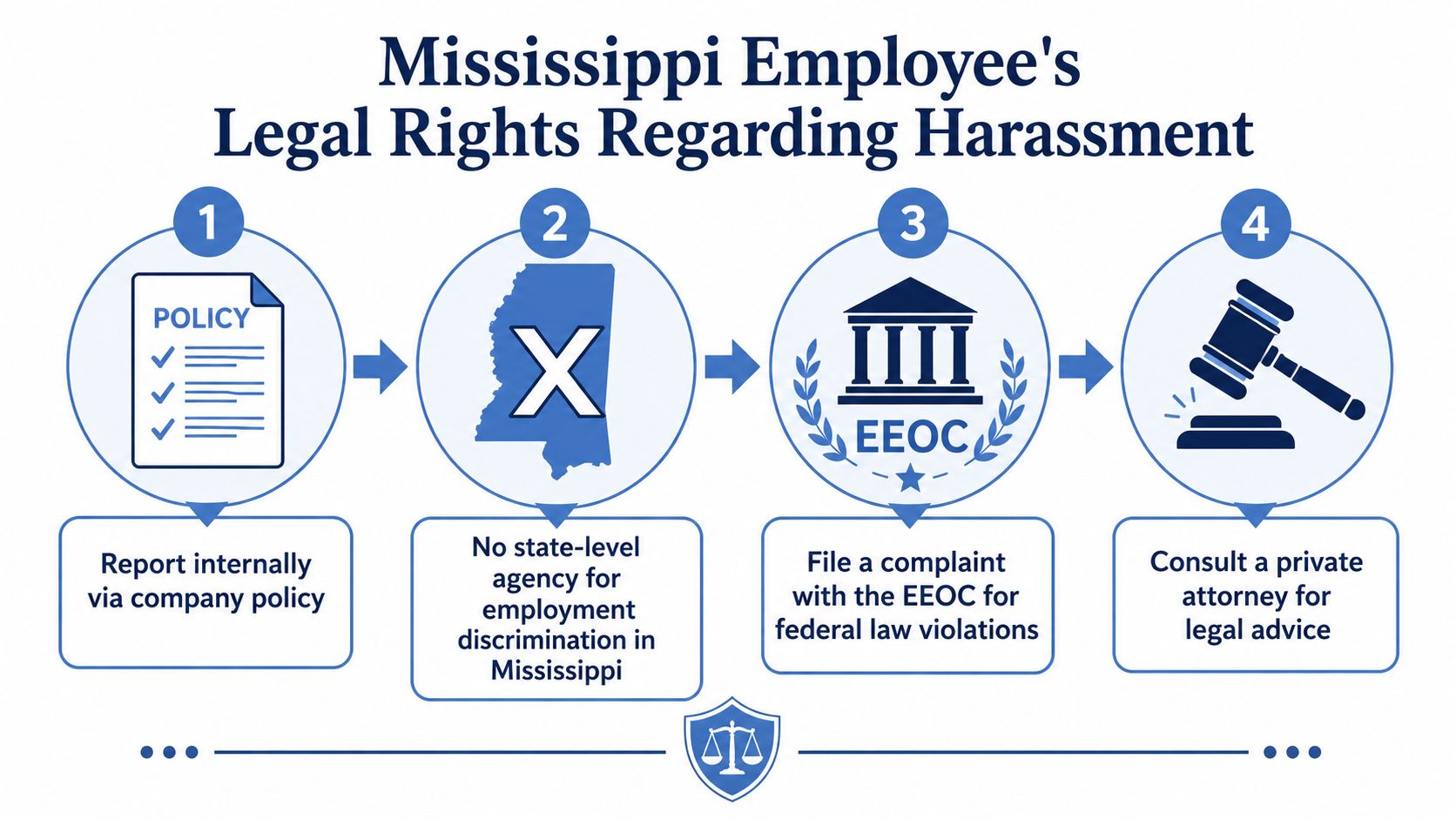
Mississippi does not have a state human rights commission or a Fair Employment Practices Agency to handle employment civil-rights claims. For many private-sector workers, that means harassment and discrimination claims must go through the EEOC under federal law. You don't get the extra state-level administrative path available in many other places.
The deadline is shorter than many workers expect
Because Mississippi does not have a state human rights commission, the deadline to file a Charge of Discrimination with the EEOC is often 180 days from the discriminatory act, not 300 days like in states with a state agency, as explained in this Mississippi civil-rights overview.
That deadline catches people off guard all the time. Workers wait because they hope the conduct will stop, or because they want to keep their heads down, or because HR says it's “looking into it.” Meanwhile, the clock keeps moving.
What that means in practical terms
Here's the practical sequence for most Mississippi employees:
- Report internally if it makes sense and if you can do so safely
- Document everything while it's happening
- Track the timing carefully
- File with the EEOC before the deadline expires if federal rights were violated
Private-sector workers in Mississippi also lack a broad state civil rights act for these claims. That means you typically cannot bring a private-employer harassment claim under Mississippi state law in state court. The path is usually federal administrative process first, then potentially federal court after that process is complete.
Mississippi employees have less procedural cushion than workers in states with state agencies. That makes early action more important, not less.
If you're trying to determine whether your claim is still timely, review this discussion of the statute of limitations for harassment claims. Waiting for HR to “work it out internally” is not a legal strategy.
Warning Signs of a Failing Prevention Program
A failing prevention program has a look and feel to it. Workers usually sense it before they can prove it.
The most obvious red flag is leadership behavior. If managers make demeaning comments, laugh off inappropriate jokes, or act annoyed when someone raises a concern, the policy doesn't matter. The culture is telling you the truth.

Signs your employer's program is mostly for show
Watch for patterns like these:
- One complaint channel only: If you can report only to your supervisor or one HR person, the system is fragile and easy to manipulate.
- Managers who minimize conduct: “He didn't mean it,” “that's just her personality,” and “you're too sensitive” are warning labels.
- Fear in the workplace: Coworkers go quiet, avoid witnesses, or tell you privately they support you but won't say anything publicly.
- No visible follow-through: Complaints disappear into a black hole and nobody can explain the process.
- Turnover in one department: When people keep leaving the same team, there's usually a reason.
Another sign is fake neutrality. Some employers pretend every complaint is just a misunderstanding between two equal participants. That approach protects repeat offenders, especially when one person has more power over schedules, assignments, evaluations, or promotion opportunities.
What a broken culture tends to produce
In a weak environment, small misconduct gets normalized. Then bigger misconduct gets excused. By the time someone finally files a formal complaint, management acts shocked.
A prevention program is failing if workers learn these lessons:
| What workers learn | What it really means |
|---|---|
| Don't report unless it's extreme | Early intervention doesn't exist |
| HR protects management first | The process lacks independence |
| Training is a joke | Nobody expects behavior to change |
| Speaking up is risky | Retaliation fear controls the workplace |
The strongest clue is often this: people know exactly who the problem is, but nobody in authority will confront it.
Next Steps If You Experience Workplace Harassment
Start documenting now. Not next week. Not after one more incident.
Write down the date, time, place, what was said or done, who saw it, and how you responded. Save texts, emails, Slack messages, Teams chats, calendar invites, screenshots, and performance reviews. If your employer changes your schedule, duties, or treatment after you report, document that too.
A practical order of operations
Your next steps usually look like this:
- Preserve evidence first: Keep copies of messages and your own timeline in a safe place you can access.
- Review the policy: Find out who receives complaints and whether there are multiple reporting routes.
- Report internally when appropriate: If the system gives you a reasonable path and reporting won't put you in immediate danger, use it.
- Pay attention to timing: Don't let internal discussions distract you from legal deadlines.
- Talk to an employment lawyer early: Early advice can help you avoid mistakes that are hard to fix later.
You also need realistic expectations. Federal harassment cases can be demanding, emotionally draining, and document-heavy. If you hire a lawyer on contingency, the average contingency fee is 40-50%. Ask direct questions about fees, expenses, strategy, and timing before you sign anything.
When to get legal advice immediately
You shouldn't wait if any of these are happening:
- Your supervisor is the harasser
- You've been punished after reporting
- HR is delaying or discouraging a written complaint
- The conduct involves repeated sexual comments, threats, touching, or severe hostility
- The EEOC deadline may be getting close
Don't let anyone convince you that keeping quiet is the professional choice. Protecting yourself is the professional choice.
If workplace harassment has put your job, income, or peace of mind at risk, Nick Norris, P.A. helps Mississippi employees understand their options under federal employment law. If you need clear advice about harassment, discrimination, retaliation, deadlines, or the EEOC process, reach out to get a case evaluation and practical guidance on what to do next.
This article has been reviewed for legal accuracy by Nick Norris. For employment law matters in Mississippi, consult with an attorney licensed to practice in your state.
Leave a Reply