
You may be sitting at a breakroom table right now, replaying something that happened at work and wondering, “Was that harassment, or am I overreacting?” Maybe a supervisor kept making comments about your body. Maybe a coworker sent messages after hours that felt personal and unwanted. Maybe you reported something informal to a manager and got a shrug instead of a response.
That uncertainty is common. In Mississippi, it can feel even heavier because there isn't a state human rights commission to step in locally. Employees often have to figure out internal policies, reporting steps, and federal procedures while still trying to keep their jobs and pay their bills. Good workplace harassment training can make that confusion smaller. Bad training can leave people stranded.
This guide is written for Mississippi employees who want a practical, plain-English understanding of what workplace harassment training should do, what it often misses, and how to use it to protect yourself. The goal isn't to turn you into a lawyer. It's to help you recognize warning signs, preserve facts, and use your employer's own procedures carefully before you ever speak with counsel.
Why Workplace Harassment Training Matters
A lot of harassment problems start subtly.
Someone makes a “joke” in a warehouse, office, hospital unit, restaurant, or jobsite. The target forces a laugh because everyone else stays silent. A manager sees tension but never addresses it. The company handbook exists somewhere, but nobody remembers what it says. By the time the conduct becomes impossible to ignore, the employee feels isolated and the employer is already behind.
That's why workplace harassment training matters. It gives people a shared map. Without it, employees guess. Supervisors improvise. Witnesses freeze. Human resources may get involved only after the damage has grown.

What employees are usually dealing with
In Mississippi workplaces, I often see three practical barriers:
- Policy confusion: People don't know what counts as harassment, who receives complaints, or whether verbal reports are enough.
- Fear of retaliation: Employees worry they'll lose hours, get written up, be transferred, or be labeled “difficult.”
- Silence from bystanders: Coworkers may witness conduct but stay quiet because they don't want conflict.
Those barriers are exactly why training isn't just a corporate ritual. It's part of workplace safety. It teaches workers how to spot misconduct early, how to report it, and how to respond when they witness it happening to someone else.
Practical rule: If training only tells employees what rule exists, but never shows them what to do on a Tuesday afternoon when a real incident happens, it isn't doing enough.
The stakes are large. Globally, 23% of employed people, approximately 743 million workers, have experienced at least one form of violence or harassment in the workplace during their working lives, according to the ILO's reported global analysis. That tells us this isn't a rare problem or a niche HR issue. It's widespread.
What good training signals
Strong training tells employees, “This workplace expects respect, and we have a process.” It also tells supervisors, “You're responsible for acting when concerns reach you.” That matters because many employees first report harassment informally. They mention it to a lead worker, department head, or shift manager before they ever submit anything in writing.
When employers ignore training, workers often pay first. Stress rises. Attendance may suffer. Trust breaks down. Then the company pays too, because poor handling of harassment can damage morale, credibility, and internal confidence.
Good training can't solve every problem by itself. But it creates a starting point people can use.
Understanding Workplace Harassment Training
Think of workplace harassment training like a fire drill.
A fire drill isn't useful because it proves the building owns alarms. It's useful because people practice what to do under pressure. Harassment training should work the same way. It shouldn't just define misconduct. It should prepare employees to recognize it, respond to it, and report it without guessing.

What real training includes
A solid program usually covers several separate skills, not one slideshow.
-
Definitions in plain language
Employees need examples of verbal, physical, visual, and digital conduct that may cross the line. Legal wording alone isn't enough. -
Reporting procedures
Training should identify where complaints go, what happens after a report, and what to do if your direct supervisor is part of the problem. -
Bystander response
Witnesses need guidance too. If a coworker sees troubling conduct, the training should offer safe ways to intervene or document what they saw. -
Manager duties
Supervisors need separate instruction because they aren't just participants. They're often the first gatekeepers in the reporting chain.
Awareness is not the same as preparation
Some employers confuse awareness with readiness.
An awareness module says, “Harassment is prohibited.” Preparation says, “If a customer corners a tipped employee, if a remote worker gets sexually explicit messages in a team chat, or if a veteran returning to civilian work faces targeted remarks, here is what to do next.”
That difference matters because employees remember specific situations better than abstract rules. A generic presentation may sound polished and still leave people unsure how to act when something uncomfortable happens in front of them.
Good training answers the question employees actually have: “What do I do if this happens to me or someone on my team?”
What to look for as an employee
If you're trying to judge the quality of your employer's workplace harassment training, ask yourself:
- Did it use realistic examples from your kind of workplace?
- Did it explain multiple reporting paths if your supervisor is involved?
- Did managers get separate guidance about receiving and escalating complaints?
- Did anyone practice responses through discussion, role-play, or scenario review?
If the answer is mostly no, the training may be built for recordkeeping rather than protection. A training certificate can show attendance. It doesn't prove understanding.
Workplace Harassment Training Requirements in Mississippi
Mississippi employees need to understand one thing clearly. Mississippi does not have a state human rights commission, meaning workers must rely exclusively on federal law and the EEOC process to address harassment or discrimination claims, as explained in this discussion of civil rights in Mississippi.
That shapes how workplace harassment training should be viewed in this state. Training isn't just about preventing bad behavior. It also helps employees create a record of what the employer told them to do, what steps they followed, and whether the employer honored its own process.
What that means on the ground
Because Mississippi lacks that state-level agency, employees often move through two tracks:
- Internal reporting through the employer's policy
- Federal administrative processes if the issue isn't corrected
That makes the employer's training materials more important than many workers realize. If training says reports can go to HR, a compliance officer, a hotline, or another manager, those details matter later. If the company promises prompt review and confidentiality limits, those promises matter too.
For employers trying to keep that process organized, strong recordkeeping through modern compliance systems can help track acknowledgments, policy updates, and report workflows. For employees, the lesson is simpler. Save what you receive and compare company actions against company promises.
Mississippi employees should pay attention to policy details
A workplace policy often gives more practical guidance than the law itself. It may explain:
- where to report harassment,
- whether anonymous reporting exists,
- who investigates,
- what anti-retaliation language the employer uses,
- and how the company documents outcomes.
If your workplace has assigned training on sexual harassment rules, review the employer-facing overview of sexual harassment training requirements and compare it to what your company provided.
Mississippi-focused takeaway: In a state without its own human rights commission, your training materials, complaint emails, handbook language, and follow-up notes can become some of the clearest evidence of whether your employer acted responsibly.
What not to assume
Don't assume that a company is handling things properly just because it offered a short annual module. Don't assume a manager's verbal reassurance counts as a completed report. And don't assume that because Mississippi is your workplace, there's a state agency ready to step in first. In many harassment matters, workers here must think federally from the beginning.
That's why training should be treated as a practical rights tool. It tells you where the employer says complaints go, how concerns are supposed to be handled, and what steps you can later show that you followed.
Key Elements of Effective Workplace Harassment Training
Not all training programs are built the same. Some are made to satisfy a checklist. Others are designed to change what people do when they see harassment, hear about it, or receive a complaint.
Research points to a few features that separate stronger programs from weak ones. The most effective programs are at least four hours long, conducted in small interactive groups, and delivered as part of a year-long campaign rather than a standalone event, according to this review on whether sexual harassment training works.
What effective programs have in common
The strongest programs usually combine structure with repetition.
| Element | Benefit |
||—|
| At least four hours of training | Gives enough time for examples, discussion, and practice instead of rushing through definitions |
| Small interactive groups | Makes it easier for employees to ask questions and work through gray areas |
| Year-long campaign | Reinforces expectations so the message doesn't disappear after one session |
| Scenario-based exercises | Helps employees connect rules to real workplace conduct |
| Manager-specific modules | Trains supervisors on receiving complaints and escalating them properly |
| Bystander intervention content | Gives witnesses tools to respond instead of staying silent |
| Civility and respect training | Builds culture before misconduct escalates into formal complaints |
| Industry-tailored examples | Makes lessons feel relevant to the actual workplace instead of generic |
Why length and format matter
A short slide deck can tell you what harassment is. It usually can't teach you how to interrupt it, report it, or manage the conversation that follows.
Small groups matter for the same reason. Employees are more likely to test confusing situations out loud. For example, someone might ask whether repeated comments from a regular customer should be reported, or whether a team lead has to pass along a complaint even when the employee says, “I'm just venting.” Those are the kinds of questions that shape behavior later.
Training works best when employees can practice judgment, not just memorize policy language.
Culture change takes more than one event
The year-long approach matters because workplace behavior is social. People watch what leaders tolerate, what managers ignore, and what happens to employees who speak up. A single session can't carry all that weight.
The best workplace harassment training keeps showing up in different forms. Refresher discussions. Supervisor coaching. Policy reminders. Realistic examples tied to the work people perform. That steady repetition tells employees that respect isn't an annual topic. It's part of how the organization operates.
For Mississippi workers, that kind of training also creates a clearer paper trail. If the employer trains repeatedly but fails to follow its own procedures when a complaint arrives, that inconsistency can become important later.
Common Red Flags in Harassment Training
Some training programs sound good until you look closely. They use polished graphics, legal phrases, and multiple-choice quizzes, but employees still leave without knowing what to do if harassment happens tomorrow.
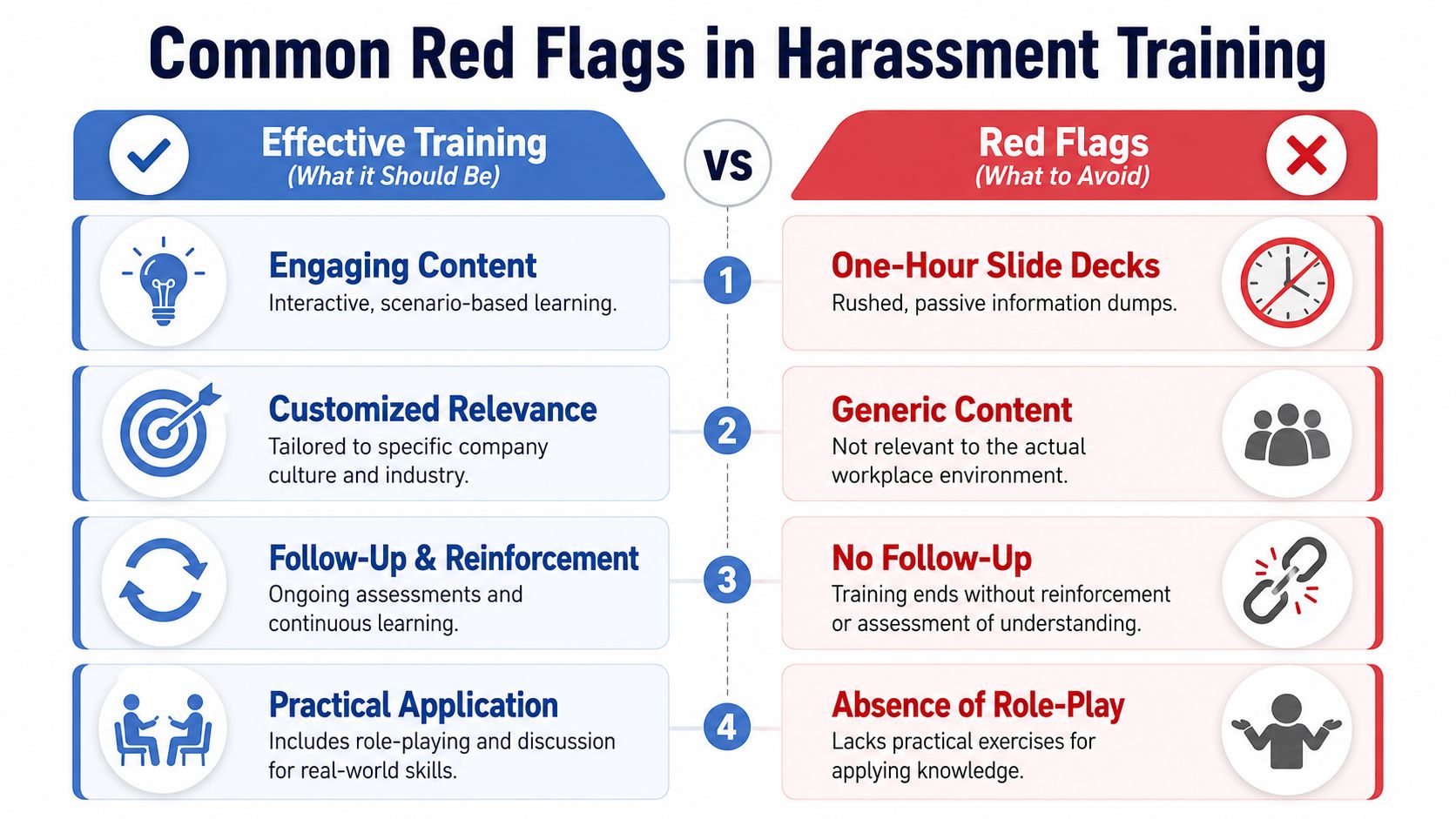
The biggest red flag is this: the training increases awareness but doesn't build skill. A meta-analysis found that harassment training has a large effect on knowledge learning (δ = 1.06) but a minimal effect on actual transfer outcomes (δ = 0.14), as summarized in this research abstract on sexual harassment training effectiveness. In plain English, people may learn the rules without changing real behavior.
Warning signs employees should notice
If your employer's training includes these features, be cautious:
- A one-hour slide deck only: Fast modules often leave no room for questions, examples, or discussion of gray areas.
- Generic examples: If the training could apply equally to a bank, restaurant, military contractor, farm, and hospital without any changes, it may be too broad to help.
- No manager coaching: Supervisors need separate instructions because they often receive the first complaint.
- No follow-up: If training ends the moment the quiz is complete, the employer may be treating harassment prevention as a box to check.
Where many programs fail Mississippi workers
A common problem is that training assumes every worker has the same power, schedule, and reporting access. That's not true.
Tipped workers may worry about losing customer income if they report harassment. Remote employees may face misconduct through chat tools or video calls. Veterans reentering civilian jobs may confront workplace dynamics that generic office modules never address. When employers ignore those realities, high-risk groups get less protection in practice.
Another red flag is heavy legal jargon without plain-language examples. If employees leave hearing terms like “hostile environment” but still can't tell whether repeated sexual comments from a shift lead should be documented, the training missed the point.
A useful test is simple. If you can't explain the reporting process to a coworker after the training, the training likely wasn't clear enough.
What weak training often looks like
Weak programs tend to have a familiar pattern:
- they define misconduct narrowly,
- rush past retaliation concerns,
- skip role-play,
- and avoid messy examples involving power differences.
That kind of training may help the employer say training occurred. It doesn't do much for the worker who needs a safe, practical route to report.
Documenting Harassment and Using Training Procedures
When harassment happens, documentation matters. Not because every note becomes evidence in a formal case, but because memory fades fast and workplace stories often change.
Your training materials and handbook should tell you where reports go. Use those procedures if it's safe to do so. If the policy gives more than one reporting path, choose the one that doesn't route your complaint back to the person causing the problem.
What to record right away
Create a simple incident log. Keep it factual.
Write down:
- Date and time: Note when the incident happened and when you recorded it.
- Location: Include the room, work area, vehicle, video platform, or messaging system involved.
- People present: Identify the person involved, witnesses, and anyone you told afterward.
- What was said or done: Use direct, concrete language. Avoid summaries like “acted weird.”
- Your response: Note whether you objected, walked away, reported it, or saved screenshots.
If your employer uses PDF-based complaint forms, tools that let you fill out PDF forms online can help you complete and save clean copies for your own records. The main point is consistency. Keep what you submit.
How to use the training process to your advantage
After you make a report, send a short follow-up email if possible. Confirm who received it, when you reported it, and the general issue. Ask what the next step will be.
You can also review practical reporting guidance in this Mississippi-focused article on how to report workplace harassment. Then compare that guidance to your company's actual process and document any gap between the two.
Here's a simple model for a follow-up email:
I'm writing to confirm that I reported workplace harassment concerns today. The conduct involved comments and behavior by [name]. Please confirm receipt of this report and advise what the next step in the investigation process will be.
Important Mississippi-specific caution
Keep your documentation focused on the harassment issue itself. Mississippi does not provide protection from retaliation for filing workers compensation claims, and there is not a retaliation claim for filing workers compensation in Mississippi. That means you shouldn't blur separate issues together if you're building a record about harassment.
A clean file is usually more persuasive than a scattered one. Save complaint acknowledgments, screenshots, schedule changes, write-ups that occur after a report, and any investigation communications. If the company gave training that promised a reporting method or anti-retaliation process, keep that training too.
When to Contact an Employment Attorney
Some workplace problems can still be corrected internally. Others can't.
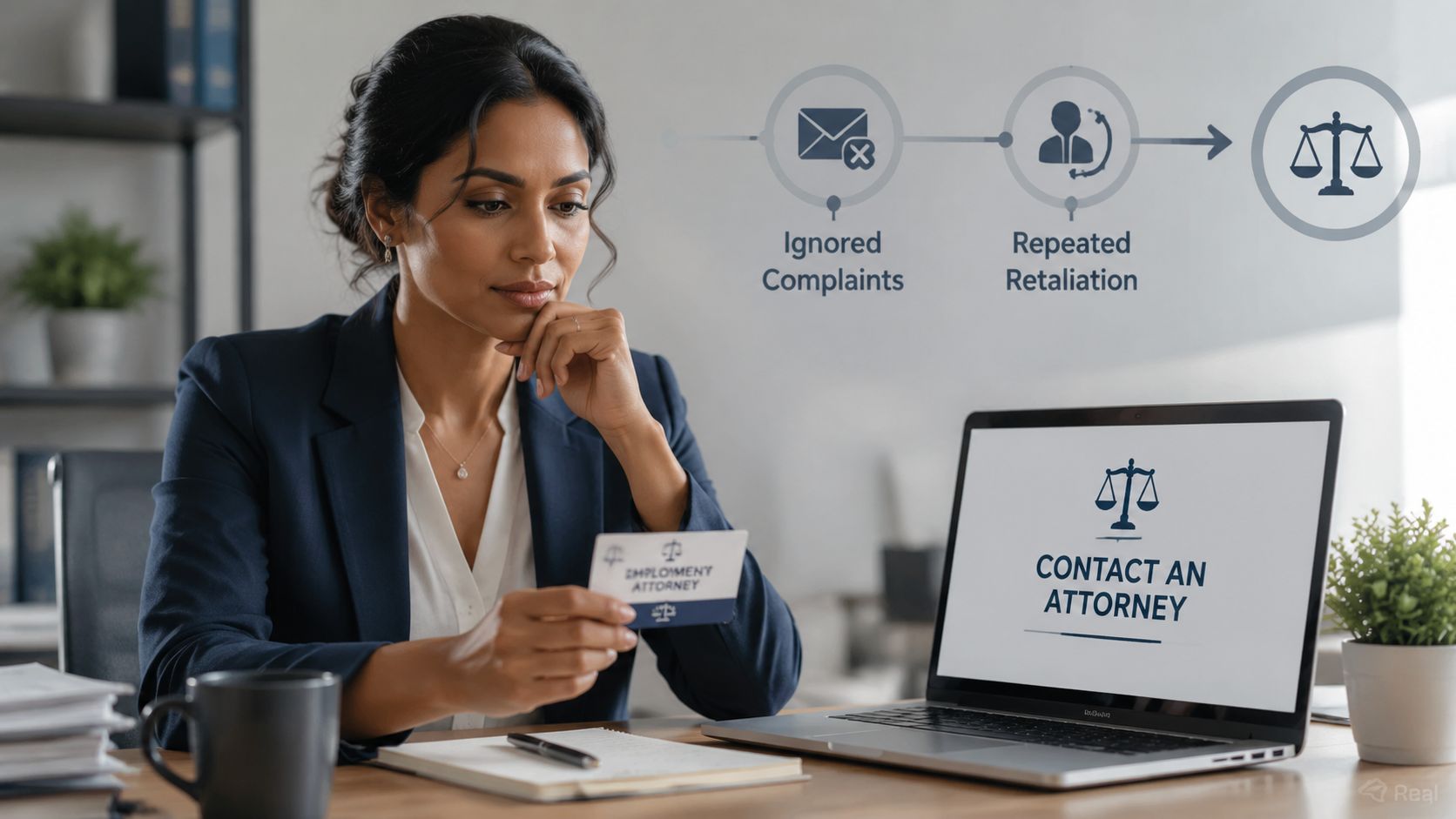
If you reported harassment and the employer responded promptly, separated the parties, investigated, and stopped the conduct, you may not need immediate legal help. But if your complaint is ignored, buried, mocked, or followed by punishment, it may be time to speak with a Mississippi employment attorney.
Signs it's time to escalate
Contact counsel when the pattern starts looking like this:
- Your report went nowhere: HR or management acknowledged the complaint but never followed up.
- Retaliation started after reporting: Hours were cut, duties changed, discipline increased, or you were treated differently after speaking up.
- The employer skipped its own process: Training and policy promised one thing, but the company did something else.
- The conduct continued: The harassment persisted after notice to management.
The reason timing matters is practical. Emails get deleted. Witness memories shift. Supervisors move on. Early legal advice can help you preserve the strongest version of the facts.
Fees and practical expectations
Many employees hesitate to call a lawyer because of cost. That's understandable. In employment cases, the average contingency fee is 40-50%. Even so, a consultation can still help you understand whether your facts fit a federal harassment or retaliation framework and what records you should preserve next.
If you want to understand what that first conversation often looks like, this page about a workplace harassment lawyer free consultation can help set expectations.
Don't wait for the situation to become unbearable before asking where you stand. Early advice is often about preservation, not immediate confrontation.
A short video overview can also help you think through the decision to seek legal guidance:
What an attorney can help you do
A lawyer can help you organize the timeline, identify gaps in the employer's response, and assess whether the facts support a federal charge. Just as important, counsel can help you avoid common mistakes, like informal texting with management instead of sending clear written reports, or resigning before understanding the consequences.
In Mississippi, where employees rely on federal processes rather than a state human rights commission, getting the facts in order early can matter a great deal.
Next Steps for Strengthening Your Harassment Prevention Efforts
If your employer provides workplace harassment training, don't treat it as background noise. Treat it like a tool. Read the slides, save the handouts, keep the policy, and pay attention to the reporting paths it gives you.
Then compare your workplace's program against what strong training looks like. Does it use realistic scenarios? Are managers trained separately? Is there follow-up after the session? If the answer is no, that weakness matters both for prevention and for documentation.
A practical roadmap
Start with a short review of your own workplace:
- Check the policy: Save the most current handbook and harassment policy.
- Review the training format: Was it interactive, customized, and clear?
- Identify reporting channels: Know every option, not just your direct supervisor.
- Track deficiencies: If the training was vague or incomplete, write down what was missing.
- Keep your records together: Store emails, screenshots, notes, and acknowledgments in one place.
Some employers also benefit from broader workplace culture support. Resources discussing Excel Wellbeing Solutions for employee health can be useful when companies want to connect harassment prevention with healthier team culture rather than bare-minimum compliance.
What employees can do even without formal power
You don't need a management title to push for better prevention.
You can ask respectful questions after training. You can request written clarification about reporting steps. You can encourage coworkers to keep records and use the channels provided. If several employees share the same concern about weak training, that pattern itself can be worth documenting.
Training is strongest when employees use it as a living procedure, not a yearly video they forget by lunch.
The most important next step is consistency. Save what your employer says. Follow the stated process when you can. Document what happened when you did. If the company's real response doesn't match its training, that gap may become one of the most important facts in the entire matter.
If you're a Mississippi employee dealing with workplace harassment, discrimination, retaliation, unpaid wages, or another serious job-related problem, Nick Norris, P.A. offers Mississippi-focused employment law guidance. A lawyer can help you review your records, evaluate your options under federal law, and decide on a practical next step.
This article has been reviewed for legal accuracy by Nick Norris. For employment law matters in Mississippi, consult with an attorney licensed to practice in your state.
Leave a Reply