

By Nick Norris, P.A.
Last updated: July 21, 2026
Reviewed by Nick Norris
Most Mississippi employment cases that we handle at Nick Norris, P.A. are taken on a 45% contingency fee. That means if we recover money for you in a wrongful termination, discrimination, retaliation, wage, or leave case, our fee is 45% of the recovery. If there is no recovery, there is no attorney fee. For advice-only work, contract review, or a severance issue that does not fit contingency, our rate is $400/hour. Every initial consultation is a free, 30-minute phone call.
If you have been fired, demoted, harassed, denied overtime, pushed out after medical leave, or retaliated against for reporting misconduct in Mississippi, cost is usually the first thing that keeps you from calling a lawyer. That hesitation is understandable. Most employees in the Jackson area, Gluckstadt, and across Mississippi want to know whether they can even afford to have the conversation. Our goal is to make that first step easier to understand.
The short version is simple. At Nick Norris, P.A., we use a 45% contingency fee for most plaintiff-side employment cases, a $400/hour rate for advice-based work, and we start with a free, 30-minute phone call so you can understand your options before spending money. In many federal employment claims, fee-shifting statutes may also require the employer to pay attorney's fees if the employee prevails, which can change the economics of the case in a meaningful way.
How Much Does an Employment Lawyer Cost in Mississippi
In Mississippi, the answer depends on the type of work you need.
If you are bringing a plaintiff-side employment claim such as discrimination, retaliation, FMLA interference, unpaid wages, or wrongful termination tied to a federal statute, we usually handle that work on a 45% contingency fee. If you only need legal advice, a document review, a non-compete review, a severance analysis, or strategy before you decide what to do, our rate is $400/hour.
That distinction matters because not every employment issue should be handled the same way. A case that may lead to a settlement or lawsuit often fits contingency. A short project with no expected financial recovery usually fits hourly work. We explain that difference during our free, 30-minute phone call so you know which model applies before moving forward.
Mississippi employees also need to understand timing. Because Mississippi does not have a state fair employment practices agency, many discrimination claims must be filed with the EEOC under the federal process. In most Title VII, ADA, and ADEA cases arising in Mississippi, that means the shorter 180-day EEOC charge deadline applies, not the 300-day deadline used in some other states. The EEOC filing path is a major reason employees in Jackson, Gluckstadt, and elsewhere in Mississippi should get advice early Mississippi EEOC filing rule.
Mississippi professional standards also matter. Lawyers practicing here must charge reasonable fees under Mississippi Rule of Professional Conduct 1.5, and Mississippi Bar standards require clarity in fee agreements and client communication. In plain English, you should be told how the fee works, how costs are handled, and what happens if the case resolves early.
Hourly market comparisons can vary across practice areas, but broad state comparisons still show why employees should ask exactly how employment work is priced instead of assuming all legal services cost the same Clio's Mississippi rate comparison.
Fee Structure Overview

If you call our office about a Mississippi employment problem, there are usually three possible pricing paths.
- 45% contingency fee. This is how we handle most plaintiff-side cases involving wrongful termination, discrimination, retaliation, unpaid wages, overtime, and leave-related claims. You do not pay an attorney fee unless we recover money for you.
- $400/hour hourly work. This is generally for advice-only matters, contract issues, severance review, or other focused work that does not fit a contingency structure.
- Free, 30-minute phone call. Every initial consultation is free and gives you a chance to explain what happened, ask questions, and find out whether your matter makes sense for contingency, hourly work, or no representation at all.
Those categories sound simple, but they solve different problems. Contingency is built for cases where money recovery may be available. Hourly billing is for advice or limited-scope work. The free phone consultation is how we sort out which path fits your situation before you commit.
For workers comparing options, a no win, no fee employment lawyer guide can help explain how contingency works in Mississippi employment cases before the first meeting.
Practical rule: ask exactly how the fee is calculated, whether costs are included, and what changes if the case settles before suit, after an EEOC charge, or in litigation.
Contingency and Hourly Fees Explained

How a 45% Contingency Fee Works in Mississippi Employment Cases
At Nick Norris, P.A., we work on a 45% contingency basis for most plaintiff-side employment cases in Mississippi. If we recover money for you, our fee is 45% of the recovery. If we do not recover money, there is no attorney fee.
This structure is common in cases involving wrongful termination, race discrimination, sex discrimination, pregnancy discrimination, disability discrimination, retaliation, unpaid overtime, off-the-clock work, FMLA interference, and similar claims under federal law. It helps employees pursue viable cases without paying an attorney fee up front.
Here is a straightforward Mississippi example. If a wrongful termination or discrimination case resolves for $100,000, the attorney fee under our contingency agreement would be $45,000, and the remaining $55,000 would go to the client, subject to how litigation costs are handled under the fee agreement. We walk through that math with clients so there are no surprises.
This kind of agreement must still comply with Mississippi Rule of Professional Conduct 1.5, which requires a reasonable fee and clear communication. That rule matters because the real question is not only the percentage. The real question is how the firm evaluates risk, advances costs, and uses fee-shifting where available.
A worker who wants a plain-language explanation of the model can review how a no-win, no-fee arrangement works in Mississippi employment cases before the first meeting.
When $400/Hour Makes More Sense
Not every employment problem belongs in a contingency case. Sometimes the most sensible approach is simply advice.
At Nick Norris, P.A., we charge $400/hour for advice-only representation or contract review. That may include:
- reviewing a severance agreement
- evaluating an employment contract or non-compete
- advising on resignation strategy
- preparing for an internal HR complaint
- helping a Mississippi employee decide whether to file an EEOC charge
- assessing whether the facts support a lawsuit before litigation begins
For many workers in the Jackson area or Gluckstadt, hourly advice is the right fit when they need quick, experienced guidance and there may never be a money recovery to support a contingency fee.
Pros and Cons at a Glance
- 45% contingency pros: no attorney fee unless we recover money, no hourly billing while the case develops, and better access to counsel for employees under financial pressure.
- 45% contingency cons: the percentage is substantial, so clients should understand the math at the beginning.
- $400/hour pros: efficient for targeted advice, document review, and short projects.
- $400/hour cons: if the matter expands, the total cost can grow without any guaranteed recovery.
A contingency fee is not free legal work. It is a risk-sharing structure. We invest time and usually advance case costs with the expectation that we are paid only if the case produces a result.
Expense Advances and Additional Costs
Attorney fees and case expenses are not the same thing. That distinction is important in Mississippi employment cases, especially when a claim moves from an EEOC charge into active litigation.
Possible case expenses may include filing fees, service of process, deposition transcripts, subpoenas, medical or payroll records, travel, mediation fees, and expert witness costs. These are litigation expenses, not attorney fees.
At our firm, we explain cost handling up front. In contingency matters, we commonly advance case costs as the matter develops. Depending on the agreement and the stage of the case, those costs may later be reimbursed from a recovery. We discuss that process during the free, 30-minute phone call and again before any representation begins.
A simple way to think about cost is by stage:
- Initial review stage. The consultation is free, and we determine whether the case appears legally viable.
- EEOC or pre-suit stage. Costs may remain relatively modest if the matter is still being investigated or negotiated.
- Litigation stage. Costs often increase once a case reaches discovery, depositions, mediation, dispositive motions, or trial preparation.
Mississippi employees should also understand the difference between an EEOC charge, a demand letter, and a filed lawsuit. They are not priced the same because they do not involve the same amount of work or expense.
When settlement is discussed, the important question is not just what the employer may pay in wages or damages. It is also whether fees and costs may be recoverable under the statute. A practical way to frame that issue is to review the categories often addressed in settlement, such as back pay, front pay, emotional distress, attorney's fees, and costs, using a resource like this settlement checklist for Mississippi discrimination claims.
Practical takeaway: ask not only what the fee is, but also who advances costs, when those costs are reimbursed, and how fee-shifting may affect the final outcome.
Employers benefit from that same clarity. A small business guide to employment law shows why good policies and records can reduce later disputes and defense costs.
Statutory Fee Shifting for Mississippi Claims
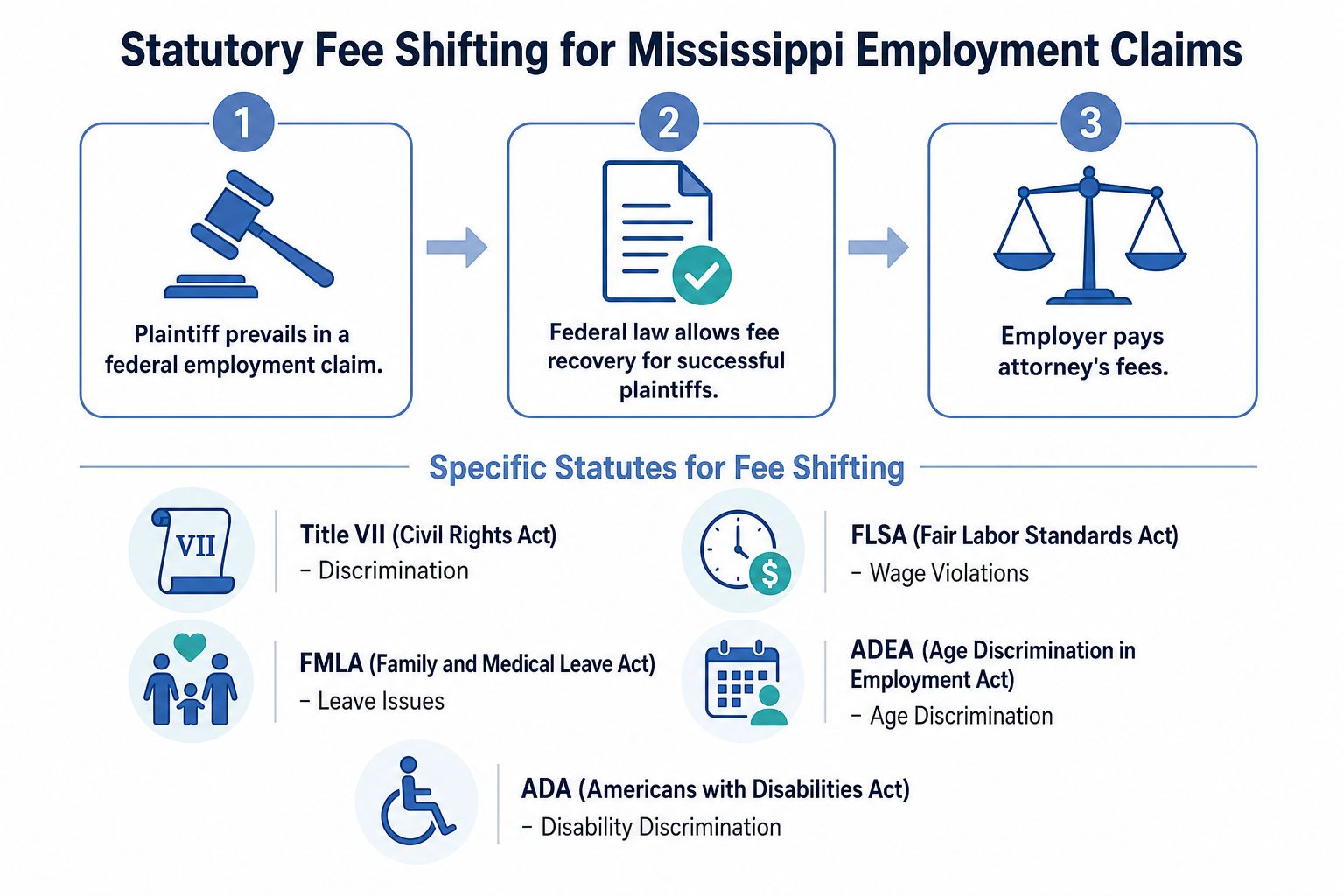
One of the biggest reasons plaintiff-side employment cases can be financially workable in Mississippi is statutory fee shifting. In several federal employment laws, a prevailing employee can recover attorney's fees from the employer.
Title VII, FLSA, FMLA, ADEA, and ADA
Under Title VII, a prevailing plaintiff may recover reasonable attorney's fees under 42 U.S.C. § 2000e-5(k). Under the Fair Labor Standards Act, fees are recoverable under 29 U.S.C. § 216(b). Under the Family and Medical Leave Act, fees and costs are available under 29 U.S.C. § 2617(a)(3). ADA fee awards generally follow 42 U.S.C. § 12205, and ADEA litigation often incorporates FLSA enforcement provisions, including fee recovery through 29 U.S.C. § 216(b).
That matters in real life because fee-shifting can change the settlement dynamic. The employer is not just looking at wage loss or emotional distress exposure. It may also be looking at the employee's attorney's fees if the case is successful.
Fifth Circuit Context for Mississippi Employees
Mississippi is in the Fifth Circuit, so federal employment cases here are shaped by Fifth Circuit precedent. That matters in practical ways.
For example, the Fifth Circuit's McDonnell Douglas burden-shifting framework often controls how circumstantial evidence discrimination cases are analyzed at summary judgment. Fifth Circuit retaliation decisions also shape what proof is enough to show protected activity, causation, and pretext. In wage cases, Fifth Circuit authority on exemptions, off-the-clock work, and damages can materially affect value. In fee disputes, Fifth Circuit law also influences how courts assess reasonableness under the lodestar method.
The main takeaway for Mississippi employees is that the legal strength of a case and the fee structure should be discussed together. A strong fee-shifting claim under federal law may justify a contingency representation where an advice-only contract issue would not.
Why Mississippi Workers Face a Shorter Filing Clock
Because Mississippi has no state human rights commission handling these federal employment claims, workers generally must proceed through the EEOC. That often means a 180-day deadline to file the charge. If the deadline is missed, the case may be lost before settlement value, fee-shifting, or litigation strategy can even be discussed.
That is one reason employees in Jackson, Gluckstadt, and throughout Mississippi should not wait to get advice.
How Fee Awards Are Usually Calculated
When a court awards attorney's fees under a federal employment statute, it usually applies the lodestar method. The court looks at reasonable hours multiplied by a reasonable rate, then evaluates whether adjustment is appropriate.
In plain English, fee shifting is not automatic money without proof. The work must be documented, the hours must be reasonable, and the result matters.
A worker trying to understand how fees fit into case value can also review what to ask for in a Mississippi discrimination settlement for a practical checklist. Employers often look at the same economic pressures, and a small business guide to employment law helps explain why early compliance can reduce later legal exposure.
Cost by Claim Type in Mississippi
Employment cases do not all cost the same amount to pursue. The type of claim affects the likely fee structure, the amount of cost advancement needed, and whether federal law may require the employer to pay attorney's fees.
It also affects settlement pressure. Employers know that defending an employment lawsuit can be expensive even before trial, which is one reason viable employment cases are often resolved before a courtroom verdict defense cost data.
| Claim Type | Typical Approach at Nick Norris, P.A. | Consultation | Cost Handling | Fee Shifting |
|---|---|---|---|---|
| Wrongful termination tied to federal law | 45% contingency fee | Free, 30-minute phone call | Costs often advanced, then addressed under the agreement | Sometimes, depends on the underlying statute |
| Discrimination | 45% contingency fee | Free, 30-minute phone call | Costs often advanced, then addressed under the agreement | Yes, often under Title VII or ADA |
| FMLA interference or retaliation | 45% contingency fee | Free, 30-minute phone call | Costs often advanced, then addressed under the agreement | Yes, under 29 U.S.C. § 2617(a)(3) |
| Unpaid wages or overtime | 45% contingency fee | Free, 30-minute phone call | Costs often advanced, then addressed under the agreement | Yes, under 29 U.S.C. § 216(b) |
| Retaliation | 45% contingency fee if tied to a viable recovery claim | Free, 30-minute phone call | Costs often advanced, then addressed under the agreement | Depends on the statute behind the retaliation claim |
| Severance or contract review | $400/hour | Free, 30-minute phone call | Usually limited and discussed in advance | Usually no fee shifting |
The strongest fee-shifting opportunities usually arise in federal discrimination, wage, overtime, and FMLA cases. By contrast, a severance review or contract question is usually more efficient as $400/hour advice work.
If you are thinking about what happens after a judgment, broader collection terms like wage garnishment court order may appear in related discussions, but for most Mississippi employees the more immediate question is whether the claim can be resolved through negotiation, EEOC process, lawsuit, fee-shifting, or some combination of the three.
How Nick Norris, P.A. Handles Fees
At Nick Norris, P.A., we represent employees, not employers. Our approach to fees is shaped by that reality. People call us after losing a job, dealing with discrimination, being denied leave, or finding out they were not paid correctly. Many are under financial pressure already. So we structure most plaintiff-side litigation work in a way that lets people pursue a strong claim without paying an attorney fee up front.
We start with a free, 30-minute phone call. That call is not a sales script. It is an initial screening conversation where we find out what happened, identify immediate deadlines, ask what documents you have, and decide whether the matter sounds like a real legal claim, an advice-only issue, or something that is not a case at all. In Mississippi employment law, timing matters. If someone in Jackson or Gluckstadt is close to an EEOC deadline, the first call has to focus on preserving the claim before anything else.
For most wrongful termination, discrimination, retaliation, FMLA, and wage cases, we work on a 45% contingency fee. That means we are paid only if we recover money for the client. We do not treat every employment dispute as a lawsuit waiting to happen. Some cases need immediate advice, some need EEOC strategy, some need early negotiation, and some should not be filed. But if the case is one where a recovery is realistically possible, contingency usually makes the most sense for the client.
For advice-only work, severance review, employment agreement analysis, and similar limited matters, we charge $400/hour. We use hourly billing when there may be no recovery fund to support contingency or when the client simply wants strategic advice before deciding what to do next.
We also address cost advancement directly. Employment cases can require filing fees, record collection, depositions, transcripts, and expert work. In appropriate contingency matters, we typically advance those costs so the client does not have to fund the litigation as it unfolds. If there is a recovery, costs are addressed under the representation agreement. That conversation happens up front because clients deserve to know how the financial side works before the case begins.
Our fee strategy also takes fee-shifting seriously. In Mississippi plaintiff-side cases under Title VII, the FLSA, the FMLA, the ADA, and similar federal statutes, attorney's fees may be recoverable from the employer if the employee prevails. That affects how we evaluate settlement, whether we recommend filing suit after the EEOC process, and how we frame damages. We do not treat fees as an afterthought. In a strong federal case, fee-shifting can materially improve the client's position.
Our approach to case type is practical. A wage case may turn on payroll records and damages math. A discrimination case may rise or fall on comparators, timing, shifting explanations, and whether the employer's stated reason looks pretextual under Fifth Circuit law. An FMLA case often turns on leave notice, medical documentation, and timing. A severance review is usually about leverage, release language, and what rights the employee may be giving up. Those are different problems, so they should not all be billed or handled the same way.
Just as important, we try to speak plainly. Clients do not come to us because they want abstract lectures about civil procedure. They want to know whether they have a case, what the deadlines are, what it may cost, and what the likely path looks like. Our philosophy is straightforward. Tell people the truth early, explain the economics clearly, and pursue plaintiff-side employment claims aggressively when the facts and law support it.
If you want to compare firms or prepare for a consultation, this guide on how to find an employment lawyer may help you ask better questions.
Common Pricing Pitfalls and Choosing a Mississippi Employment Lawyer
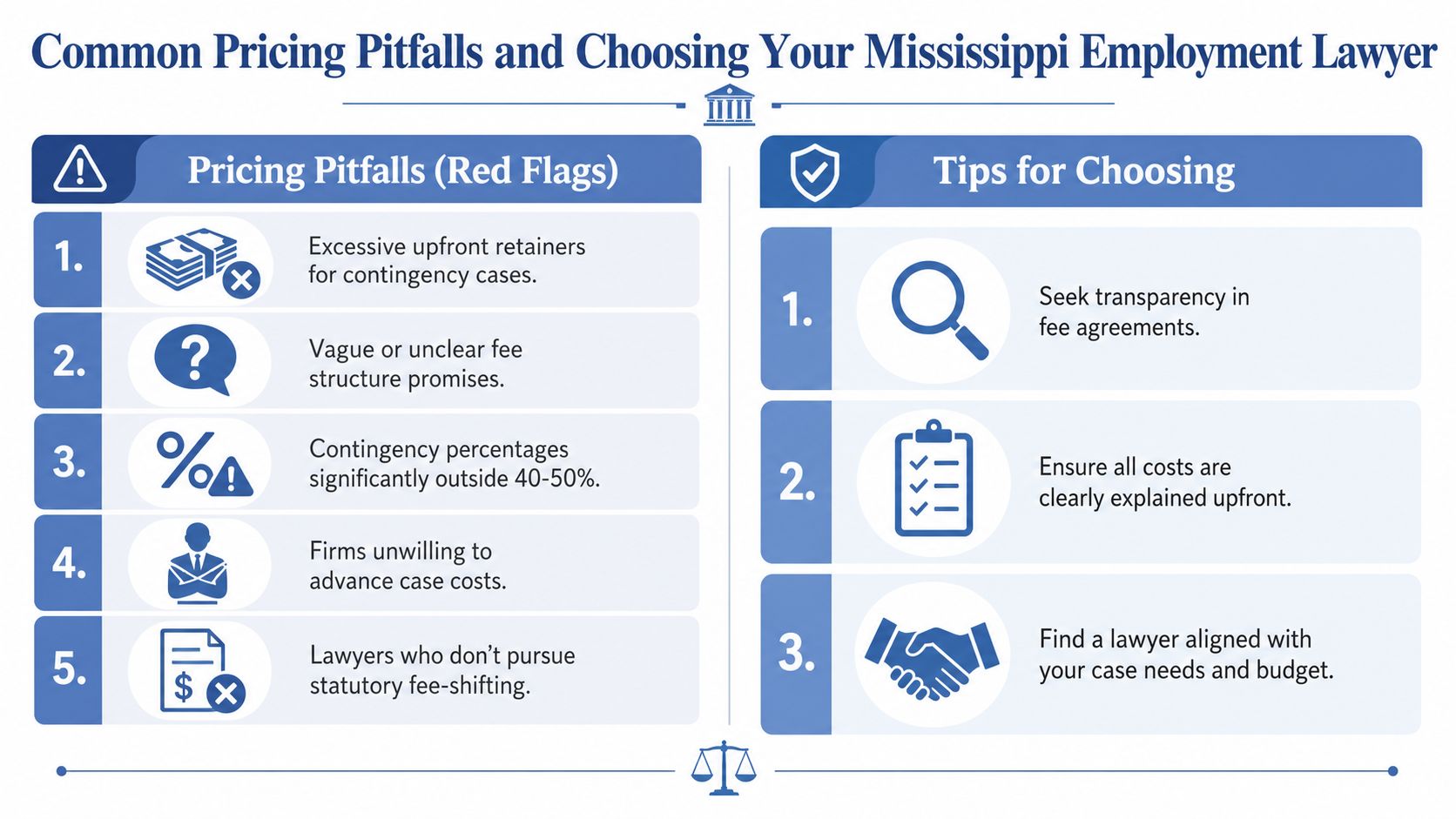
A fee agreement should be understandable before you sign it. If it is vague, that is a problem.
Here are common warning signs Mississippi employees should watch for:
- Unclear contingency math. If the lawyer cannot clearly explain how a 45% contingency fee works, ask more questions.
- No explanation of costs. You should know whether the firm advances costs and how reimbursement works.
- No discussion of fee-shifting. In federal employment cases, that is a major part of the economics.
- No screening for deadlines. In Mississippi, missing the EEOC filing deadline can destroy the claim.
- A strategy that does not match your goal. A quick severance review at $400/hour is different from building a discrimination lawsuit for litigation.
Good questions to ask include:
- Is this the kind of Mississippi case you handle on a 45% contingency fee?
- If not, is the work billed at $400/hour, and what is the likely scope?
- Is my initial consultation a free, 30-minute phone call?
- Will the firm advance costs?
- Does my claim have a fee-shifting statute?
- What deadlines apply under Mississippi and federal law?
- How do Fifth Circuit standards affect the strength of my case?
The right lawyer is not just the cheapest option. The right lawyer is the one who understands plaintiff-side employment litigation in Mississippi, explains the fee structure clearly, and has a strategy that fits your facts.
Frequently Asked Questions About Employment Lawyer Cost in Mississippi
Is the consultation really free?
Yes. At Nick Norris, P.A., the initial consultation is a free, 30-minute phone call. We use that time to understand the issue, identify key deadlines, and determine whether the matter may fit contingency or $400/hour advice work.
Do I have to pay anything up front for a discrimination or wrongful termination case?
Usually not in a contingency matter. If we take a Mississippi employment case on a 45% contingency fee, you do not pay an attorney fee up front. We also discuss cost advancement at the beginning so you understand how litigation expenses are handled.
Why would I ever pay $400/hour instead of using contingency?
Because some matters do not involve a likely money recovery. If you want a severance agreement reviewed, need advice about resigning, or want to understand your rights before filing anything, $400/hour may be the more practical option.
What do Mississippi clients usually ask on the first phone call?
Real clients often ask questions like these:
- Do I have enough evidence, or is it just my word against theirs?
- How long do I have to file with the EEOC in Mississippi?
- Should I quit before I talk to a lawyer?
- Is this retaliation if they cut my hours after I complained?
- Can I afford to bring this case if I just lost my job?
- What records should I save before my work email access disappears?
- If I live near Jackson or Gluckstadt, do I still handle most of this by phone?
Those are the kinds of practical questions we expect, and they are exactly why the first call is free.
Does fee shifting mean the employer automatically pays my lawyer?
No. Fee shifting depends on the statute, the outcome, and in some cases court approval. For example, Title VII fee claims arise under 42 U.S.C. § 2000e-5(k), FLSA fee claims under 29 U.S.C. § 216(b), and FMLA fee claims under 29 U.S.C. § 2617(a)(3). It is a powerful part of the case economics, but it is not automatic.
Do you handle only Mississippi cases?
This article is focused on Mississippi employment law, Mississippi deadlines, Mississippi professional standards, and the federal employment statutes applied in Mississippi courts and the Fifth Circuit.
Talk With Nick Norris, P.A. About Employment Lawyer Cost in Mississippi
If cost is the reason you have not called a lawyer yet, start with the easiest step. Talk with Nick Norris, P.A. during a free, 30-minute phone call about what happened, what deadlines may apply, and whether your case belongs on a 45% contingency fee or as $400/hour advice work.
We represent employees in Mississippi, including the Jackson area, Gluckstadt, and surrounding communities. If you are dealing with wrongful termination, discrimination, retaliation, unpaid wages, or FMLA problems, call 601-641-4897 and find out where you stand before a deadline passes.
You can also learn more at Nick Norris, P.A..
This article has been reviewed for legal accuracy by Nick Norris. For employment law matters in Mississippi, consult with an attorney licensed to practice in your state.
Leave a Reply