

You've been at work, you've asked for help, and now you're staring at a stack of papers, an email trail, and a question you didn't expect to be asking: can a lawyer take this kind of case without charging you up front? That's the practical issue for a lot of Mississippi workers who think they may have a civil rights or employment claim. The answer often turns on whether the case can be handled on contingency, what the retainer says about costs, and whether the facts are strong enough for counsel to take the risk.
By Nick Norris, P.A.
Last updated: August 11, 2026
Reviewed by Nick Norris
What Contingency Representation Means for Civil Rights Claims
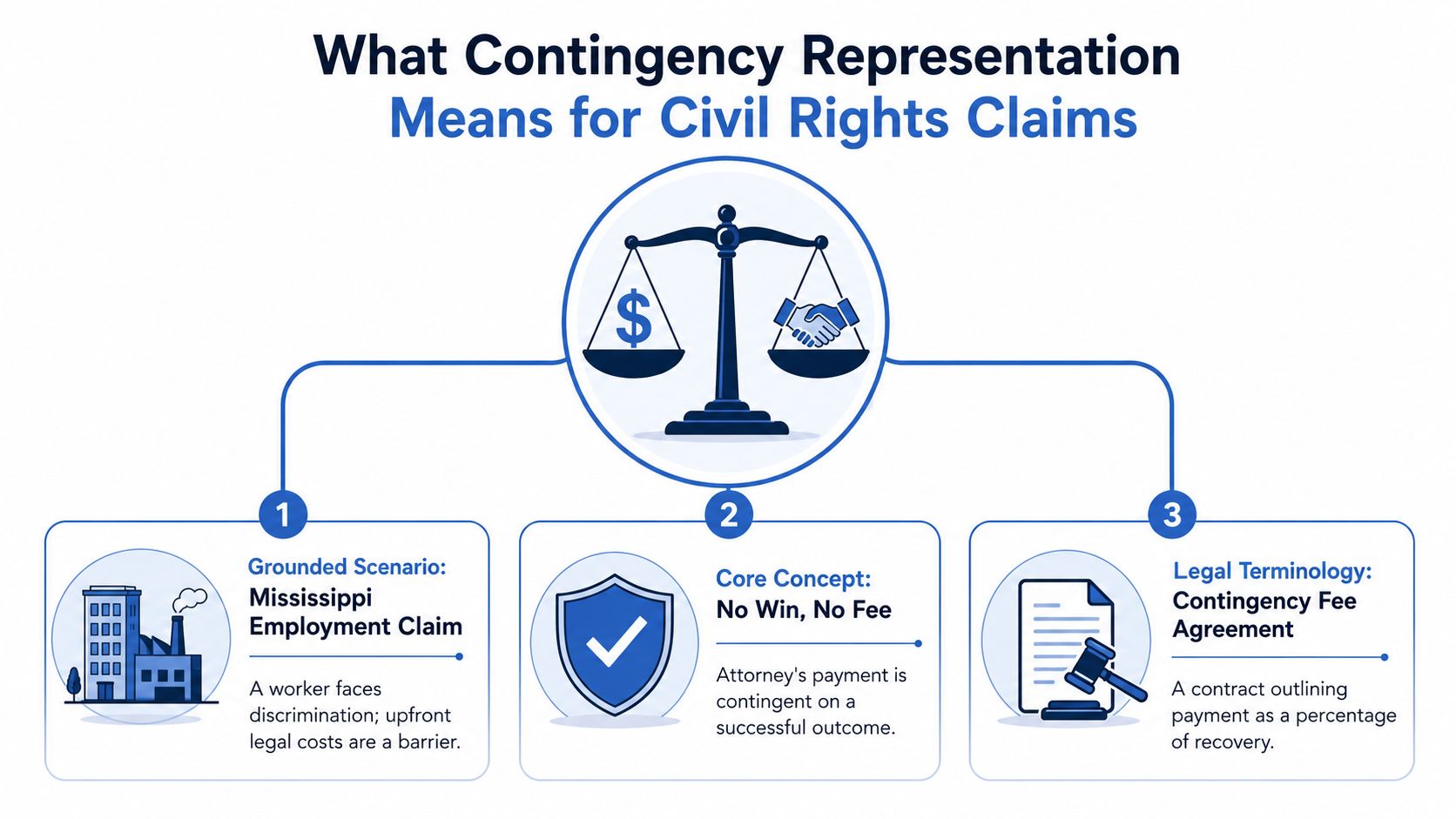
A worker in Jackson or the Pine Belt can have a solid discrimination story and still hesitate to call a lawyer because money is tight. That hesitation is common, and it's exactly why contingency representation exists. Instead of billing by the hour, the lawyer is paid from a share of any recovery, and if there's no recovery, the lawyer typically gets no fee.
The core idea in plain English
A contingency fee agreement is a contract that ties payment to outcome. In civil rights and employment work, that usually means the lawyer takes a percentage of the settlement or judgment rather than asking for a retainer at the start.
Practical rule: if the case doesn't produce money, the client usually doesn't owe attorney's fees, but the agreement still needs to spell out how costs are handled.
That distinction matters. A fee can be contingent while case expenses, like filings, records, or experts, are treated separately depending on the retainer. For a Mississippi employee facing retaliation, harassment, or discrimination, the difference between “fee” and “costs” can decide whether the case is realistic to bring at all.
The structure also changes the lawyer's incentive. A lawyer who only gets paid if the case succeeds has every reason to focus on recoverable claims, solid evidence, and a result that justifies the litigation risk. That's why contingency work is so common in civil rights and employment disputes where the client may not have the cash to fund months or years of litigation.
In Mississippi practice, that financial structure sits beside another reality, the forum and theory of the claim matter just as much as the facts. Some claims are suited to contingency, some aren't, and some need careful sorting before anyone promises representation.
How Contingency Fee Structures Work
The math looks straightforward until you read the retainer. In legal commentary, the typical contingency range is 33% to 40% of the award or settlement, and practitioners often use one-third as a starting point in many plaintiff matters legal commentary on contingency civil rights attorney fees. In civil rights cases, that percentage can change with the stage of the case, because the work and risk change as the matter moves forward.
What the percentage means in practice
An early resolution usually keeps the fee near the lower end of the range. Once a federal lawsuit is filed, discovery begins, or trial gets closer, the agreement may allow a higher percentage because the lawyer is taking on more work and more risk. The retainer should say whether the fee changes after filing, after dispositive motions, or on appeal.
| Case Stage | Typical Attorney Percentage | Who Pays Case Costs |
|---|---|---|
| Early settlement | Often near one-third | Depends on the agreement |
| After filing suit | Can rise as the case becomes more complex | Depends on the agreement |
| Trial or appeal work | Often higher than early stages | Depends on the agreement |
A simple example helps. If a Mississippi employee settles a case for a hypothetical recovery, a one-third fee means the lawyer takes one share, while a 40% fee means the lawyer's share is larger because the case became more expensive or riskier to pursue. The exact number depends on the written agreement, not on a general rule of thumb.
Federal fee shifting also matters. Under 42 U.S.C. § 1988, a successful civil rights plaintiff may ask the court to shift reasonable attorney's fees to the losing defendant, which can change how counsel structures the agreement in a winning case. That does not erase the contract, but it does affect how lawyers think about compensation, as discussed in the fee commentary above.
Read the engagement letter line by line. The percentage matters, but so do costs, appeal language, and whether recovery under fee-shifting statutes changes who gets paid first.
For Mississippi workers, the key is knowing whether the retainer assigns expenses to the client, the lawyer, or both, because that is where surprises usually show up. A careful review also helps you compare the fee terms with the broader cost questions discussed in Mississippi employment lawyer cost considerations.
Contingency Fees Versus Hourly and Hybrid Billing
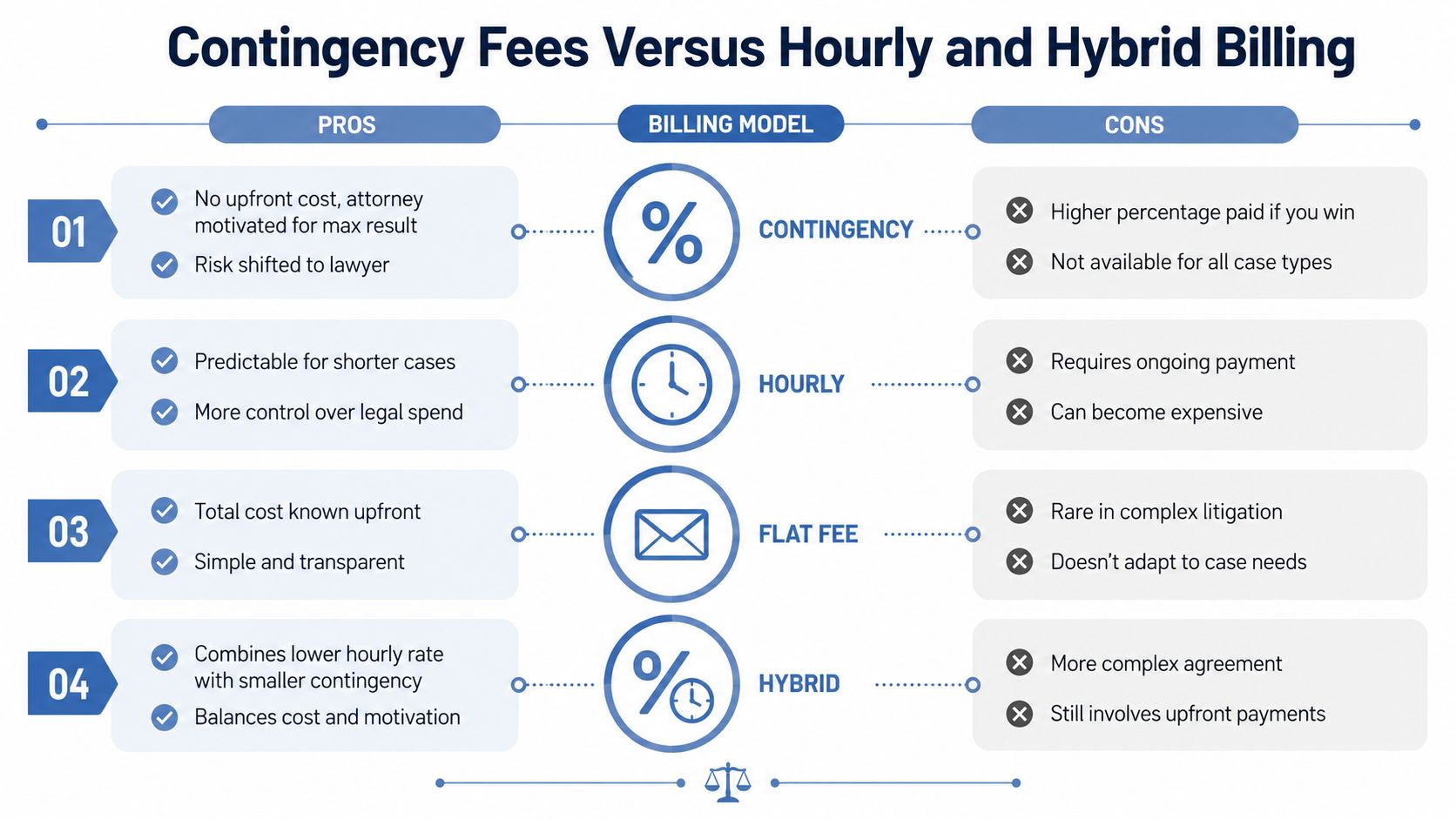
Not every case belongs on contingency. Hourly billing, flat fees, and hybrid arrangements all solve different problems, and the right one depends on the case's risk profile, not which one sounds cheapest at first glance.
The trade-offs that matter
Contingency shifts financial risk to the lawyer. That helps workers who can't pay up front, but it also means the lawyer is selective and will pass on cases that don't have enough proof, damages, or collection potential.
Hourly billing gives the client more control over ongoing spend. It can make sense for narrower disputes or unusual claims where the outcome is hard to value, but the client has to fund the work as it goes.
Flat fees are simpler, but they're rare in complex civil rights litigation because the work rarely stays simple.
Hybrid arrangements split the difference. A firm might combine a reduced hourly rate with a smaller contingency component when the case has real merit but the economics are uncertain.
For a Mississippi employee, the practical question is whether the claim is strong enough for a lawyer to carry the risk. If it is, contingency can be the better fit. If it isn't, hourly billing may be the only structure that gives the lawyer room to investigate without betting the firm on an uncertain result.
One useful reference point for cost conversations is this Mississippi employment cost overview, because fee structure and case expense are never the same thing.
The best choice is the one that matches the case's risk, the proof available, and the client's ability to handle costs along the way.
Which Civil Rights and Employment Claims Qualify in Mississippi
Mississippi has no state human rights commission, so workers often have to look to federal law and federal forums for the claims that realistically fit contingency representation. That matters because the absence of a state commission changes where a case gets evaluated and how fast counsel can decide whether the claim is worth taking.
The claims lawyers most often look at
Civil rights and employment lawyers in Mississippi commonly evaluate federal claims under Title VII of the Civil Rights Act, the Americans with Disabilities Act, the Age Discrimination in Employment Act, the Equal Pay Act, the Family Medical Leave Act, the WARN Act, USERRA, and 42 U.S.C. § 1983 claims against state actors. Those are the claims most likely to have a recognizable damages path and a legal framework that contingency counsel can assess.
A worker asking about retaliation after a workplace injury needs a very careful answer. Mississippi law does not provide protection from retaliation for filing workers' compensation claims, so that specific theory is not one a contingency civil rights attorney can pursue here. The right move is to look for any other viable employment theory, not to force a claim that doesn't exist.
That's also why this article does not address filing civil rights lawsuits in Mississippi state court. In practice, the claims most workers are asking about here are federal claims, and the legal evaluation starts there.
Why the forum matters in real life
The lack of a Mississippi human rights commission means the early screening conversation has to be precise. A worker may have an ugly workplace story, but not every ugly story has a claim a lawyer can take on contingency.
A good consultation doesn't begin with promises. It begins with identifying the statute, the decision-maker, and the proof that ties the two together.
If the facts fit one of the federal paths above, contingency may be realistic. If they don't, the lawyer should say so quickly, because time spent on the wrong theory usually helps nobody.
How Lawyers Screen Cases for Contingency Representation
A contingency civil rights attorney is basically making a business judgment before making a legal bet. The question is not just whether the worker was treated unfairly. The question is whether the claim is strong enough, provable enough, and collectible enough to justify carrying the case without hourly payment.

What gets a case accepted or declined
Legal merit comes first. The facts have to fit a recognized claim, and the proof has to support it.
Potential damages come next. A case can be morally strong and still be economically weak if the recoverable value is too small for the work required.
Liability matters because the lawyer needs to know who is responsible and whether the right defendant can be reached.
Feasibility and resources decide the rest. Even a serious case can be declined if the evidence will be hard to gather, the timeline is too long, or the firm's docket is already full.
The economic logic is simple. Civil rights cases can involve expert witnesses, discovery fights, and appeal risk, so weak cases can create a negative return even when the story is sympathetic civil-rights litigation economics and contingency practice. That's why some firms screen tightly and why some good cases still get turned away.
If you're trying to organize your own information before calling around, a practical tool is a reliable call handling system. For firms that need to manage intake efficiently, handle 557M legal calls is one example of a phone support resource that can keep initial contact from slipping through the cracks.
A simple self-check helps:
- Do I have a clear legal theory? If not, the lawyer will have to build one from scratch.
- Do I have documents or witnesses? If not, the case may be too thin.
- Is there a realistic recovery? If not, contingency may not work.
- Can I identify who did what? If not, liability may be hard to prove.
Some firms decline cases for reasons that have nothing to do with merit, including caseload limits or a practice focus on different kinds of disputes. Early honesty saves everyone time.
Evaluating a Contingency Civil Rights Attorney in Mississippi
A contingency contract doesn't mean you stop vetting the lawyer. It means you vet for different things. The right Mississippi employment lawyer should understand federal civil rights claims, know how Mississippi claims are screened, and be direct about whether the case belongs on contingency at all.
What to ask in the consultation
Start with experience. Ask whether the firm has handled claims like yours, whether the lawyer is familiar with EEOC procedures and federal employment statutes, and who will do the day-to-day work. If you're talking about a Title VII, ADA, or retaliation matter, the lawyer should be able to explain the path in plain English.
Fee transparency matters just as much. Ask how the contingency percentage changes, what counts as a cost, and whether the agreement treats fee-shifting recovery under 42 U.S.C. § 1988 as part of the compensation structure. A good retainer should answer those questions without you having to guess.
For readers who want a broader overview of the practice area, this Mississippi civil rights attorney resource gives useful context for how these claims are evaluated locally.
Communication style is a real signal. The lawyer should be willing to discuss both strengths and weaknesses, not just the upside. A serious practice won't promise victory, and it won't blur the difference between a strong legal theory and a winnable case.
If the consultation feels rushed, vague, or salesy, keep looking. A contingency case still needs clear analysis, not pressure.
A firm's public communication can also tell you a lot. For offices that want a steady educational presence, a law firms newsletter service can help keep clients and prospects informed, but the key question is whether the lawyer can explain your case clearly in the room.
For Mississippi workers, the practical red flags are simple: no written fee agreement, no clear answer on costs, and no discussion of weaknesses. If you hear those, walk away. If you get a direct answer, the lawyer is probably treating the case the way a contingency case should be treated, as a careful risk assessment.
Call Nick Norris, P.A. at 601-641-4897 for a confidential consultation if you want to talk through a Mississippi employment or civil rights claim and find out whether contingency representation makes sense.
Documents and Evidence to Prepare Before You Call
A lawyer can only evaluate what you can show. Before you call, gather the records that tell the story in order, even if you think some of them make you look bad. Don't delete messages, and don't clean up the paper trail. Preservation matters because discarded evidence can create spoliation problems later.
What to save
- Personnel records: Keep your personnel file, job description, and any disciplinary history you already have.
- Performance material: Save reviews, written warnings, improvement plans, and any recognition letters.
- Pay and time records: Hold on to pay stubs, timesheets, schedules, and overtime records.
- Offer and separation documents: Keep offer letters, severance agreements, and any release you were asked to sign.
- Policy documents: Save the employee handbook, anti-harassment policy, and complaint procedures.
- Communications: Preserve emails, texts, internal chat logs, and voicemail notes that relate to the issue.
- Supporting proof: Photographs, screenshots, and contemporaneous notes of incidents can be important.
A tight chronology helps more than a long narrative. Put the date, the person involved, what happened, and who saw it. That saves the lawyer time and makes it easier to see whether a contingency case is even available.
If your issue starts with a need for a right-to-sue notice, this right-to-sue letter overview can help you understand why that paper matters before you pick up the phone.
Bring the documents you have, not the documents you wish existed. A lawyer can work with imperfect facts much better than with a missing timeline.
If the file is organized, the first meeting goes faster, the screening is sharper, and the lawyer can tell you sooner whether contingency representation is realistic.
Timelines, Outcomes, and Alternative Funding Options
A Mississippi worker can do everything right and still spend a long time waiting for movement. A charge may start with intake and EEOC filing, then move into investigation and conciliation, then litigation and discovery, and later mediation, trial, settlement, or appeal. That pace matters in contingency work because the lawyer has to judge proof, cost, and the client's patience at the same time, from the first meeting onward.

Case outcome risk should be discussed plainly. One study of § 1983 police cases reported plaintiffs prevailed in approximately 57.7% of those suits, which shows that civil rights claims can have real value even when the defense fights hard civil-rights litigation outcomes and sanctions data. The same review reported plaintiffs were sanctioned on motion 47.1% of the time in civil-rights cases versus 8.45% in non-civil-rights cases, which is why careful screening and careful pleading matter in these matters civil-rights litigation outcomes and sanctions data.
A contingency arrangement still does not fit every meritorious case. If the claim falls outside the normal range, a client may need legal aid, a different fee structure, or, in limited situations, another funding arrangement. Federal fee-shifting can also matter in a successful civil rights case because the statute may allow the losing defendant to pay reasonable attorney's fees.
Mississippi practice adds one more practical point. The state has no human rights commission, so many workplace discrimination and retaliation claims still end up in federal or other available forums rather than a state commission process. That reality affects timing, filing strategy, and whether a lawyer can reasonably take the case on contingency in the first place.
Byline, review credit, and date matter because workers need current information, not stale advice. By Nick Norris, Attorney. Last updated: August 11, 2026. Reviewed by Nick Norris.
If you're dealing with a Mississippi workplace dispute and want a straight answer about contingency representation, reach out to Nick Norris, P.A. for a confidential consultation. The office handles Mississippi employment matters with the kind of fee and case screening analysis that helps workers understand their options before they commit.
Leave a Reply