

You're in a meeting where your supervisor explains that your position is ending. You believe the actual reason was your race, age, disability, sex, religion, or a complaint about discrimination. You leave with emails, unanswered questions, and a growing fear that you may have waited too long to act.
That fear is justified, but it shouldn't leave you frozen. The employment discrimination statute of limitations can determine whether you preserve a federal claim or lose the ability to pursue it. Mississippi workers generally must begin with the federal Equal Employment Opportunity Commission, and the filing window can be short.
This guide focuses only on Mississippi employment law. It explains how the deadline works, which event starts the clock, why Mississippi workers usually face the 180-day EEOC deadline, and what to do when retaliation or workplace harassment is involved. If a job offer disappeared after a background check, reviewing HiredBySkill's background check advice may also help you identify whether the employer's stated reason deserves closer scrutiny. For a broader discussion of workplace protections, see Mississippi workplace discrimination laws.
Your Legal Rights Have an Expiration Date
A statute of limitations is a legal deadline for starting a claim. In the discrimination context, the first required step usually isn't filing a lawsuit. It's filing a charge with the EEOC. If that charge arrives after the applicable deadline, the agency or a court may treat the claim as untimely.
That creates a practical use-it-or-lose-it problem. You may have a strong explanation for what happened, supportive coworkers, and documents showing inconsistent treatment. None of those advantages reliably cures a missed filing deadline.
Start with the date, not the explanation
Many workers wait while they investigate the employer's motive. They ask whether a termination was really caused by discrimination, whether a supervisor's comments were serious enough, or whether a later event changes the picture. Those questions matter, but they shouldn't delay an assessment of the filing date.
Write down the dates of the employment action and preserve the surrounding records. Include termination notices, promotion decisions, disciplinary warnings, accommodation requests, harassment reports, text messages, performance reviews, and communications with human resources.
Practical rule: You don't need to prove the entire case before seeking deadline advice. You need to identify the potentially unlawful act and protect the time available to file.
Mississippi workers also face a structural complication. The state doesn't have a human rights commission that handles employment discrimination claims, so workers typically rely on federal channels rather than a state administrative body. That makes understanding the EEOC process especially important.
A consultation with a Mississippi employment lawyer can help separate a late concern from a potentially timely claim. Even when the facts are incomplete, early review can identify the controlling date, the legal theory, and the documents that need immediate preservation.
The 180-Day EEOC Filing Deadline in Mississippi
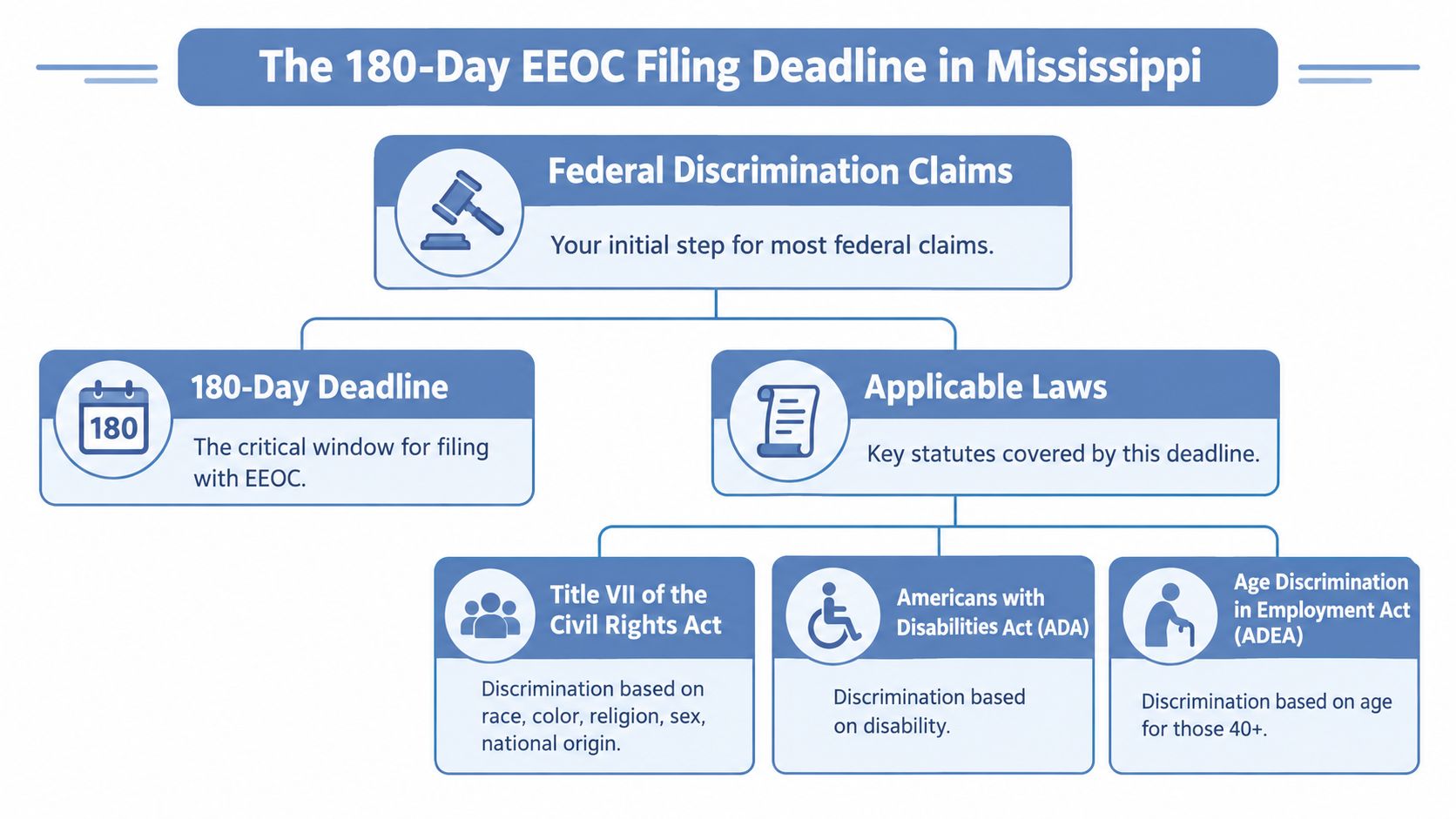
For most Mississippi employment discrimination claims under Title VII, the Americans with Disabilities Act, and the Age Discrimination in Employment Act, an employee generally must file an EEOC charge within 180 calendar days of the alleged discriminatory act. The EEOC describes the ordinary and deferral-jurisdiction rules in its guidance on time limits for filing a charge.
Mississippi generally falls under the 180-day rule because it doesn't have a state human rights commission or similar state agency handling employment discrimination claims. The absence of that state administrative agency usually means there's no deferral-agency basis for extending the federal period. Mississippi-focused employment-law guidance discusses this federal-channel structure in its overview of Mississippi employment law.
Which federal laws commonly use this deadline
The 180-day framework commonly applies to claims involving:
- Title VII: Discrimination based on race, color, religion, sex, or national origin, along with related harassment and retaliation theories.
- The ADA: Discrimination connected to a disability, including disputes involving reasonable accommodation.
- The ADEA: Age discrimination claims covered by federal law.
The EEOC charge is an administrative filing. It puts the agency on notice and starts the process for reviewing the allegations. It also preserves the possibility of pursuing a federal court claim later, subject to additional requirements and deadlines.
Mississippi's lack of a state agency often causes confusion because workers hear about a 300-day filing period. The 300-day period applies in jurisdictions with a state or local fair employment practices agency covering the same conduct. In those jurisdictions, the available window is longer than Mississippi's ordinary federal period. The EEOC's official time-limit guidance explains the distinction between ordinary jurisdictions and deferral jurisdictions.
Treat 180 days as a maximum, not a planning target
Waiting until the last available day creates avoidable risk. You may need time to gather facts, correct an incomplete filing, identify all responsible parties, or address an administrative problem. An online submission that isn't properly completed may not protect your position the way you expect.
The safest approach is to seek advice promptly after the discriminatory event. You can review the EEOC process through this guide to filing a discrimination complaint, but a general explanation can't calculate the deadline for your particular facts.
Calculating Your Filing Window From the Unlawful Act
The clock usually starts with the unlawful employment practice, not the date you finally understand the employer's motive. That distinction matters because employees often discover the significance of an event only after reviewing later documents or hearing what happened to another worker.
For a termination, the relevant event is generally the termination itself, often tied to the last day of employment. For a demotion, it's generally the date the demotion took effect or was communicated. For a failure to promote, the focus is usually the date the employer made and communicated the decision, not the later date when you become convinced that discrimination influenced it.

Separate acts receive separate deadlines
The Supreme Court's decision in National Railroad Passenger Corp. v. Morgan clarified that each discrete discriminatory act must be challenged within the statutory filing window. The opinion distinguishes separate events such as termination, failure to promote, demotion, and denial of transfer from a hostile work environment pattern. You can review the decision in the Supreme Court opinion for National Railroad Passenger Corp. v. Morgan.
That means a later discriminatory event doesn't automatically revive an earlier one. If an employer terminates you and later denies another employee a promotion, the two decisions may involve different acts and different timing questions. A related workplace history can provide context, but context isn't the same as a new filing period for every prior event.
Use a date chart rather than relying on memory:
- Name the action. Write “termination,” “demotion,” “denied transfer,” “denied accommodation,” or another specific act.
- Record when it happened. Use the notice date, effective date, meeting date, or communication date.
- Save proof. Keep the email, letter, text, calendar entry, or personnel document that supports the timing.
- Calculate from the earliest defensible date. Do not assume uncertainty gives you extra time.
- Get advice before the period ends. A lawyer can assess whether several events are separate acts or part of a legally recognized pattern.
The date of discovery often feels like the fair starting point. Federal discrimination timing rules may focus instead on when the employer took the action.
Harassment requires a more careful analysis. A hostile work environment claim can involve conduct occurring across multiple days, and a timely contributing act may allow the agency or court to consider the broader environment. That doesn't mean every old incident becomes independently actionable, and it doesn't make delay safe. Document each incident and identify the most recent conduct.
A termination, promotion decision, or demotion is usually easier to date than a pattern of harassment. That apparent simplicity can be dangerous because workers may wait for a written explanation or final confirmation. The filing clock may already be running.
This video may help you organize the basic timing concepts before you seek case-specific advice:
Are There Exceptions That Can Extend the Deadline
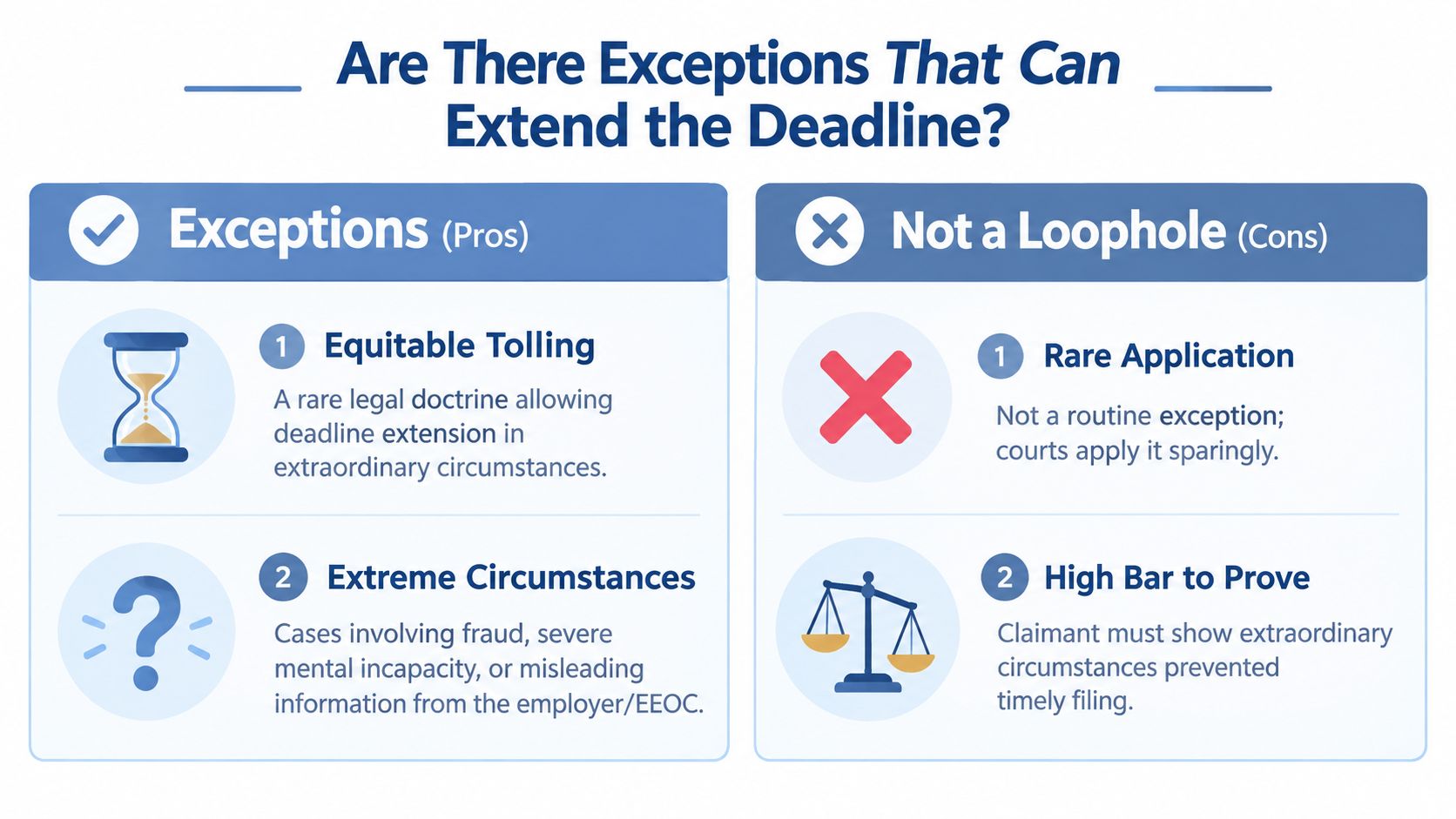
Workers sometimes hear that a deadline can be “tolled,” meaning the clock may be paused or extended. Equitable tolling exists as a narrow legal doctrine, not a general safety net for delayed claims.
The argument usually depends on unusual circumstances. An employee may contend that the employer actively misled them about their rights, that fraud prevented timely action, or that an extraordinary condition made filing impossible. The evidence must connect the circumstance to the missed deadline.
Why relying on tolling can fail
A worker's lack of legal knowledge usually isn't enough by itself. Neither is the hope that the employer will reverse the decision, an internal investigation that takes too long, or a belief that filing with human resources automatically preserves an EEOC deadline.
Those circumstances may explain why someone waited. They don't necessarily change the filing date. A worker who delays while pursuing an internal complaint may still need to protect the EEOC deadline separately.
Do not make an exception your filing plan. File within the ordinary period whenever possible, then ask counsel whether tolling has any application.
The analysis becomes more complicated when an employment agreement contains a shortened limitations period. Recent appellate decisions have split on that question. The Fourth Circuit held in 2026 that private agreements can't shorten federal Title VII or ADEA deadlines, while the Sixth Circuit had earlier reached a similar result for Title VII claims outside arbitration. Mississippi workers should have any agreement reviewed rather than assuming a clause is enforceable or harmless.
Look for language in offer letters, employment contracts, severance agreements, arbitration agreements, and separation documents that purports to limit the time for bringing a discrimination claim. An agreement may raise separate questions about arbitration, notice, waiver, or the forum for resolving the dispute. Those issues should be analyzed before you sign or rely on the document.
A continuing pattern also doesn't automatically extend every deadline. The continuing violation doctrine in Mississippi employment cases may be relevant to some fact patterns, but a continuing relationship or repeated unfair treatment isn't enough by itself. The legal characterization depends on what happened, when it happened, and whether the conduct represents separate decisions or a connected unlawful practice.
The Role of the EEOC and Your Right to Sue
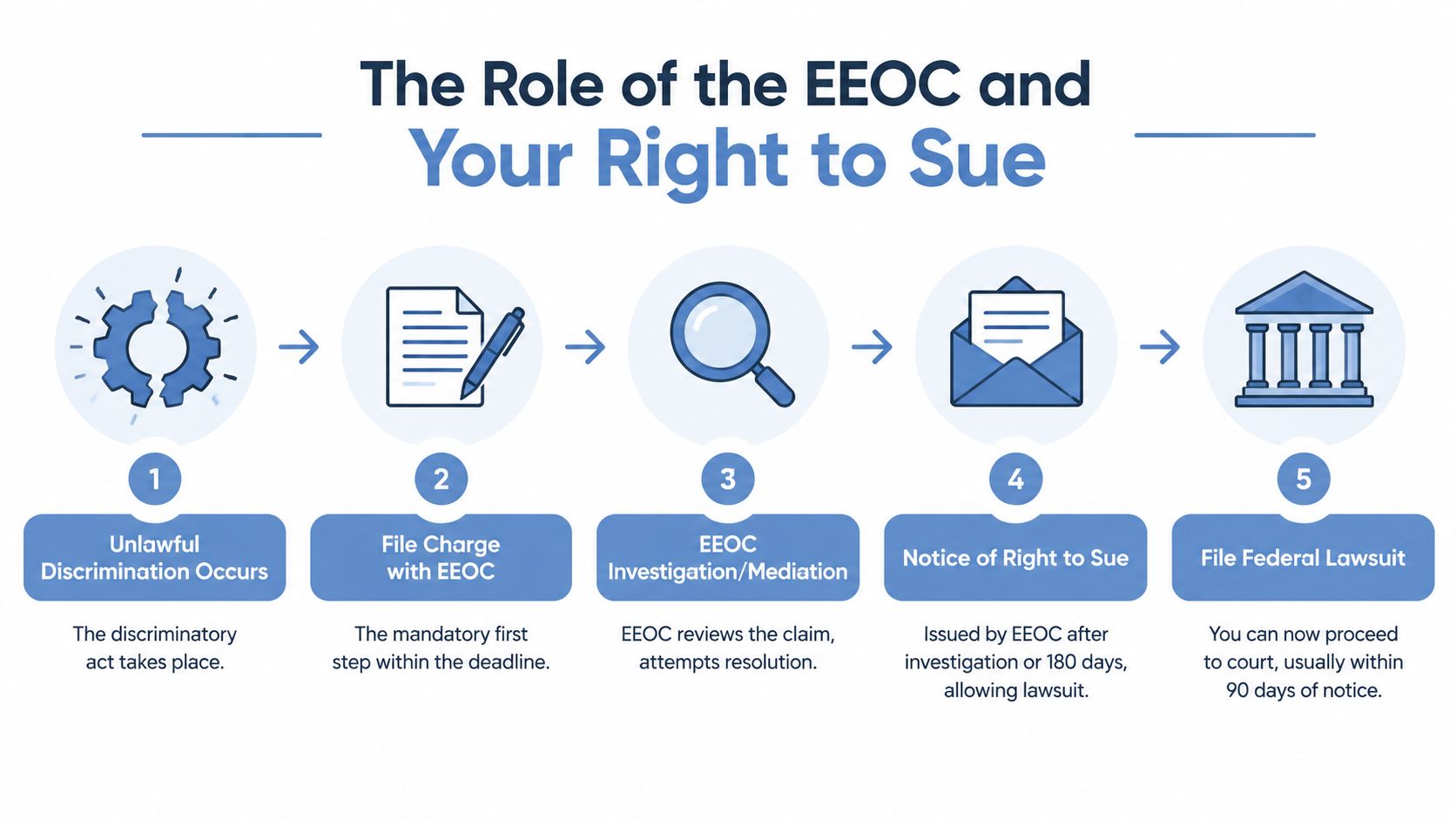
For many federal discrimination claims, the EEOC charge is the required administrative starting point before a federal lawsuit can proceed. This requirement is often called administrative exhaustion. Filing a charge gives the agency an opportunity to receive the allegations, notify the employer, investigate, and in some cases offer mediation or another resolution process.
The charge should identify the protected basis, the employer's conduct, the dates involved, and the connection between the conduct and the alleged discrimination or retaliation. A vague narrative can create problems later if the federal claim goes beyond what the EEOC charge reasonably presented.
What happens after filing
The process can include several stages:
- The EEOC receives the charge. The agency records the allegations and typically provides notice to the employer.
- The employer responds. The employer may submit a position statement or other information disputing the allegations.
- The agency investigates or offers mediation. The path depends on the charge, the parties, and the agency's handling of the matter.
- The EEOC closes or resolves the charge. The agency may issue a notice explaining that the charge is being closed.
- A Right to Sue notice may open the next step. That notice can permit a federal lawsuit, but it also carries its own deadline and should be reviewed immediately.
A Right to Sue notice isn't the same as a finding that discrimination occurred. It's a procedural document that can affect whether and when a court action may proceed. Keep the notice, envelope or electronic delivery record, and every related EEOC communication.
Retaliation has its own date
Retaliation can arise after a worker reports discrimination, participates in an investigation, opposes discriminatory conduct, or engages in another protected activity. The relevant date is usually the retaliatory act, such as termination, demotion, schedule reduction, discipline, or another materially adverse response.
Mississippi retaliation guidance states that the filing deadline is usually 180 days from the retaliatory act, making the date especially important in a case involving a sequence of complaints and employer actions. The timing rule is discussed in Mississippi guidance on hostile work environment and retaliation.
Keep the discrimination claim and retaliation claim organized separately. A retaliation theory may depend on proof that the employer knew about protected activity and acted because of it. That theory can have a different triggering event from the underlying discrimination allegation.
What Mississippi Workers Should Do Next
If you believe discrimination occurred, start preserving evidence today. Don't edit messages, delete social media content, discard paperwork, or rely on a work account that you may lose access to after termination. Keep a private chronology with dates, names, witnesses, exact words where you remember them, and the documents that support each event.
A practical deadline checklist
- Identify the latest potentially unlawful act: Separate termination, demotion, promotion, accommodation, harassment, and retaliation events.
- Mark the 180-day date: Use the earliest reasonable triggering date, not the date you finished investigating.
- Gather the core records: Save employment policies, evaluations, disciplinary notices, applications, accommodation communications, and complaints.
- Protect confidentiality: Don't send privileged communications through an employer's email or device.
- Get an EEOC strategy: Determine what to include in the charge and whether additional claims need to be preserved.
Cost shouldn't prevent you from asking how the process works. Mississippi employment lawyers commonly use contingency arrangements, and Mississippi-focused guidance states that fees often average 40% to 50%. Broader Mississippi guidance describes contingency fees in the 33% to 50% range. You should ask about the percentage, case expenses, settlement authority, and what happens if the case doesn't recover money before signing an agreement. More detail appears in this Mississippi employment lawyer cost guide.
One local misconception needs direct correction. Mississippi doesn't provide a specific state-law retaliation claim for filing a workers' compensation claim. Mississippi-focused commentary explains that the Workers' Compensation Act contains no anti-retaliation remedy for that protected act. That doesn't mean every adverse action is legally irrelevant, but it does mean you shouldn't assume a workers' compensation filing automatically creates a Mississippi retaliation claim.
Mississippi workers should act before uncertainty becomes delay. Gather the dates, preserve the records, and speak with counsel while the EEOC filing period remains available.
Nick Norris, P.A. evaluates Mississippi employment discrimination, harassment, retaliation, and wrongful termination matters, including the timing of EEOC charges. Visit Nick Norris, P.A. to request a consultation and discuss the dates and evidence that may affect your rights.
Leave a Reply