

You're at work in Mississippi, and the problem isn't loud or obvious. Maybe you've started dreading meetings, your sleep is shot, or panic keeps hitting right before a shift, then your supervisor says you're “not yourself” and starts circling performance issues instead of asking what changed. That's where ADA mental health protections matter, because the law can force an employer to deal with the actual issue instead of punishing you for the symptoms.
Mississippi employees often assume they have to choose between staying quiet and getting fired. That's the wrong frame. If a mental health condition is limiting your ability to concentrate, interact with others, sleep, or work, the ADA can require your employer to engage in the interactive process and consider a reasonable accommodation. The federal law matters especially here because Mississippi does not have a human rights commission, so the practical enforcement path usually runs through federal law and, if needed, an EEOC charge.
The scale of this issue is not small. In 2022, the National Institute of Mental Health estimated 59.3 million adults had any mental illness, or 23.1% of U.S. adults, and 15.4 million adults had serious mental illness, or 6.0% of adults. NIMH also reported that 30.0 million adults with any mental illness, or 50.6%, received treatment in the past year, which shows how common treatment and workplace questions really are. For someone looking for a broader clinical overview of care options, online psychiatry Pennsylvania is a useful reference point, even if your legal rights at work are what matter most right now.
Historical enforcement data tell the same story. The U.S. Commission on Civil Rights reported that EEOC charges alleging emotional or psychiatric impairments rose from 8.7% of ADA charges in 1992 to 15.0% in 1996, then to 15.5% in 1997 and 18.3% in 1998, with psychiatric disability charges still leading at 15.8% in 1999. That history matters because it proves mental-health-related workplace conflict isn't some new edge case. It's been part of ADA practice since the beginning.
Why ADA Mental Health Protections Matter at Work
A Mississippi worker often comes to this issue after a simple break in the routine. Maybe a nurse asks for steadier shifts because panic attacks are getting worse, or a warehouse employee can't keep up after a depressive episode and HR starts talking about attendance discipline. The employer may act like this is just a personality problem or a motivation issue. It isn't always that simple, and the ADA exists precisely because workplace strain and psychiatric symptoms can collide in a way that needs a legal fix.
The law does not care whether the condition is visible. It cares whether a mental impairment substantially limits one or more major life activities, and that's why ADA mental health claims show up so often in employment disputes. Major life activities include things like concentrating, interacting with others, sleeping, thinking, and working, so the analysis is about day-to-day function, not labels.
Practical rule: if the problem at work is tied to a symptom, not just a preference, the ADA conversation has started.
Mississippi workers are protected by the same federal framework as everyone else. That matters because workplace decision-makers often respond to invisible disabilities with skepticism, especially when the employee still shows up and tries to push through. A condition doesn't stop being real because the person is still functioning.
For readers trying to understand the medical side of these issues, employers and employees alike should remember that treatment is only part of the picture. The legal question is whether the condition limits work-related functioning in a material way, not whether the person has handled it privately for years. That distinction is why mental health accommodations are often contested even when the diagnosis itself is not.
What Qualifies as a Disability Under the ADA
The legal threshold is narrower than people think, but it's also more employee-friendly than many supervisors assume. A mental health condition has to be a mental impairment that substantially limits one or more major life activities. The ADA Amendments Act made the coverage analysis broader, so the question is not whether you look disabled to other people. It's whether the condition affects function in a legally meaningful way.

The diagnosis is not the whole test
Depression, bipolar disorder, anxiety disorders, panic disorder, OCD, PTSD, schizophrenia, and personality disorders are all commonly discussed as covered impairments under EEOC guidance and Civil Rights Commission analysis. But the diagnosis label is not the end of the inquiry. The question is whether symptoms substantially limit functioning.
That's why a person with panic attacks may qualify even if the attacks come and go. It's also why someone in remission can still fall under the law if the condition remains functionally limiting or has a record of prior impairment. The ADA looks at the practical effect on life, not just the medical chart.
What counts as major life activity
Work is one major life activity, but it isn't the only one. Concentrating, interacting with others, communicating, thinking, and sleeping all matter because mental health conditions often hit those functions first. A good doctor's note or HR request should connect the condition to the exact limitation, not just repeat the diagnosis.
A weak claim says, “I have anxiety.” A stronger one says, “My anxiety causes panic episodes that make it hard to stay on task during customer calls, so I need a quieter workspace and written instructions.” That difference matters because the ADA is built around functional limits.
A condition can qualify even if it isn't permanent, and even if it flares up instead of staying constant.
The best way to think about this is simple. Diagnosis starts the conversation, but functional limitation decides the case. If the symptoms interfere with job performance, the ADA analysis has real teeth.
Examples of Reasonable Accommodations for Mental Health
The right accommodation is the one that removes the barrier tied to the condition, not the one that sounds nicest on paper. The Department of Labor lists flexible scheduling, telecommuting, leave for treatment or recovery, more frequent or unscheduled breaks, and reduction of workplace distractions as common accommodations for psychiatric disabilities. Those are not special favors. They're tools that let someone keep doing the job.

A nurse in Hattiesburg with panic disorder may not need a new job, just a more predictable schedule that reduces symptom spikes. A teacher dealing with depression may need written instructions instead of rapid-fire verbal directions so nothing gets lost during a bad week. A dispatcher with PTSD may need fewer interruptions and a quieter workspace because constant noise and sudden contact can trigger symptoms.
What employers often miss is that the ADA does not require the employee's favorite solution. It requires an effective one. If a request for remote work isn't workable, the employer still has to consider other options that address the same barrier.
See more disability accommodation examples on our related post.
The interactive process should be direct. Tell HR, in writing if possible, that you have a medical condition affecting your work and you're requesting a specific accommodation. Do not overshare private treatment details unless they're needed to document the limitation.
After that, the employer should talk through alternatives instead of stonewalling. If the company suggests a different schedule, a different break policy, or a better communication method, that's often exactly how the process is supposed to work.
A request works best when it ties the symptom to the job barrier and then to the accommodation. If the barrier is concentration, ask for a quieter space, written assignments, or fewer interruptions. If the barrier is attendance tied to treatment, ask for leave or a modified schedule rather than hoping the employer guesses what you need.
How to Request an Accommodation Step by Step
The strongest accommodation requests are short, specific, and documented. Start with the condition, identify the work problem, and state the adjustment you want. You do not need a dramatic letter, just a clear one.
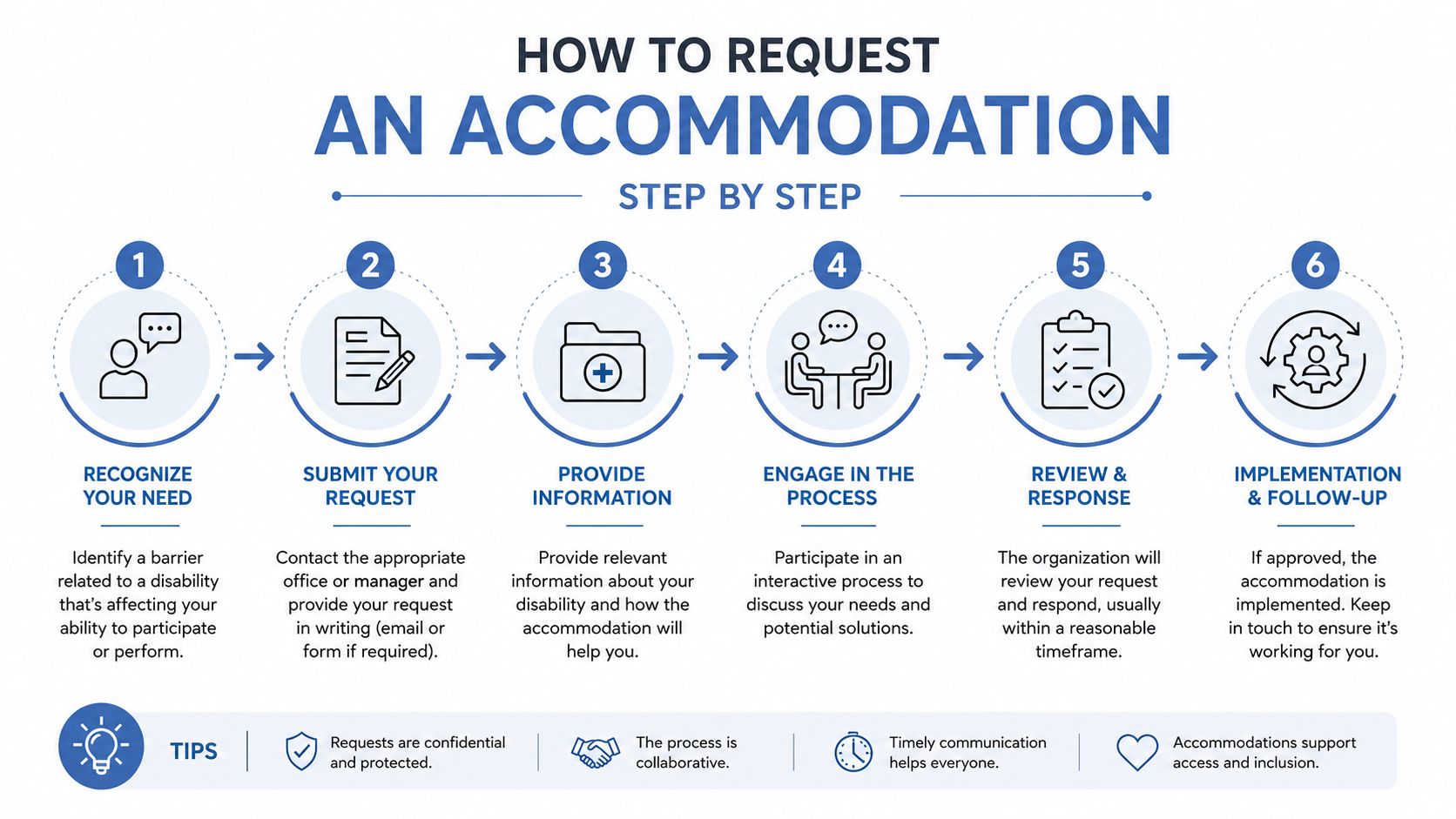
Use the right words
Send the request to HR or your supervisor, and keep a copy. Say something like, “I have a medical condition that affects my ability to concentrate during long shifts. I'm requesting a modified schedule and fewer unscheduled interruptions so I can keep performing my job.” That is enough to put the employer on notice.
Do not make the request sound like a vague complaint. “I'm overwhelmed” is human, but it's not specific enough by itself. The employer needs a clear accommodation request tied to a work limitation.
Keep the back-and-forth going
If the employer offers something else, respond seriously. Courts expect a real dialogue, and refusing to discuss alternatives can hurt a good claim. If the alternative solves the barrier, take it and keep the record.
Practical rule: write everything down, every email, every meeting, every change in the employer's position.
For a broader guide on the accommodation process, this detailed accommodation request resource is useful. The point is simple, though. Ask for the help you need, describe the functional problem, and stay engaged until the employer answers.
Here's a quick comparison that helps people sort out the common leave and accommodation tools:
| Option | Best use | What it usually does |
|---|---|---|
| ADA accommodation | Ongoing work barrier caused by a disability | Adjusts how the job is done |
| FMLA leave | Time away for a serious health condition | Protects job leave and return rights |
| Workers' compensation | Work-related injury or illness | Addresses the injury claim, not the accommodation duty |
The mistake I see most often is silence. Employees wait too long, or they complain to a coworker instead of making a formal request. If you need protection, ask for it in a way the company cannot ignore.
Documentation and What Employers Can Ask About Mental Health
Employers do have some room to ask for documentation, but the law draws a line. A private employer, state or local government, employment agency, or labor union generally cannot make disability-related inquiries or require medical exams unless the request is job-related and consistent with business necessity, and those exams usually come after a conditional offer of employment. That means an employer can't go fishing for private mental health history just because it's curious or uncomfortable.
The best documentation is narrow. A doctor's letter should confirm the condition is a mental impairment, explain the work-related limitation, and connect the requested accommodation to that limitation. It does not need to hand over your entire record.
If you want a treatment-related resource to support a conversation with a clinician, improving your treatment plan can help frame the medical side. But from a workplace standpoint, the key is still function, not a detailed therapy history.
What HR can and cannot demand
HR can ask for enough information to verify the need for accommodation. HR cannot demand unrelated diagnoses, every prescription you've ever taken, or ongoing updates that go beyond the issue at hand. If the employer wants more, ask why it is necessary and insist that the request stay job-related.
A good medical note usually answers three questions. What is the functional limitation, what accommodation helps, and why does that accommodation address the limitation? If those pieces are in the letter, the employer has much less room to stall.
If HR overreaches, push back in writing. Say you'll provide documentation supporting the accommodation request, but not unrelated medical records. That keeps the conversation within the ADA's limits and creates a paper trail if the employer starts acting like privacy does not matter.
How ADA Leave Intersects With FMLA and Other Job Protections
Mental health leave often triggers more than one law at once. A Mississippi employee may need protected leave under the ADA, FMLA leave for a serious health condition, or time off tied to a workers' compensation claim. Employers love to blur those buckets. Don't let them.
Here's the side-by-side comparison:
| Law | Eligibility trigger | Leave available | Pay status | Job restoration |
|---|---|---|---|---|
| ADA | Disability-related work limitation | As a reasonable accommodation, if effective | Usually unpaid unless employer policy says otherwise | Return to the job if the accommodation supports performance |
| FMLA | Serious health condition and coverage requirements | Up to the protected leave available under the statute | Unpaid, unless paid leave is substituted | Reinstatement rights when leave is properly used |
| Workers' compensation | Work-related injury or illness | Depends on the claim and medical treatment needs | Often tied to benefit structure, not regular wages | Not the same as ADA reinstatement rights |
The big Mississippi-specific point is this. Mississippi does not provide retaliation protection for filing workers' compensation claims. That makes federal protection even more important when the mental health problem is tied to work stress, trauma, or another on-the-job event.
Read our related guide on ADA leave of absence issues.
The safest move is to document every request separately. If you need treatment time, ask whether FMLA applies. If you need schedule changes or reduced triggers at work, ask for an ADA accommodation. If the condition is work-related, keep the workers' comp claim in its own lane.
For people who want to track symptoms during leave or disability-related absences, an AI-powered journaling tool can help organize the timeline. That kind of record can be useful when you're trying to show how symptoms affected work over time.
Retaliation and Common Employer Defenses
An employer cannot punish you for requesting an ADA accommodation, opposing discrimination, or participating in an EEOC investigation. Retaliation claims are separate from the underlying disability claim, and they matter because a company often reacts badly once an employee asserts rights. A demotion, schedule cut, or termination right after a request can be powerful evidence.
Mississippi employers usually defend these cases a few familiar ways. They say the employee is not disabled, the accommodation would create an undue hardship, the employee can't perform essential job functions, or the discipline was just about performance. Those arguments are not magic words. They have to hold up against the facts.
Timing matters. If the adverse action follows closely after the accommodation request, that creates a problem for the employer. So does uneven treatment, especially when other employees with similar performance issues were handled more gently.
What defeats the usual defenses
Evidence beats excuses. A supervisor who complains about the request, a written timeline showing the employer ignored the interactive process, or records showing the accommodation was never considered can all cut through the defense. The EEOC charge process gives you a place to put those facts on record.
If the employer says you were fired for performance, make them prove it consistently. Were you warned before the request, or only after? Did the employer talk through alternatives, or did it jump straight to discipline? Those details often decide the case.
Mississippi workers also need to know one more hard truth. There is no retaliation claim under state law for filing a workers' compensation claim. If the issue touches leave, disability, or discrimination, the federal channels matter a lot more than many realize.
How to File an EEOC Complaint From Mississippi
Mississippi does not have a state human rights commission, so the EEOC is the main administrative path for an ADA mental health discrimination charge. If your employer denied an accommodation, disciplined you after a request, or fired you because of a psychiatric disability issue, don't sit on it. The filing clock matters.
In Mississippi, the deadline is generally 300 days from the discriminatory act. Miss that deadline and you can lose the charge, even if the underlying facts are strong. Bring your emails, medical note, discipline records, leave paperwork, and a timeline of exactly when each event happened.

The intake process usually starts with a phone or online contact, then moves to a charge if the facts fit. After that, the EEOC may offer mediation. If mediation doesn't resolve the dispute, an investigator reviews the charge and asks for documents or statements from the employer. Conciliation can follow if the agency finds cause or sees a path to settlement.
The remedies can be real. Depending on the facts and proof, a case can involve back pay, front pay, compensatory damages, punitive damages, and injunctive relief. That's why people should take the claim seriously early, not after the damage is already locked in.
A lawyer becomes worth calling when the employer refuses to engage, the paperwork starts getting weaponized, or the retaliation starts right after the request. Most Mississippi employment lawyers handle these matters on contingency, and the average fee is typically 40-50% of the recovery, so you need to understand the economics before you decide to wait. If you've been demoted, threatened, or terminated after raising a mental health issue, pick up the phone and get advice fast.
By Nick Norris, Attorney
Last updated: 2026-08-08
Reviewed by Nick Norris
Call 601-641-4897 if your employer is ignoring your mental health accommodation request, overreaching on medical documentation, or retaliating after you asked for help. Nick Norris, P.A. represents Mississippi employees in ADA and other workplace cases, and we can help you figure out your next step before the deadline runs out.
Leave a Reply