

A leave request can turn into a financial crisis before an employee has time to understand what happened. A warehouse worker in Jackson may ask for six weeks of FMLA leave to care for her mother after a stroke, receive a denial, and then find herself terminated the following Monday. Her immediate concerns aren't abstract legal theories. She may be missing wages, losing employer-sponsored health coverage during treatment, and facing the cost of private COBRA continuation.
The harder question follows quickly: if the employer violated the FMLA, what can the employee realistically recover? The answer depends on whether the case involves denied leave, retaliation, lost benefits, a technical recordkeeping failure, or several violations at once. It also depends on proof, mitigation, the employer's defenses, and the fee arrangement that determines what remains after the case ends.
Mississippi workers should evaluate the damages issue early. Mississippi employment contingency fees are commonly described in the 40% to 50% range, with broader employment-law guidance describing roughly 33% to 50% depending on case stage, risk, and recovery (Mississippi employment-law fee guidance). Good leave management compliance with LeaveWizard can help employers avoid these disputes, but once a worker is denied protected leave or punished for requesting it, the financial analysis becomes central to deciding whether a claim is worth pursuing.
When a Denied Leave Request Becomes a Damages Question
The Jackson warehouse worker's termination creates two separate problems. First, she may have lost the leave itself. Second, she may have lost the job because she requested or attempted to use that leave. Those facts can support different FMLA theories, and each theory affects the damages analysis.
Suppose her employer stops her paycheck immediately. The wage loss may continue while she searches for comparable work. Her health insurance may end at the same time she needs treatment for her mother, and private COBRA continuation may cost more than she can afford. If she misses work to provide care, she may also lose overtime opportunities, employer contributions, or other benefits tied to active employment.
The law doesn't award money just because an employer acted unfairly. An employee must connect the violation to a measurable loss or seek an equitable remedy that addresses the employment harm. That means preserving the documents that show what the employer promised, denied, paid, withheld, or changed.
The first financial questions
Before assigning a value to the case, I would want to know:
- What was denied: Was the employee denied qualifying leave, discouraged from using it, or terminated after requesting it?
- What income disappeared: Did the employee lose salary, hourly wages, overtime, commissions, bonuses, or expected increases?
- What benefits changed: Did health coverage lapse, or did the employee incur medical expenses during the coverage gap?
- What happened afterward: Did the employee search for comparable work, accept lower-paid work, or remain unemployed?
The damages question also affects litigation economics. A case with a short leave denial and no wage loss may require a different strategy from a termination case with substantial back pay and strong evidence of retaliation. Mississippi's contingency-fee reality means gross damages aren't the same as the amount an employee ultimately receives.
Practical rule: Don't evaluate an FMLA case by asking only whether the employer was wrong. Ask what loss the violation caused, what proof supports that loss, and what defenses could reduce it.
The Two Types of FMLA Claims and Why They Matter
FMLA cases generally involve interference or retaliation. The distinction controls what the employee must prove, which employment harm matters, and how damages should be calculated.
Interference occurs when an employer denies, restricts, or mishandles an employee's right to qualifying leave. The central question is what the employee would have received or avoided if the employer had handled the leave lawfully. A claim may arise when the employer refuses to recognize qualifying leave, counts protected absences against the employee, or fails to return the employee to the same or an equivalent position.
The employee generally must show that the employer's conduct interfered with an FMLA entitlement and caused harm. Damages may include denied leave benefits, lost wages, and benefits connected to the denial. If the employee remained employed and suffered no economic loss, the monetary recovery may be limited, even when the employer's notice or paperwork was defective.
Retaliation addresses a different wrong: the employer punishes the employee for exercising FMLA rights. Protected activity can include requesting leave, taking leave, providing medical certification, or objecting to an alleged FMLA violation.
Retaliation focuses on the employment action
A retaliation claim asks whether protected FMLA activity contributed to an adverse employment decision. Termination, demotion, reduced hours, discipline, or another negative action may support a broader damages case when the timing and evidence connect the decision to the employee's protected conduct.
The resulting damages analysis can include back pay, front pay, lost benefits, and reinstatement. Reinstatement may be impractical after the employment relationship has collapsed. In that situation, front pay may serve as the alternative remedy, although its duration and amount can become contested issues.
The two theories can overlap, but they require different proof. An employer may have interfered with leave without retaliating, or may retaliate after properly processing the leave request. That distinction affects discovery, settlement value, and the evidence needed at summary judgment or trial.
Both claims can support liquidated damages and an award of reasonable attorneys' fees and costs when the employee prevails. Liquidated damages are not an automatic doubling of every award. An employer can defeat that presumption by proving it acted in good faith and had reasonable grounds to believe its conduct complied with the FMLA. The employee still must establish the required elements and connect the violation to actual harm.
Damages You Can Recover for an FMLA Violation
An employee terminated after requesting protected leave may have a damages claim tied to lost wages, benefits, and future employment. The recovery depends on proving the loss and connecting it to the FMLA violation. Payroll records, benefit statements, tax documents, job-search records, and a clear timeline usually matter more than an estimate based on the employee's highest possible earnings.
Back pay and benefits
Back pay generally runs from the violation through settlement, judgment, or another legally relevant endpoint. It can include regular wages, overtime, and expected raises when those amounts can be shown with reasonable certainty. A worker earning $48,000 annually who was denied ten weeks of leave would start with the salary and period involved, then adjust for actual payments, replacement work, and other evidence. That calculation is an illustration, not a guaranteed award.
Benefits can materially change the total. If an employee loses employer-sponsored health coverage and pays a $620 monthly insurance premium during treatment, the employee should preserve premium notices, COBRA materials, medical bills, and proof of payment. Other employment benefits may also be recoverable if the violation caused their loss.
Interest, liquidated damages, and equitable relief
Pre-judgment and post-judgment interest may affect the final recovery. The applicable federal rate and calculation period must be determined for the particular case. Liquidated damages may add an amount equal to qualifying lost wages and benefits, although the employer can argue that its good-faith defense defeats that additional amount. That issue often changes the value of an FMLA settlement, so employees should review how FMLA case value is calculated before treating a demand or offer as a likely net recovery.
Equitable relief may include reinstatement, restoration to an equivalent position, promotion, or front pay. Reinstatement is not always workable after the employment relationship has collapsed. Front pay then requires a fact-specific assessment of future loss, employability, comparable positions, and whether returning to the workplace would fail.
| Damages Category | How It Is Calculated | Example |
|---|---|---|
| Lost wages | Pay the employee would have earned, adjusted for replacement income and proven mitigation | Salary, hourly wages, overtime, or expected raises during the recoverable period |
| Lost benefits | Value of benefits lost because of the violation | Employer health coverage, retirement contributions, or other employment benefits |
| Interest | Applicable federal interest calculation for the relevant period | Interest added to an established wage or benefit loss |
| Liquidated damages | An additional amount potentially equal to qualifying lost wages and benefits | A matching award when the employer doesn't establish the required defense |
| Front pay | Future employment loss when reinstatement isn't feasible | Compensation tied to a proven period of continued wage and benefit loss |
| Reinstatement or promotion | Court-ordered employment relief | Return to the same or an equivalent position, or correction of a denied advancement |
The practical calculation should separate documented losses from uncertain future damages. It should also account for replacement income, mitigation evidence, and the possibility that liquidated damages will not be awarded. That is the amount worth testing against the employer's defenses and the cost of pursuing the claim.
Liquidated Damages and the Good-Faith Defense
An employee is fired soon after requesting FMLA leave. The timing and the employer's changing explanations may support retaliation, but they do not automatically produce an award equal to twice the wage loss. Under 29 U.S.C. § 2617(a)(1)(A)(ii), an additional amount equal to qualifying lost wages and benefits is generally the statutory default. An employer can avoid that additional award by proving both good faith and reasonable grounds for believing its conduct complied with the FMLA.
The employer carries that burden. Good faith asks whether the employer acted in good faith. Reasonable grounds asks whether its position was objectively reasonable. A simple claim that management misunderstood the FMLA rarely resolves the issue. Policies, manager training, internal communications, investigation steps, legal advice, and the employer's response to the leave request may all become evidence.
Why the defense changes settlement value
A termination shortly after an FMLA request, paired with hostile comments or shifting explanations, can make the defense difficult to establish. A disputed medical certification, unclear notice, or technical compliance issue may give the employer a stronger argument that its conduct was reasonable.
The defense generally concerns the additional liquidated amount, not whether the employee can recover proven back pay or benefits. That distinction matters during settlement discussions. A claim that appears to support an equal additional award may settle for less if the employer has credible contemporaneous records showing an effort to comply.
| Scenario | Burden of Proof | Typical Outcome |
|---|---|---|
| Employer clearly denied qualifying leave or punished protected activity | Employer must prove good faith and reasonable grounds to avoid the additional award | Back pay and benefits remain central, while liquidated damages become a major dispute |
| Employer presents contemporaneous compliance efforts and a documented legal position | Employer must support both subjective good faith and objective reasonableness | The court may deny or reduce the additional award if the defense succeeds |
| Technical recordkeeping violation without denied leave or wage loss | Employee must still establish compensable harm | Monetary recovery may be limited, and liquidated damages depend on the proven violation and defense |
| DOL enforcement proceeding | The employer's good-faith showing remains relevant to the additional award | Wage recovery and liquidated damages depend on the enforcement findings |
The calculation of FMLA liquidated damages is therefore a legal and factual exercise, not a mechanical doubling formula. Federal materials discussing FMLA liquidated damages provide context for how the additional award and employer defense may be analyzed (federal materials discussing FMLA liquidated damages). That framework helps evaluate settlement value, but it does not predict what an individual Mississippi employee will recover. The employee's documented loss, the employer's records, and the cost of proving the case remain decisive.
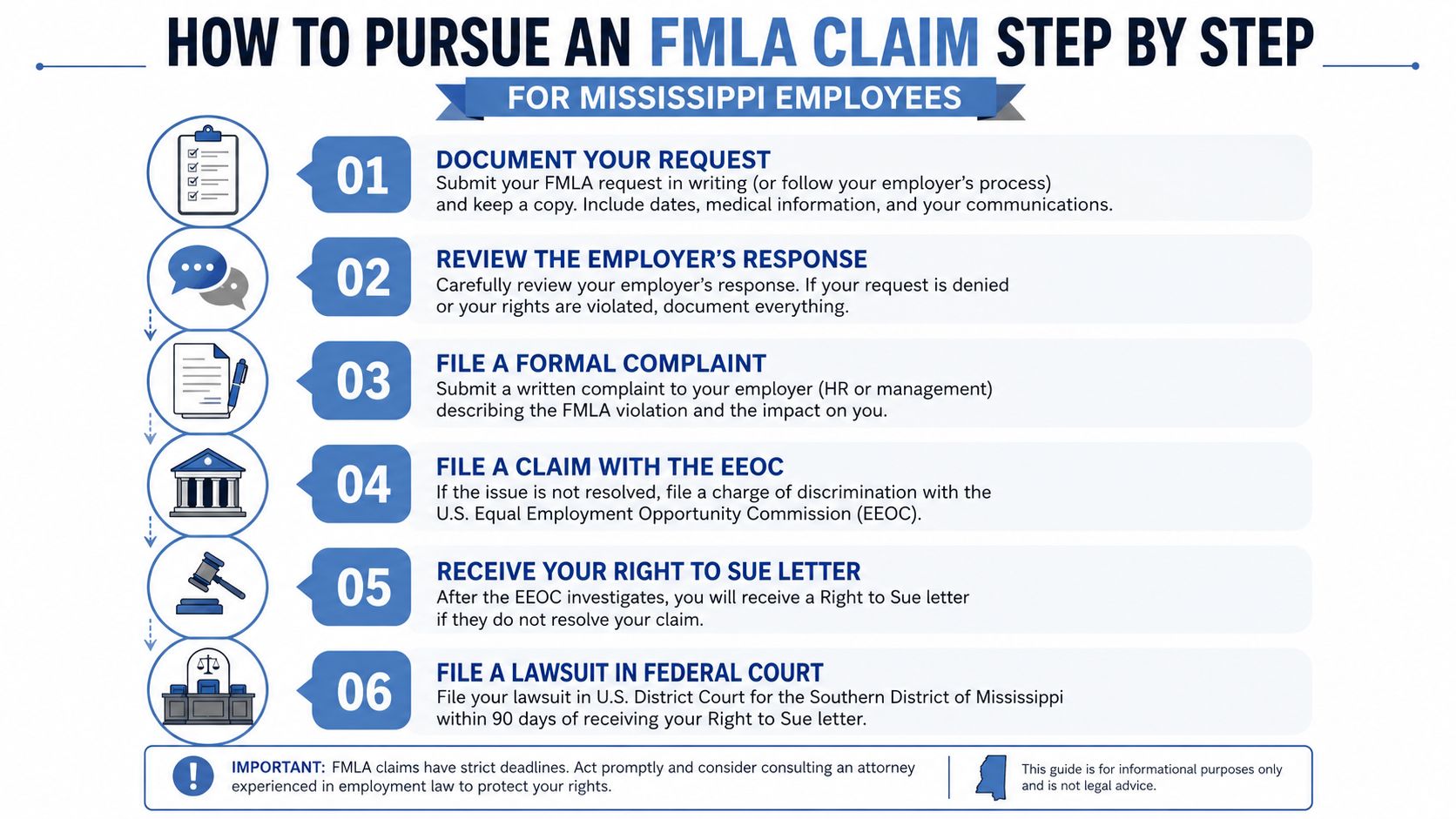
How to Pursue an FMLA Claim Step by Step
The strongest FMLA cases usually begin with disciplined evidence preservation, not an angry message to a supervisor. Write down the leave request, the employer's response, the medical-certification process, the dates of discipline or termination, and the people involved.
Start with the record
Save emails, text messages, leave forms, medical certifications, attendance records, pay stubs, performance reviews, discipline notices, and termination documents. Keep the original files when possible, and don't alter messages or write explanations directly on the originals.
A certification dispute deserves special attention. If the employer claimed the medical information was incomplete, preserve the request for clarification, the provider's response, and every deadline. A notice problem can become a defense that limits both liability and damages.
Track the deadline
Private FMLA claims generally face a two-year limitations period for non-willful violations and a three-year period for willful violations, as described in Mississippi-focused FMLA guidance (FMLA interference and retaliation deadlines). The willfulness issue matters because it can determine whether the claim survives longer, but employees shouldn't wait for a court to decide that question before seeking advice.
The FMLA generally doesn't require an employee to complete an EEOC charge before bringing a private claim. That differs from several discrimination statutes. An employee may consider a Department of Labor complaint or a private federal action, depending on the facts, goals, evidence, and deadline.
Choose the forum and build the damages proof
FMLA litigation proceeds in federal court. Mississippi workers should avoid assuming that a state-law forum offers a separate FMLA remedy, and this article doesn't address filing an FMLA lawsuit in state court. Counsel will evaluate jurisdiction, the employer's coverage, the employee's eligibility, and the appropriate defendants before filing.
Discovery commonly focuses on payroll, attendance, personnel files, decision-maker communications, comparator treatment, benefit losses, job searches, and the employer's stated reason for the action. Service of process follows filing, and settlement discussions may occur before or after discovery reveals weaknesses in either side's case.
Contested cases often resolve over 12 to 24 months, but timing varies with motion practice, discovery disputes, court schedules, and the willingness of both sides to negotiate. A prompt evidence review can improve the settlement posture even when trial remains possible.
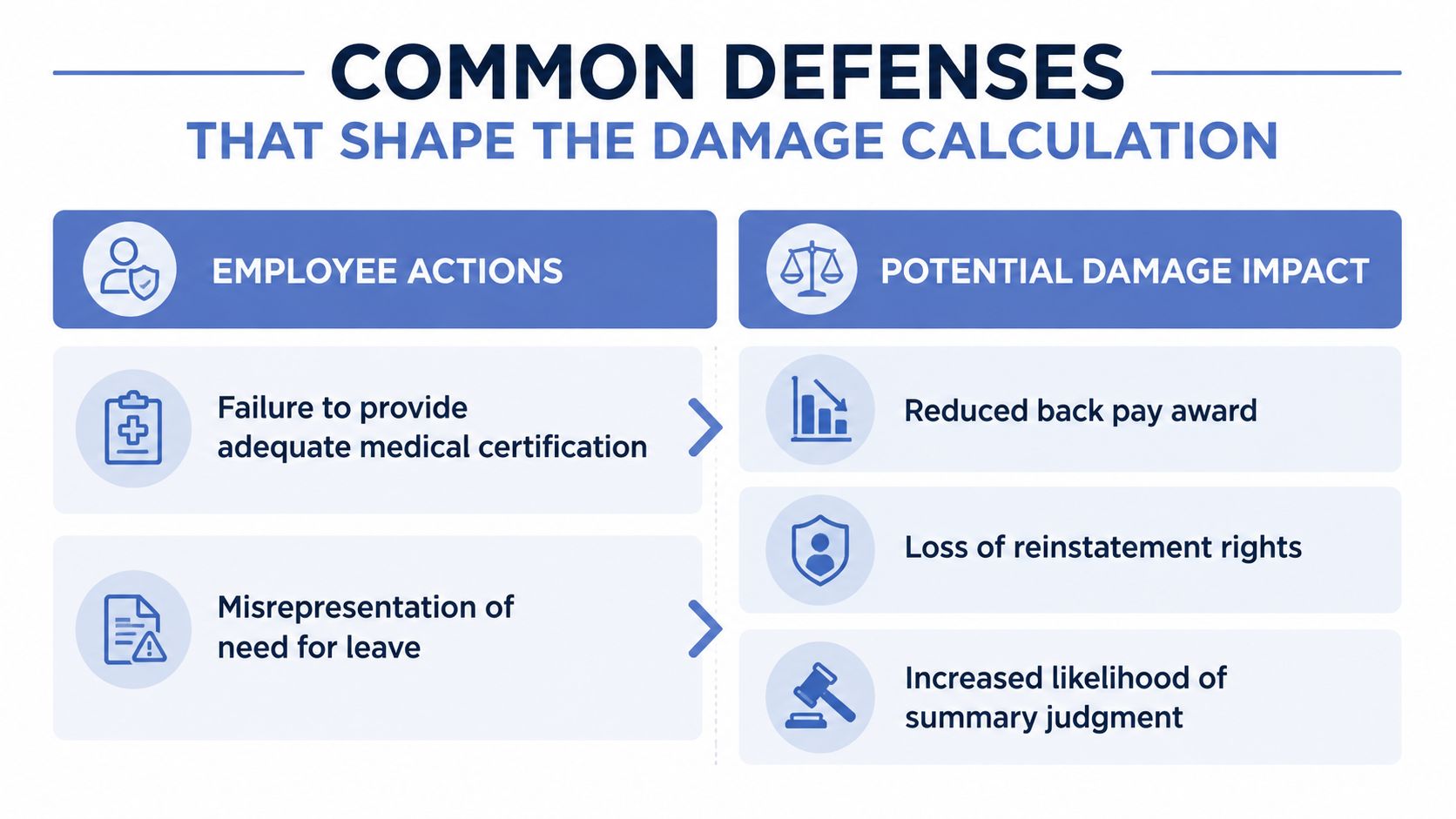
Common Defenses That Shape the Damage Calculation
Employer defenses often affect the size of an award before they decide whether the entire claim survives. The employee's records must answer each defense directly.
Certification and notice problems
An employer may argue that the employee didn't provide adequate medical certification or failed to follow a reasonable call-in procedure. If that argument succeeds, the employer may contend that the disputed absence wasn't protected, cutting off back pay tied to that period.
The practical response is documentation. Show what the employee submitted, when it was submitted, whether the employer requested clarification, and whether the employee had a fair opportunity to correct an alleged deficiency. A vague recollection won't carry the same weight as a complete email chain and medical form.
Honest belief and after-acquired evidence
In retaliation cases, an employer may argue that it acted for an honest, non-retaliatory reason, such as documented misconduct or performance concerns. A reasonable but mistaken belief can defeat liability if the evidence supports the employer's decision-making process. Timing alone may not overcome a consistent record created before the leave request.
After-acquired evidence can also affect the remedy. If the employer discovers misconduct after termination, that evidence may limit reinstatement or front pay even if it doesn't erase the original violation. The employee's future recovery can shrink when comparable employment was available but the employee didn't make a reasonable search.
Technical violations without economic loss
A recordkeeping-only violation illustrates why the phrase “FMLA violation damages” doesn't always mean a large wage award. If the employer maintained deficient records but didn't deny leave, terminate the worker, or cause a measurable economic loss, a court may decline lost wages and focus on limited relief, such as an injunction or other equitable remedy.
The Department of Labor's enforcement structure still treats liquidated damages as part of the statutory framework, subject to the employer's good-faith showing. But the underlying damages base matters. No proven lost wages means there may be little or nothing to double.
A strong case doesn't merely identify an employer defense. It shows, document by document, why that defense doesn't explain the decision or why it doesn't eliminate the employee's loss.
Mississippi Contingency Fees and What You Actually Take Home
A damages award is a gross figure, not the amount an employee necessarily receives. The final recovery depends on the fee agreement, case expenses, liens, taxes, and whether the claim resolves through settlement, trial, or appeal.
The agreement should state when the contingency percentage changes. Some contracts use one percentage for a negotiated settlement and a higher percentage if the case requires trial or an appeal. It should also identify whether the fee is calculated from the gross recovery or after expenses are deducted. Those terms can change the employee's net result even when the headline settlement amount stays the same.
Read the cost provisions carefully. Filing fees, medical-record charges, deposition expenses, expert work, and other litigation costs may come out separately. A contract may deduct those costs before calculating the fee, or calculate the fee first and subtract costs afterward. The difference should be clear before the claim is filed.
The Mississippi employment-law contingency-fee discussion explains why these terms deserve review before a worker accepts or rejects an offer. A lawyer may also receive a separate attorneys' fee award from the employer under applicable law, but the agreement should explain how that payment affects the employee's obligation. Handling a claim without counsel avoids a contingency fee, while leaving the employee responsible for pleadings, discovery, evidentiary objections, expert issues, and settlement valuation.
A worked example
Assume a $60,000 gross settlement, a 45% contingency fee, and $4,000 in case costs. The fee would be $27,000, leaving roughly $29,000 after that fee and the stated costs. This illustration does not predict a particular case outcome.
| Recovery Component | Amount | Notes |
|---|---|---|
| Gross settlement | $60,000 | Total negotiated recovery before fees and costs |
| Contingency fee | $27,000 | 45% of the gross settlement |
| Case costs | $4,000 | Assumed filing, records, deposition, or related expenses |
| Estimated net recovery | $29,000 | Gross recovery minus the stated fee and costs |
The practical comparison is between the net value of a realistic offer and the likely net value after additional litigation. A larger demand does not necessarily produce a larger take-home recovery if trial preparation adds time, expense, and risk.
Settlement lens: Evaluate what remains after the agreed fee and case costs, not the largest number appearing in a demand letter.
Taking the Next Step With a Mississippi Employment Attorney
A useful consultation should produce decisions, not just sympathy. Bring the documents that allow counsel to test the timeline and estimate the loss.
Bring a complete file
Gather:
- Employment information: Start and end dates, job title, pay rate, work location, and supervisor names.
- Leave records: The written request, employer response, certification forms, call-in messages, approval or denial notices, and attendance records.
- Employment action documents: Discipline, performance reviews, termination paperwork, schedule changes, and explanations given by management.
- Financial proof: Pay stubs, benefit statements, insurance notices, medical expenses, job applications, interviews, and replacement earnings.
Don't delete unfavorable material. An attorney needs the complete record to identify risks before the employer does.
The initial evaluation should address whether the facts suggest interference or retaliation, whether the limitations period remains open, whether the employer and employee meet FMLA coverage and eligibility requirements, and whether the likely damages justify litigation costs. Counsel should also discuss the weaknesses, including certification disputes, mitigation problems, inconsistent employee statements, or evidence supporting the employer's stated reason.
Make the decision with full information
A Mississippi worker may consider a Department of Labor complaint, a private federal claim, or an early settlement approach. Each path carries different advantages, burdens, timing considerations, and risks. There is no responsible way to choose among them without reviewing the evidence and estimating the likely recovery after fees and costs.
Information about the marketing of legal services guide can help explain how law offices communicate their services, but an employee's decision should rest on the proposed representation agreement, the lawyer's assessment, and the facts of the FMLA dispute.
Nick Norris, P.A. is one Mississippi employment-law office that evaluates FMLA interference and retaliation matters, including the evidence, deadlines, damages, and practical options available to an employee. Call 601-641-4897 with the core documents organized so the consultation can focus on what happened and what recovery may be realistic.
By Nick Norris, P.A.
Last updated: August 21, 2026
Reviewed by Nick Norris
Nick Norris, P.A. evaluates Mississippi FMLA interference and retaliation claims, including lost wages, benefits, liquidated damages, and settlement strategy. Visit Nick Norris, P.A. to request a case evaluation and discuss your options before important evidence or deadlines are lost.
Leave a Reply