
You're in a Jackson retail shop, a Hattiesburg warehouse, or a manufacturing plant somewhere in between. A supervisor keeps making comments about your accent, hijab, age, disability, or personal life. At first, coworkers call it joking. Then the comments become regular, your schedule changes after you object, and management tells you not to be so sensitive.
That pattern deserves attention. Harassment isn't just a vague feeling of discomfort. Under federal employment law, the legal category matters because it can determine which statute applies, whether the conduct is actionable, what evidence matters, and where you must file. Mississippi workers face an added complication because the state has no human rights commission for ordinary private employment discrimination complaints.
This guide breaks down the major types of harassment at work in Mississippi, including identity-based harassment, sexual harassment, quid pro quo conduct, hostile work environments, retaliation, and online abuse. If you recognize your situation, start by documenting what happened and review these signs of workplace harassment before the evidence disappears.
When Workplace Behavior Crosses the Rules
A clerk in a Jackson retail shop hears the same comments about her accent every shift. Her supervisor laughs when customers ask her to repeat herself, coworkers imitate her pronunciation, and someone eventually tells her that “people like her” should work in the stockroom. She complains. The next schedule gives her fewer hours and the least desirable shifts.
That change doesn't automatically prove unlawful retaliation, but it changes the situation from ordinary workplace friction to a problem that needs careful legal analysis. The comments may involve national origin harassment. The scheduling decision may support a retaliation theory if she complained about discriminatory conduct and the employer took action because she complained. The two issues require different evidence, even though they arose in the same workplace.
A warehouse supervisor in Hattiesburg might face a similar escalation after employees repeatedly joke about her hijab. A manager may frame the remarks as harmless teasing, but the legal questions are more concrete:
- Was the conduct unwelcome?
- Was it connected to a protected characteristic?
- Did it affect a job decision?
- Was it severe or pervasive enough to alter working conditions?
- Did the employer know, or should it have known, what was happening?
Practical rule: Don't argue with management about whether conduct “counts” as harassment before you preserve what happened. Write down the facts first.
Naming the category is the first practical step. Sexual harassment usually involves unwelcome sexual comments, advances, images, requests, or touching. Race and national origin harassment can involve slurs, stereotypes, or mocking an accent. Religious harassment can involve hostility toward observance, clothing, prayer, or beliefs. Disability and age harassment involve conduct tied to a disability or age-based assumptions.
The next sections explain how federal law treats those categories, how quid pro quo and hostile work environment claims differ, and why Mississippi workers generally must use federal channels rather than a state human rights agency.
What Harassment Legally Means at Work
Think of workplace harassment as a legal umbrella, not a synonym for every unpleasant interaction. A rude boss, unfair criticism, or personality conflict may be miserable without violating federal discrimination law. The conduct becomes legally significant when it is unwelcome, tied to a protected trait, and serious enough to affect employment or the working environment.
The U.S. Equal Employment Opportunity Commission's harassment guidance separates the analysis into two basic paths. Under quid pro quo harassment, a supervisor connects an employment benefit or consequence to submission to unwelcome conduct. Under a hostile work environment theory, conduct based on a protected characteristic is severe or pervasive enough to interfere with work or create an intimidating, hostile, or offensive environment.
Protected harassment versus workplace bullying
Federal statutes protect workers from harassment based on legally recognized characteristics. Title VII addresses race, color, religion, sex, and national origin. The Americans with Disabilities Act addresses disability discrimination. The Age Discrimination in Employment Act protects workers from age discrimination within its coverage.
General bullying is different. Mississippi law largely doesn't provide a broad workplace-bullying claim because a supervisor is cruel, insulting, or unfair. The conduct may violate company policy, create a safety problem, or support another employment claim, but a worker still needs a legal connection to a protected trait or protected activity for many federal harassment theories.

A single incident can matter, especially when it involves a tangible employment action, a threat, unwanted touching, or an explicit demand from a supervisor. A hostile environment claim usually depends on the whole workplace picture, including the frequency, severity, context, and effect of the conduct. The seven categories below fit into these two legal frameworks in different ways.
Seven Main Types of Harassment Workers Face
The first five categories identify what protected characteristic the conduct targets. The last two identify how the harassment operates. That means one incident can fit more than one category, such as religious harassment carried out through a hostile work environment or sexual harassment tied to a promotion decision.
| Type of Harassment | Protected Trait | Federal Statute | Typical Conduct |
|---|---|---|---|
| Sexual harassment | Sex | Title VII | Unwelcome sexual advances, comments, requests, images, or touching |
| Racial or national origin harassment | Race, color, or national origin | Title VII | Slurs, stereotypes, accent-based mockery, or exclusion |
| Age harassment | Age, generally workers 40 and older | ADEA | Age-based insults, exclusion, or assumptions about ability |
| Disability harassment | Disability or perceived disability | ADA | Insults, invasive comments, exclusion, or interference with accommodation |
| Religious harassment | Religion or religious practice | Title VII | Jokes, hostility toward observance, scheduling conflicts, or grooming pressure |
| Quid pro quo harassment | Any protected trait, often sex | Title VII, ADA, ADEA, as applicable | Job benefits or consequences conditioned on submission or rejection |
| Hostile work environment | Any protected trait | Title VII, ADA, ADEA, as applicable | Severe or pervasive conduct that changes working conditions |
Sexual harassment includes unwelcome sexual advances, sexual comments, requests for sexual favors, unwanted touching, and sexual imagery. It can target any gender, and the harasser can be a supervisor, coworker, customer, or other person connected to the job.
Racial or national origin harassment includes racial slurs, stereotypes, repeated jokes about ethnicity, mocking an accent, or treating a worker as inferior because of ancestry or birthplace. Context matters. A single awkward comment may not meet the legal threshold, but repeated conduct combined with exclusion or job consequences can create a stronger claim.
Age harassment under the ADEA concerns age-based treatment involving workers within the statute's protected range. Telling an older worker that training is for younger employees, calling the worker obsolete, or excluding them from opportunities because of age can become evidence of discrimination or harassment.
Disability harassment includes ridicule, humiliating questions, insults, and exclusion based on an actual or perceived disability. Refusing to discuss a reasonable accommodation isn't automatically harassment, but hostile comments about the need for an accommodation can support a broader ADA claim.
Religious harassment can involve jokes about faith, pressure to abandon religious clothing or grooming, hostility toward prayer or observance, and scheduling practices that disregard religious obligations. The employer must analyze accommodation issues separately from harassment, but the same facts may support both.
Quid pro quo and hostile work environment describe the legal mechanics. They don't replace the protected-trait categories. A worker should identify both the trait involved and the way the conduct affected the job.
Quid Pro Quo Versus Hostile Work Environment
Quid pro quo means “this for that.” A supervisor says, directly or indirectly, that a job benefit depends on accepting unwelcome conduct. For example, a manager tells an employee that a promotion is available if the employee goes on a date, or threatens to cut hours after the employee rejects sexual advances.
The key evidence is the connection between the conduct and an employment decision. A worker should preserve messages, note the exact request, identify who heard it, and record what happened afterward. A single linked employment action may be enough to establish the core of a quid pro quo theory, although the full claim still depends on the facts and applicable law.
A hostile work environment claim works differently. Repeated crude jokes, racial slurs, unwanted touching, sexually explicit images, or religious insults may create an abusive workplace even when no supervisor expressly ties the conduct to a promotion, schedule, or termination. The question is whether the conduct is severe or pervasive enough to alter the terms and conditions of employment.
The evidence is different
| Element | Quid Pro Quo | Hostile Work Environment |
|---|---|---|
| Main question | Was an employment decision tied to submission or rejection? | Did protected-class conduct seriously alter working conditions? |
| Typical proof | Request, threat, offer, decision, timing, witnesses | Pattern, frequency, severity, witnesses, messages, management notice |
| Timing | Often turns on one conversation and one job action | Usually develops across multiple incidents |
| Best records | Texts, emails, evaluations, schedules, promotion records | Incident log, messages, photos, witness names, complaints, investigations |
| Possible source | Usually a supervisor or person with authority | Supervisor, coworker, customer, vendor, or other workplace participant |
Hostile environment cases require more than showing that work felt unpleasant. The conduct must be connected to a protected characteristic and evaluated in context. Management's knowledge also matters, particularly when coworkers or third parties are involved.
Evidence matters most when it preserves the connection between conduct and consequence. Don't only write that a supervisor was “creepy” or “mean.” Record what was said, what decision followed, and who knew.
Real Examples of Identity-Based Harassment
A Black warehouse worker in Mississippi hears a lead repeatedly tell racist jokes during loading. The lead uses stereotypes about Black employees, directs the jokes at one worker, and continues after the worker says the comments need to stop. Coworkers hear the remarks, but the supervisor dismisses the complaint as “just how the lead talks.”
The legal analysis would focus on the words, repetition, audience, effect on the worker, and employer response. The worker should preserve the dates of each incident, identify everyone present, and save any written complaint or response from management. If scheduling, discipline, or assignments change after the complaint, those records matter too.

A Muslim cashier at a Gulf Coast retailer asks for time to pray. Her manager mocks the request, tells other employees that she is “showing off” her religion, and schedules her during the same observance after she raises the issue. Those facts may involve religious harassment, religious accommodation, or both. The worker should keep the schedule, written requests, manager responses, and names of coworkers who witnessed the comments.
Four situations that deserve a closer look
- Disability: A healthcare clerk with diabetes uses an insulin pump. Her supervisor publicly questions whether she is sick, makes coworkers watch when she checks the device, and refuses to let her discuss the issue privately. The public humiliation and disability-based comments may support an ADA analysis, while the accommodation refusal requires its own review.
- Age: A mechanic who is 58 is told that new-equipment training is “for younger people.” The employer then excludes him from training and criticizes him for lacking experience with the equipment. The statements, training records, and performance reviews can show whether age-based assumptions influenced opportunities.
- National origin: A manufacturing employee is repeatedly told to “speak American” despite communicating clearly with customers and coworkers. The comment may become more significant when combined with accent mockery, exclusion, or discipline directed at the employee but not others.
- Religion: An agricultural worker is pressured to remove religious clothing despite being able to perform the job safely while wearing it. The pressure, the stated reason, and whether the employer applied the same rule consistently should all be documented.
The strongest record is factual. Write the exact words, location, date, witnesses, and response. Save the original message instead of relying only on a screenshot, and don't alter company records or take confidential information you aren't permitted to access.
Federal Law and the Mississippi Filing Reality
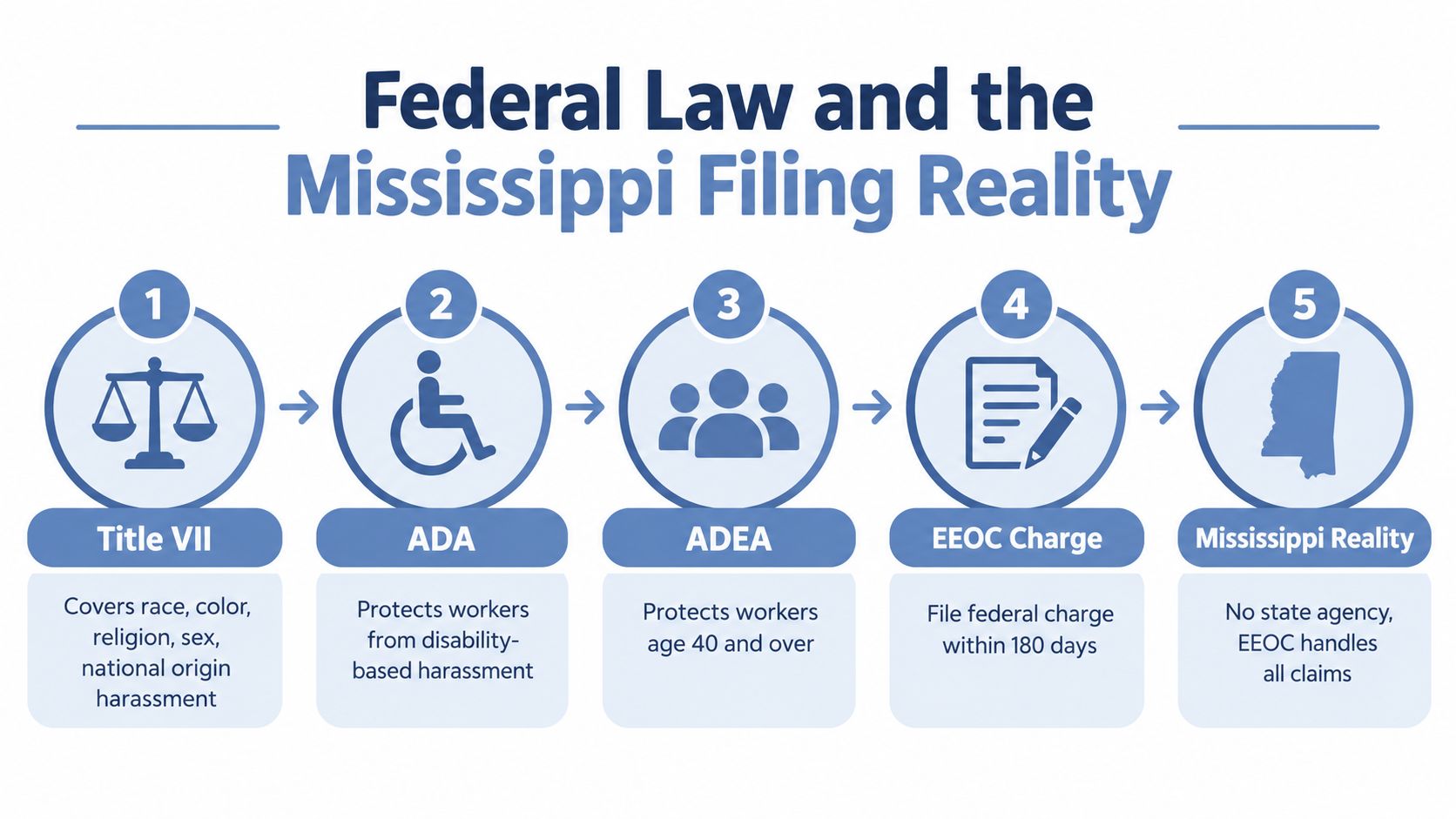
Mississippi workers generally must look to federal law for employment harassment claims. Mississippi doesn't have a state human rights commission or comparable general state agency for private employment discrimination complaints, so workers usually rely on the federal Equal Employment Opportunity Commission rather than filing with a Mississippi administrative body. That structural reality affects where you start and how carefully you track deadlines.
The primary federal statutes are:
- Title VII: Covers race, color, religion, sex, and national origin harassment.
- Americans with Disabilities Act: Covers disability-based harassment and discrimination.
- Age Discrimination in Employment Act: Protects workers age 40 and older from covered age discrimination.
For many Mississippi claims, an EEOC charge must be filed within 300 days of the discriminatory act. The EEOC's Mississippi filing information should be checked for current procedures and office details, particularly because the charge process and available intake options can change.
What happens after an EEOC charge
The EEOC generally gives the employer notice of the charge and may request a response, investigate the allegations, facilitate conciliation, or take other administrative action. The worker may receive a right-to-sue notice, which permits the worker to pursue a federal claim subject to the applicable deadline and legal requirements.
A public employee may have a separate route through the Mississippi State Personnel Board grievance process, depending on the employer and issue. That process is not a substitute for evaluating federal deadlines. Workers should not assume that an internal grievance pauses an EEOC deadline.
For a plain-English explanation of the next stage, review what a right-to-sue letter means. The important point is simple: Mississippi's lack of a state human rights commission doesn't mean there is nowhere to file. It means the federal filing path carries greater practical importance.
How to Report and Preserve Evidence
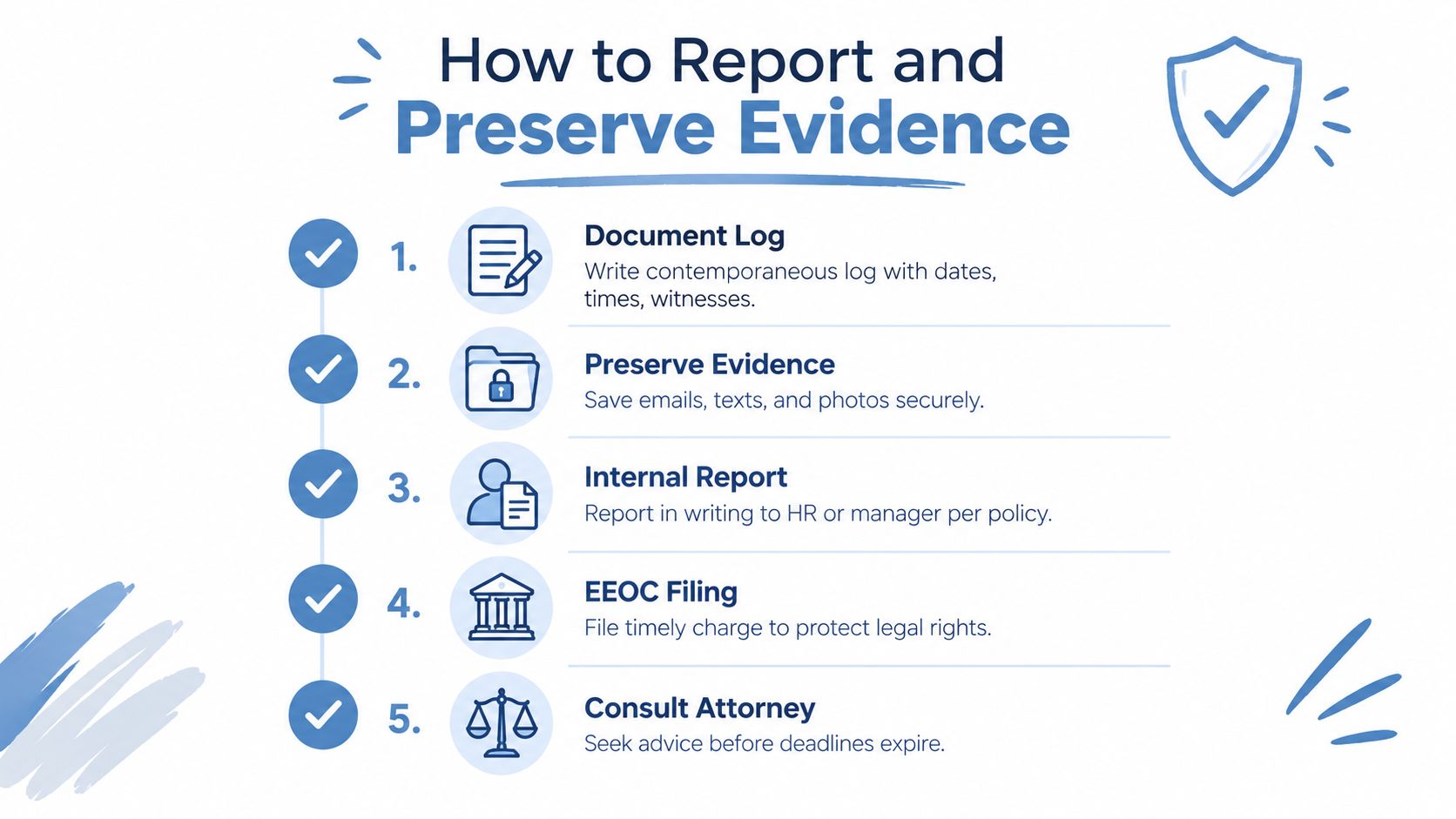
Start preserving evidence before confronting the harasser or warning coworkers. A contemporaneous log should identify the date, time, location, people present, exact words or conduct, and what happened afterward. Use a personal device or account consistent with your employer's policies, and keep copies somewhere the employer can't alter or delete.
Build a usable record
- Create an incident log. Record each event separately. Avoid conclusions such as “everyone is retaliating.” Write what happened, who acted, and how the event affected your work.
- Preserve communications. Save emails, texts, voicemails, photographs, schedule changes, performance reviews, disciplinary notices, and relevant work-platform messages. Keep original files where possible.
- Identify witnesses. Write down who was present and what each person could personally observe. Don't pressure coworkers to change their accounts.
- Keep complaint records. Save your report, the employee handbook section you followed, HR responses, meeting invitations, and investigation correspondence.
- Track consequences. Compare schedules, assignments, evaluations, discipline, hours, and promotion decisions before and after your complaint.
Report internally in writing when it is safe. Check the handbook for the required channel, whether that means a manager, human resources, compliance line, or another designated contact. Employers often attack a claim by arguing that the worker never used the stated procedure, so following the policy can strengthen the record.
Don't resign in anger and then lose access to the evidence. Preserve lawful copies first, and get advice before signing a release, severance agreement, or separation document.
For Mississippi-based Title VII, ADA, and ADEA claims, the EEOC charge deadline is generally 300 days from the discriminatory act. Filing may occur through the EEOC's public portal or intake process. Counsel may also communicate with the agency about preserving rights, but a worker shouldn't assume that contacting a lawyer automatically satisfies the deadline.
Use this guide to reporting workplace harassment when you need a written reporting plan. If an investigation or conciliation doesn't resolve the matter, potential remedies depend on the claim, evidence, employer, and procedural posture.
One Mississippi-specific warning deserves separate attention. Mississippi doesn't provide a separate state-law retaliation claim for filing a workers' compensation claim, and Mississippi courts have declined to recognize a wrongful-discharge cause of action based solely on filing such a claim. Keep a workplace harassment complaint and a workers' compensation injury claim factually separate where possible, and get advice about the protections that may apply to each.
Common Misconceptions and Next Steps
Harassment doesn't have to be physical. Repeated slurs, sexual comments, religious hostility, disability-based humiliation, and discriminatory messages can matter even when nobody touches you. Physical conduct may make a case more obvious, but federal law also examines verbal, visual, and other unwelcome conduct.
One rude comment isn't automatically unlawful harassment. A single comment can matter if it connects to a job decision or is exceptionally serious, but hostile environment claims are usually judged by the totality of the circumstances. Courts look at context, severity, frequency, whether the conduct was threatening or humiliating, and whether it interfered with work.
Quitting doesn't automatically destroy a claim. Resignation can create difficult proof questions, especially if the employer argues that conditions weren't intolerable or that the worker never reported the issue. Don't resign or sign a release without understanding the consequences.
Small employers aren't automatically exempt from every law. Title VII and the ADA generally use a 15-employee threshold, while the ADEA generally uses a 20-employee threshold. Those thresholds don't answer every coverage question, and other federal protections may apply differently.
Mississippi's lack of a state agency doesn't leave you without a filing route. The EEOC is the central administrative channel for many private-sector discrimination and harassment claims. Public employees may have additional grievance procedures, but those procedures don't eliminate the need to protect federal deadlines.
Calendar the 300-day EEOC deadline, continue documenting, and follow the internal complaint procedure when doing so is safe. Before signing severance, accepting a resignation package, or giving an employer a recorded statement, consider speaking with a Mississippi employment attorney. A consultation is confidential, and early advice can prevent an avoidable procedural mistake.
Federal harassment claims are workable, but they carry real timing and proof risks. Getting counsel involved early usually protects the claim. It doesn't signal weakness.
Nick Norris, P.A. evaluates Mississippi workplace harassment, discrimination, retaliation, and wrongful-termination matters and helps workers understand their federal filing options and evidence needs. Contact the office for a confidential case evaluation, and visit Nick Norris, P.A. to learn how the firm can help protect your employment rights.
Leave a Reply