
You've told your supervisor that you need time away from work for surgery, treatment, or to care for a close family member. Instead of guidance, you receive a short message: “Your FMLA request is denied.” You may not know whether the problem is your hours, your employer's size, a medical form, or the way your employer is treating you after the request.
For Mississippi employees, an FMLA denial usually falls into one of three categories. The employer may be saying you're not eligible, your paperwork may be incomplete or late, or the denial may be an unlawful attempt to interfere with or punish your use of protected leave. Those categories look similar from the employee's side, but they require different responses.
When Your FMLA Request Is Denied in Mississippi
Consider a Mississippi hourly employee who has worked for the same employer for more than a year. A doctor recommends treatment, and the employee asks for leave. The employer sends a certification form, but the provider leaves part of it blank. The employee then receives a denial and assumes the company has rejected the medical condition itself.
That conclusion may be wrong. The denial could reflect a paperwork defect, not a judgment about whether the employee is sick. The employer may have identified missing information and allowed time to correct it, or it may have skipped that correction process and denied the request too quickly.

Other employees face a different problem. A recently hired worker may have a serious health condition but not enough time with the company. A part-time worker may believe regular employment automatically qualifies, while the employer disputes the hours calculation. Still others satisfy the eligibility requirements and submit adequate certification, then face attendance discipline, hostility, or pressure not to take leave.
Three different stories behind one denial
- Eligibility gate: The employee fails one of the federal coverage requirements, such as the employment-duration, hours-worked, or employer-worksite test.
- Paperwork failure: The employee doesn't return a complete and sufficient certification on time, or doesn't correct a deficiency after receiving notice.
- Unlawful interference or retaliation: The employee appears eligible and properly documented, but the employer blocks, discourages, penalizes, or punishes the use of FMLA rights.
The U.S. Department of Labor's 2018 worksite survey reported that 3.5% of covered worksites denied any FMLA leave applications during the prior 12 months. Among worksites that denied requests, the most frequently cited reasons involved notice failures, exhausted leave entitlement, and conditions that didn't meet the serious-health-condition standard, according to the Department of Labor's FMLA worksite data.
Mississippi has an added practical complication. The state doesn't have a human rights commission or a state Fair Employment Practices Agency handling these employment claims, so workers generally rely on federal law and federal enforcement channels. A related explanation of Mississippi employment civil-rights enforcement describes why the federal process matters.
The immediate task isn't to argue with the word “denied.” It's to identify which kind of denial occurred, preserve the documents, and respond before a deadline expires.
How FMLA Protections Work for Mississippi Employees
An FMLA request can look like a simple absence request, but the law works more like a safety net with several openings. The worker must fit the eligibility rules, the leave reason must qualify, and the required notice and certification must be handled correctly. A denial may therefore reflect a threshold problem, a paperwork problem, or interference with a protected right.
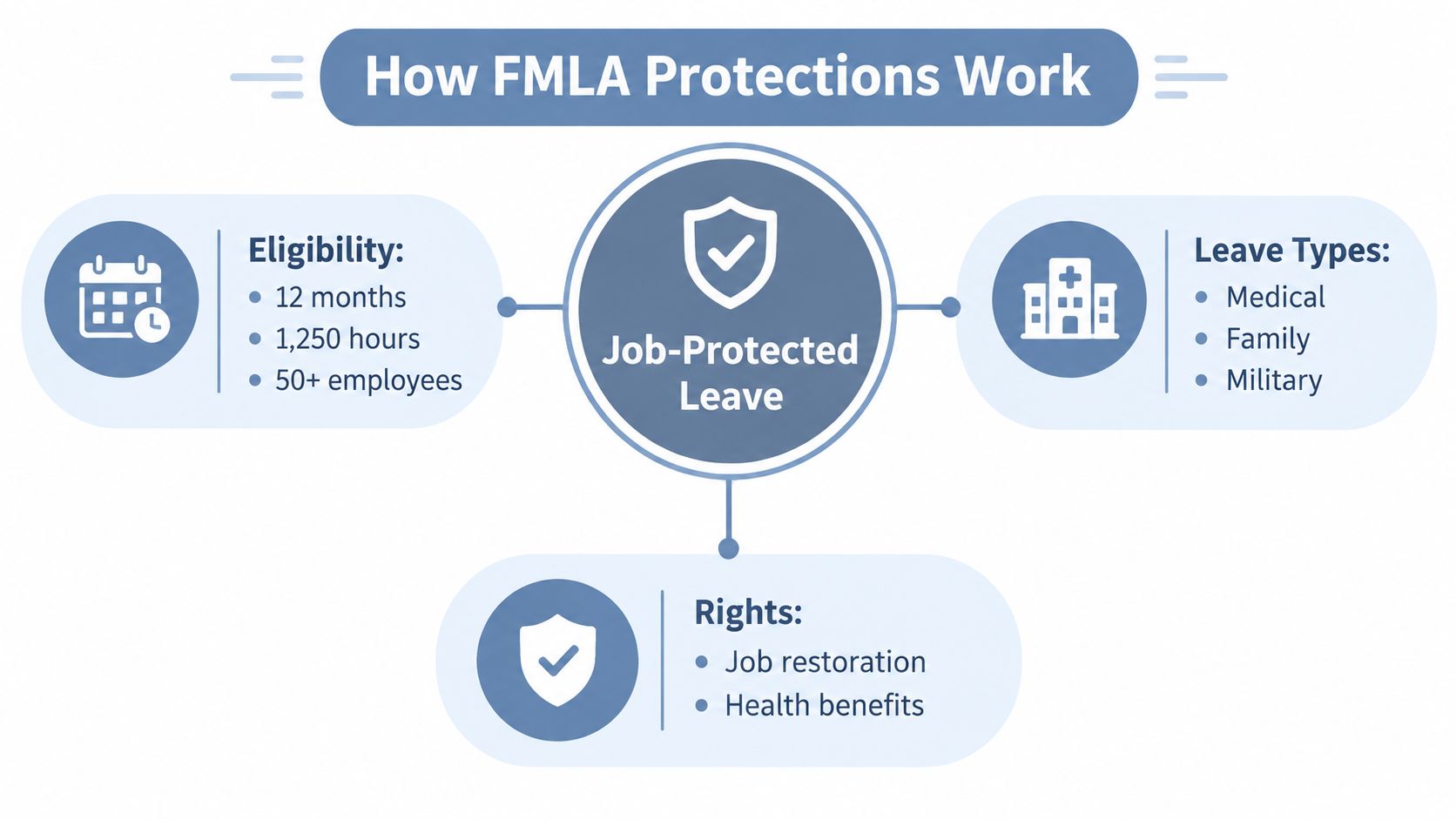
The Family and Medical Leave Act is a federal law enacted on February 5, 1993, and effective on August 5, 1993. It created a federal right to up to 12 weeks of unpaid, job-protected leave for qualifying family and medical reasons. Amendments in 2008 and 2009 expanded protections involving military-family leave. The U.S. Department of Labor's FMLA fact sheet summarizes the law's basic protections.
What the safety net protects
FMLA leave may cover an employee's own serious health condition, certain family-care needs, and qualifying military-family reasons. Its central benefit is job preservation, not wages. An eligible employee may take unpaid leave while keeping the employment protections provided by the statute, including return-to-work rights under applicable rules and continued group health-plan treatment.
The law has limits. A request to work remotely is not automatically an FMLA request. FMLA generally protects time away from work, while another law or workplace process may address an accommodation. Separating those issues helps identify what the employer denied.
A practical eligibility snapshot
Before challenging a denial, gather four facts:
- Employment history: Whether you have worked for the employer for at least 12 months.
- Hours: Whether you worked at least 1,250 hours during the 12 months before leave begins.
- Worksite coverage: Whether the employer has at least 50 employees within 75 miles of your worksite.
- Leave reason: How the medical, family, or military reason fits an FMLA category.
The Department of Labor's FMLA eligibility questions and answers explains these requirements. The timing matters because eligibility is measured when leave begins. For practical help with the request process, review this guide to applying for FMLA leave.
Mississippi has no state agency that substitutes for these federal protections. A worker dealing with an FMLA denial generally must look to the federal statute, Department of Labor enforcement, and, when related discrimination or retaliation is involved, the federal Equal Employment Opportunity Commission process.
Why Employers Deny FMLA at the Eligibility Stage
An employee may have a serious medical condition, submit a leave request, and still receive a denial before the employer evaluates the condition itself. Eligibility is the first gate. If one part of that gate fails, the employer may deny FMLA leave on a statutory ground. That makes the denial different from a paperwork failure or interference with protected leave.
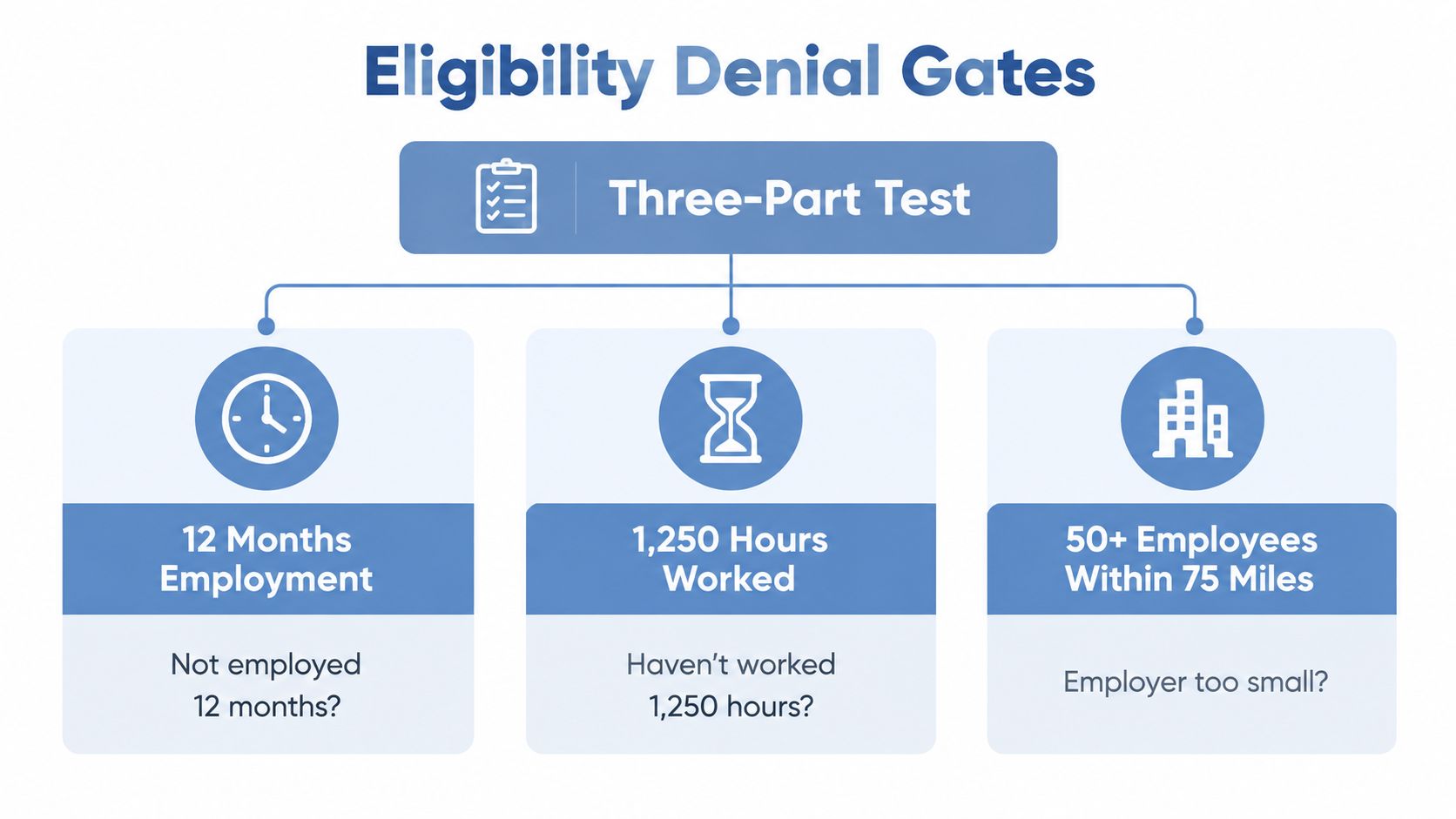
The eligibility test has three parts:
- Employment duration: You must have worked for the employer for at least 12 months.
- Hours of service: You must have worked at least 1,250 hours during the 12 months before leave starts.
- Employer coverage: You must work at a site where the employer has at least 50 employees within 75 miles.
The Department of Labor's FMLA eligibility questions and answers describes these requirements and explains that eligibility is measured when leave begins. That date can decide the outcome. An employee who completes the required employment period after requesting leave may still be ineligible for leave that starts before the requirement is met.
The hours calculation can decide the outcome
The 1,250-hour requirement works like a measuring tape for the specific year before leave begins. A rough weekly comparison can help screen the issue, but it cannot replace the actual calculation. Varying schedules, unpaid gaps, and seasonal work can change the result.
Employers should apply FLSA compensable-hour principles, rather than copying a payroll total. Employees can compare the employer's calculation with timecards, schedules, pay records, and other records showing hours worked. Paid time away may not equal compensable hours worked for this purpose, so an assumption about paid hours can lead to the wrong conclusion.
A part-time employee who consistently works near the weekly benchmark may satisfy the requirement. Someone who worked many hours earlier in the year but later had an extended absence may fall short because the employer must measure the particular 12-month period before leave starts.
The employer-size and worksite rule
Employer coverage depends on the employee count within 75 miles of the worksite, not the company's national reputation or total workforce. A large organization can still face a worksite-coverage question if the nearby employee count does not satisfy the statutory test.
Recent hires face a separate problem. A worker may have an urgent, legitimate medical condition and still fail the 12-month requirement. That denial concerns statutory eligibility, not whether the health situation is genuine.
Use this self-check before disputing the decision:
Practical rule: Ask the employer to identify the exact eligibility requirement it says you failed. Then compare that answer with your employment dates, hours, and worksite facts.
The video below provides another visual explanation of how an eligibility denial can occur:
A denial may be lawful when one eligibility gate fails. An incorrect hours count, incomplete worksite analysis, or wrong leave-start date can change the result. In Mississippi, there is no state agency that replaces these federal protections, so the dispute may require federal enforcement or legal review.
Common Lawful and Unlawful Reasons for FMLA Denial
A denial based on a missed certification deadline is different from a denial designed to discourage protected leave. The document may look similar, but the legal questions are not.
The Department of Labor states that an employer may deny or delay FMLA protection when an employee doesn't provide timely, complete, and sufficient medical certification after the required opportunity to cure deficiencies. The employee generally has 15 calendar days to return the certification, and the Department of Labor FMLA frequently asked questions explains the consequences of failing to meet the deadline or correct identified problems.
The paperwork trap
The employer should issue the certification request, track the deadline, and identify what information is incomplete or insufficient. A healthcare provider's form may need clarification about the expected duration of incapacity, the need for intermittent leave, or other information required to support eligibility.
A lawful documentation denial usually has a clear paper trail. An unlawful denial may involve no meaningful deficiency notice, shifting explanations, refusal to accept timely documents, or discipline for absences that should have been designated as protected.
| Situation | What It Usually Means | Next Step for Employee |
|---|---|---|
| Notice failure | The employer says it didn't receive adequate notice of the need for leave, or the request didn't provide enough information to recognize a possible FMLA situation. | Preserve the original message, explain the request in writing, and ask what information is missing. |
| Certification returned late or incomplete | The employer may delay or deny protection after the deadline and cure process, depending on the facts. | Check the delivery date, obtain proof of submission, and correct every listed deficiency promptly. |
| Leave entitlement exhausted | The employer says the available FMLA entitlement has already been used. | Request the employer's accounting and compare it with prior designations and leave records. |
| Condition disputed | The employer says the condition doesn't meet the serious-health-condition standard. | Ask the provider to address the relevant functional limitations and treatment information without unnecessary medical disclosure. |
| Eligible leave refused despite adequate documentation | The denial may interfere with the right to take qualifying leave. | Preserve communications and seek prompt review before discipline or termination occurs. |
| Punishment after requesting or using leave | The timing or conduct may support a retaliation or interference concern. | Record changes in scheduling, attendance treatment, comments, discipline, and termination reasons. |
The Department of Labor's enforcement data lists denial of leave as a recurring violation category, including 241 cases in FY2013, 304 in FY2016, 230 in FY2018, and 156 in FY2020. Those figures appear in the Department of Labor FMLA enforcement data, and they reinforce why employees should preserve the sequence of requests, forms, responses, and discipline.
For examples of conduct that may raise interference concerns, review FMLA interference examples. The important distinction is practical: a lawful denial identifies a genuine legal defect, while unlawful interference blocks a right the employee otherwise meets the requirements to use.
What to Do After a Denial and How to Protect Your Rights
A denial letter shouldn't end your analysis. It should start a fact-gathering process.
Begin with the employer's stated reason
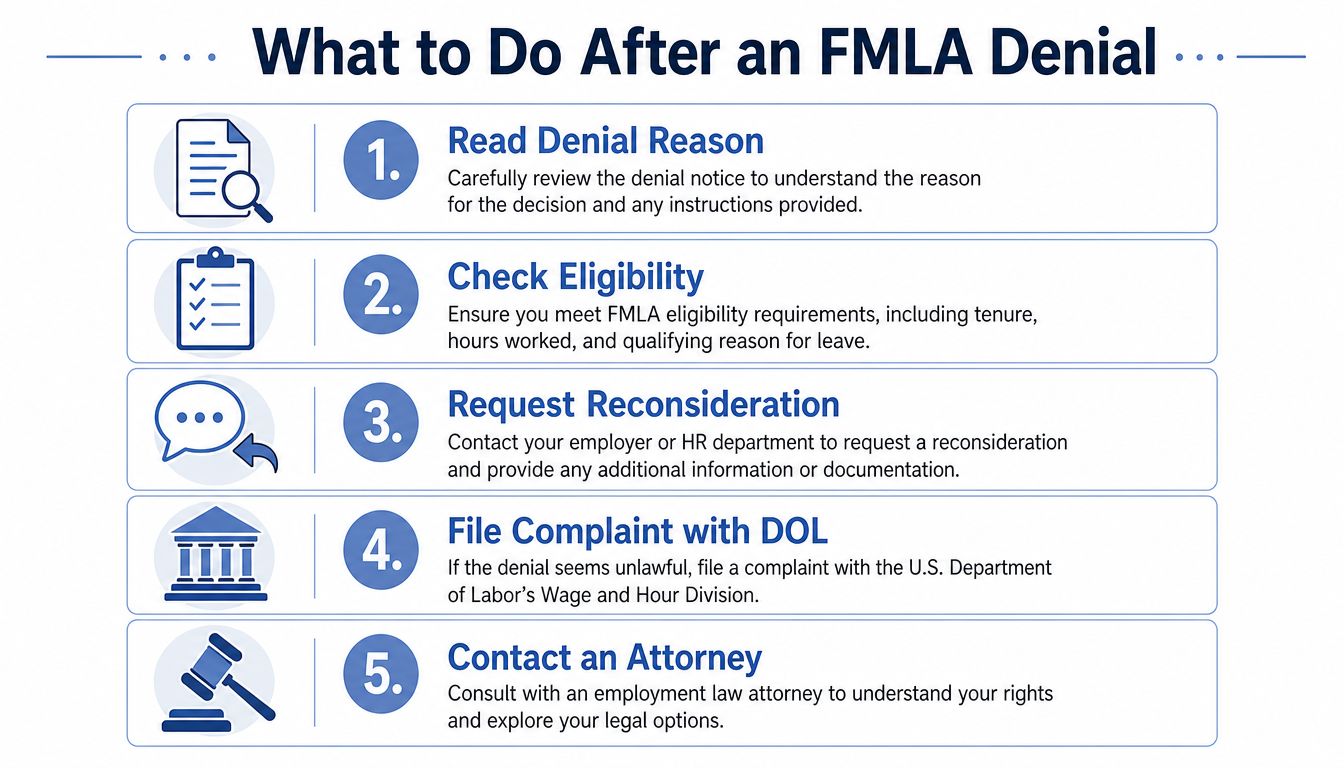
Read the notice carefully and identify whether it refers to eligibility, certification, notice, exhaustion, or the qualifying reason for leave. If the employer only says “not eligible,” ask which requirement failed and request the calculation or explanation in writing.
Then check the dates. Confirm when you requested leave, when the employer issued the certification request, when your provider completed it, and when the employer received it. The 15-calendar-day certification deadline can become decisive, so keep delivery confirmations, portal receipts, fax records, emails, and messages.
Build a clean record
Create one folder, whether digital or paper, with:
- Employer notices: Keep the denial, eligibility notices, certification requests, deficiency notices, and designation communications.
- Medical paperwork: Save copies of forms submitted by your provider and any correction or supplementation.
- Time records: Gather schedules, timecards, pay records, and other evidence relevant to the hours calculation.
- Communications: Preserve emails, text messages, supervisor messages, and notes from telephone calls.
- Workplace actions: Record attendance points, warnings, schedule changes, lost assignments, or termination events after the request.
Keep medical details limited to what is needed for the FMLA process. Don't send an entire medical file when the employer is asking for certification information. Ask the provider to answer the relevant questions fully and clearly.
Request reconsideration in writing
A concise reconsideration message can identify the specific issue without making unsupported accusations. State that you're asking the employer to review the denial, attach corrected certification if appropriate, and explain why the eligibility calculation or deadline record may be incorrect.
If the employer identified a deficiency, cure it rather than arguing around it. If you believe the employer failed to provide a meaningful chance to correct the form, say so calmly and preserve the response.
Know the Mississippi enforcement reality
Mississippi employees generally rely on federal law and the EEOC process, not a state human rights commission, for employment discrimination, harassment, and retaliation claims. The Department of Labor may also be relevant to FMLA administration and enforcement. The correct agency and claim depend on what happened, so an employee shouldn't assume that an FMLA denial automatically belongs in an EEOC charge or that every workplace dispute follows the same route.
FMLA retaliation is also separate from workers' compensation issues. Mississippi doesn't provide a specific state-law retaliation claim for filing a workers' compensation claim, and the Mississippi Workers' Compensation Act doesn't create an anti-retaliation remedy for that act. Don't combine those theories without examining the facts and the legal source of each protection.
If your health, job, or attendance record is at immediate risk, get advice before taking a step that could create additional consequences. A careful timeline is often more useful than an angry response.
Documentation Evidence and When to Contact a Mississippi Attorney
The strongest record usually answers five questions: What did you request? When did you request it? What did the employer ask for? What did you submit? What happened afterward?
Start with the materials closest to those questions. Timecards and pay records can test the hours calculation. The employee handbook and leave policy can show the employer's stated procedure. Certification forms and deficiency notices can reveal whether the employer gave a fair opportunity to correct missing information.
Email and text messages may show the tone and timing of the response. Provider notes can help explain the need for leave and the facts supporting a serious health condition, but employees should avoid collecting or sharing unnecessary private medical records.
Separate FMLA from workers' compensation
Mississippi workers' compensation retaliation is not treated like a standard protected-retaliation claim under Mississippi state law. The Mississippi Supreme Court has declined to recognize a wrongful-discharge or public-policy tort for termination after seeking workers' compensation benefits, as summarized in Mississippi workers' compensation retaliation guidance.
That limitation doesn't erase the underlying compensation claim. A termination doesn't end the workers' compensation claim, and benefits may continue independently of the employment relationship through the Mississippi Workers' Compensation Commission. FMLA rights and workers' compensation rights should be analyzed separately.
Decide whether a case evaluation makes sense
Attorney review may be useful when the employer's explanation changes, the hours calculation appears wrong, a timely certification was ignored, or discipline followed closely after the leave request. It can also help when a worker is unsure whether the problem involves FMLA interference, retaliation, disability discrimination, or a separate wage issue.
Mississippi employment contingency fees commonly fall in the 40% to 50% range, with the percentage tied to recovery and no upfront payment described by Mississippi employment-law sources. Fee arrangements differ, so ask for the terms in writing before representation begins.
For a related explanation of potential recovery issues, read FMLA violation damages. A consultation doesn't change the facts, but it can help organize the record, identify the correct enforcement path, and protect against avoidable deadline mistakes.
Moving Forward After a Denial of FMLA in Mississippi
A denial of FMLA rights in Mississippi usually tells one of three stories. You may have failed an eligibility gate, missed or submitted defective paperwork, or faced conduct that interfered with protected leave or punished you for requesting it.
Use a short checklist:
- Read the stated reason and ask for clarification in writing.
- Verify eligibility using employment dates, hours, and worksite coverage.
- Check certification timing and preserve proof of submission.
- Save every communication before messages disappear.
- Separate legal theories, especially FMLA issues from Mississippi workers' compensation retaliation.
- Seek advice promptly if discipline, termination, or changing explanations are involved.
Mississippi's lack of a state human rights commission means federal protections and federal procedures matter. Self-advocacy may resolve a simple certification problem, but an attorney's review can add value when the employer's actions don't match the paperwork or when your job is at risk.
Nick Norris, P.A. evaluates Mississippi FMLA denials, certification disputes, interference, and retaliation concerns by reviewing the timeline and employment records. Visit Nick Norris, P.A. to request guidance about the denial and the practical options available for your situation.
Leave a Reply