

You may be staring at a date on a termination letter, an EEOC notice, or a string of HR emails and thinking you're already too late.
That feeling is common. A lot of Mississippi workers wait because they're trying to keep the job, calm things down, gather proof, or just get through the week. Then the deadline issue shows up all at once.
The good news is that a missed-looking deadline isn't always the end of the road. Sometimes the law recognizes tolling, which can pause a filing clock in limited situations. But tolling is narrow, fact-specific, and easy to misunderstand. In Mississippi employment matters, that confusion gets worse because Mississippi does not have a state human rights commission, so many workers must use the federal EEOC route instead.
Why Deadlines Feel Unfair and How Tolling Helps Mississippi Workers
A Mississippi worker gets harassed on the job, reports it internally, and hears management say they're “looking into it.” Weeks pass. Then more weeks. The worker is still trying to protect a paycheck, still hoping the company will fix the problem, and still unsure whether the conduct is bad enough to justify legal action.
By the time that worker starts searching online, the first fear is usually simple: “Did I wait too long?”
That's where the idea of a tolling statute of limitations matters. In plain English, tolling is a legal rule that can pause a deadline clock under the right facts. It doesn't make every late claim timely. It doesn't erase delay. But it can protect workers when fairness requires that the clock stop running for a period of time.

Tolling is the law's version of a pause button. It can preserve time you otherwise would have lost, but only if the facts fit a recognized rule.
Why Mississippi workers need a Mississippi-specific view
Mississippi workers face a different path than workers in states with their own human rights agency. Mississippi does not have a state human rights commission, so discrimination, harassment, and retaliation complaints generally don't begin with a Mississippi administrative agency. Workers usually have to use the federal EEOC process for many claims, which changes the route, timing, and paperwork involved, as explained in this discussion of Mississippi employment statute of limitations issues.
That difference matters because workers often assume an internal complaint, supervisor meeting, or company investigation automatically protects the deadline. Often, it doesn't.
What tolling can and can't do
Tolling can help when an employer concealed facts, when extraordinary circumstances blocked a timely filing, or when a recognized administrative or class-based rule applies. It can also matter when a federal claim and a related state-law claim were both pending in federal court.
It can't rescue every delay. If a deadline is treated as jurisdictional, tolling usually isn't available. And even where tolling can apply, the worker often has to show diligence, not just hardship.
What Tolling Really Means and How It Pauses the Clock
Many assume that hearing the term “tolling” means the deadline starts over. That's the first big mistake.
A tolling statute of limitations usually means the clock pauses. It does not usually vanish. It does not usually restart from day one. If you had time left when the pause began, that remaining time usually becomes important when the clock starts running again.

The pause-button analogy
Think of a filing deadline like a kitchen timer.
If the timer runs for a while and then pauses, the elapsed time still counts. When you hit play again, the timer resumes where it stopped. That is usually how tolling works.
By contrast, an extension adds time. A restart wipes the old count away and begins a new one. Those are different concepts, and mixing them up causes real harm in employment cases.
Core concept: Tolling usually suspends the running of time. It usually does not create a brand-new filing period.
The EEOC makes this point clearly in its guidance. It explains that equitable tolling does not automatically begin the filing period anew and instead only extends it for a reasonable period, which is one reason workers should move quickly even when they think tolling may apply, according to the EEOC's threshold issues guidance.
Why courts allow tolling at all
Tolling didn't appear out of nowhere. It's a long-established legal doctrine. Federal law reflects it in several statutes. For example, 18 U.S.C. § 3290 tolls criminal limitations periods during a defendant's fugitivity, and 18 U.S.C. § 3292 allows tolling when the government seeks evidence from a foreign authority. Federal doctrine also traces to a 1945 Supreme Court statement that equitable tolling should be read into federal limitations statutes. Over time, courts moved away from rigid rules tied to physical presence and toward fairness-based exceptions such as concealment, disability, class-action tolling, and administrative-delay tolling, as summarized in the Justice Department's discussion of tolling.
That history matters for workers because employment deadlines often involve fairness questions. Did the worker know enough to act? Did the employer hide the truth? Did something outside the worker's control block action despite real effort?
The jurisdictional problem
Not every deadline can be tolled. Some deadlines are treated as jurisdictional, which usually means courts cannot extend them through equitable doctrines. Others are treated as claims-processing rules, which means tolling may be available if Congress did not make the deadline jurisdictional.
That distinction matters in employment and civil-rights matters. A worker may have a stronger tolling argument when the deadline is nonjurisdictional and the facts show both diligence and a serious barrier to timely filing.
Main Tolling Doctrines Every Employee Should Understand
A Mississippi worker gets passed over, reports it, and hears, "HR is looking into it." Weeks turn into months. Then the worker learns the filing deadline may have kept running the whole time.
That is why tolling matters. It is the law's way of pausing a deadline in limited situations when fairness requires it. The hard part is that "tolling" is not one single rule. It is a group of different doctrines, and each one asks a different question about why the worker did not file on time.
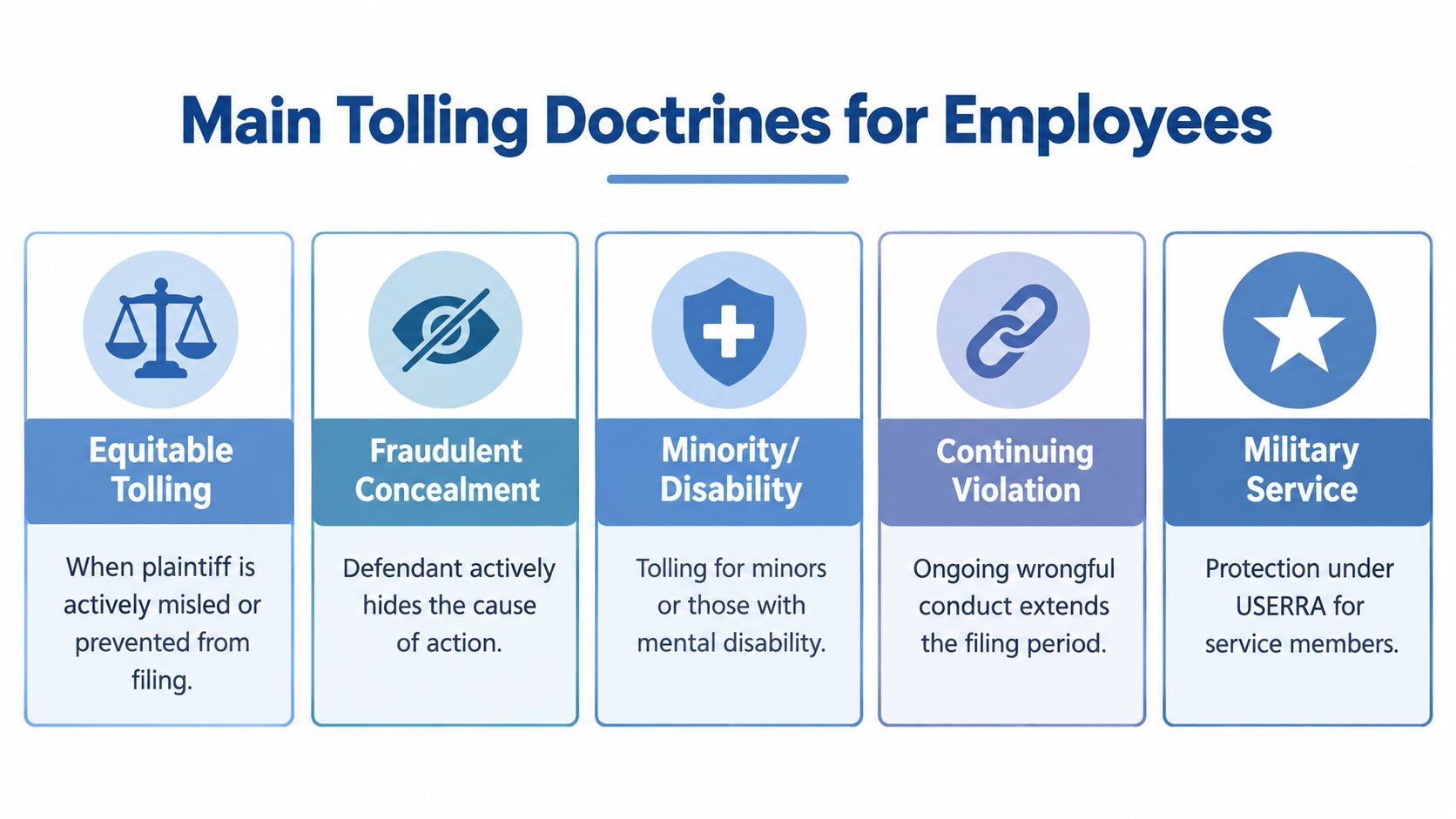
Equitable tolling
This is the doctrine workers usually mean first. Equitable tolling can pause a deadline when the worker pursued the claim with reasonable diligence but an extraordinary obstacle outside the worker's control blocked timely filing. The federal standard is discussed in the Arellano briefing on equitable tolling.
A simple way to understand it is this: the court asks two questions. Did you keep trying? And did something serious, unusual, and external stop you anyway?
For a Mississippi employee, that might mean repeated efforts to gather records, contact the right agency, follow instructions, and submit paperwork, only to be prevented by a rare barrier that ordinary delay or workplace stress does not explain. Proof matters here. Dates, emails, call logs, and written instructions can make or break the argument.
Fraudulent concealment
Fraudulent concealment focuses on what the employer did, not just what the worker knew.
If an employer hid the facts behind the claim, the worker may argue the deadline should be paused because the claim could not reasonably have been discovered earlier. In an employment case, that can involve altered time records, hidden pay practices, false explanations for discipline, or steps taken to cover up discrimination.
Courts usually want more than suspicion or confusion. They want facts showing concealment and a delayed discovery that was reasonable under the circumstances.
Minority or disability tolling
Some tolling rules protect people who could not realistically protect their own rights for a period of time because of age or legal incapacity. In employment cases, this issue is less common than equitable tolling, but it can matter.
Workers sometimes hear "disability" and assume any medical condition stops the clock. That is too broad. The question is usually whether the condition created a legal or practical incapacity serious enough to prevent timely action.
Legislatures sometimes write these protections directly into statutes, and courts have long discussed those structured tolling rules in legal scholarship, including the Cornell Law Review discussion of tolling doctrines and class-related tolling.
Continuing violation
Some workplace problems happen on one date. Others happen as a series.
The continuing violation doctrine matters most when related acts build over time, such as repeated harassment or an ongoing pattern of discriminatory conduct. In the right case, a later act within the filing period can affect how earlier related acts are treated for timeliness.
Workers often get tripped up here. An ongoing effect, like continuing stress from an old decision, is usually different from continuing unlawful acts. If you want a clearer Mississippi-focused explanation, see this article on the continuing violation doctrine in employment cases.
Here's a short explainer video that helps frame how legal timing issues work in practice.
Administrative and EEOC-related tolling
This doctrine matters in Mississippi because workers usually look to the EEOC, not a state civil-rights agency, to start many discrimination and retaliation claims.
That Mississippi detail changes how people should think about timing. An HR complaint at work and a charge with the EEOC are different things. Internal review may help prove what happened, but it does not usually pause a federal deadline by itself. A tolling argument in this setting usually depends on a recognized legal rule, such as misleading agency instructions or some other accepted basis, not on the employer saying it is "handling" the problem.
A pause is not a restart, either. If a court tolls a period for a limited time, the worker usually gets the remaining time left on the original clock. The worker does not get a brand-new full filing period unless a specific rule says so.
Other doctrines worth knowing
Group cases create their own timing rules. In American Pipe, the Supreme Court recognized a form of class-related tolling for absent class members in certain situations. That does not mean every workplace group case works the same way.
This point matters in wage-and-hour cases especially. A worker should not assume that one employee's filing protects everyone else or that a collective claim pauses every deadline automatically.
Tolling Doctrines at a Glance
| Doctrine | What Triggers It | What You Must Show |
|---|---|---|
| Equitable tolling | Extraordinary barrier prevented timely filing | Diligence and a circumstance outside your control |
| Fraudulent concealment | Employer hid key facts | Facts showing concealment and delayed discovery |
| Minority or disability tolling | Legal incapacity interfered with action | Evidence that the condition prevented timely action |
| Continuing violation | Repeated related workplace conduct | A timely connection between acts, not just old harm |
| EEOC or administrative tolling | A recognized filing rule affects timing | Compliance with the applicable administrative process |
| Class-related tolling | A qualifying class filing affects absent members | That the doctrine applies to your posture |
How Tolling Affects Federal and Mississippi Employment Deadlines
Mississippi workers need to think about timing through a federal lens more than many people expect.
That's because Mississippi does not have a state human rights commission, so many discrimination, harassment, and retaliation claims generally move through the EEOC process instead. If you want a broader overview of those timing rules, this guide on the employment discrimination statute of limitations in Mississippi is a useful companion.

The EEOC route in Mississippi
Because Mississippi lacks a state agency counterpart, workers commonly use the federal system from the start. That affects where the claim goes, how the paperwork begins, and which deadlines matter first.
The practical danger is delay caused by hope. A worker may wait on HR, an internal investigation, or a supervisor's promise. Those things may matter as evidence, but they don't automatically stop a federal filing clock.
Timeline example one
Suppose a worker reports repeated sex-based harassment. HR says it's under review. The worker waits, believing that patience is the safe move. Months later, HR closes the complaint without meaningful action.
If tolling is available, the worker still has to ask the right question: Was the clock paused, and if so, when did it resume? The answer usually isn't “you get to start over now.” It's “how much time had already run before the pause, and how much remained after it ended?”
A worker can lose a good claim by assuming a pause means a reset.
That pause-versus-restart distinction drives real case outcomes. It's one reason tolling arguments should be built around dates, documents, and specific events rather than general unfairness.
Timeline example two
Now take a federal case that includes related state-law claims. A worker files those state-law claims in federal court as supplemental claims. Later, the federal court dismisses them.
Under 28 U.S.C. § 1367(d), the Supreme Court has held that the state-law claim is suspended while pending in federal court and then gets an additional 30-day window after dismissal. The clock does not merely create a grace period. It stops and later resumes, as explained in this analysis of the Supreme Court's reading of Section 1367(d).
For employment strategy, that rule can preserve related claims while a worker pursues the federal path. The key is that the supplemental claim must have been properly pending in federal court.
Collective claims and wage cases
Workers also ask whether joining a wage case later automatically saves their claim. That's risky.
Recent wage-and-hour commentary covering 2025 developments says collective actions under the FLSA do not categorically require equitable tolling, so opt-in plaintiffs often need individualized proof of diligence and extraordinary circumstances, according to the Jackson Lewis wage-and-hour review. In practice, that means a worker who joins late shouldn't assume the group case solved the deadline problem.
A simple way to think about preserved time
Use three date categories:
- Starting date: When the claim accrued or the filing clock began.
- Pause date: The event that might support tolling.
- Resume date: When the tolling event ended and the remaining time began running again.
If you can't identify all three, you're not ready to rely on tolling.
Practical Steps to Preserve Your Claim and Protect Tolling Arguments
A Mississippi worker may do everything that feels responsible. Report the problem to HR. Answer follow-up questions. Wait for the company to finish its review. Then the worker learns the EEOC deadline kept running the whole time.
That is why preservation matters so much. Tolling arguments are usually won or lost with dates, documents, and proof that you kept trying to protect your rights.
Your immediate preservation checklist
Start by building a file that shows what happened and when. In a tolling dispute, your timeline works like the receipt drawer for a tax return. If the dates and papers are organized, your argument is easier to prove.
- Write out the timeline: List the date of the firing, harassment, pay problem, leave denial, or other event. Then add the date you complained, each HR response, and each outside filing effort.
- Save proof that you acted diligently: Keep emails, online portal screenshots, certified mail receipts, intake confirmations, calendar entries, and notes from phone calls.
- Preserve evidence of concealment or misinformation: If a manager hid payroll records, gave a false reason for discipline, changed time entries, or told you something misleading about your rights, save it together in one place.
- Track agency steps with care: In many Mississippi discrimination cases, the EEOC is the main administrative route because Mississippi does not have its own state human rights commission handling these charges.
- Treat HR and legal deadlines as separate tracks: HR investigations may matter, but they usually don't replace external deadlines.
- Get legal advice early: A lawyer can sort out whether you are dealing with equitable tolling, fraudulent concealment, a continuing violation argument, or an ordinary deadline calculation.
One missed date can shrink the time you have left.
What to bring to a legal consultation
Bring the papers that fix dates in place. If you were terminated, bring the termination notice. If the issue involves unpaid wages or overtime, bring pay stubs, time records, schedules, and any messages about hours worked. If the issue involves discrimination or retaliation, bring write-ups, emails, texts, handbook pages, and screenshots from any complaint system.
Bring exact filing confirmations if you submitted an EEOC charge or any other agency paperwork. If someone at work gave you incorrect information and you relied on it, write down who said it, when they said it, and what you did because of that statement.
Practical rule: Tolling arguments are strongest when your paper trail shows both diligence and a real obstacle.
Fee expectations and one important workers' compensation warning
Workers often ask about cost at the same time they ask about deadlines. Fee arrangements in Mississippi vary by claim type. Mississippi Code § 71-3-63 limits attorney fees in workers' compensation matters to 25% of the award, which differs from the contingency percentages sometimes discussed in other Mississippi employment cases, as explained in this overview of Mississippi workers' compensation attorney fee limits.
Workers' compensation also has a trap that surprises many Mississippi employees. Mississippi does not recognize a retaliation claim just because a worker filed a workers' compensation claim. If the same facts may also involve discrimination, retaliation under a different law, leave rights, wage claims, or military service protections, each claim needs its own deadline analysis.
For workers who need help sorting out deadline questions and claim type issues, Nick Norris, P.A. is one Mississippi employment law option that evaluates discrimination, harassment, retaliation, wage, FMLA, WARN, and USERRA matters statewide.
Related issues that often travel with tolling
Timing problems rarely stay in one box. A worker may start with a discrimination deadline question, then realize the same facts also touch leave rights, layoff notice, or unpaid wages. Each of those claims can follow a different rule.
The safe approach is simple. Preserve every date, every filing confirmation, and every document that shows why any delay happened. In Mississippi, that careful recordkeeping matters even more because many employment claims run through the federal EEOC process rather than a separate state agency system.
Common Pitfalls That Cause Workers to Lose Tolling Protection
A lot of workers don't lose because the underlying claim is weak. They lose because they make a timing assumption that sounds reasonable but isn't legally safe.
Mistake one: thinking tolling restarts the clock
This is the most common error. A worker believes some event paused time, so the worker assumes a full new filing period begins afterward.
Usually, that's wrong. Tolling commonly pauses and later resumes the clock. If a lot of time had already run before the pause, the worker may have far less time left than expected.
Mistake two: assuming a group wage case automatically protects everyone
Workers in wage-and-hour cases often think joining later is enough. But collective actions under the FLSA don't automatically create tolling for every late participant. In many situations, the worker still needs individualized proof of diligence and extraordinary circumstances.
That makes delay dangerous. Waiting to “see how the case develops” can backfire.
Mistake three: waiting for HR to finish
A Mississippi worker reports discrimination, gets told the company is investigating, and decides not to file externally yet. That may feel cooperative. It may even feel responsible.
But internal processes rarely toll federal deadlines by themselves. Unless a recognized tolling rule applies, HR review and legal deadlines move on separate tracks.
Mistake four: ignoring the jurisdictional question
Some workers hear that courts can be flexible about deadlines and stop there. But flexibility depends on the kind of deadline involved. If the deadline is jurisdictional, tolling usually won't save the case.
That's why “it seems unfair” is not enough. The legal category of the deadline matters.
Mistake five: failing to document diligence
A worker may have worked hard to pursue the claim but kept no proof. That creates a problem because equitable tolling usually turns on documented effort. Courts want to see dates, communications, filing attempts, and barriers, not only a later explanation.
Taking the Next Step to Protect Your Mississippi Employment Rights
If you're worried about a deadline, don't guess. A tolling statute of limitations issue usually turns on a close reading of dates, filings, and what happened between them.
The workers most likely to benefit from tolling are usually the ones who acted, kept records, and can show a recognized reason the clock should have paused. The workers most at risk are often the ones who waited because HR seemed promising, because the employer denied wrongdoing, or because they assumed they'd get a fresh start later.
Before you talk with a lawyer, gather your timeline, every complaint you made, the employer's responses, and any proof that facts were hidden or that extraordinary circumstances blocked timely action. If your issue involves discrimination, harassment, retaliation, unpaid wages, FMLA, WARN, or USERRA rights in Mississippi, the deadline analysis should be done promptly and claim by claim.
You may also want to read more about the EEOC route and other Mississippi employment protections so you can spot where your case fits and what clock may already be running.
Nick Norris, P.A. helps Mississippi workers evaluate employment deadlines, including whether tolling may preserve discrimination, harassment, retaliation, wage, FMLA, WARN, or USERRA claims. If you're worried that time may be running out, visit Nick Norris, P.A. to learn more and request an evaluation before a deadline problem gets harder to fix.
Leave a Reply