

You report harassment to your supervisor or human resources. After that, your schedule changes, your workload grows, and meetings that once included you suddenly happen without you. Nobody says, “This is punishment,” but the workplace feels different, and you're left wondering whether the change is retaliation or ordinary management.
That uncertainty is common. A workplace retaliation lawsuit rarely depends on one openly hostile statement. More often, the issue is whether the employer's decisions, timing, explanations, and treatment of comparable employees show that your protected complaint caused the harm.
Mississippi workers face a distinct procedural reality. Mississippi does not have a state human rights commission, so employees alleging discrimination or retaliation generally rely on federal administrative channels, especially the Equal Employment Opportunity Commission, rather than a Mississippi commission process. This guide focuses only on Mississippi employment law and federal protections available to Mississippi workers. It also addresses an important limit: Mississippi does not provide protection from retaliation for filing a workers' compensation claim, so filing a workers' compensation claim alone doesn't create a retaliation claim.
Introduction to Workplace Retaliation Lawsuits in Mississippi
Suppose a Jackson employee tells management that a supervisor made discriminatory comments. Before the complaint, the employee received favorable reviews and regular assignments. Soon afterward, the supervisor removes the employee from preferred projects, changes the schedule, criticizes minor mistakes, and begins documenting alleged performance problems.
The employee may feel punished, but a legal claim requires more than a bad atmosphere or an unpleasant supervisor. The central question is whether the employer took a materially adverse action because the employee engaged in protected activity. The EEOC's enforcement and litigation statistics show that retaliation has been the most frequently alleged basis in EEOC charges for many years. In fiscal year 2024, the EEOC received 42,301 retaliation charges, representing 47.8% of 88,531 discrimination charges. The agency reported that retaliation surpassed race discrimination as the most frequently alleged basis beginning in fiscal year 2009.
Those figures describe the national enforcement picture, not the value or strength of any individual Mississippi claim. They do show why retaliation deserves careful attention, particularly when the employer never admits its motive.
A sudden change after a complaint isn't automatically illegal retaliation, but it is a reason to preserve evidence and examine the timeline carefully.
The most useful way to evaluate your situation is to separate the questions. What exactly did you report or participate in? What changed afterward? Who made the decision? Did the employer's explanation remain consistent? Were similar employees treated differently? The answers can reveal whether the problem is a legally actionable retaliation claim, another employment dispute, or conduct that needs additional facts before an attorney can assess it.
What Counts as Protected Activity and Adverse Action
Think of a workplace complaint as pulling an alarm. The law doesn't require the alarm to lead to a criminal conviction before protecting the person who used it in good faith. It protects certain employee actions because workers must be able to report discrimination, harassment, and other legally protected concerns without being punished for speaking up.
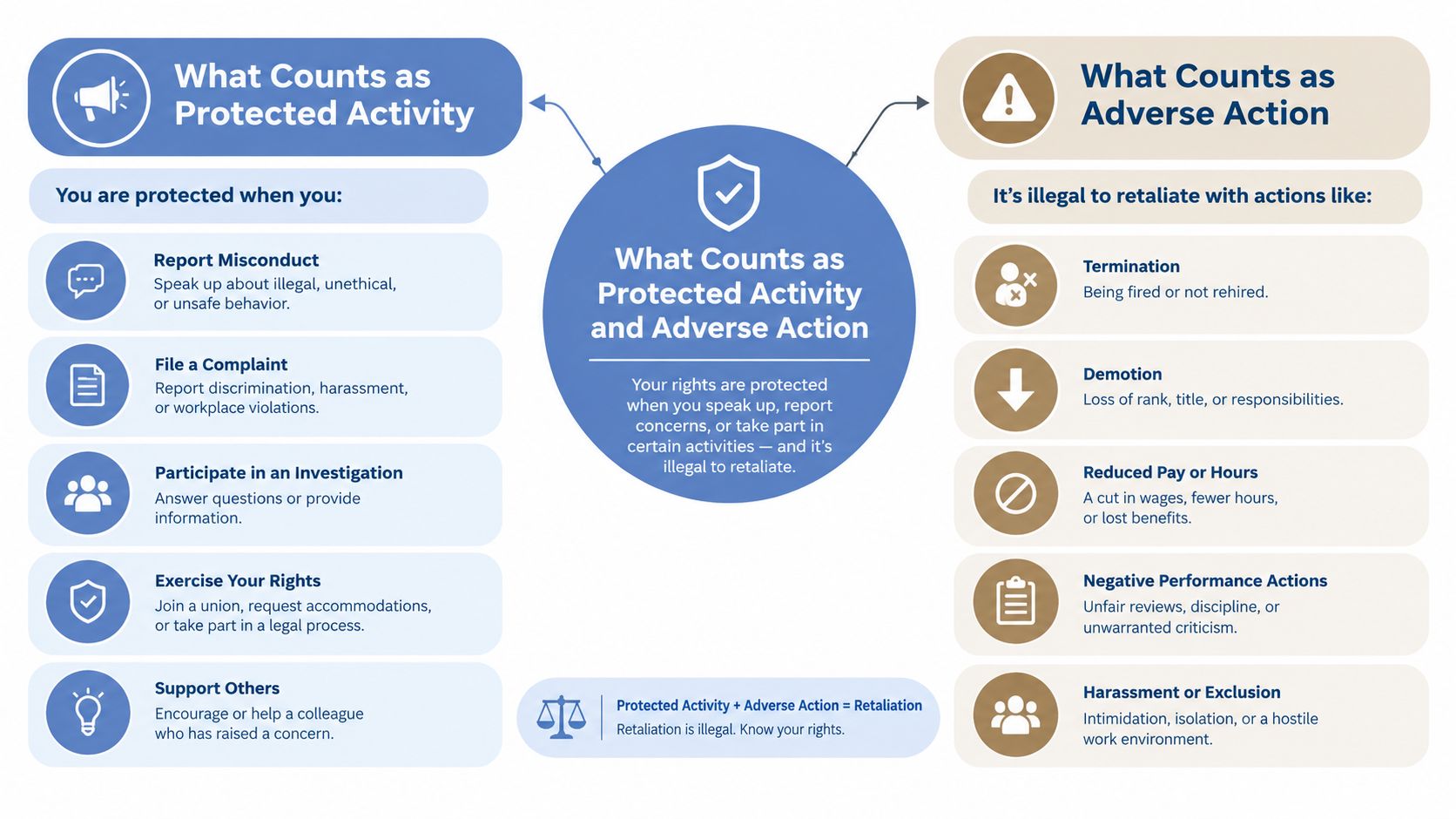
The first element is protected activity
Protected activity generally falls into two categories. Opposition means objecting to conduct the employee reasonably believes violates an employment law, such as reporting discrimination or harassment. Participation means taking part in an investigation, proceeding, or charge involving an employment-law concern.
You don't need to use perfect legal language. A message saying, “I believe my supervisor is treating me differently because of my disability,” may be more useful than a vague statement that the supervisor is “being unfair.” An informal internal complaint can matter, too. Tell HR, a supervisor, or another responsible company representative what happened, identify the concern as clearly as you can, and keep a copy of what you submitted.
Not every workplace disagreement is protected. A complaint about a rude manager, a disliked schedule, or ordinary favoritism may not qualify unless the facts connect the concern to conduct covered by a federal protection. The law examines the substance of the complaint, not merely whether the employee used the phrase “retaliation.”
For related background, see what protected concerted activity means. That concept can involve employee discussions about workplace conditions, but it isn't identical to every discrimination-retaliation theory.
The second element is materially adverse action
An adverse action isn't limited to termination. A demotion, pay reduction, denial of an opportunity, schedule change, undesirable reassignment, serious discipline, or conduct that would discourage a reasonable worker from making a protected complaint may qualify depending on the facts.
The key is significance. A petty slight or isolated annoyance usually isn't enough by itself. But a pattern of schedule disruptions, exclusion, heightened scrutiny, and threats can become materially adverse when the combined effect makes the employee's work substantially worse or would deter a reasonable person from speaking up.
The third element is causation
Causation connects the alarm to the employer's response. The EEOC's retaliation guidance identifies the basic framework as protected activity, materially adverse action, and a causal connection. For private-sector and state or local government claims, the usual Supreme Court standard is “but for” causation. In plain language, the adverse action would not have happened absent the retaliatory motive.
A close timeline can support an inference, but timing alone may not finish the job. Stronger proof often combines contemporaneous records, comparator treatment, inconsistent explanations, and evidence that the employer began building a case only after the complaint.
The video below offers another visual explanation of the basic retaliation framework.
Common Examples of Retaliation Beyond Termination
Termination is the easiest retaliation example to recognize, but it isn't the only one. The EEOC's fiscal year 2025 annual report states that discharge and constructive discharge were the most frequent allegations in retaliation lawsuits filed in that year. Constructive discharge describes circumstances so intolerable that an employee feels forced to resign. Neither concept means every firing or difficult job becomes retaliation. The employer's motive remains central.
Subtle retaliation often looks like a series of administrative decisions:
- Workload shifts: Your responsibilities increase sharply, deadlines become unrealistic, or desirable work moves to coworkers.
- Scheduling changes: Management assigns less favorable shifts, removes reliable hours, or changes your schedule without a clear business explanation.
- Exclusion from meetings: You're left out of meetings, communications, or projects that remain available to comparable employees.
- Sudden discipline: A manager begins issuing warnings for conduct previously tolerated or creates a negative performance record after your complaint.
- Negative references: A former employer gives unusually damaging information after you participate in a protected investigation.
- Promotion or assignment decisions: You lose an opportunity soon after reporting discrimination, while the employer gives shifting explanations.

The legal question isn't whether the employer made a decision you disliked. It's whether the action was materially adverse and connected to your protected activity. A schedule change may be ordinary management in one setting, but a schedule change that causes serious hardship immediately after a complaint can carry a different significance. Exclusion may be harmless in one role and career-damaging in another.
Evidence makes the pattern visible
Keep the documents that existed before the complaint, including performance reviews, praise, attendance records, schedules, and project assignments. Then compare them with what happened afterward. A before-and-after record can expose whether discipline was consistent or whether management suddenly changed its approach.
Comparator evidence can be especially important. If other employees made similar mistakes but weren't disciplined, identify who they were, what happened, and whether the decision-makers knew about your complaint. Don't guess about motives in your notes. Record dates, words used, people present, and the practical effect of each change.
The strongest timeline often shows more than bad timing. It shows a protected complaint, a sharp shift in treatment, and an employer explanation that doesn't fit the records.
Federal Laws and Mississippi Specific Filing Realities
Mississippi retaliation claims generally arise under federal laws, depending on the protected activity and the underlying workplace issue. Title VII protects employees who oppose or participate in matters involving discrimination based on protected characteristics, including race, sex, religion, and national origin. The Americans with Disabilities Act addresses retaliation connected to disability discrimination complaints, accommodation requests, or participation in an ADA matter. The Age Discrimination in Employment Act protects qualifying opposition and participation involving age discrimination.
The Family and Medical Leave Act can protect an employee who requests or uses qualifying leave or complains about interference with FMLA rights. Other federal laws may apply to particular protected activity. The correct statute matters because each law can have different definitions, procedures, deadlines, and available remedies.
Mississippi uses the federal administrative route
Mississippi has no state human rights commission. A worker alleging discrimination or retaliation generally uses the EEOC's federal process rather than filing with a Mississippi human rights agency. That procedural fact affects planning from the beginning because an employee must identify the correct federal theory, preserve supporting evidence, and watch the applicable administrative deadline.
Federal discrimination statutes commonly require an EEOC charge before a federal lawsuit can proceed. The deadline can depend on the statute, the type of employer, the date of the challenged action, and whether another agency process applies. Don't assume that an internal HR complaint pauses the federal deadline. It may not.
A chronological filing checklist
- Identify the protected activity. Write down exactly what you reported, requested, opposed, or participated in, along with the date and recipient.
- Identify each adverse action. Include schedule changes, discipline, exclusion, lost opportunities, compensation changes, and termination, not only the most dramatic event.
- Confirm the governing law. Title VII, the ADA, the ADEA, the FMLA, or another federal statute may control different facts.
- Check the EEOC deadline promptly. An attorney can evaluate the deadline and filing route based on your circumstances.
- Preserve the record. Save lawful copies of relevant emails, reviews, schedules, written complaints, and messages. Don't remove confidential business information that you have no right to possess.
Mississippi law has another important limit. Mississippi does not provide protection from retaliation for filing a workers' compensation claim. Therefore, there isn't a retaliation claim based solely on filing a workers' compensation claim. Additional facts may involve another legal theory, but the workers' compensation filing itself doesn't create the retaliation claim described here.
Because deadlines and tolling questions can be technical, review how tolling can affect a statute of limitations and get advice specific to the events in your workplace.
Damages and Remedies Available in a Retaliation Case
A successful retaliation claim is designed to address harm caused by the unlawful action, not to provide a windfall. The available remedy depends on the statute, the employer, the evidence, and the connection between the retaliation and the losses.
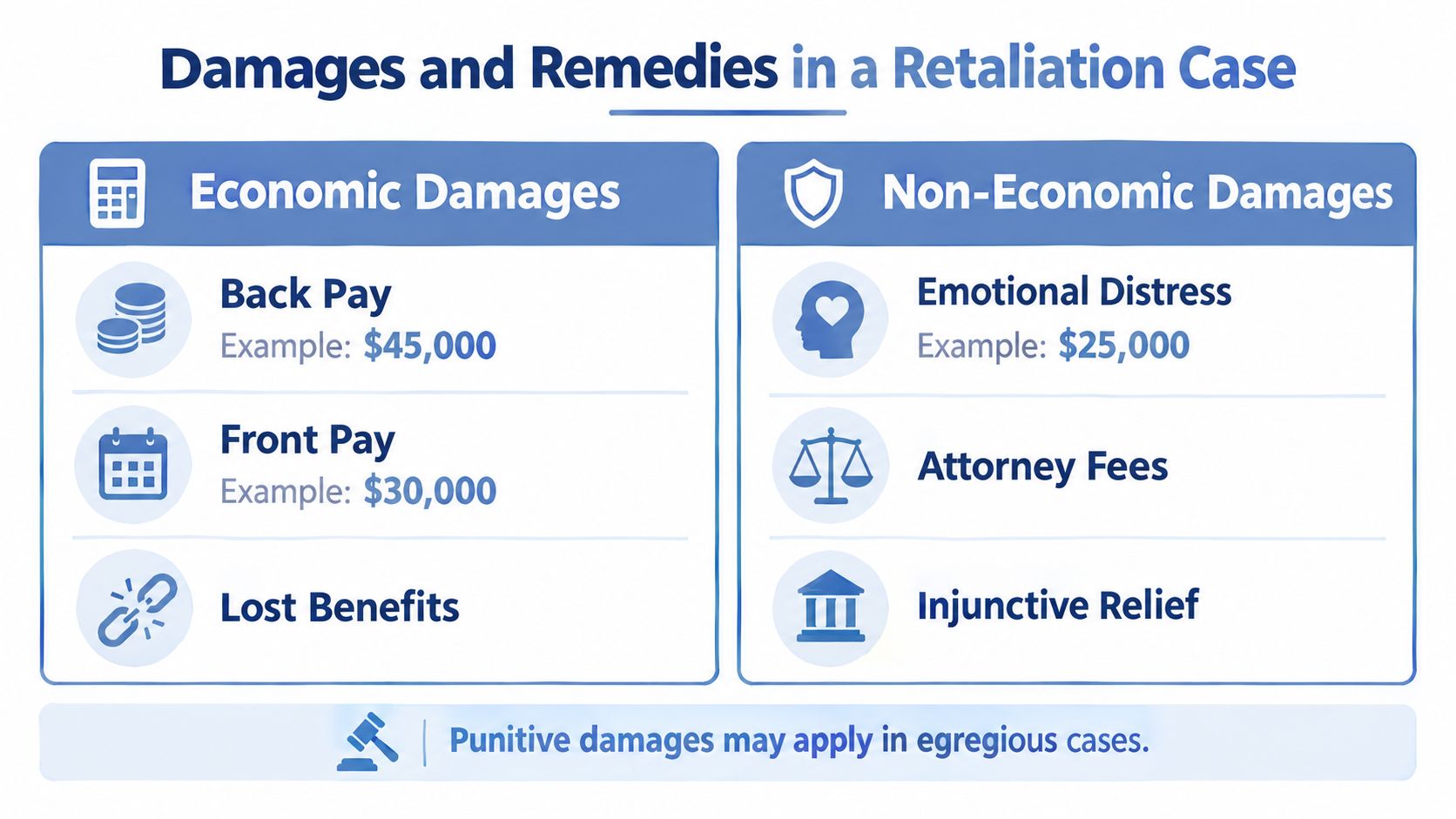
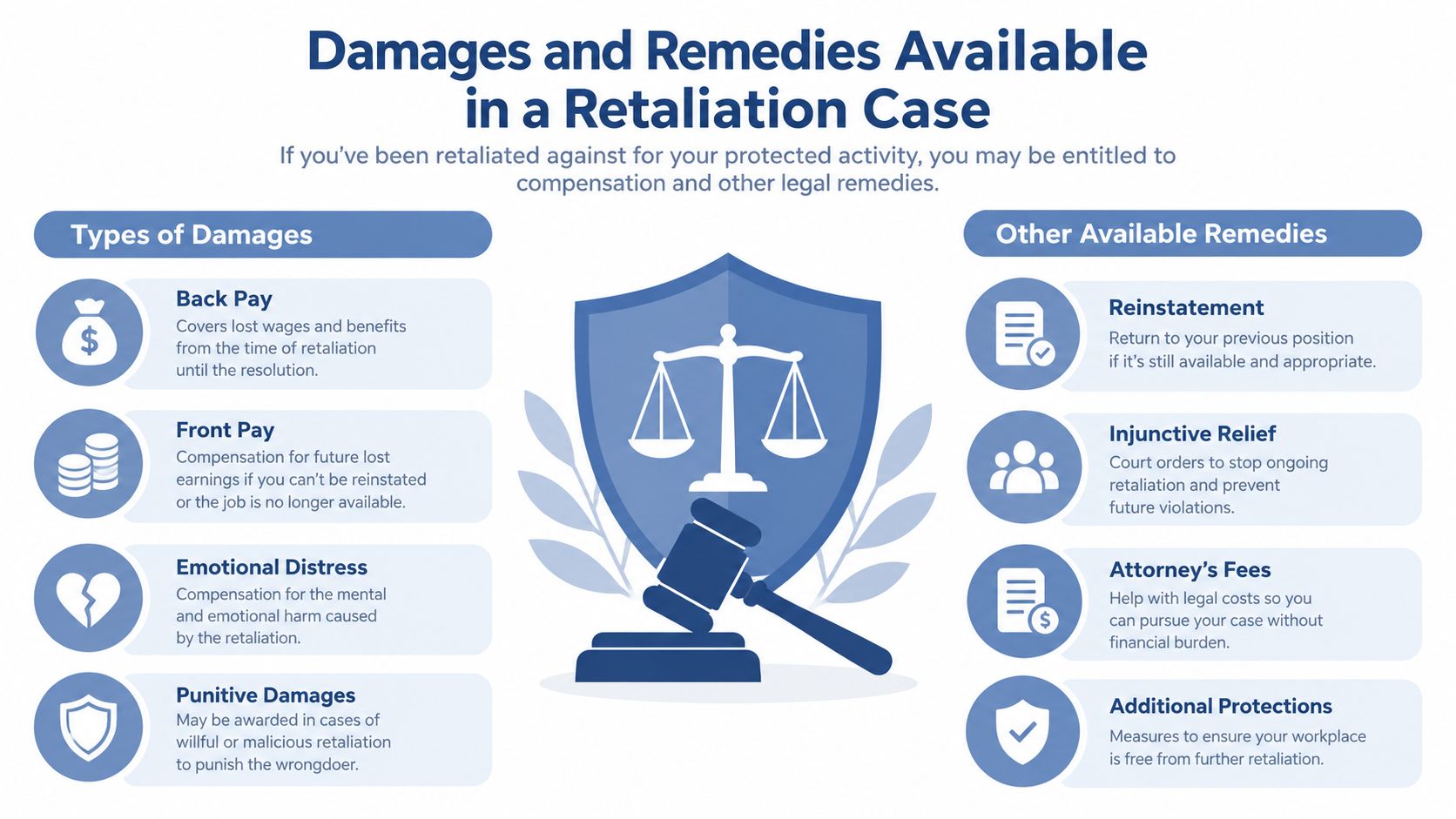
Back pay can address wages lost after a demotion, termination, reduction in hours, or other retaliatory action. Front pay may be considered when returning to the former position isn't practical. Lost benefits can also matter when the retaliatory action interrupted health coverage, retirement contributions, bonuses, or other employment benefits.
Compensatory damages may address proven non-economic harm, such as emotional distress. The employee still needs evidence. Medical records, counseling records, contemporaneous notes, testimony from people who observed the change, and proof of the workplace consequences can help establish the nature of the injury.
Equitable and punitive remedies
Equitable relief focuses on correcting the employment situation. Depending on the claim, a remedy may include reinstatement, correction of records, an order requiring lawful conduct, or other workplace changes. Reinstatement isn't appropriate or workable in every case, especially when trust has broken down or the position no longer exists.
Punitive damages may be available in egregious circumstances under some federal laws, but they aren't automatic. The facts must support the required legal standard, and statutory limits may apply. Attorney fees can also be recoverable in qualifying cases, but a potential recovery doesn't guarantee that every cost will be paid or that the case will end with a favorable result.
Mississippi employment cases are often handled through contingency arrangements. A Mississippi legal source describes the average contingency fee as 40% to 50% of any recovery, while a Mississippi Supreme Court discussion describes a typical formulation as 40% through trial and 50% if an appeal is taken. See how employment lawyers may be paid in Mississippi for questions to ask about the percentage, litigation expenses, and what happens if there is no recovery.
The fee structure is only one part of the decision. A careful evaluation should weigh lost income, proof of emotional harm, available equitable relief, litigation risk, expected duration, and settlement options. A strong case may resolve through negotiation rather than trial, and a large-looking loss may be difficult to recover if causation or documentation is weak.
How the Investigation and Litigation Process Unfolds
The process usually begins before anyone files a lawsuit. You report the underlying conduct internally, or you document what happened and seek legal advice. HR may investigate, ask for interviews, review records, and issue a conclusion. Keep your own factual timeline while the events are fresh, because the employer's investigation file may not contain every detail you remember.
Preserve evidence before the record changes
Create a private chronology with dates, names, exact words when you remember them, documents involved, and what changed afterward. Keep lawful copies of your complaints, HR responses, schedules, performance reviews, disciplinary notices, relevant text messages, and emails. Don't alter documents or forward confidential business material indiscriminately. Ask an attorney how to preserve evidence without creating a separate workplace problem.
A practical checklist includes:
- Timeline: Record the protected activity and every later adverse event.
- Documents: Save written complaints, reviews, schedules, warnings, and termination materials.
- Witnesses: Note coworkers who saw the conduct or know how comparators were treated.
- Explanations: Write down each reason management gave and when it was given.
- Before-and-after proof: Preserve evidence of your performance and treatment before the complaint.
For a focused evidence discussion, review how to prove retaliation at work. The purpose isn't to build a dramatic story. It's to preserve reliable facts that let an attorney test causation.
The EEOC stage often shapes the case
A worker generally files an administrative charge with the EEOC when the applicable federal law requires that step. The EEOC may request a position statement, conduct fact gathering, offer mediation, or pursue conciliation. In fiscal year 2025, the EEOC reported securing over $528 million in monetary relief during pre-litigation enforcement, including about $245.3 million through mediation across 7,929 resolved cases, according to its agency performance report.
Those figures don't predict your outcome. They do show why administrative strategy matters. The EEOC reported 90,743 charges resolved and 49,807 pending at year-end in fiscal year 2025, so an administrative matter may take time and may not end with a lawsuit. If the agency issues a right-to-sue notice, the notice controls an important later deadline. Federal litigation can then involve pleadings, discovery, depositions, motions, settlement discussions, and trial preparation.
Protecting Your Claim and Next Steps for Mississippi Workers
Start with facts, not conclusions. Save your complaint, the response, schedules, reviews, warnings, messages, and termination documents. Write a dated account of what happened, identify witnesses, and track changes in workload, meetings, assignments, and discipline. Keep copies off employer systems, but don't take materials you aren't legally allowed to possess.
Separate the original workplace problem from the retaliation. A discrimination complaint may be protected even if an investigation later finds insufficient proof of discrimination, but the exact wording and context matter. A workers' compensation filing alone doesn't create a Mississippi retaliation claim, so don't assume every negative event after a leave or injury report falls under the same rule.
Mississippi workers generally rely on the EEOC's federal administrative process because the state has no human rights commission. Deadlines can depend on the statute and facts, so prompt legal review is safer than waiting for the employer's internal process to finish.
Related resources may help you identify the governing issue, including information about the Family and Medical Leave Act, WARN Act protections, and USERRA rights. You don't need to decide immediately whether to file a workplace retaliation lawsuit. You do need to protect the evidence that will allow a Mississippi employment attorney to evaluate your options.
As a Mississippi workplace retaliation lawyer, Nick Norris, P.A. evaluates retaliation matters, helps employees preserve timelines and evidence, and develops strategies for negotiation, EEOC proceedings, or federal litigation. Visit Nick Norris, P.A. to request a confidential evaluation of what happened and learn what steps may protect your claim.
Leave a Reply