

You report discriminatory comments to your supervisor, but the conduct continues. You start sleeping poorly, avoid coworkers, and lose confidence in work you once handled easily. At home, your family notices that you're withdrawn and irritable. You may be asking whether Mississippi law lets you recover for that harm, especially if your lost wages don't fully describe what the workplace did to you.
Emotional distress damages can sometimes compensate that nonfinancial injury. But a discrimination claim alone doesn't automatically establish emotional harm, and ordinary frustration isn't automatically a substantial damages claim. The strength of the case usually depends on the evidence connecting specific employer conduct to specific changes in your mental health, daily life, work, or relationships.
What Emotional Distress Damages Mean for Mississippi Workers
Consider a Mississippi employee who is repeatedly subjected to sex-based remarks, excluded from important meetings, and treated differently from coworkers. She reports the conduct, but management minimizes it. Over time, she begins documenting panic before each shift, stops attending social events, and asks family members to help her manage ordinary responsibilities.
Those consequences may be relevant to emotional distress damages, a form of nonpecuniary compensation for harm that doesn't appear on a wage statement. The category can include emotional pain, suffering, inconvenience, mental anguish, loss of enjoyment of life, humiliation, reputational harm, and related psychological or dignitary injuries. The Supreme Court filing discussing Title VII remedies describes the significance of the Civil Rights Act of 1991, which added compensatory and punitive damages for intentional discrimination under Title VII.

The two questions a claim must answer
A claimant generally must prove actual compensable injury and a causal connection between that injury and unlawful employment conduct. Proving that an employer discriminated, harassed, or retaliated doesn't by itself prove that the employee suffered compensable emotional harm.
Evidence becomes more useful when it shows what changed and when. A coworker may describe your distress after a particular incident. A family member may explain that you stopped sleeping or withdrew from normal activities. Medical or counseling records may document symptoms, treatment, or medication. A chronology can help separate workplace-related symptoms from distress that existed before the disputed conduct.
Emotional distress damages also differ from economic damages. Lost wages, medical expenses, and job-search costs address financial consequences. Emotional distress damages address the intangible effects of the employer's conduct. A single event can produce both categories, but each requires its own proof.
Practical rule: Don't describe the harm only as “stress.” Identify the symptom, the timing, the effect on your life, and the workplace event you believe caused it.
The law recognizes that intentional workplace discrimination can injure more than a person's income. It can affect dignity, confidence, family life, reputation, and the ability to enjoy ordinary activities. Still, an exaggerated account can undermine an otherwise legitimate claim. A careful explanation supported by contemporaneous evidence usually works better than a dramatic conclusion unsupported by records or witnesses.
Employees researching possible theories can learn about employment claims, while Mississippi workers may also find it useful to review whether they can sue an employer for emotional distress. The right legal theory matters because the available remedies depend on the statute and facts involved.
Legal Theories That Support Emotional Distress Claims
Mississippi employees don't have one universal emotional-distress claim for every bad workplace experience. The conduct, the protected right involved, and the statute supplying the remedy all matter.
Intentional discrimination under federal law
Title VII and the Americans with Disabilities Act can support compensatory damages for intentional discrimination, including qualifying emotional harm. The Civil Rights Act of 1991 marked a foundational change in Title VII litigation. Before that law, Title VII primarily focused on equitable remedies such as back pay, reinstatement, and injunctions. Section 102 added compensatory and punitive damages for intentional discrimination, including non-economic harm such as mental anguish, humiliation, inconvenience, and loss of enjoyment of life. That statutory change recognized workplace discrimination as an injury affecting personal dignity and psychological well-being, not only employment income.
The distinction between intentional discrimination and disparate impact is important. The remedy structure doesn't treat every discrimination theory alike. A claimant must identify the specific theory and confirm that the statute authorizes the damages being requested.

Hostile work environment and retaliation
A hostile-work-environment claim may involve repeated harassment tied to a protected characteristic. The emotional harm must still connect to unlawful conduct, rather than merely to an unpleasant personality conflict, a difficult supervisor, or ordinary workplace tension. Retaliation claims under laws that protect employees for reporting discrimination or participating in a protected process can also carry distinct remedies, but the statute and facts control.
Employees should be cautious about labeling every adverse action retaliation. The employer must have taken action because of legally protected activity, and the damages analysis depends on the law supporting the claim.
Intentional infliction and other employment statutes
Mississippi employees may also consider whether extreme and outrageous conduct supports an intentional-infliction theory. That is not a substitute for proving discrimination, and not every humiliating or unfair act meets that demanding standard. The facts must be evaluated under the elements of the specific claim, including the nature of the conduct and the resulting injury.
FMLA, USERRA, and other employment statutes have their own remedial structures. Some may allow recovery for certain losses but not emotional distress damages. The Age Discrimination in Employment Act is a particularly important example. Emotional distress damages aren't available under that statute in the same way they may be available under intentional-discrimination provisions of Title VII or the ADA.
The practical question is not just whether conduct was hurtful. Ask four questions:
- What right was violated? Identify the protected characteristic, protected activity, disability-related right, leave right, service-related right, or other legal protection.
- What statute applies? Different laws authorize different forms of relief.
- Was the conduct intentional? Intent can affect whether compensatory and punitive damages are available.
- What harm can be proved? The claim needs evidence of actual injury and causation, not only proof of misconduct.
Mississippi Filing Requirements and Federal Procedures
Mississippi does not have a state human-rights commission that independently processes employment-discrimination complaints. Employees alleging discrimination or related retaliation generally rely on the federal Equal Employment Opportunity Commission rather than filing through a separate Mississippi human-rights agency.
That procedural reality makes federal deadlines especially important. Waiting for an internal investigation, hoping conditions improve, or negotiating informally with management can consume time without preserving every legal right. An internal complaint may help establish notice and give the employer an opportunity to respond, but it doesn't replace the need to evaluate the EEOC process promptly.
Start with a dated record
Write down the dates of the discriminatory comments, harassment, discipline, schedule changes, denied opportunities, complaints, and resulting symptoms. Preserve emails, text messages, performance reviews, written warnings, meeting notices, and messages to people outside work. Keep the record factual. Don't alter original messages or create a narrative that overstates what happened.
A charge typically identifies the employer, the employment events, the protected basis or protected activity, and the relevant dates. The EEOC process can affect later litigation, so descriptions should be accurate and complete. A charge shouldn't become a place to speculate about medical diagnoses or damages that aren't supported by the available facts.
Understand the right-to-sue process
The EEOC may investigate, facilitate resolution, request information, or take other action. The procedural path can vary, and receiving a right-to-sue notice creates a separate deadline that requires immediate attention. Mississippi employees can review what a right-to-sue letter means before deciding how to respond.
Missing a federal deadline can affect a claim even when the underlying workplace conduct was serious.
Do not treat the lack of a Mississippi human-rights commission as a reason to delay. It means employees need a clear federal filing strategy, early preservation of evidence, and a realistic assessment of which legal theories remain available. It also means that a conversation with an employment lawyer can be useful before submitting a charge, particularly when several events occurred over time or the employer has offered a separation agreement.
How Emotional Distress Damages Are Calculated and Capped
There is no definitive formula that converts anxiety, humiliation, sleeplessness, or loss of enjoyment into a particular dollar amount. The fact-finder evaluates the evidence, including the severity, duration, credibility, functional effect, treatment, corroboration, and connection to the employer's conduct. A diagnosis may help explain an injury, but the absence of a diagnosis doesn't automatically resolve the issue.
For covered intentional-discrimination claims under Title VII, the ADA, and comparable federal statutes, compensatory and punitive damages are combined for statutory-cap purposes. The cap depends on the employer's size. These figures come from the EEOC's explanation of remedies in employment-discrimination cases.
| Employer Size | Combined Cap |
|---|---|
| 15 to 100 employees | $50,000 |
| 101 to 200 employees | $100,000 |
| 201 to 500 employees | $200,000 |
| More than 500 employees | $300,000 |
The cap isn't the whole case value
The combined cap applies to compensatory and punitive damages. It doesn't necessarily include every other form of relief. Back pay, certain front-pay or equitable remedies, prejudgment interest, attorneys' fees, and documented out-of-pocket losses may be analyzed separately, depending on the claim and applicable law.
That distinction changes how a case should be evaluated. An employee might have limited emotional distress evidence but substantial wage loss. Another employee might have strong proof of psychological harm but little economic loss. A statutory maximum isn't a settlement guarantee, a prediction of a verdict, or a substitute for reviewing the entire remedy structure.
Employer size should be verified early. Workforce counting can affect the applicable cap, and the relevant number may require reviewing the employer's records rather than relying on a casual estimate. Counsel should also classify each claimed loss instead of placing every item under emotional distress.
Claim selection controls available remedies
The ADEA doesn't allow emotional-distress damages in the same manner as Title VII or the ADA. Wage, leave, retaliation, constitutional, and other theories may carry different rules. A worker who assumes that every employment statute permits the same damages can make an avoidable strategic mistake.
The better approach is to map each factual event to a legal theory, then identify the remedies that theory supports. That analysis can reveal that back pay, reinstatement, injunctive relief, or attorneys' fees remain important even when emotional distress is capped or unavailable.
Evidence Strategies for Proving Emotional Distress in Mississippi
A credible claim usually develops along a continuum. At one end is ordinary workplace upset, such as frustration after an argument or disappointment after a routine employment decision. At the other is a medically recognized psychiatric injury with documented symptoms and functional impairment. Between those points, corroborated evidence can still show meaningful harm, even when the employee hasn't received a formal diagnosis.
The central task is to show what happened to you, when it happened, and how it changed your life. The EEOC's discussion of emotional-harm proof emphasizes actual harm and causation rather than punishment. It also recognizes that emotional-harm awards don't have a definitive valuation formula.
Build contemporaneous proof
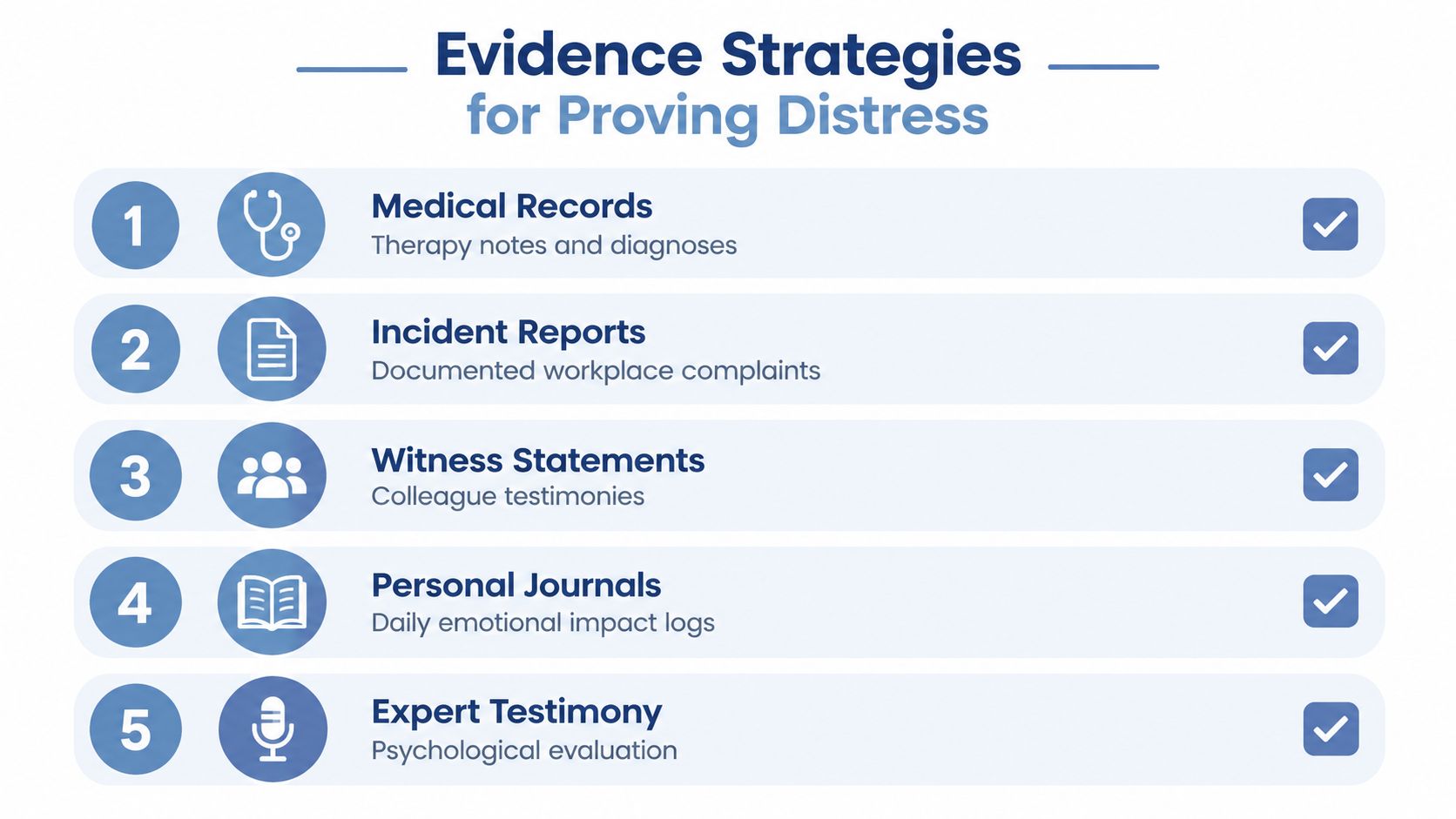
Start with a private, factual chronology. Record the event, the people involved, what was said or done, your immediate response, and what changed afterward. Texts to a spouse or trusted person, calendar entries, personal journals, and contemporaneous emails can help show that symptoms were described close to the time they occurred.
Document functional changes, not just feelings. Did you stop attending church or family gatherings? Did you miss work, make unusual errors, withdraw from coworkers, or struggle to complete ordinary tasks? Did sleep disruption, medication, or persistent fear affect your routine? Specific details allow a fact-finder to assess harm without asking that person to rely on a general statement that you were stressed.
Use witnesses and records carefully
Coworkers may confirm the workplace events. Family members may describe changes outside work. Medical providers, counselors, and prescribing professionals may provide records or testimony about symptoms and treatment. Work-performance records can be useful when they show a before-and-after change, but they can also create complications if the employer argues that performance problems had another cause.
Treatment can strengthen proof, but it carries a trade-off. If you seek more than nominal emotional-distress damages, the employer may argue that your mental condition is at issue and seek relevant records or information. Therapy isn't something an employee should pursue merely to manufacture evidence, and declining treatment doesn't prove that the injury wasn't real. Make health decisions for health reasons, then understand that privacy protections may change if you place your mental condition directly in dispute.
Separate old symptoms from new ones
Preexisting anxiety, depression, family stress, medical conditions, or earlier workplace problems don't necessarily defeat a claim. They do make causation more important. A clear chronology can show what existed before the alleged discrimination and what began or worsened afterward.
Documentation works best when it is accurate, timely, and specific. It shouldn't read like a damages demand drafted after the dispute began.
Avoid inflating symptoms or adopting a diagnosis you haven't received. Credibility matters. A modest but well-supported account of sleep loss, counseling, social withdrawal, or family observations may carry more weight than an unsupported claim of permanent psychological injury.
Practical Outcomes, Costs, and When to Consult an Attorney
There isn't a reliable universal value range for emotional distress claims in Mississippi. Case value depends on the legal theory, proof of discrimination or harassment, employer size, duration and severity of the conduct, wage loss, treatment, corroboration, credibility, available defenses, and the remedies authorized by the statute.
Settlement discussions also involve risk on both sides. An employer may focus on the absence of treatment, alternative causes, or inconsistent accounts. An employee may focus on contemporaneous messages, witness observations, documented complaints, and changes in daily functioning. Neither side should confuse the statutory cap with the likely settlement value.
The commonly cited contingency-fee range for Mississippi employment cases is approximately 40% to 50% of the recovery. Under a contingency arrangement, the fee is generally owed only if money is recovered, but the written agreement controls important details, including whether the percentage applies to the gross recovery or the amount remaining after expenses. It should also explain who pays filing, discovery, expert, deposition, and other litigation costs, and whether the percentage changes if the case settles early or proceeds through litigation or appeal. Employees can review how much an employment lawyer costs in Mississippi before signing an agreement.
Signs that early advice may help
Consulting a Mississippi employment attorney is especially useful when:
- The conduct is documented: Emails, messages, complaints, witness accounts, or records preserve the timeline.
- The employer knew: Supervisors or human-resources personnel received complaints and failed to respond appropriately.
- Your life changed: Symptoms affected sleep, work performance, relationships, treatment, medication, or ordinary activities.
- The employer offers an agreement: A release may affect discrimination, retaliation, wage, or emotional-distress claims.
- Several laws may apply: Title VII, the ADA, the FMLA, USERRA, and other laws can provide different remedies.
Warning signs deserve equal attention. A claim may be difficult when the conduct is only a personality conflict, the alleged discrimination has no connection to a protected characteristic, the symptoms are unsupported, or the selected statute doesn't authorize emotional distress damages. Filing a workers' compensation claim itself isn't protected by a general Mississippi statutory retaliation claim. Any possible protection must come from a different, specifically applicable federal or Mississippi theory, such as a qualifying retaliation or whistleblower provision.
Nick Norris, P.A. represents Mississippi employees in matters involving discrimination, sexual harassment, retaliation, wrongful termination, and related employment-law claims where emotional distress may be part of the available recovery.
If workplace discrimination or harassment has affected your mental health, preserve your records and get advice before a federal deadline passes or you sign an employer agreement. Visit Nick Norris, P.A. to request a confidential evaluation of your Mississippi employment claim and discuss the evidence, legal theory, and remedies that may apply.
Leave a Reply