

In Mississippi, an employment discrimination lawsuit typically requires filing a charge with the federal EEOC within 180 days, because Mississippi has no state-level human rights commission. The EEOC received 88,531 new discrimination charges in FY 2024, including claims involving retaliation, harassment, race, sex, and disability discrimination.
You may be reading this after a termination, a sudden schedule change, a denied promotion, or a performance review that seems unlike anything you received before. Your employer may have offered a neutral explanation, such as poor performance, attendance, restructuring, or a policy violation. The difficult question is whether that explanation is genuine or whether it hides discrimination or retaliation.
Mississippi employees usually begin with the Equal Employment Opportunity Commission, not an immediate lawsuit. The evidence you preserve, the date you act, and the way you describe the protected conduct can determine whether a potential claim remains viable.
What Is an Employment Discrimination Lawsuit in Mississippi
Suppose a Mississippi employee with a strong work history is denied a promotion. A less-qualified coworker receives the position, the employee's responsibilities are reduced, and a supervisor begins documenting minor mistakes. The employee suspects race, sex, age, or disability discrimination, but the employer says the decision was based on “fit” or “performance.”
An employment discrimination lawsuit is a civil claim alleging that an employer made an employment decision because of a protected characteristic or protected activity. Protected characteristics can include race, color, religion, sex, pregnancy, national origin, age, disability, or genetic information. Protected activity can include opposing unlawful discrimination, participating in an EEOC investigation, or asserting another right protected by law.
Unfair treatment alone usually isn't enough. A difficult supervisor, favoritism, a bad workplace decision, or an unfair performance review may be upsetting without violating employment-discrimination law. The legal question is whether the employer acted because of a protected trait or because the employee engaged in protected conduct.

What makes a Mississippi claim practical
A viable case often develops from several connected facts rather than one dramatic statement:
- A protected basis: The employee belongs to a protected class or engaged in protected activity.
- An adverse action: The employer fired, demoted, disciplined, refused to hire, reduced hours, denied a promotion, or changed working conditions.
- A connection: Timing, comments, comparators, inconsistent discipline, or shifting explanations connect the action to the protected basis.
- Proof: Emails, text messages, evaluations, policies, payroll records, and witness testimony support the employee's account.
Mississippi has no general state human-rights commission for private-sector employment discrimination. That makes the federal administrative route especially important. Before deciding whether to remain silent, complain internally, or consult counsel, preserve the documents that show what changed and when.
Disparate Treatment and Disparate Impact Explained
A Mississippi employee can have a strong discrimination claim without having direct proof of slurs or an outright admission. The legal theory matters because it changes what you must prove and what records you need to preserve early.
Disparate treatment is intentional discrimination. The question is whether the employer acted differently because of a protected trait or protected activity. A supervisor who excuses attendance issues for one worker but disciplines another after a disability accommodation request may create that kind of claim. So can a promotion decision where a qualified woman is passed over after sex-based remarks, or where a similarly qualified man receives better treatment under the same standards.
Disparate impact is different. It focuses on a neutral rule that falls harder on a protected group. The policy may look evenhanded on paper, but the results may not be. A screening test, lifting requirement, scheduling rule, or promotion process can trigger this theory if it screens out or burdens a protected group at a higher rate. In those cases, the fight usually turns on how the rule works in practice, whether it caused the disparity, and whether the employer can justify it as job-related and necessary. For a closer explanation, see what disparate impact discrimination means.
Why classification changes the evidence
This distinction affects case value from the start.
| Theory | Central question | Useful evidence |
|---|---|---|
| Disparate treatment | Did the employer treat this person differently because of a protected characteristic or activity? | Decision-maker comments, comparator records, timing, inconsistent discipline, changing explanations |
| Disparate impact | Did a neutral policy disproportionately burden a protected group? | Policy language, workforce records, selection results, exceptions, business justification |
Some cases involve both theories. An employee may challenge a biased supervisor's decision and also challenge the policy that allowed the result. That overlap is common in EEOC charges, where workers often allege multiple forms of discrimination in the same filing.
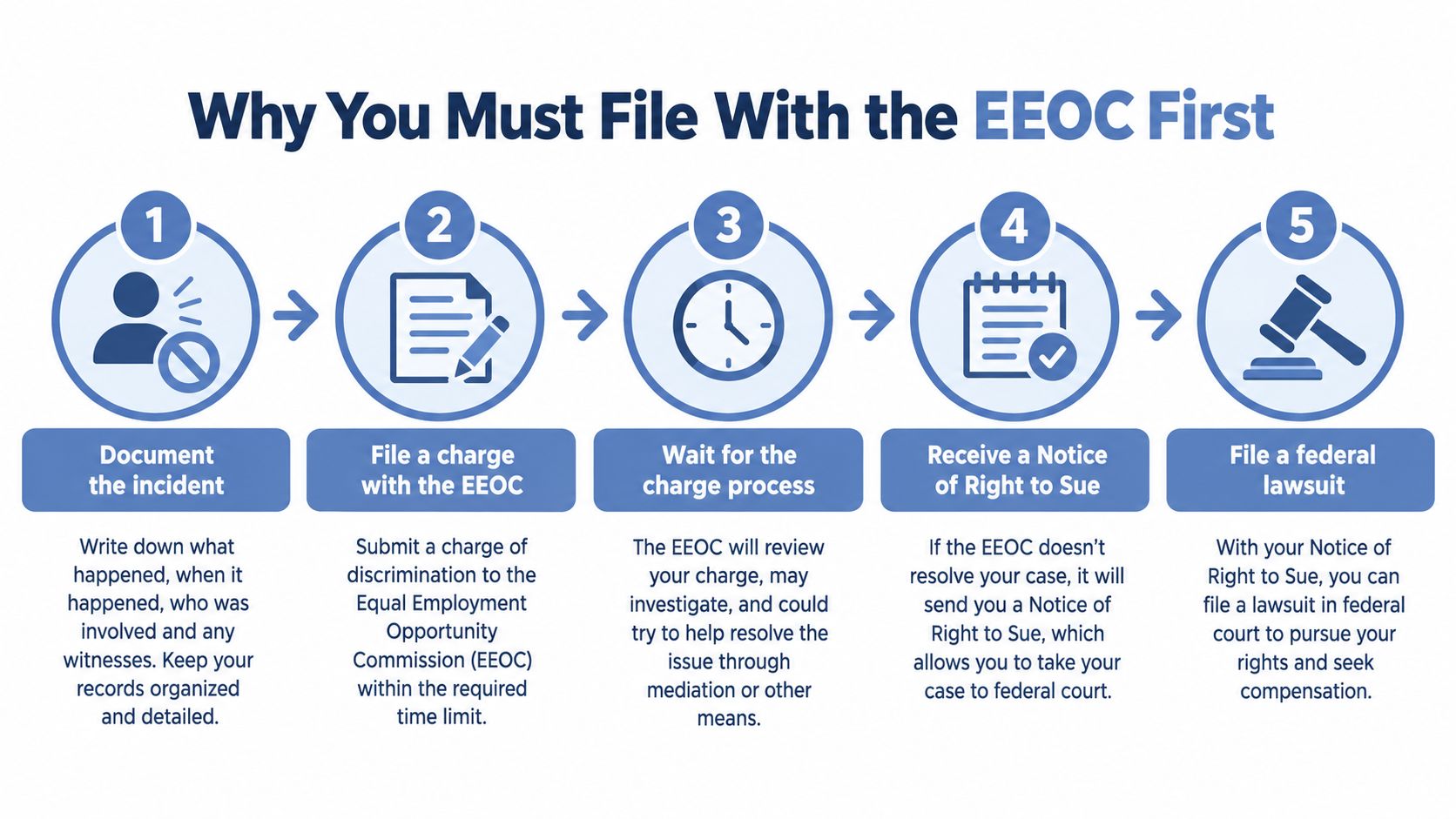
Why You Must File With the EEOC First
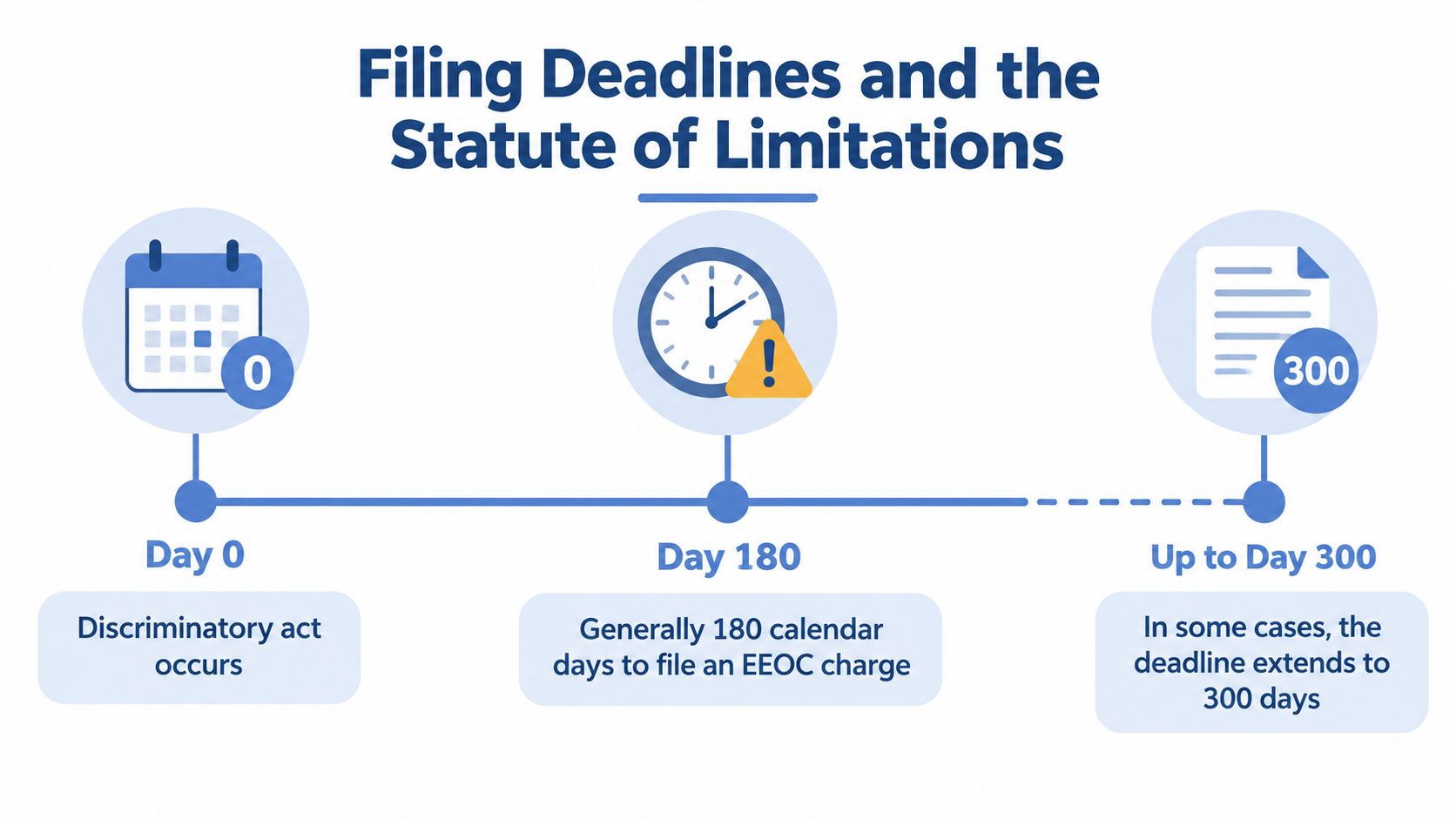
For most Mississippi private-sector discrimination claims, the first formal step is filing a charge with the Equal Employment Opportunity Commission. A worker generally must file within 180 calendar days of the alleged discriminatory act. The period can extend to 300 days where a state or local agency enforces a comparable antidiscrimination law, but Mississippi doesn't have a general state human-rights commission serving that role for private-sector discrimination claims.
That distinction matters. An employee who waits for an internal investigation, severance discussion, or settlement conversation may lose the opportunity to pursue a federal claim. An employer's internal process doesn't automatically replace the EEOC charge requirement or stop the federal deadline.
What the administrative process does
The EEOC charge gives the agency and employer notice of the dispute. The agency may investigate, request information, facilitate mediation or conciliation, and evaluate whether the allegations fall within its enforcement authority. The process also creates an administrative record that can matter later.
The EEOC's FY 2024 workload shows why this step isn't merely a formality. The agency received 88,531 new discrimination charges, a 9.2% increase from the prior year, resolved 87,219 charges, and obtained more than $469.6 million in monetary relief for individuals during the administrative process, according to the EEOC's FY 2024 performance report.
If the matter isn't resolved, the worker may receive a Notice of Right to Sue. That notice permits the employee to pursue a federal lawsuit, subject to the applicable deadline and the claims that were properly presented to the EEOC.
Practical rule: File early enough to protect the deadline, and describe the facts broadly enough to identify related discrimination and retaliation theories without guessing at facts you can't support.
Filing Deadlines and the Statute of Limitations
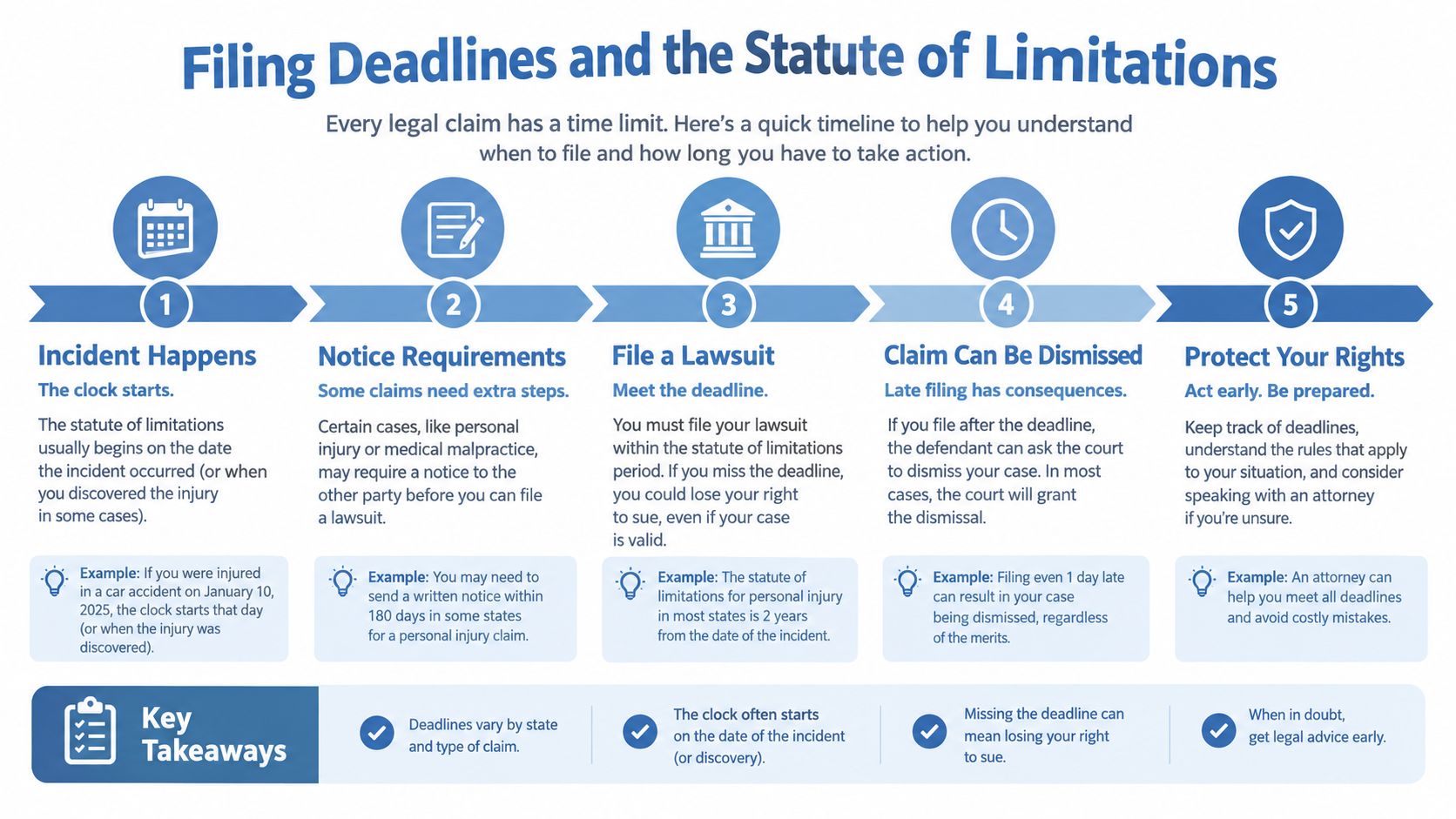
The most dangerous misconception is that an employee can wait until the workplace situation becomes unbearable. In many cases, the clock starts with a discrete event, such as termination, demotion, refusal to hire, failure to promote, or a specific disciplinary decision.
Under the EEOC's filing deadline guidance, a worker generally must file a charge within 180 calendar days of the alleged discriminatory act. The period can extend to 300 days where a state or local agency enforces a comparable antidiscrimination law. Mississippi employees should analyze the deadline immediately rather than assume that an internal complaint, appeal, or settlement discussion pauses it.
Harassment requires a different examination. The filing period generally runs from the last incident, while earlier related incidents may still be considered as part of the hostile-work-environment theory. That doesn't mean every old event remains actionable, so the chronology must identify each incident and explain how the events relate.
Build the record before it disappears
Start a private chronology. Record the date, speaker, decision-maker, witnesses, stated reason, and immediate consequence for each important event. Preserve:
- Employment records: Performance reviews, warnings, schedules, pay records, job applications, termination notices, and policy documents.
- Communications: Emails, text messages, direct messages, calendar entries, and written complaints.
- Witness information: Names, job titles, contact information if known, and what each person personally observed.
- Protected activity: The exact complaint, request, opposition, or participation that may trigger legal protection.
Don't take confidential company information unrelated to your claim or violate a policy governing access to records. Give counsel the original materials and explain how you obtained them.
A deadline analysis should also separate the alleged legal basis, such as race, sex, disability, religion, national origin, age, pregnancy, or retaliation. For a practical discussion of timing, see employment discrimination statute of limitations guidance.
Burden of Proof and Employer Defenses
Most employment discrimination cases aren't won just by showing that an employer's decision was harsh. The central dispute is often whether the employer's stated reason is genuine.
Under the familiar McDonnell Douglas burden-shifting framework, the employee first presents facts supporting a prima facie case. The employer then identifies a legitimate, nondiscriminatory reason for the decision. The employee must finally produce evidence from which a factfinder could conclude that the stated reason is pretext, meaning the explanation is false, selectively applied, or not the reason.
How pretext appears in records
Consider an employee who received acceptable reviews for years and was disciplined shortly after reporting race discrimination. The employer says the termination resulted from poor performance. The timing alone may not prove retaliation or discrimination, but the case becomes stronger if the performance criticism appeared only after the complaint, differs from earlier evaluations, or wasn't applied to comparable employees.
Useful comparisons include:
| Employer position | Evidence that may test it |
|---|---|
| “The employee violated policy.” | Did other employees commit similar violations without comparable discipline? |
| “Performance declined.” | Do earlier reviews, sales records, or objective results contradict the claim? |
| “The decision was restructuring.” | Were duties retained, and were similarly situated employees treated differently? |
| “The supervisor didn't know about the complaint.” | Emails, meeting notes, reporting lines, or witness testimony showing knowledge |
Shifting explanations matter because a decision-maker who gives different reasons at different times may undermine the employer's credibility. So can a policy that is enforced rigidly against one employee but informally against another.
Digital records require care. Preserve the original message, surrounding conversation, date information, and source rather than relying only on a screenshot. A guide to authenticating digital evidence can help explain why foundation and reliability matter when electronic communications become disputed.
A missing slur or written admission doesn't end the analysis. Circumstantial evidence often matters most when the employer's explanation conflicts with its own records.
Retaliation Claims and Workers Compensation Myths
You report discrimination to HR, then your schedule changes, your supervisor starts documenting minor issues, and meetings happen without you. In Mississippi, that pattern often raises a retaliation question before a discrimination claim is fully investigated.
Retaliation remains one of the most commonly alleged workplace claims, according to the EEOC's FY 2024 performance report. What matters in a real case is not just timing. The stronger cases usually show that the decision-maker knew about the complaint and that the employer's treatment changed in a way that affected the employee's job, pay, duties, schedule, or future opportunities.
Protected activity has to be specific enough to put the employer on notice. Saying a supervisor is unfair may not be enough by itself. A complaint about race, sex, disability, harassment, pregnancy, religion, age, or another protected category is usually much clearer. So is participating in an internal investigation or an EEOC charge. Mississippi workers often miss this step because the state has no general human-rights agency handling these claims first, so the wording of the complaint matters early.
The workers' compensation misconception
Clients ask this all the time. Filing a workers' compensation claim in Mississippi does not automatically create a separate retaliation lawsuit just because the employer later terminates the employee.
Workers' compensation law deals with on-the-job injuries and benefits. Employment retaliation law protects different conduct, such as complaining about discrimination, requesting a lawful accommodation or qualifying leave, participating in an EEOC matter, or opposing an unlawful employment practice. Those are different legal tracks, and mixing them can weaken a case.
That does not mean a firing after a work injury is legally harmless. It may still involve disability discrimination, failure to accommodate, wage issues, a contract problem, or retaliation tied to some other protected complaint. The point is narrower. The injury claim by itself should not be treated as a standalone Mississippi retaliation cause of action.
Separate the events: Identify the injury claim, the employer's stated reason, timing, prior discipline, comparator treatment, policy violations, and any independent protected activity.
When to Hire an Employment Discrimination Attorney
Self-representation is possible, but filing papers isn't the same as proving an employment discrimination lawsuit. The worker must manage administrative exhaustion, deadlines, claim scope, evidence preservation, discovery, dispositive motions, damages, and potentially arbitration provisions.
Federal litigation data indicates that employment filings exceeded 20,000 in 2025, more than 16% were filed pro se, and pro se employment filings more than doubled from 2021 through 2025. The same data reports that pro se plaintiffs lost on the merits at a ratio greater than 40 to 1 from 2023 through 2025, as discussed in Lex Machina's analysis of workplace-dispute trends. The figures don't prove that every unrepresented claim lacked merit, and lawyers can't guarantee success. They do show how procedural and evidentiary complexity affects outcomes.
What early counsel can change
An employment lawyer can help determine whether the facts support discrimination, retaliation, disability accommodation, leave, wage, or whistleblower theories. Early review can also prevent a worker from signing a release, mischaracterizing the protected complaint, deleting evidence, or missing an EEOC deadline.
For a Mississippi employee, the first consultation should address:
- The chronology: What happened, when it happened, who knew, and what changed afterward.
- The employer's explanation: Whether the reason appears documented, consistent, and applied to comparable employees.
- The forum: Whether an arbitration clause or other agreement affects where the dispute proceeds.
- The fee agreement: Whether the lawyer will work hourly, on contingency, or through another arrangement.
- The claim strategy: Whether negotiation, an EEOC charge, litigation, or another step best protects the worker's interests.
A quoted 40% to 50% contingency fee isn't a fixed Mississippi legal rate. Mississippi Rule of Professional Conduct 1.5(c) recognizes contingent-fee agreements, while the fee must remain reasonable under the applicable professional rules. The written agreement should explain the percentage, when it changes, and whether expenses such as filing charges, depositions, records, mediation, investigators, or experts are separate. The Mississippi Bar's formal opinion on contingent fees provides useful context.
Workers often use practical tools to stay organized during a job search or after termination. An AI tool that applies to jobs for you may assist with applications, but it can't evaluate discrimination evidence, preserve legal rights, or replace advice about an EEOC charge.
For help evaluating counsel, review how to find an employment lawyer. Gather your termination documents, performance records, communications, complaint history, and witness list before the consultation.
Nick Norris, P.A. helps Mississippi employees evaluate discrimination, harassment, retaliation, wrongful termination, and related workplace claims, including the EEOC steps that may come before an employment discrimination lawsuit. Visit Nick Norris, P.A. to request a consultation and discuss the deadlines, evidence, and practical options affecting your case.
Leave a Reply