

Most workers assume the hardest part is proving the harassment happened. In Mississippi practice, the harder fight often starts after you report it, when schedules change, reviews sour, or a supervisor who once praised your work suddenly builds a paper trail against you.
That's why sexual harassment allegations should be treated as a documentation and chronology problem, not a simple credibility contest. Dates, exact words, witnesses, and what changed after your complaint usually matter more than a polished summary written months later. Build that record early, and you give an investigator, and later your lawyer, something concrete to test.
What Counts as a Sexual Harassment Allegation
An allegation is a factual claim that hasn't yet been proven. It isn't a legal finding, and calling conduct harassment in a break room conversation doesn't make it a formal claim. What matters is who you told, what you said, when you said it, and whether you can prove it.
Three Levels of Raising a Concern
- Informal allegation: You tell a trusted supervisor or coworker what happened, but nothing is written down. This can put the employer on notice, yet it's easy for memories to diverge later.
- Written complaint: You put dates, conduct, and witnesses in an email or complaint form and keep a copy. This creates a timestamp the employer can't easily recharacterize.
- Formal charge or claim: You file with a government agency, for Mississippi workers usually the U.S. Equal Employment Opportunity Commission (EEOC), alleging a violation of federal law.

Not every rude comment qualifies. A single off-color joke from a coworker, promptly stopped after you object, is different from repeated sexual comments, touching, or messages that make the workplace hard to endure. Federal law generally analyzes these cases in two categories.
Quid pro quo harassment involves a supervisor linking a job benefit or detriment to sexual conduct. Think of a manager who implies that a promotion, better shifts, or keeping your job depends on going along with advances. The power imbalance is central, because the person making the demand controls tangible employment decisions.
A hostile work environment involves unwelcome conduct based on sex that's severe or pervasive enough to alter working conditions. That can include repeated propositions, sexual messages, lewd comments about your body, or physical contact. One severe incident may be enough in some situations, while a pattern matters in others.
Practical rule: Describe behavior, not conclusions. "On March 3 in the stockroom, he said X and touched Y while Z stood nearby" helps an investigator. "He harassed me all spring" doesn't.
Scale matters for context. The EEOC's sexual harassment charge data recorded 27,291 charges between fiscal years 2018 and 2021, representing 27.7% of all harassment charges, with sexual harassment accounting for 9.8% of all charges under the statutes it enforces, up from 7.7% during fiscal years 2014 to 2017.
Mississippi adds a structural twist. There's no general Mississippi human rights commission for ordinary private employment discrimination claims, so most workers rely on federal statutes and the EEOC process. That makes your first internal complaint and your personal records unusually important. They're often the foundation of everything that follows.
Why Allegation Numbers Understate What Is Happening
The wording of a survey question can change what workers report. In a meta-analysis covered by the National Academies review of sexual harassment research, women asked directly whether they had experienced sexual harassment reported an average prevalence of 24%. When researchers asked about specific behaviors and classified the answers, the average rose to 58%. The analysis included more than 86,000 respondents across 55 probability samples.
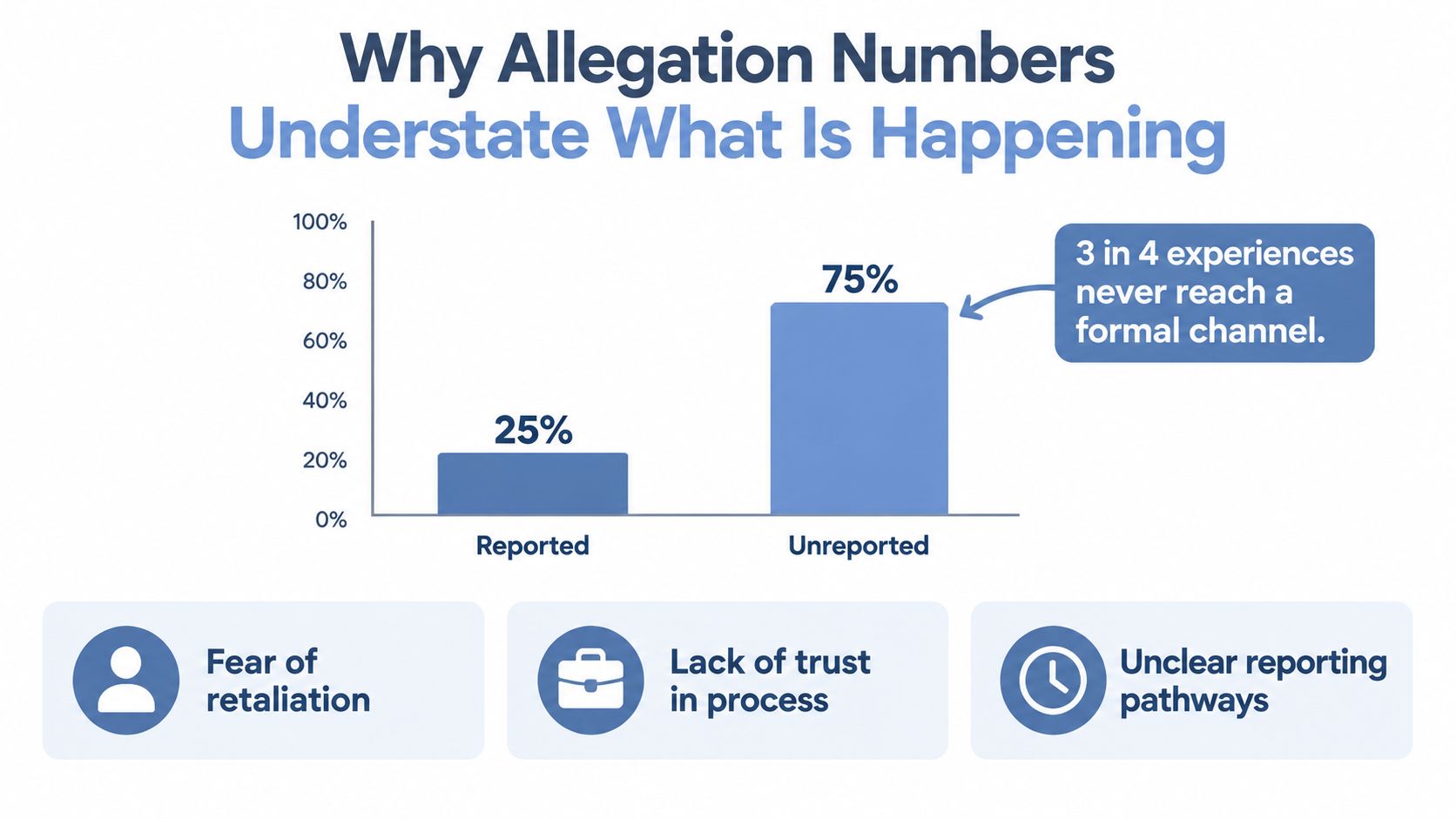
That gap matters when an employer treats delayed reporting as proof that nothing happened. A worker may wait because the accused controls their schedule, the job supports their household, or earlier complaints received no response. Delay alone does not resolve what happened. The useful question is what the chronology shows before and after a complaint.
Silence can have practical causes:
- Economic dependence: Reporting may put shifts, overtime, or the job itself at risk.
- Unclear channels: HR may report to the accused manager, or a small business may have no HR department.
- Minimization: A worker may initially view the conduct as manageable, then see it escalate.
- Distrust: Fear of disbelief, gossip, or punishment can outweigh expectations of help.
A 2025 study of media professionals reported by Inquirer.net found 29% experienced workplace sexual harassment, and 69% of those victims did not report it. Among the leading barriers were fear of job harm at 20%, no reporting mechanism at 19%, and fear of retaliation at 12%.
For Mississippi workers, these findings do not mean every unreported allegation will succeed. They do show why the lack of an immediate formal complaint should not end an investigation. A text to a friend, a saved schedule, or an informal report to a lead worker can help establish when conduct occurred and what followed. If hours, duties, or treatment changed after a complaint, those records may also show retaliation and sharpen the chronology.
The practical task is to preserve records that explain both the delay and the sequence of events. Employers should examine the barriers a worker faced, not treat the reporting date as a credibility verdict. A clear timeline can make the delay understandable while documenting what happened after the worker spoke up.
Building a Time-Sequenced Evidence Record
A timeline can turn a disputed account into a sequence an investigator can test. For Mississippi employers, what happens after a complaint may create the clearest evidence of retaliation. For workers, dated records can show what changed and when, without making the case depend on memory alone.

For each incident, note the date, time, location, exact words or physical conduct, witnesses, and your response. Write the entry the same day when possible. If you are reconstructing events later, record when you made the note and what you relied on. A candid account of a delayed entry is more useful than a polished log that obscures when it was created.
Preserve Records Without Taking What Is Not Yours
Keep full message and email threads so context remains visible. Save schedules and assignments from before and after an incident, and after a complaint. Performance reviews, attendance records, awards, and discipline notices can establish how your work was viewed before events changed. Retain complaints, replies, the name of each recipient, and the handbook version that describes reporting procedures. Note witnesses' names, roles, and what they personally saw or heard. Do not coach them.
Keep personal copies somewhere you will not lose access if your work account closes. That does not give you permission to remove confidential business records. Ordinary messages about your own treatment differ from trade secrets or private information about coworkers. If a file is sensitive, preserve enough identifying detail to locate it and ask counsel before copying it.
Consider a small Mississippi employer where a shift lead sends late-night texts, then cuts a worker's weekend hours after she complains to the owner. Each item may be disputed on its own. Together, the messages, schedules, payroll records showing lost hours, and a coworker's account establish a sequence an investigator can check. The change after the complaint may matter more than any single record.
The International Labour Organization global survey on violence and harassment at work covered more than 74,000 employed people across 121 countries. It found approximately 6.3%, about 205 million workers, had experienced sexual violence or harassment during their working lives, while 4.5% reported exposure within the preceding five years.
The survey's findings also support tracking records by sex, type of harassment, and sector, because overall totals can hide concentrated risks. Employers can use that approach to identify repeat actors and delays in complaint handling. Workers can use a dated chronology to document patterns, employer notice, and what followed, rather than relying on recollection alone.
How Mississippi Employees Raise an Allegation
Your first decision is practical, not theoretical. Who can receive the complaint, stop the conduct, and create a record that survives if the employer does nothing?
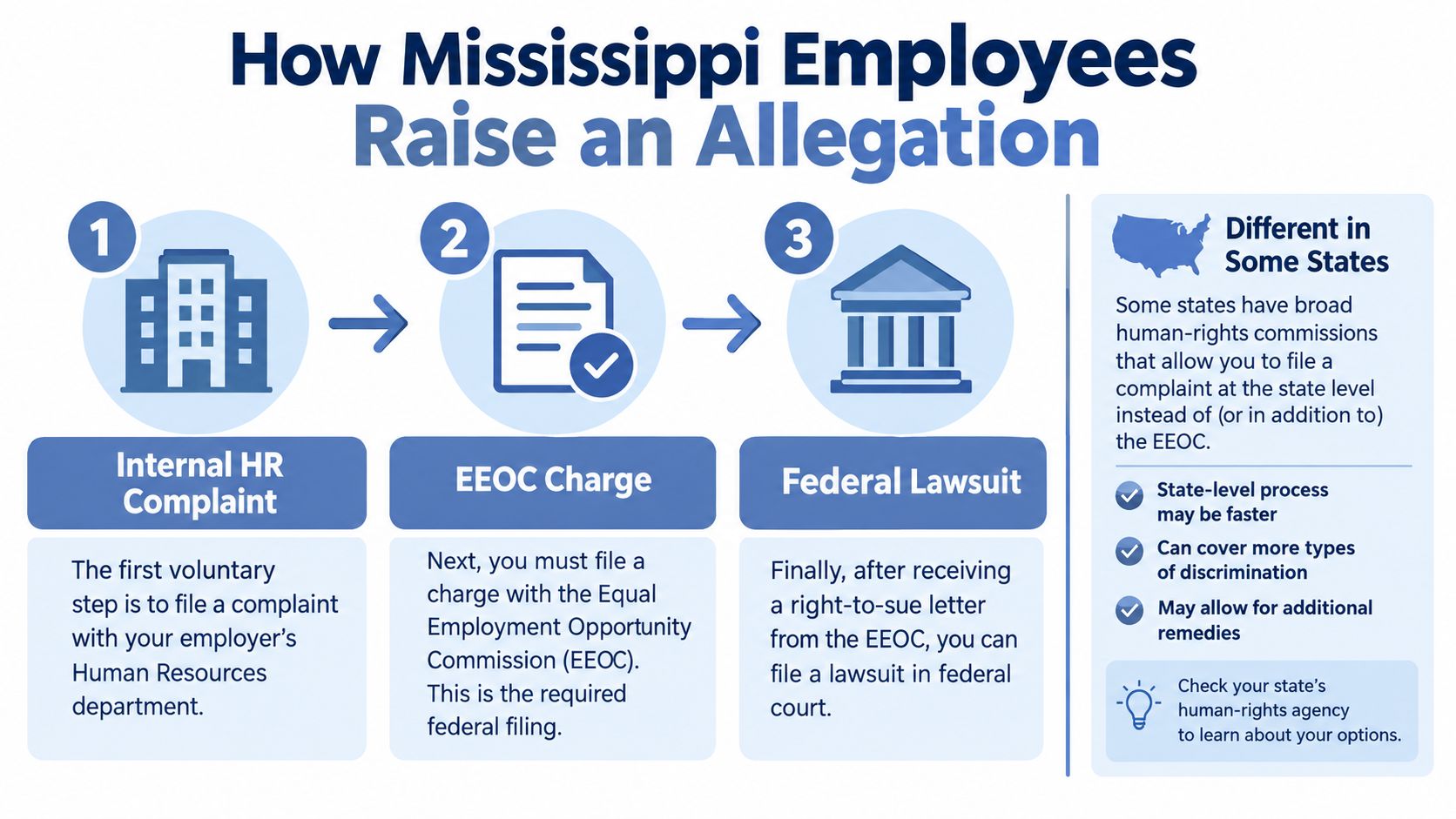
Start with the employer's stated channel if it's safe to use. If the handbook directs complaints to HR, use HR. If your supervisor is the accused, use the alternate channel the policy provides. Put the core facts in writing even if you first speak in person, then keep a personal copy.
A useful internal complaint is short and specific. Identify the conduct, dates, witnesses, impact on your work, and what you need, such as separation from the accused during the investigation. Avoid threats, speculation about motives, and unrelated grievances. You're creating the document an EEOC investigator may read later.
Our related post on how to report workplace harassment walks through wording choices that keep a complaint factual and usable. Read it before you send anything if you're drafting under stress.
The Federal Route in Mississippi
Mississippi doesn't offer the broad state human rights commission process many workers expect. The Mississippi Department of Health civil rights complaint page concerns matters within that agency's jurisdiction and shouldn't be confused with a statewide forum for ordinary private employment claims. Most Mississippi sexual harassment claims therefore move under Title VII through the EEOC.
An EEOC charge is not a lawsuit. It's an administrative filing that triggers notice to the employer and an investigation or mediation process. Investigators typically compare your timeline with the employer's documents, witness accounts, policies, and personnel records. Vague charges invite vague answers, while dated incidents force specific responses.
Timing is unforgiving. Mississippi employees generally must act within the applicable federal charge-filing window, commonly discussed as 300 days for many Title VII matters, but the correct deadline depends on the claim and circumstances. Don't calculate it casually from the last incident if there's a pattern, a termination, or separate retaliation. Get the date evaluated early.
The EEOC figures noted in the opening section show these charges are a recurring national enforcement issue, not a rare category. Still, filing doesn't guarantee the agency will litigate for you. More often, the value lies in preserving federal rights, obtaining the employer's position, and receiving a notice of right to sue if the process doesn't resolve the dispute.
Expect months, not days, unless mediation resolves things early. Continue documenting while the charge is pending. New discipline, schedule cuts, or exclusion after filing may require an amendment or a separate retaliation allegation, and waiting until the investigation ends can lose critical detail.
Why Retaliation Becomes the Central Legal Risk
A harassment allegation can remain disputed, but a workplace decision made after the complaint may create a clearer legal record. For Mississippi employers, the central risk often shifts to how they treat the complainant and witnesses once decision-makers know about the report. For employees, that sequence can supply evidence beyond competing accounts of the alleged harassment.
A University of Massachusetts analysis of sexual harassment charges covering five years of EEOC and state or local fair employment filings found 68% included an allegation of employer retaliation, while 64% of complainants reported losing their jobs after complaining. The analysis also describes a Government Accountability Office measurement gap in systematically aggregating retaliation following sexual harassment complaints. These figures do not establish that every workplace dispute is retaliation. They show why the events after a report deserve careful attention.
The practical question is what changed, and when. A documented layoff planned before the complaint, misconduct supported by records, or a department-wide schedule change may explain an employer's decision. The chronology helps test that explanation against what happened.
Start with the worker's baseline: duties, hours, pay, evaluations, and discipline before the report. Then identify who learned about the complaint and when. Compare that record with any later changes to workload, schedule, access, promotion prospects, discipline, or employment. Timing matters, as does whether the employer followed its usual policy and treated comparable employees similarly. Documents created at the time may carry more weight than reasons offered only after a dispute arises.
Witnesses and employees who oppose harassment may also have retaliation protections. Record any role in an investigation or support for a coworker's complaint, along with subsequent workplace changes. The explanation of protected activity and retaliation covers why the protected conduct, employer knowledge, and adverse action must connect.
The key question is whether the records changed after management learned about the complaint.
Mississippi has a specific limit: Mississippi doesn't recognize a separate retaliation claim under the Workers' Compensation Act merely because you filed or pursued a workers' compensation claim. A harassment or Title VII retaliation theory should not be recast as workers' compensation retaliation. Other protections may apply if the facts involve discrimination, protected leave, whistleblowing, or another independently protected activity. The legal theory must fit the facts.
Employers should review materially adverse decisions involving complainants and witnesses, preserve relevant records, and check in after a complaint. Employees should keep their own dated log of changes, who made them, the reasons given, and any witnesses. A clear chronology can expose inconsistencies without asking anyone to rely on memory alone.
Interim Protections Mississippi Workers Can Actually Use
Interim help is narrower than most workers hope. Federal law doesn't provide an instant protective order for every workplace complaint, and Mississippi has no general human rights commission that can step in quickly as an interim forum. You need requests an employer can implement now.
During an investigation, ask in writing for measures that reduce contact without punishing you. Examples include reporting to a different supervisor, changing the accused person's shift, moving workstations, pausing one-on-one meetings, or routing communication through email. Be cautious about accepting a transfer that cuts your pay, hours, or advancement while the accused keeps the better position. That "solution" can become evidence of adverse treatment.
A Script That Stays Professional
Say this: "While the investigation is pending, I'm requesting no unsupervised one-on-one meetings with the person I reported and written instructions from my interim supervisor. I can continue my current duties and schedule." That request is specific, tied to safety, and shows willingness to work.
Other federal protections may help depending on the facts. FMLA leave may be available if you have a qualifying serious health condition and meet eligibility rules. The ADA may require accommodation if a related disability limits a major life activity. USERRA protects uniformed service members on covered service and reemployment issues. None of these converts harassment itself into automatic paid leave, so don't assume eligibility without checking the medical and employment criteria.
Workers' compensation is another limited tool. Mississippi coverage generally applies to employers with five or more employees, but it isn't a substitute for a harassment charge and doesn't create the separate retaliation claim discussed above. A workplace injury claim and a federal discrimination claim answer different legal questions.
The need for monitoring is real. The National Academies discussion of retaliation research reports a 15-year study of 129 claims that found retaliation in 98% of cases involving women who reported harassment, while cautioning that formal data likely undercount unreported retaliation. Outcomes included termination, constructive discharge, economic loss, aggression, and further harassment.
Treat that figure as a warning from a specific study, not a prediction for your case. Ask for interim measures early, confirm agreements by email, and report violations promptly. If the employer refuses every reasonable separation measure, that refusal belongs in your timeline.
Evaluating a Claim With Mississippi Employment Counsel
Bring documents, not just a narrative. A useful first meeting covers your timeline, internal complaints, messages, schedules, reviews, discipline, witness names, EEOC paperwork, and any post-complaint changes. Organize them chronologically so counsel can spot deadline and retaliation issues quickly. Our guide on how to prepare for your first talk with an employment lawyer gives a practical packing list.
Counsel should evaluate more than whether the conduct sounds offensive. Expect questions about employer size, supervisor status, notice, the employer's response, tangible job harm, mitigation, and whether retaliation is stronger than the underlying harassment theory. A candid lawyer may tell you the EEOC process is worth pursuing even if litigation later would be difficult, or that a claim is timely but evidentially weak.
Fees need the same candor. Many employee-side lawyers use a contingency fee, meaning the fee is a percentage of recovery. A LegalClarity overview of employment lawyer costs reports common ranges of approximately 25% to 40%, many near 33% to 40%, with 40% to 50% quoted by some practices for complex or heavily litigated matters. In Mississippi employment cases, 40% to 50% is a realistic range to expect in many contingency arrangements, especially as litigation risk rises, but it isn't a mandatory statewide rate.
Before signing, confirm the percentage at each stage, whether expenses come out before or after the fee, who pays costs if there's no recovery, and how settlement authority works. Ask whether early EEOC mediation, a negotiated separation, or requesting a notice of right to sue best fits your goals. The right path depends on evidence, deadlines, tolerance for delay, and whether you're still employed.
Your Action Checklist After an Allegation
- Preserve evidence today: Save messages, schedules, reviews, policies, witness names, and dated notes in chronological order.
- Complain in writing: State the conduct, dates, locations, witnesses, and requested interim separation, then keep a personal copy.
- Calendar the federal deadline: Get the EEOC filing window evaluated immediately instead of estimating it yourself.
- Track every post-complaint change: Log schedule, duties, pay, discipline, access, and separation decisions against your prior baseline.
- Request interim measures in writing: Ask for no-contact arrangements, alternate supervision, or schedule protection that doesn't penalize you.
- Use the correct legal theory: Remember Mississippi workers' compensation filing alone isn't an independent retaliation claim.
- Get a confidential evaluation: Bring the timeline and documents to Mississippi employment counsel before deadlines or personnel actions narrow your options.
If you're dealing with sexual harassment at work anywhere in Mississippi, Nick Norris, P.A. can evaluate your timeline, explain the federal EEOC path, and assess whether post-complaint retaliation has created a separate claim. Reach out for a confidential conversation before you resign, sign a separation agreement, or let a filing deadline pass.
Leave a Reply