

You've been told your employment case may settle for $100,000. That sounds like enough to plan around, until you see the amount coming to you is smaller. The difference can include your lawyer's fee, case expenses, and other deductions. Before you sign a fee agreement or settlement, make sure you understand how each one affects your net recovery.
This guide focuses on attorney fees and costs in Mississippi employment cases. It explains common payment arrangements, walks through settlement math, and shows why a possible fee award from an employer doesn't automatically replace the terms you agreed to with your lawyer.
Attorney Fees Versus Costs and Why the Split Matters
Suppose your case settles for $100,000 and you wonder why your check is smaller than the headline amount. Start by separating two charges. Attorney fees pay the lawyer for legal work. Costs are expenses incurred to move the case forward.
Think of a restaurant meal. The fee is the chef's labor; costs are the groceries. Both can come out of the same settlement, but they're different charges, and your agreement should explain how each is handled.
| Cost item | What it covers | Who advances or pays | Recoverable from employer? |
|---|---|---|---|
| Attorney fee, contingency | Percentage of the recovery | Deducted from the recovery | Only if a fee-shifting statute applies |
| Attorney fee, hourly | Billed hours at the agreed rate | Client, often through a retainer | Yes, if the statute awards a reasonable fee |
| Court filing and service | Filing fee and process server | Advanced by firm or client, repaid per agreement | Generally yes, as a taxable cost |
| Deposition and transcripts | Reporter fee and transcript pages | Advanced by firm or client, repaid per agreement | Generally yes when reasonably necessary |
| Expert witness fees | Economist, medical or vocational experts | Advanced by firm or client, repaid per agreement | Usually only where the statute allows it |
| Electronic discovery and copying | Vendor hosting and bulk copies | Advanced by firm or client, repaid per agreement | Varies by statute and court ruling |
| Travel and mileage | Trips for depositions or hearings | Advanced by firm or client, repaid per agreement | Varies by agreement and court ruling |
Why the fee and cost columns matter
Federal courts generally allow certain litigation expenses, such as filing, transcript, and copying costs, to be taxed under 28 U.S.C. § 1920. “Taxed” here means the court may order the other side to repay eligible costs. Expert-witness fees usually need a statute that specifically allows them. The rules can depend on the claim and the court's decision, so don't assume every expense will be repaid.
The agreement decides who advances costs while the case is ongoing and who must repay them after a recovery. It may also say what happens to costs if there's no recovery. Review those terms alongside the fee percentage, and use this guide to employment lawyer fees and costs to compare the pieces.
Four Fee Arrangements Mississippi Workers Encounter
A lawyer offers to handle your case for a share of any money recovered. Another asks for payment by the hour. Those arrangements affect when money leaves your pocket, who carries the risk, and what you may owe if the case does not result in a recovery. The written agreement sets the actual terms. This Mississippi employment-law fee guide discusses fees, but any percentage you consider should be treated as an example to compare against your own agreement, not a guaranteed market rate.
| Arrangement | How the lawyer is paid | What the agreement should clarify | Who carries the risk |
|---|---|---|---|
| Contingency | A percentage of money recovered | The percentage, what amount it applies to, and whether a fee is due without a recovery | Usually lower upfront fee payments for the client, with payment tied to recovery |
| Hourly | Billed hours at an agreed rate | Hourly rate, billing increments, retainer, and invoice schedule | Client pays as work proceeds |
| Flat fee | One fixed price for a defined task | What work is included and what happens if the task expands | Client may pay more for work outside the agreed scope |
| Hybrid retainer | A combination, such as a reduced percentage and hourly or retainer billing | When the payment method or percentage changes | Depends on the stage of the case and agreement |
With a contingency fee, the lawyer's fee generally depends on money recovered. For illustration, a 40% fee on a $100,000 recovery is $40,000. A 50% fee on the same amount is $50,000. Those calculations leave $60,000 or $50,000 before case costs and other deductions. The agreement also needs to explain the order: does the lawyer calculate the percentage before costs come out, or after? That order changes the amount left for you.
Hourly billing works differently. You may pay a retainer, which is money deposited toward future bills, then receive charges for the time spent on the case. Ask for the rate, billing increments, and invoice schedule in writing. A flat fee may suit a defined task, such as reviewing a severance agreement. Confirm what is outside that task. A hybrid combines payment methods, and the agreement should state when the terms change.
The percentage sets the fee. The calculation order and costs affect what you keep.
A fee agreement can also address costs, which are separate from the lawyer's fee. Check whether you must repay costs if the case ends without a recovery. In some employment cases, a law may allow a court to order the employer to pay attorney fees. That is a separate track from your agreement: whether any court-awarded fees reduce or replace what you owe depends on the agreement's terms.
For more on contingency terms, see this guide to no-win, no-fee employment representation. Workers with wage disputes can also review information about unpaid overtime claims.
Working Through a Settlement to Your Net Check
A settlement amount isn't the same as the amount you take home. Here's a hypothetical calculation using a $100,000 settlement and $5,000 in case costs, with no liens or taxes included.
First, calculate the attorney fee. If the fee is calculated on the gross settlement, a 40% agreement produces a $40,000 fee, while a 50% agreement produces a $50,000 fee. Subtract the $5,000 in costs, and the amount left before taxes and liens is $55,000 or $45,000, respectively.
| Scenario | Fee calculated on | Attorney fee | Case costs | Net before taxes and liens |
|---|---|---|---|---|
| 40% contingency | Gross $100,000 | $40,000 | $5,000 | $55,000 |
| 40% contingency | $95,000 after costs | $38,000 | $5,000 | $57,000 |
| 50% contingency | Gross $100,000 | $50,000 | $5,000 | $45,000 |
| 50% contingency | $95,000 after costs | $47,500 | $5,000 | $47,500 |
The second and fourth rows apply the percentage after costs are subtracted. That order changes the fee calculation and the amount left for you. The net before taxes and liens is what remains after the fee and costs in this example, not necessarily the final amount deposited in your account.

A settlement may include back pay, front pay, compensatory damages, and statutory penalties. Those components may be treated differently for tax purposes, so ask for the settlement agreement to identify the amounts clearly. “No win, no fee” doesn't necessarily mean “no financial risk.” Expenses may be handled separately, and the agreement determines whether you repay costs from a recovery.
The economic stakes can rise as a case moves toward trial. A federal regulatory analysis estimated average employer attorney fees of about $111,000 for cases resolved at summary judgment and about $237,000 for cases that proceeded through trial, using the midpoint of inflation-adjusted ranges (federal regulatory analysis). Those are employer-side estimates, not what an employee pays. They help show why timing and case expenses matter. If your claim involves a termination, review the information on wrongful termination in Mississippi, and consider this guide to discrimination settlement terms. Use the checklist near the end of this article to prepare questions before signing.
Federal Laws That Let Employees Shift Fees
A worker who wins a federal employment claim may be able to ask the employer to pay reasonable attorney fees. This is called fee-shifting. It is separate from the worker's fee agreement. A statute may allow a fee award, while the agreement determines what the worker owes the lawyer and how any award is credited.
| Law | Protects workers from | Fee rule for a prevailing employee |
|---|---|---|
| Title VII | Discrimination and harassment based on race, color, religion, sex, or national origin | Reasonable fees may be awarded; successful complainants generally have a presumption of entitlement in federal-sector cases |
| ADA | Disability discrimination | Reasonable fees may be available to a prevailing employee |
| ADEA | Age discrimination against workers 40 and older | Fee availability depends on the applicable legal and administrative setting |
| FLSA | Unpaid overtime and minimum wage violations | A prevailing employee may seek reasonable attorney fees and costs |
| FMLA | Leave interference and retaliation | A prevailing employee may seek reasonable attorney fees and costs |
| USERRA | Military-service reemployment and discrimination | Attorney fees may be available in qualifying cases |
| WARN Act | Layoffs without the required 60-day notice | A fee award may depend on the court's discretion |
These laws do not all use the same fee rules. The right to request fees, and whether a court awards them, depends on the claim and its legal setting. For leave-related rights, see FMLA employment rights. Employees with military-service concerns can review USERRA rights, and workers affected by a qualifying mass layoff can read about the WARN Act. Even if a law allows a fee award, the employer does not automatically pay every amount billed. The court assesses the request, while the client agreement governs the lawyer-client relationship.
The federal filing route in Mississippi
Mississippi doesn't have a state human rights commission. For workplace discrimination claims under laws such as Title VII and the ADA, employees generally file a charge with the U.S. Equal Employment Opportunity Commission (EEOC). In Mississippi, the charge deadline is generally 180 days from the alleged unlawful act. The EEOC explains its time limits for filing a charge. An EEOC charge can also affect how an employer responds, as explained in this overview of what an EEOC complaint may mean for an employer.
The filing deadline and the fee question are separate parts of the process. Meeting the deadline may preserve a route to pursue a claim, but it does not guarantee a fee award. Whether fees are available depends on the law and the case's outcome. A lawyer can assess which claims may apply and how the fee agreement treats any recovery or award.
How Courts Calculate a Fee Award
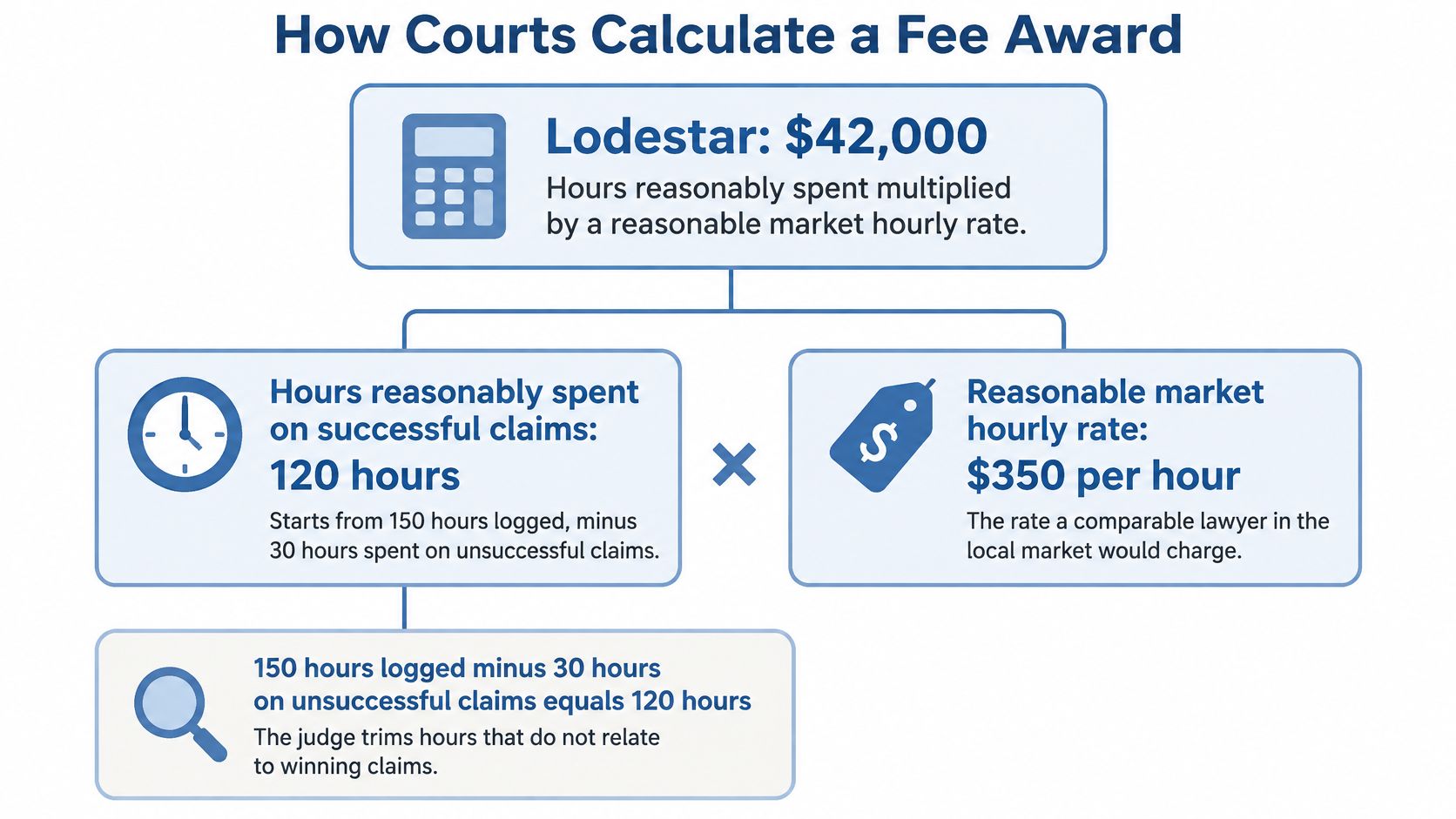
The amount a worker owes under a fee agreement and the amount a court awards are separate calculations. A court may use the lodestar method for an employment-discrimination fee request. It multiplies the reasonable hours spent on successful claims by a reasonable local hourly rate. The contract's contingency percentage does not set that court calculation.
Here is a hypothetical example. A lawyer's records show 150 hours of work. The court excludes 40 hours tied to unsuccessful or unrelated claims, then removes 10 hours for duplicative work, vague entries, or clerical tasks billed as legal work. That leaves 100 reasonable hours. If evidence supports a local rate of $300 per hour, the lodestar is 100 × $300, or $30,000, before any adjustment.
This flowchart shows how reasonable hours and rates produce a lodestar fee award.
That figure is an example, not a promise about what a judge will award. Hours must reasonably advance a successful claim. Costs, such as filing fees, transcripts, and expert invoices, are considered separately. Whether those expenses can be recovered depends on the statute and the procedure in the case. In federal-sector EEO cases, the EEOC's remedies guidance discusses reasonable attorney fees and costs for qualifying prevailing complainants.
A strong result or a contingency agreement does not ordinarily increase the lodestar by itself. The Supreme Court has said the lodestar is presumed reasonable. An increase generally requires extraordinary circumstances and specific proof that the usual calculation misses a relevant factor, as explained in the Supreme Court decision on lodestar enhancements.
For a worker, the award is not automatically the amount received as a personal check. The settlement agreement and fee agreement determine how settlement funds are distributed, while a court fee award is a separate calculation. Ask how any award or recovered costs affect the deductions from your settlement.
Clear time records make the court's review easier. Each entry should show the date, person who did the work, time spent, and task. Vague, excessive, duplicative, or unrelated entries can reduce the request. In wage disputes, including unpaid overtime claims, fee requests follow the same basic lodestar logic.
A fee award is only as strong as the timesheet behind it.
How to Request Fees in Federal Employment Cases
A worker may win a federal employment case and still need to take specific steps to request fees. The process depends on whether the case went through the federal-sector EEO system or federal court. Keep the fee request separate from the settlement math: a fee award is a different track, and what the worker owes under a fee agreement depends on that agreement.
Confirm the EEOC charge was filed on time. Mississippi has no state human rights commission, so the federal filing route matters. For Title VII and ADA fee claims, filing an EEOC charge is an early step.
Confirm the claim allows fee-shifting and that you qualify. Fee-shifting means the law may require the employer to pay reasonable legal fees. A win alone does not guarantee payment. The claim must have a fee provision, and the legal standard must be met.
Keep detailed time records from the start. For each entry, note the date, who did the work, the hours, and the specific task. Clear records show how the lawyer's work related to the successful claim and why the time was reasonable.
Keep cost records separate from attorney time. Save bills and proof of payment for filing fees, transcripts, copying, and expert invoices. These are case expenses, not hours billed by the lawyer, and different rules may apply to their recovery.
Follow the federal-sector procedure if you work for the federal government. A federal-sector EEO complainant generally submits a verified fee statement, with appropriate expert-witness fees and other costs, within 30 days of receiving the decision. The agency or administrative judge generally issues a fee determination within 60 days. Private-sector employees do not use this agency procedure.
In federal court, check the deadline and request costs separately. Federal Rule of Civil Procedure 54(d)(2) generally gives 14 days after judgment to file a fee motion, unless a statute or court order sets a different rule. Eligible costs are requested separately under Rule 54(d)(1) and 28 U.S.C. § 1920. Expert-witness fees are not taxable under § 1920 alone; a statute must authorize them.
Answer objections with records and clear explanations. An employer may challenge the hours or expenses as unreasonable. Explain the work behind the request, and identify any reductions for errors or unnecessary billing.
Before signing a settlement release, check whether it resolves the fee claim as well as your own claims. The settlement may set out who pays fees and costs, or may close off a separate request. Do not assume that winning a settlement leaves the fee issue open.

Confirm Your Fee Agreement Before You Sign
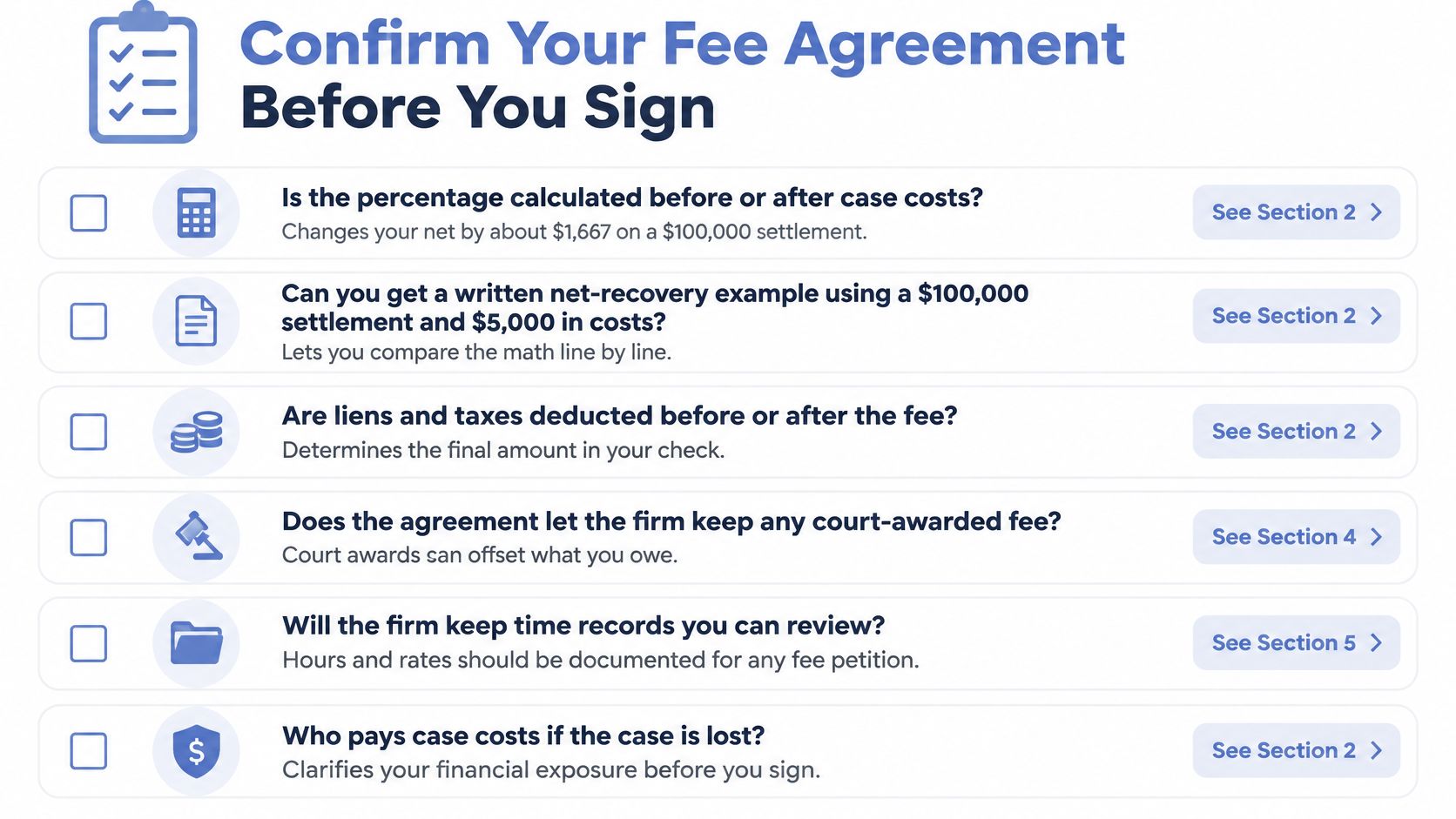
Before signing, copy this checklist into an email to the lawyer and ask for written answers. A clear agreement should let you estimate what you might owe and what could remain after fees and costs. If the lawyer can't explain the math in plain language, ask for a sample breakdown before you commit.
- Is the percentage calculated before or after case costs? Ask for both calculations using a sample recovery.
- Can you provide a written net-recovery example? Request a sample using a $100,000 settlement and $5,000 in costs.
- Who pays costs if there's no recovery? Ask whether costs are advanced, reimbursed, capped, or subject to your approval above a stated amount.
- Does the agreement cover appeals and post-judgment work? Confirm when the percentage changes, including after discovery or trial preparation.
- How does an employer-paid fee award affect the contract? Ask whether the award offsets what you owe, is paid to the lawyer separately, or is handled another way.
- How are retainers and billing disputes handled? Ask when statements arrive, how a retainer is held and refunded, and how you can challenge a charge.
Ask for a settlement breakdown that separates fees and costs from back pay and other damages. Don't sign without understanding when a percentage may rise or assuming an employer-paid fee award will cover your contractual obligations. You can also review these questions to ask an employment lawyer before your consultation.
If you're considering representation, bring the draft agreement to an initial consultation with Nick Norris, P.A. The office can review the terms with you and discuss how fees and costs may apply to your Mississippi employment matter. You can also learn more about Mississippi employment law representation.
Nick Norris, P.A. offers free initial consultations for Mississippi employment-law matters and can discuss fee agreements, case expenses, and possible fee-shifting in your situation. Bring your draft agreement and questions about the settlement math to Nick Norris, P.A. to discuss your options before you sign.
Leave a Reply