

You've lost your job, the bills haven't stopped, and your employer has sent an offer that looks substantial until you read the release attached to it. You want to know whether the payment is fair, what you'll actually keep, and whether signing will make it harder to find your next job.
For a Mississippi worker, evaluating a discrimination lawsuit settlement means looking beyond the headline number. The stage of the dispute, the evidence, the tax allocation, and the promises buried in the agreement all affect what you're receiving and what you're giving up.
What a Discrimination Lawsuit Settlement Pays
Say a Jackson-area warehouse worker reports harassment and is pushed out a month later. The employer offers a lump sum, but the letter doesn't explain whether it covers lost wages, emotional distress, legal fees, or anything else.
A settlement is a negotiated agreement that ends specified claims in exchange for money, workplace terms, or both, usually through a signed release and often without an admission of wrongdoing. It can happen before a lawsuit is filed or after litigation begins.
The worker's first task isn't deciding whether the number sounds generous. It's identifying what the employer is buying and what each part of the payment represents.
Settlement Components and What Each One Covers
| Component | What it compensates | How it is measured | Tax note |
|---|---|---|---|
| Back pay | Wages and benefits lost from the adverse action until resolution | Pay rate times time out of work, minus interim earnings | Taxed as wages, with withholding |
| Front pay | Future lost earnings when returning isn't practical | Projected wage gap over a supported period | Generally treated as wages; confirm reporting and withholding |
| Compensatory damages | Emotional distress, mental anguish, and inconvenience | Medical or counseling records, testimony, and a journal | Generally taxable; the physical-injury exclusion ordinarily doesn't cover employment discrimination |
| Punitive damages | Punishing malicious or reckless discrimination | Applicable legal standard and employer-size limits | Generally taxable |
| Reinstatement or promotion | Return to the job or the position the worker should have received | Pay difference and career value | Future earnings are taxed as wages when paid |
| Attorneys' fees and costs | Legal fees and case expenses | Fee agreement and expense records | The fee portion may count as income; review available deductions |
| Nonmonetary terms | Neutral reference, personnel-file correction, training, and policy changes | Practical usefulness and enforceability | Usually no direct payment to tax; confirm any associated benefit |
These categories describe potential remedies, not a promise that every claim supports every category. The EEOC's fiscal year 2024 enforcement report identifies remedies including back pay, benefits, reinstatement, promotion, and hiring, showing why settlement value can include more than cash.
Label the Offer Before Judging It
For the warehouse worker, a neutral reference might help secure another position. Correcting a personnel file could also matter if the employer has recorded an inaccurate reason for termination.
Those promises need specifics. A reference provision should identify who will respond and what that person will say, rather than merely promising a favorable reference.
Practical rule: Ask for a written allocation of the offer before treating the lump sum as compensation you can spend.
The allocation also gives your lawyer and tax adviser something concrete to review. An employer's label doesn't automatically determine tax treatment, but an unexplained payment makes informed negotiation harder.
How Settlement Value Gets Calculated
A Mississippi employee earning $52,000 annually is terminated after making a discrimination complaint and remains unemployed for six months. The employee's starting back-pay calculation is $26,000, before subtracting interim earnings or making other adjustments. The employer has 120 employees, a detail that matters when identifying the applicable cap on certain damages.
That calculation gives the parties a place to begin, not a prediction of settlement value. The procedural stage matters too: a pre-suit offer and an offer after months of litigation reflect different amounts of risk, proof, and expense.
Build a Supported Valuation
- Calculate back pay. Use payroll records, scheduled hours, commissions, and other supported earnings. Subtract income earned elsewhere during the relevant period.
- Evaluate front pay. If returning to the job is unrealistic, estimate the likely wage gap and support the proposed period with evidence about comparable work.
- Add lost benefits. Document losses such as health coverage and retirement contributions, taking care not to count the same loss twice.
- Assess compensatory damages. Connect emotional harm to specific events and support it with treatment records, testimony, or contemporaneous notes.
- Apply the relevant damages limits. Keep wage loss separate from the combined compensatory-and-punitive calculation.
- Value nonmonetary terms. Consider whether a specific promise would improve future employment prospects or conditions at work.
- Compare realistic net outcomes. Account for proof problems, additional costs, collection risk, and the amount left after legal fees.
The rules depend on the law behind the claim. For example, age claims under the ADEA do not use the same compensatory-and-punitive model. Liquidated damages require a willful violation.
Combined Compensatory and Punitive Damage Caps by Employer Size
For covered intentional-discrimination claims under Title VII and the ADA, 42 U.S.C. § 1981a(b)(3) sets combined compensatory-and-punitive caps based on employer size. Back pay is calculated separately and does not count toward these caps.
| Employer size | Combined compensatory and punitive cap | Back pay treatment |
|---|---|---|
| 15 to 100 employees | $50,000 | Not capped |
| 101 to 200 employees | $100,000 | Not capped |
| 201 to 500 employees | $200,000 | Not capped |
| More than 500 employees | $300,000 | Not capped |
In the example, a $90,000 offer might allocate $26,000 to back pay, $4,000 to lost benefits, and $60,000 to compensatory damages. That compensatory amount is below the applicable combined cap, but the cap does not show whether the offer is fair. The employee's future wage loss, the strength of the liability evidence, and the value of a possible return to work may all change the assessment.
A cap sets a limit on particular damages; it does not guarantee an award. Punitive damages also require more than proof that an employment decision was unlawful. Understanding how to calculate punitive damages helps distinguish punishment-based damages from payment for actual losses.
Start negotiations with a valuation tied to evidence, not with the employer's opening number as the measure of fairness. Each counteroffer should explain what changed, such as added wage loss, stronger support for emotional harm, or a narrower release. A useful counteroffer shows the reason for the difference, not just a higher demand.
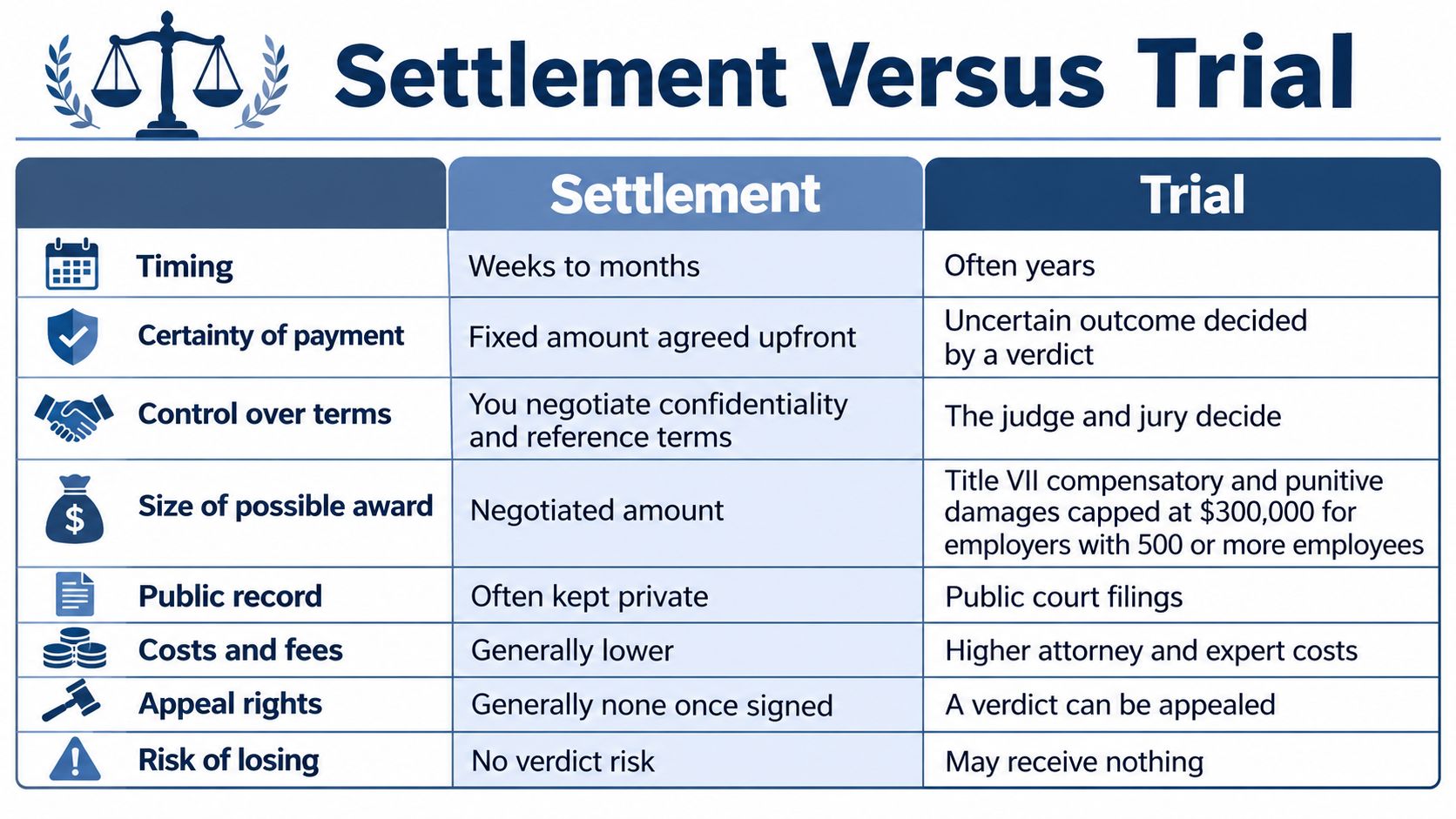
Settlement Versus Trial by Situation
| Factor | Settlement | Trial |
|---|---|---|
| Timing | Payment timing can be negotiated; processing may take weeks or months | Often a year or more, with additional time possible for appeals |
| Certainty of payment | Amount is known at signing, subject to compliance and collection | Outcome uncertain, including a possible zero |
| Control over terms | Worker negotiates confidentiality, references, and reforms | Judge or jury determines available relief |
| Size of award | Negotiated amount, often below a best-case verdict | Uncapped back pay and applicable damages limits can permit a larger recovery |
| Public record | Confidentiality can be negotiated, but existing filings remain | Filings and verdict are generally public |
| Costs and fees | Usually fewer additional litigation expenses | More discovery, expert, and trial expenses; contractual fee increases may apply |
| Appeal rights | Usually resolved through the agreement rather than an appeal | Both sides may have grounds to appeal |
The comparison below highlights the practical trade-offs, although no graphic can predict your case's schedule or result.
Match the Decision to Your Situation
Settlement may make sense when the evidence is mixed but the losses are clear. Suppose the employer has inconsistent explanations, but no witness will confirm discriminatory remarks. A reliable payment may be preferable to financing a long dispute over the employer's motive.
Continuing litigation may deserve consideration when documents strongly support liability and the employer won't address substantial losses. Even then, a clear-looking document must survive challenges about context, decision-maker involvement, and alternative explanations.
Treat reinstatement as a working arrangement, not a symbolic victory. Ask who will supervise you, whether your duties and seniority will be restored, and how future complaints will be handled.
Procedural Stage Changes the Meaning of a Number
According to the EEOC's fiscal year 2025 results announcement, about $528 million came through pre-litigation enforcement, while approximately $27 million resulted from litigation involving 2,505 individuals. Those are different enforcement categories, not comparable price lists for individual cases.
An agency conciliation, a privately negotiated agreement, and a court judgment don't involve the same process. Filing suit doesn't automatically increase what you'll receive, and accepting a pre-suit resolution doesn't automatically mean you settled cheaply.
Before choosing a path, answer this checklist:
- Proof: What evidence connects the adverse action to discrimination rather than an unfair but lawful decision?
- Time: Can you manage the financial and personal demands of continuing?
- Expense: What additional fees and costs would each stage create?
Clauses That Can Cost More Than the Payment
The general release can cost more than any other provision because it defines which legal rights you surrender. A substantial check may be poor compensation for a release that reaches unrelated disputes you haven't evaluated.
Read the agreement as a set of obligations, not as paperwork attached to the payment.
Review the Highest-Risk Terms
- General release: Identify every released claim, employer-related entity, and covered period, and remember that a release cannot prospectively waive claims based on future unlawful conduct.
- Age-discrimination waiver: An individual ADEA release generally requires at least 21 days to consider and 7 days to revoke, with additional rules potentially applying to group programs.
- Confidentiality: Check whether it covers the amount, underlying facts, or both, and preserve appropriate disclosures to family, advisers, and government agencies.
- Agency access: A provision purporting to stop you from filing a charge with or cooperating with the EEOC is a red flag.
- Non-disparagement: Define prohibited statements and determine whether identified employer representatives have reciprocal obligations.
- No-rehire: Check whether it excludes you only from the former workplace or also from affiliates and future acquisitions.
- Neutral reference: Specify the contact person, permitted response, and procedure for correcting an improper reference.
- No admission: Understand that payment commonly resolves disputed allegations without the employer admitting discrimination.
- Enforcement: Identify who monitors promised changes and what remedy is available if the employer breaks the agreement.
The related discussion of a separation and release agreement can help you recognize provisions that extend beyond the discrimination dispute.
Put Workplace Promises Into Enforceable Language
Nonmonetary remedies aren't decorative extras. The EEOC's fiscal year 2025 annual performance report reports that 99% of conciliation agreements included targeted equitable relief and 91.2% of lawsuit resolutions were settlements.
Individual relief might include correcting your record. Structural relief might require training, revised complaint procedures, or monitoring that benefits coworkers as well.
A smaller payment with a usable reference and a narrow release may serve you better than a larger payment that blocks future employment opportunities.
Value that trade by asking what the provision changes in your life. Then ask whether the language makes that change enforceable. Before signing, request a clause-by-clause redline showing what your lawyer proposes to remove, narrow, or add.
What You Actually Keep
Consider a hypothetical $100,000 settlement, $5,000 in expenses, and a 40% contractual fee. If expenses come out first, the fee is $38,000 on the remaining $95,000, leaving $57,000 before taxes.
If the fee is calculated on the full settlement first, the fee is $40,000, and subtracting expenses leaves $55,000 before taxes. The gross offer hasn't changed, but the contract's expense order changes your proceeds.
Separate Fees From Tax Withholding
A settlement statement should distinguish the employer's payment, attorney compensation, reimbursed expenses, withholding, and the amount distributed to you. Don't assume the check you receive equals your final after-tax recovery.
The agreement should explain wage allocations generally reported on a W-2 and other taxable damages generally reported on an appropriate Form 1099. Having no withholding on a damages payment doesn't make that payment tax-free.
Certain unlawful-discrimination claims qualify for an above-the-line attorney-fee deduction under Internal Revenue Code section 62(a)(20). Ask a tax adviser to confirm eligibility, limits, and reporting rather than assuming the entire fee portion will escape taxation.
Check the Contract, Not an Assumed Average
There isn't support for treating 40%–50% as an established Mississippi average or a mandatory deduction. OfficeConsumer's employment-attorney cost guidance describes approximately 33%–40% contingency fees, with percentages potentially changing as a case advances.
Your written agreement controls the contractual calculation, subject to applicable professional requirements. Ask how a separately negotiated attorney-fee payment or potential court-awarded fee would affect your obligation, too.
For more context, review the office's explanation of attorney fees and costs.
Before accepting, request:
- Fee percentage: The rate applicable at the current procedural stage.
- Expense order: Whether expenses are deducted before or after calculating the fee.
- Step-up terms: The event that triggers any increased percentage.
- Payment date: When the employer must pay and what conditions must occur first.
- Net estimate: A written distribution estimate, with taxes clearly separated from legal expenses.
Mississippi Deadlines and Protections
A settlement's headline amount means little if the claim has already missed a filing deadline. In Mississippi, the applicable law determines where a worker files and how quickly they must act.
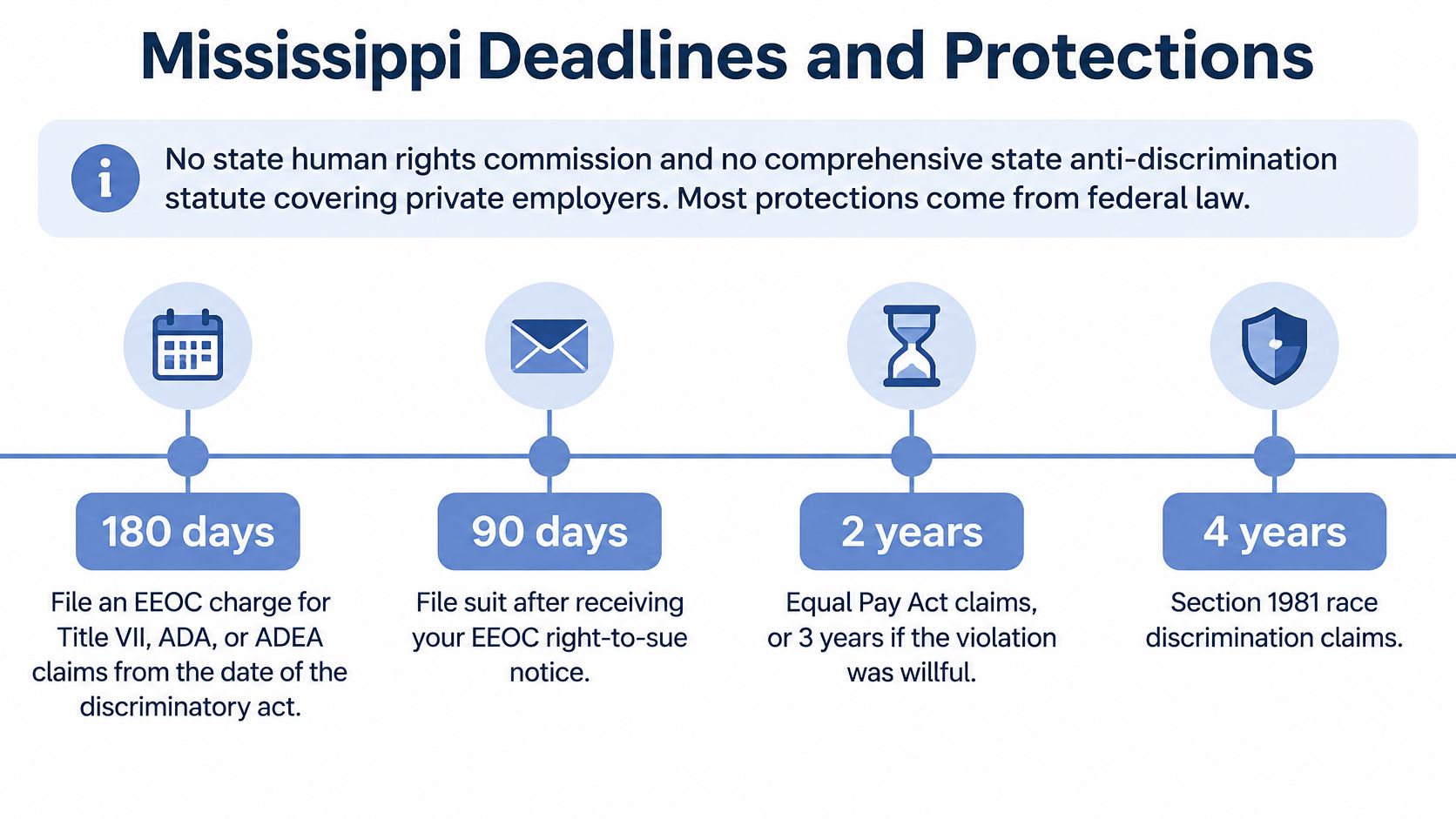
Mississippi does not have a human rights commission or a broad state anti-discrimination statute covering private employers. The Mississippi Department of Employment Security's Equal Opportunity Department handles equal-opportunity responsibilities within its programs. It is not a general commission for private-sector discrimination claims.
Mississippi employees commonly rely on federal protections such as Title VII, the ADA, the ADEA, and the FMLA. The deadlines below are general screening points. Before relying on them, identify the law that applies to the conduct and the event that starts its clock. The EEOC's guidance on filing deadlines explains federal charge-filing limits.
Mississippi Deadlines and Protections for Discrimination Settlements
| Issue | Mississippi rule | What it means for you |
|---|---|---|
| EEOC charge under Title VII or the ADA | Generally 180 days from the discriminatory act | Missing the charge deadline can end the federal claim |
| Federal suit after right-to-sue notice | Generally 90 days after receipt | Record when the notice arrives and calculate the deadline |
| ADEA age claim | Generally, file a charge within 180 days; a suit may begin after 60 days following the charge | An age claim may proceed before a full EEOC decision, but notice-related deadlines also matter |
| FMLA violation | 2 years, or 3 if willful | No EEOC charge is required; a suit can be filed directly |
| Human rights commission | None for private employers | The EEOC handles most private-sector discrimination charges |
| Workers' compensation retaliation | No standalone claim merely for filing a claim | A separate legal protection must apply |
| Public employee whistleblower | Narrow protection for qualifying information or testimony given to a state investigative body | Applies only to qualifying public employees and covered conduct |
These dates are starting points, not a complete analysis of every claim. For example, a Section 1981 claim may have a different limitations period. A settlement discussion also ordinarily does not stop a filing deadline, so calculate from the legally relevant event rather than the employer's latest offer.
Identify the Protected Conduct
Discrimination can occur during hiring, before an employee starts work. If an assessment screened you out, preserve its instructions, any accommodation requests, and rejection communications. MyCulture.ai's guide to hiring assessment risks provides context about personality tests and discriminatory screening.
Mississippi's public-employee whistleblower statute protects qualifying public employees from specified adverse actions directly caused by providing covered information or testimony. It is limited to covered employees and conduct, not every workplace complaint.
Mississippi also does not recognize a retaliation claim solely because an employee filed or pursued workers' compensation benefits, as explained in Baker Donelson's Mississippi employment guide. If an employee is discharged after an injury, an independent protection, such as disability discrimination or qualifying whistleblowing, must support the claim. A settlement's procedural stage matters here: a potential claim, a timely filed charge, and a lawsuit that has advanced further are not interchangeable when assessing what the agreement resolves.
Take These Steps Before You Sign a Release
A settlement's headline amount is only part of the decision. Before signing, use the nine steps below to check the evidence, deadlines, payment terms, and restrictions in the agreement.

Prepare the Record and Review the Deal
- Record the adverse action, dates, and witnesses promptly. Keep communications you lawfully possess, but do not take confidential company files you are not entitled to access.
- Calendar the applicable EEOC charge deadline from the adverse act. Ask counsel to check the calculation, particularly if employment decisions happened on different dates.
- File the charge and request mediation where offered. Keep the filing confirmation, and distinguish a submitted charge from an initial inquiry.
- List your damages separately. Track back pay, benefits, future losses, and other damages with supporting records.
- Respond to the first offer with a documented counteroffer. Identify the losses or agreement terms the employer has not addressed.
- Request a written allocation and a clause-by-clause draft. Read the entire agreement, including attachments and any policies it incorporates.
- Check the fee percentage, expense order, and tax allocation. Request an estimated distribution statement so you can see what may remain after deductions.
- Review confidentiality, non-disparagement, and any applicable age-waiver timing. Resolve unclear restrictions before signing, not after payment.
- Sign only after payment, reference terms, and enforcement steps are in writing. Keep the final signed agreement and calendar each required performance date.
Act Even if You Think Time Has Run Out
If a filing window may have closed, seek advice promptly. Different claims can have different deadlines, and the relevant adverse action may not be the same for each one.
For a leave-related dispute, preserve leave requests, medical-certification communications, attendance notices, and return-to-work instructions. These records can help clarify whether the concern involves leave interference or a disagreement about attendance.
This video provides additional context as you prepare questions about your employment dispute.
Bring the offer, complete release, fee agreement, termination documents, and wage records to a consultation. Ask for a deadline check and a clear explanation of the proposed net recovery before authorizing acceptance.
Nick Norris, P.A. represents Mississippi workers in employment disputes and can evaluate filing deadlines, settlement offers, and proposed releases. Visit Nick Norris, P.A. to request a consultation, and bring your draft agreement and damages records to review the payment and terms before signing.
Leave a Reply