

You report a supervisor's sexual harassment at a Jackson-area warehouse. Two weeks later, you're moved to nights and given fewer hours. Your manager calls it a staffing decision, but you're left wondering whether speaking up cost you your paycheck.
An employer retaliation lawsuit asks whether your employer punished you for exercising a legally protected right. For Mississippi workers, answering that question requires more than suspicious timing. You need to identify the protected activity, document what changed, and use the correct filing process before the deadline expires.
What an Employer Retaliation Lawsuit Covers
The warehouse worker's situation involves two separate questions: Did the supervisor engage in unlawful harassment, and did management punish the worker for reporting it? Those questions can produce different answers.
Think of the complaint as a smoke detector. The alarm alerts management to a possible problem. A retaliation lawsuit asks whether management reacted by punishing the person who sounded the alarm, or whether an unrelated, legitimate reason explains the employment decision.
The workplace change may be obvious, such as termination, or less direct, such as a reduction in available work.

The complaint and the punishment are different issues
A worker doesn't necessarily have to win the original discrimination claim to establish retaliation. For an opposition complaint, the worker's reasonable, good-faith belief that the conduct violated discrimination law matters, even if the evidence ultimately doesn't establish discrimination.
That distinction protects the reporting process. Otherwise, employees would have to prove their entire discrimination case before they could safely tell management about a concern.
An employer retaliation lawsuit may arise after a worker:
- Opposes discrimination, including by making an internal harassment complaint.
- Participates in an investigation, such as answering questions about a coworker's discrimination allegations.
- Files an agency charge, asking an enforcement agency to address unlawful treatment.
- Exercises another protected right, such as taking qualifying medical or family leave.
The applicable law determines which activities receive protection. A complaint about unlawful discrimination and a complaint about an unpopular supervisor aren't automatically the same thing.
Why the distinction matters in Mississippi
Retaliation is the most frequently alleged form of workplace discrimination nationally, and the EEOC's fiscal year 2024 Annual Performance Report reports 88,531 new discrimination charges that year. That total covers discrimination charges overall, not just retaliation allegations.
Practical rule: Describe what happened and why you believe it involved a protected right. Calling something unfair isn't always enough to identify unlawful discrimination.
A worker who reports sexual comments has identified a different legal concern from someone who objects only to a manager's rude tone. The exact words, surrounding circumstances, and employer's understanding all matter.
The Three Things You Must Prove
A manager learns that an employee reported discrimination, then cuts the employee's hours. To assess whether that decision could support a retaliation claim, organize the evidence around three requirements: protected activity, materially adverse action, and causation. The EEOC's enforcement guidance on retaliation describes these core elements.
The requirements work like links in a chain. A worker generally needs facts supporting each one, rather than showing that a supervisor acted unfairly.

Protected activity and material harm
Protected activity is conduct covered by the law at issue. An informal report to a manager may qualify if it reasonably communicates a concern about discrimination. For example, saying that women receive lower pay for the same work points to a possible discrimination issue more clearly than saying management does not appreciate you.
Taking part in a discrimination investigation may also qualify. A request for, or use of, protected leave involves a different law, so the right you exercised matters when assessing the claim.
Materially adverse action is conduct serious enough that it could discourage a reasonable worker from exercising a protected right. In Burlington Northern & Santa Fe Railway Co. v. White, decided in 2006, the Supreme Court held that retaliation need not involve firing or another final employment decision.
A punitive assignment, a meaningful loss of hours, or a threatening response may meet this standard. A passing annoyance usually does not. Consider the practical effect of the decision, not just the label the employer gives it.
Connecting the decision to the complaint
Causation asks whether the protected activity caused the challenged action. Under the usual Title VII and ADEA standard, retaliation must be a but-for cause: without the retaliatory motive, the action would not have happened, even if other motives also played a role.
Knowledge connects the complaint to the decision. Identify who received the report, who influenced the decision, and when those people learned about it.
Use these questions to organize the evidence:
- Identify the report. What did you say, and to whom?
- Establish knowledge. What shows the relevant manager knew?
- Describe the harm. What changed in your work or income?
- Test the explanation. Do records support the employer's stated reason?
- Compare similar coworkers. Were workers with similar responsibilities and records treated differently?
Pretext means the employer's stated reason may not be the actual one. For example, a claimed staffing shortage may be less convincing if the company gives your removed shifts to someone else.
Suppose you complain on Monday, your manager acknowledges the complaint Tuesday, and your schedule is cut Thursday despite a clean performance history. The report may support protected activity, the acknowledgment supports the manager's knowledge, and the schedule change shows harm. Close timing can support an inference of causation, but records explaining the schedule change still matter.
For a step-by-step guide to organizing these facts, see how to prove retaliation at work. The EEOC Office of General Counsel's annual report is also available for readers seeking the agency's report.
This video offers another way to approach the proof questions.
Federal and Mississippi Protections and Deadlines
A worker who reports discrimination to a supervisor may still need to file with the right agency before a legal deadline. The deadline depends on what workplace right is involved, so identify the subject of the complaint before choosing the filing route.
Retaliation protections, filing routes and deadlines
| Law | Protects retaliation for | Where the claim starts | Deadline |
|---|---|---|---|
| Title VII of the Civil Rights Act | Opposing race, color, religion, sex, or national origin discrimination, or participating in a charge | EEOC charge | Generally 180 days in Mississippi for the charge; generally 90 days after receiving a right-to-sue notice |
| Americans with Disabilities Act | Opposing disability discrimination or requesting accommodation | EEOC charge | Generally 180 days for the charge; generally 90 days after receiving a right-to-sue notice |
| Age Discrimination in Employment Act | Opposing age discrimination involving workers 40 and older | EEOC charge | Generally 180 days for the charge; separate rules govern when suit can begin and the deadline after an EEOC termination notice |
| Family and Medical Leave Act | Requesting or taking protected leave, or opposing FMLA violations | Department of Labor or direct lawsuit | Generally 2 years from the violation, or 3 years for a willful violation |
| Fair Labor Standards Act | Complaining about unpaid overtime or minimum wage violations | Department of Labor or direct lawsuit | Generally 2 years from the violation, or 3 years for a willful violation |
| USERRA | Exercising military service and reemployment rights | Department of Labor VETS or direct lawsuit | Generally 3 years for a direct lawsuit under 38 U.S.C. § 4327(b) |
| Mississippi common-law wrongful discharge | Conduct within narrow public-policy exceptions to at-will employment | Civil action, without agency intake | Generally 3 years under Miss. Code Ann. § 15-1-49; counsel should confirm the applicable theory and timing |
Start with the right enforcement route
Mississippi does not have a human rights commission. For federal employment-discrimination retaliation by a private employer, workers ordinarily start with an EEOC charge. Use 180 days as the safe planning assumption for an ordinary Mississippi private-employer discrimination charge. The longer 300-day period depends on a state deferral agency, which Mississippi does not have for these claims.
Federal employees follow a different administrative process. A wage complaint also does not become an EEOC matter just because the employer responds with retaliation. The Department of Labor's retaliation-rights guidance distinguishes discrimination complaints from other protected workplace activities. The subject of your report helps determine the agency and procedure.
Don't confuse an internal report with a legal filing
An HR investigation is not an EEOC charge. A manager's promise to investigate or ongoing negotiations do not pause the need to check a filing deadline. Treat the internal complaint as one step, not as a substitute for filing with the agency or court that handles the claim.
Calculate deadlines separately for each challenged action. A later demotion, for example, does not necessarily revive an expired claim about an earlier suspension.
Calendar every challenged action separately. Don't assume the newest event preserves every older event.
A single workplace complaint can also involve more than one legal route. An employee who reports sex discrimination and unpaid overtime may need to consider discrimination protections as well as wage protections. Do not assume one filing covers both.
If a deadline may have been paused or extended, the rules for tolling and statutes of limitations require careful review. Keep track of the date of each event and get advice about the applicable claim before relying on an exception.
Examples of Actions That Count and Actions That Don't
An hourly employee at a Mississippi distribution center reports that women receive less pay for the same work. On the next schedule, two weekend shifts disappear, and her supervisor assigns her to the least desirable dock. To understand whether those actions may support a retaliation claim, look at what changed, how it affected her, and whether the employer knew about her complaint.
Did losing shifts reduce her earnings? Did the dock assignment cut off access to better-paid work? Did the employer use its usual scheduling process? Those details help show whether a workplace change caused meaningful harm or was only unwelcome.
Evaluate the effect, not just the label
A company may call a transfer lateral even if it makes the employee's work materially worse. The reverse can also happen: an employee may dislike a change that causes no meaningful harm. The label alone does not settle the question.
Reduced hours, an undesirable transfer, intensified discipline, or a harmful reference may warrant review even if the worker remains employed. Record the action and its practical effect, then compare it with the employer's stated reason and treatment of similar workers.
Employer actions and whether they usually support a claim
| Employer action | Protected activity | Usually actionable? |
|---|---|---|
| Hypothetically, firing two weeks after an HR harassment complaint | Opposing harassment | Potentially; timing and employer knowledge support further investigation, not an automatic finding |
| Hypothetically, cutting hours from 40 to 20 after a discrimination charge | Filing a charge | Potentially; the substantial income loss may show meaningful harm |
| Assigning the worst route after a protected FMLA request | Requesting protected leave | Potentially, if the route is materially worse and the request caused the change |
| Warning one worker for tardiness while comparable coworkers receive none | Complaining about pay discrimination | Possibly; selective enforcement may support the claim |
| Criticizing work quality based on an established performance history | No protected activity identified | These facts alone do not establish retaliation |
Distinguish selective punishment from ordinary supervision
An attendance warning does not automatically show retaliation. Compare the employee's attendance record with the written policy, management's usual practice, and how similar coworkers were treated. A consistent process points to ordinary supervision; a sudden, uneven response after a protected complaint calls for closer examination.
For practical context on consistent attendance practices, see a supportive attendance guide for managers. It is a management resource, not legal authority.
An injury claim and a discrimination complaint are different kinds of workplace activity. Filing a workers' compensation claim alone does not identify a separate protected complaint in the examples above. If an injured employee also opposes disability discrimination, that distinct activity may matter; the question is whether the employer's action followed and was connected to it. The injury claim by itself does not answer that question.
How a Retaliation Claim Moves From Complaint to Appeal
A complaint doesn't move automatically from HR to an agency and then to a courtroom. Each stage requires a separate decision, and some cases resolve without litigation.
The process graphic offers a broad overview. An actual federal case involves additional procedural steps.
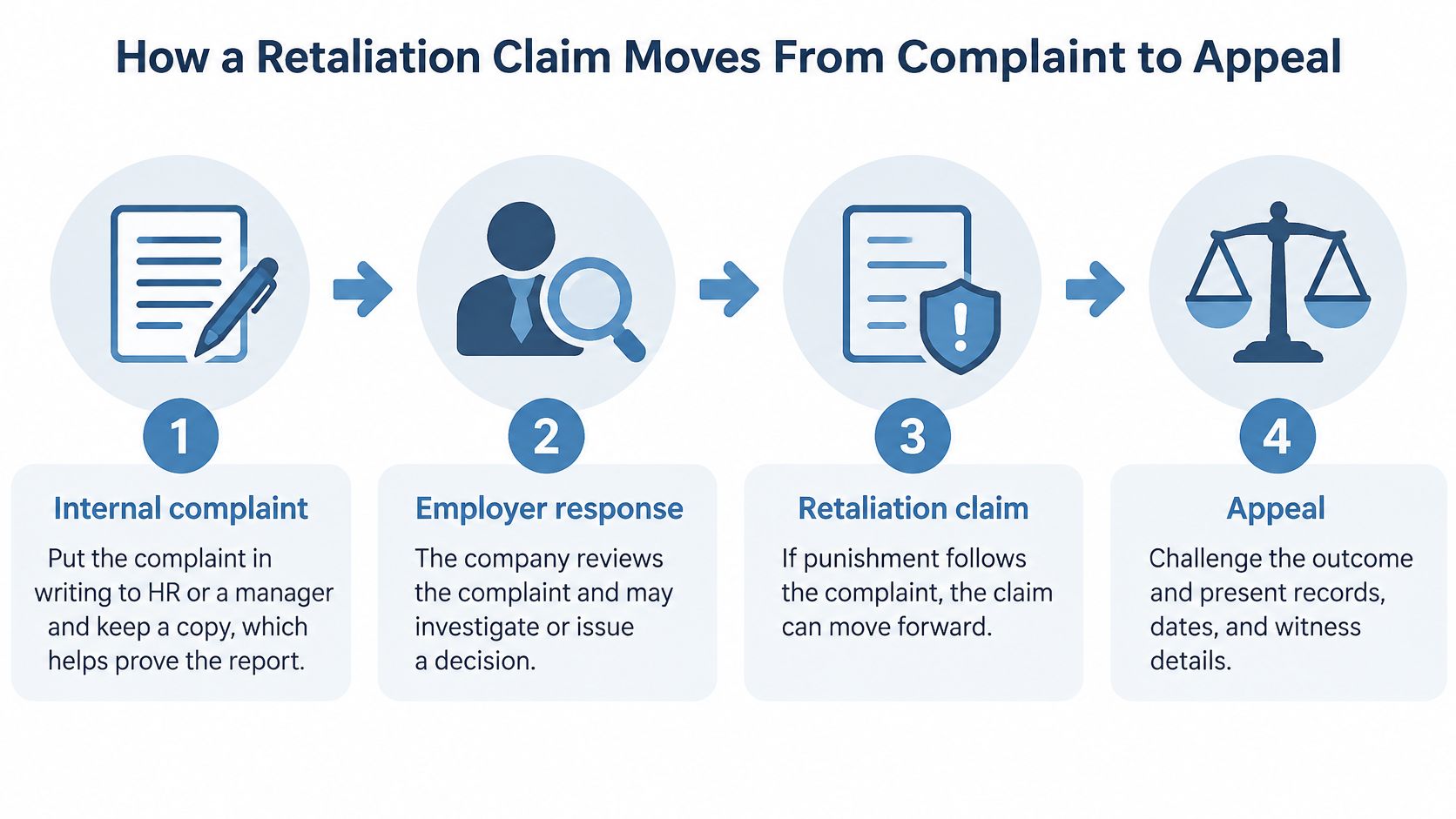
From the first report to the agency decision
Internal complaint. Report the discrimination concern to HR or an appropriate manager when safe and appropriate. Keep the wording factual and retain confirmation of delivery.
Employer action. Record what management does afterward, including the decision-maker, stated explanation, and practical effect. A dated account helps distinguish what you knew at the time from what you learned later.
Agency charge or other filing. Use the route governing the claim. Discrimination retaliation ordinarily involves an EEOC charge, while FMLA, FLSA, and military-service issues require their own procedural analysis.
Investigation and possible resolution. The employer may provide a written response, and the agency may request information or offer mediation. Conciliation is an effort to resolve a matter after an agency finding, not a guaranteed payment.
The EEOC's fiscal year 2024 reporting announcement states that the agency resolved 87,219 charges and secured more than $469.6 million through the administrative process. These national results cover the agency's administrative work, not the expected recovery or odds of success in a Mississippi retaliation case.
From permission to sue to appellate review
Right-to-sue procedures. Title VII and ADA claims generally require the appropriate EEOC notice before a private lawsuit. ADEA procedures differ, so don't assume every discrimination statute requires the same notice before suit.
Federal lawsuit. Counsel files a complaint stating the facts and legal claims. The employer may answer the allegations or ask the court to dismiss claims for legal or procedural reasons.
Discovery. The parties exchange relevant documents, respond to written questions, and take depositions, which are recorded testimony under oath. Your lawyer may seek scheduling records, internal communications, and evidence testing the employer's explanation.
Settlement, trial, and appeal. The parties may negotiate a resolution, sometimes through mediation, or proceed to trial if the claims survive pretrial review. An appeal asks a higher court to review alleged legal errors; it isn't ordinarily a fresh trial with new witnesses.
A complete timeline helps at every stage, but an appeal depends heavily on what the parties preserved in the court record.
Review notices and court orders promptly with counsel. Appeal deadlines are short, and post-judgment motions can affect their calculation. FMLA and FLSA claims can proceed directly in court without first completing an EEOC charge process.
Evidence to Preserve and Steps to Take This Week
Save evidence according to what it proves, not merely where you found it. A folder containing hundreds of disconnected screenshots is harder to evaluate than an organized set of records tied to specific events.
Build a usable record
- Protected activity. Keep complaint emails, HR portal submissions, texts, and acknowledgments. For a verbal report, write a dated note identifying the participants and what you remember saying.
- Knowledge and sequence. Preserve messages showing that supervisors learned about the complaint. Identify who recommended the challenged action and who approved it.
- Practical harm. Keep schedules, pay statements, reassignment notices, disciplinary forms, and termination paperwork. Note lost benefits or other concrete consequences.
- Comparisons and explanations. Retain your own performance evaluations and available workplace policies. Identify coworkers with comparable jobs and records, without taking their private personnel files.
Only keep records you're legally entitled to possess. Don't access another employee's account, copy unrelated customer information, or remove privileged communications. Tell counsel about important records you can't lawfully obtain so preservation and discovery can address them.
Take focused action now
- Calendar the filing review. Record each challenged act and ask the EEOC or counsel to confirm its deadline. Don't calculate only from the most recent event.
- Write a dated timeline. Separate firsthand observations from information someone else gave you.
- Back up lawful personal copies. Keep original messages and attachments when possible, rather than relying entirely on cropped screenshots.
- Review documents before signing. Obtain advice before accepting a severance agreement or release that could affect your claims.
- Keep the dispute off social media. Preserve relevant existing posts and avoid publishing accusations or confidential information.
Continue performing your job and following legitimate workplace rules where possible. Don't provoke a confrontation to obtain evidence, and don't rewrite an old note to make it appear contemporaneous.
Damages, Remedies and What Attorney Fees Cover
Title VII compensatory and punitive damage caps by employer size
| Employer size (employees) | Combined compensatory and punitive cap | Outside the cap |
|---|---|---|
| 15 to 100 | $50,000 | Back pay, front pay, reinstatement, attorney's fees |
| More than 500 | $300,000 | Back pay, front pay, reinstatement, attorney's fees |
These are selected employer-size bands, not the complete schedule. The cap applies to specified types of damages, not every remedy. It does not determine what a particular claim is worth or guarantee that the employee will receive payment.
Match the remedy to the loss
The remedy depends on the harm and the law that applies. Compensatory damages may cover emotional distress and other qualifying harm. Punitive damages may address malicious or recklessly indifferent conduct, but they are not available against government employers.
For lost income, back pay covers past lost earnings and benefits. Front pay may cover future earnings losses if returning to the job is not appropriate. Reinstatement means returning the employee to employment. These remedies address different losses, much like separate parts of a repair: the right fit depends on the evidence, employment relationship, and governing statute.
Other laws provide different remedies:
- FMLA claims may provide lost wages and benefits, plus an equal amount in liquidated damages in qualifying cases.
- FLSA claims may provide unpaid wages and an equal amount in liquidated damages.
- USERRA claims may provide lost wages and benefits, with additional liquidated damages for willful violations.
Liquidated damages are an extra amount authorized by certain statutes. They are not a general award for emotional distress. The discussion of workplace retaliation settlements offers related context on compensation and resolution terms. A remedy available under one law may not be available under another, so the legal basis for the claim matters.
Separate attorney fees from litigation expenses
Employment lawyers often work on contingency. That means the lawyer's fee is generally a share of any monetary recovery, rather than an hourly charge at the outset. The exact fee and the handling of expenses depend on the written agreement.
Ask how filing fees, deposition charges, expert expenses, and records costs are treated. For example, find out whether expenses are deducted before or after the lawyer's percentage is calculated, who pays them if there is no recovery, and how any court-awarded attorney fees affect the agreement.
Before signing: Get the fee percentage and expense terms in writing. A percentage alone does not show what you may receive after expenses.
Common Questions Before You Contact a Lawyer
What if I already quit?
You may still have a claim. One possible theory is constructive discharge, which applies when conditions become so intolerable that a reasonable person would feel forced to resign. Keep your resignation letter and note the conditions and dates. An unpleasant job alone does not meet that standard.
What if I missed the deadline?
A claim based on that act may be barred, but ask for an individual review before assuming every option is gone. A later retaliatory act may need its own filing analysis. It does not revive an earlier claim.
Can I file an EEOC charge without a lawyer?
Yes. The EEOC accepts charges through its online Public Portal, by telephone, and at its field offices, and counsel can help identify claims, organize facts, and assess timing.
For an initial consultation, prepare a short timeline and key documents. Some offices use legal intake specialists to collect this information. The attorney should provide legal conclusions and strategy.
Nick Norris, P.A. evaluates Mississippi employment claims and offers personalized representation through negotiation, litigation, or appeal. Bring your complaint, any changed schedules or discipline records, and a dated timeline. These details can help the office assess your protected activity, the employer's response, and filing deadlines. Visit Nick Norris, P.A. to schedule a consultation.
Leave a Reply