

How to prove hostile work environment in Mississippi: Step-by-step guide
To win a hostile work environment case, you have to do more than just show you have a bad boss or a toxic workplace. The key is proving the harassment was either so severe or so pervasive that it fundamentally changed your job conditions, and—critically—that it was all happening because of a protected part of who you are, like your race, sex, or disability. This isn't about general workplace conflict; it's about connecting the dots to show a clear pattern of discriminatory abuse.
What Qualifies as a Hostile Work Environment in Mississippi

Let's be clear: having a difficult job, a demanding manager, or annoying coworkers isn't enough to meet the legal definition of a "hostile work environment" in Mississippi. The law sets a much higher bar than just a stressful or unpleasant atmosphere.
For the behavior you’re facing to be legally actionable, it has to be something a reasonable person would find intimidating, abusive, or hostile. More than that, it has to be so bad that it actually interferes with your ability to perform your job. A rude supervisor, for instance, might just be a bad manager. But when that behavior crosses a specific legal line, you have a potential claim.
The Foundation of the Claim: Why Is It Happening?
This is the absolute most critical part of any hostile work environment claim: the reason for the harassment. The mistreatment must be directly tied to your membership in a legally protected class.
Federal laws, which cover all employees in Mississippi, outline several protected characteristics. The harassment you're experiencing must be based on one of these:
- Race or Color: This includes racial slurs, offensive "jokes," or being treated unfairly because of your race or the color of your skin.
- Religion: Facing ridicule for your faith, being pressured to convert, or being denied reasonable accommodations for your religious practices.
- Sex: This is a broad category covering sexual harassment, unwelcome advances, offensive comments about gender, and discrimination based on your gender identity or sexual orientation.
- Age: This protection is specifically for workers who are 40 years of age or older and are being targeted with ageist comments or treated differently than younger colleagues.
- Disability: Enduring harassment because of a physical or mental disability.
- National Origin: Being mocked for your accent, heritage, or the country you come from.
If the hostility stems from a personality clash or you have a manager who is an equal-opportunity jerk to everyone, it probably isn't illegal, no matter how unfair it feels. You have to be able to connect the harassment to your protected status.
Severe vs. Pervasive Conduct: The Two Paths to a Claim
The harassing behavior must also be either "severe" or "pervasive." These terms help measure the intensity and frequency of the abuse to determine if it crosses the legal threshold.
A severe incident is so extreme that a single occurrence is enough to create a hostile work environment. Think of things like a physical assault, a direct threat of violence, or the use of an egregious racial slur. It’s an act so shocking it instantly poisons the workplace.
Pervasive conduct, on the other hand, is about a pattern of less severe but persistent and ongoing harassment. One offensive joke might not be enough to file a lawsuit. But a daily barrage of discriminatory comments, insults, or demeaning actions can add up to create an abusive atmosphere. Here, it’s the sheer frequency that makes the behavior illegal.
Key Takeaway: The law is designed to filter out what it considers "petty slights or minor annoyances." The environment must become objectively abusive to the point that it fundamentally changes your relationship with your job.
It can be tough to know where the line is between unprofessional behavior and legally actionable harassment. This table should help clarify the difference.
Actionable Harassment vs Unprofessional Conduct
| Behavior | Is It Legally Actionable? | Why or Why Not? |
|---|---|---|
| A coworker repeatedly makes crude sexual jokes and comments on your appearance. | Yes | This is pervasive conduct based on sex, creating an abusive environment. |
| Your boss yells at everyone in the department and is generally rude and impatient. | No | While unprofessional, it's not targeted at a protected class. He's an equal-opportunity bully. |
| A manager uses a racial slur when speaking to you once. | Yes | A single use of a severe racial slur is often considered severe enough to be actionable on its own. |
| You are consistently excluded from team lunches and social events. | Probably Not | Unless you can prove you're being excluded because of your race, age, religion, etc., this is likely just poor social conduct. |
| Colleagues mock your accent and heritage daily. | Yes | This is a clear pattern of pervasive harassment based on national origin. |
As you can see, the motivation behind the behavior is what matters most in the eyes of the law.
This distinction is vital. Documenting a consistent pattern of behavior is often the key to building a strong case. Sadly, this is a widespread problem. The Workplace Bullying Institute found that 52.2 million American workers are directly bullied at work, with millions more witnessing it. These numbers show just how common these hostile environments really are. You can learn more about these troubling workplace statistics on cake.com.
Building Your Case with Strong Evidence

If you're going to prove a hostile work environment, you can't just rely on your feelings or vague complaints. Your entire claim will rise or fall based on the quality of the evidence you gather. You need to think like an investigator, meticulously building a record of the harassment that no one can deny.
Your goal is to paint such a clear and detailed picture that an outsider—like an EEOC investigator or a jury—can understand exactly what you went through, even though they weren’t there to see it. This isn’t about just telling your story; it's about proving it with concrete facts.
Create a Detailed and Private Log
This is hands-down the most critical thing you can do. Our memories fade, especially under stress, so don't trust yourself to remember the details later. Get a notebook or start a document on your personal computer immediately and log every single incident.
A word of caution: Never use a work computer or company-owned device for this. Your employer likely has the right to monitor their own systems, and the last thing you want is for them to find your log. Keep it at home and keep it private.
Each entry needs to be specific. Vague notes won't cut it. For every incident, write down:
- Date and Time: Pinpoint exactly when it happened.
- Location: Where were you? In a public breakroom? Your boss's office?
- Who Was Involved: Name the person or people engaging in the behavior.
- Who Else Was There: Note any witnesses who saw or heard what happened. Their testimony can be a game-changer.
- What Was Said or Done: Use direct quotes if you can. If not, describe the words, actions, and gestures as precisely as possible. Don't forget to include your own reaction.
- How It Made You Feel: This is crucial for establishing the abusive nature of the environment. Did you feel humiliated, anxious, or scared? Write it down.
An entry like "Mark was mean to me again" is useless. What you need is something like this: "May 15, 2024, 10:00 AM in the breakroom. Mark told me I was 'too old to learn the new software' in front of Sarah and John. He patted me on the shoulder and said, 'Don't worry, you'll be retiring soon anyway.' I felt completely humiliated, and my hands were shaking."
That’s the kind of detail that shows a clear pattern of discriminatory and pervasive conduct.
Preserve All Digital and Physical Evidence
Your personal log is your narrative, but you also need to collect the tangible proof that backs it up. In today's world, digital communications are often a goldmine for this kind of evidence because they provide a dated, undeniable record.
Start discreetly gathering and saving copies of anything that supports your claim. Store everything on a personal cloud drive like Google Drive or Dropbox, or on a personal thumb drive.
Here’s what to look for:
- Emails: Forward any incriminating emails from your work account to your personal email.
- Texts & Instant Messages: Take clear screenshots of harassing texts or messages from platforms like Slack or Microsoft Teams. Make sure the sender’s name and the date are visible.
- Performance Reviews: Unfairly negative reviews can be powerful, especially if they suddenly appeared after you pushed back against the harassment.
- Company Policies: Find and download a copy of the employee handbook, paying close attention to the company’s anti-harassment policy and official reporting procedures.
- Voicemails: If you get a harassing voicemail, use a recording app on your personal phone to save it.
Crucial Tip: Never use company equipment to make copies. Don't use the office scanner or photocopier. This can tip off your employer and could even be a violation of company policy. Stick to your personal devices for everything.
Identify and Approach Potential Witnesses
Witnesses can make or break a case. Their testimony provides independent corroboration, showing that it’s not just your word against someone else’s.
Think back through the incidents. Who else was in the room? Who overheard the offensive "jokes" or saw you being targeted in meetings? These are your potential witnesses.
It's a delicate situation, of course. Many people are afraid of retaliation and don't want to get involved. You should never pressure anyone. It’s often best to approach them privately and just ask if they remember a specific event.
Even if they are hesitant, just knowing who saw what is valuable information for your attorney later on. Their willingness to eventually speak up during a formal investigation could be what tips the scales in your favor. Understanding how these situations are typically handled can also give you confidence, which is why we've put together a guide on the workplace investigation process.
Your Next Step: Reporting the Harassment Internally
Before you can take legal action, you almost always have to give your employer a chance to make things right. That means formally reporting the harassment using the company’s own procedures. Don't think of this as just another box to check—it's a crucial step that protects your legal rights later on.
Navigating this process feels daunting, I know. But doing it correctly is one of the best ways to strengthen your potential case. It proves you acted in good faith to solve the problem internally, and it puts the ball squarely in your employer's court. If they fail to act or their response is weak, that failure becomes a key piece of your hostile work environment claim.
First, Find and Follow Your Company's Policy
Your first move is to get your hands on the company's official anti-harassment policy. It's almost always in the employee handbook. If you can't find your copy, just ask Human Resources for one; they have to give it to you.
Once you have it, read it carefully. The policy will spell out exactly who you need to report the harassment to. It might be an HR manager, a specific company representative, or even an executive. You must follow these instructions to the letter. If you go off-script, your employer could later argue they were never properly notified, which can seriously damage your case.
What if the policy says to report to your direct supervisor, but they're the one causing the problem? The policy should always provide an alternative. In that situation, you simply go to the next person up the chain listed in the procedure.
How to Write a Professional Complaint
A verbal complaint isn't enough. You need to put it in writing. An email is perfect because it creates an automatic, timestamped record.
When you write it, your goal is to be professional, clear, and factual. Resist the urge to use emotional language, make sweeping accusations, or issue threats. Just stick to the facts you’ve been carefully documenting in your private log.
Your written complaint should include a few key things:
- A Clear Opening: Start by plainly stating that you are reporting harassment that is creating a hostile work environment.
- Specific Examples: Provide a few clear, concise examples of what happened. Be sure to include dates, what was said or done, and who was there.
- The "Why": If you can, connect the behavior to your protected class. For instance, "These comments are all about my age," or "I noticed this treatment only started after I requested an accommodation for my disability."
- A Call to Action: End by saying you want the harassment to stop and that you're asking the company to take immediate and effective action to fix the situation.
For a deeper dive into crafting this critical document, take a look at our guide on how to report workplace harassment effectively.
Remember, the whole point of this letter is to put your employer on formal notice. It forces their hand and creates an official paper trail showing you did everything right.
What Happens After You Hit "Send"?
Once your complaint is submitted, your company is legally required to conduct a prompt and thorough investigation. Usually, this means someone from HR will want to interview you, the person you accused, and any witnesses you named.
Be ready for these meetings. Bring a copy of your complaint and your personal log of incidents. Your job is to answer questions honestly and stick to the facts you’ve documented. It can be emotional, but try your best to stay on topic.
Sadly, what you’re going through is far from rare. Research reveals that a staggering 74.9% of employees have worked in a toxic culture. The top culprits? Poor leadership (78.7%) and poor communication (69.8%), according to insights from PeopleKult. Knowing this doesn’t make it easier, but it shows that this is a widespread problem, not a personal failing.
After the investigation wraps up, the company should tell you what they found and what they plan to do. Their response could be anything from:
- Disciplining the person who harassed you.
- Mandating anti-harassment training for the team.
- Moving you or the harasser to a different department.
- Or, they might conclude that no harassment occurred.
The single most important thing to watch for after you complain is retaliation. Your employer cannot legally punish you for reporting harassment in good faith. If you suddenly get a bad performance review, get demoted, or are even fired right after filing your complaint, you might have an entirely new—and often much stronger—legal claim for retaliation.
Filing Your Claim With The EEOC
So, you’ve reported the harassment to HR, followed the company’s internal process, and… nothing. The behavior continues, and it’s clear your employer isn’t going to fix the problem. When internal channels fail, your next move is to seek help from an outside agency.
For employees in Mississippi, that path leads to the U.S. Equal Employment Opportunity Commission, better known as the EEOC.
Because Mississippi does not have a human rights commission, the EEOC is your sole venue for filing a formal charge. Think of it as the required first step before you can ever take your case to court. You can't sue your employer for harassment in federal court without first going through the EEOC.
The Critical 180-Day Deadline
This is, without a doubt, the most important rule to remember. In Mississippi, you must file your charge with the EEOC within 180 days of the last discriminatory act. This isn't a suggestion; it's a hard-and-fast deadline. If you miss it, you almost certainly lose your right to sue, period.
The 180-day clock starts ticking from the most recent incident. In a hostile work environment claim, which is usually built on a pattern of conduct, that "last act" could be the final offensive comment, the last time you were unfairly passed over for a shift, or any related behavior that contributes to the hostile atmosphere. Don't wait until day 179.
Expert Insight: Waiting too long is one of the most common and devastating mistakes I see. The moment you realize your employer isn't taking your complaint seriously, you should start preparing your documentation for the EEOC. The clock is always running.
How To Start The EEOC Process
Getting the ball rolling is fairly straightforward. You can start the process by submitting an inquiry through the EEOC's online public portal, calling them, or visiting the Jackson, Mississippi office in person.
The first real step is an initial interview with an EEOC staff member. They’ll listen to your story and make a preliminary determination about whether your situation is covered by the laws they enforce.
Come to this interview prepared. Bring your detailed log of incidents, copies of every relevant email and text, and the names of any potential witnesses. The more organized you are, the more effectively you can communicate the severity of the situation and show the investigator that your claim has substance.
The infographic below illustrates the internal steps you should have already completed, which create the foundation for your external EEOC claim.
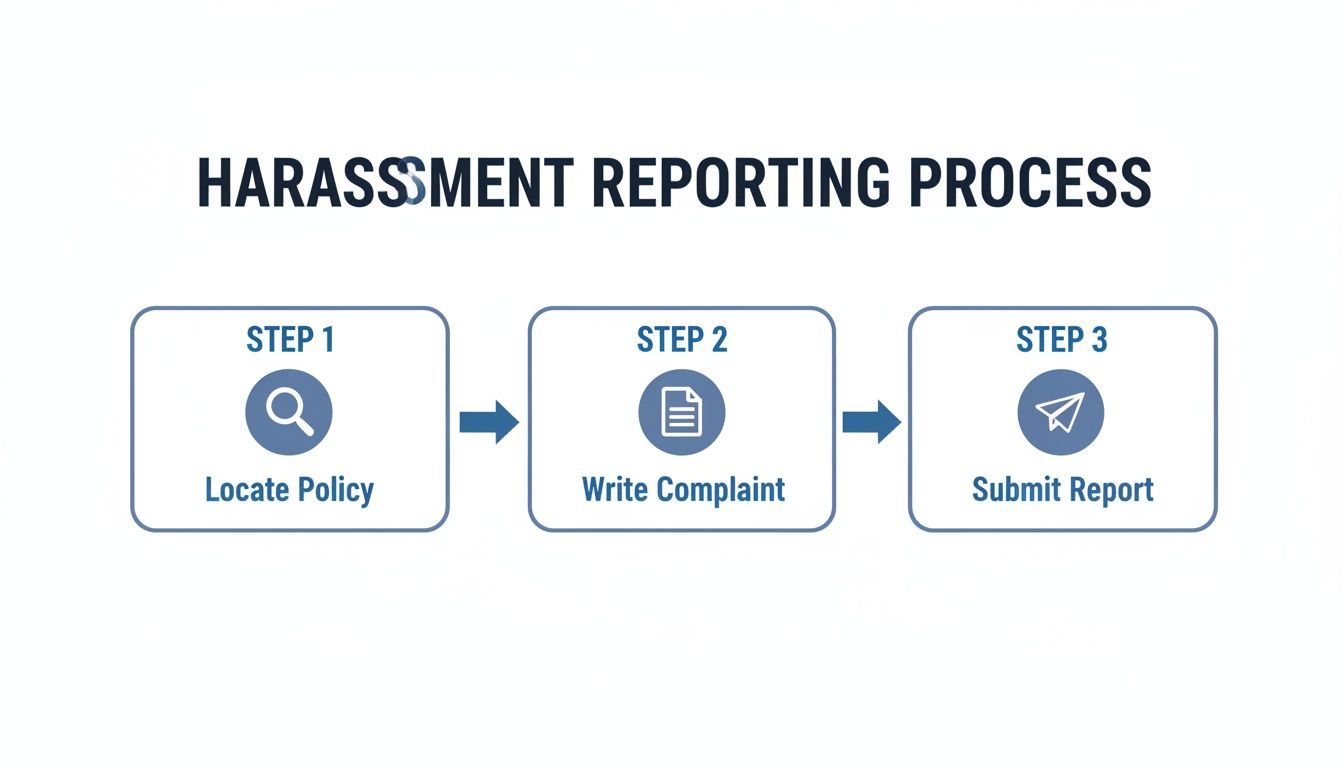
Having this paper trail from your internal complaint is crucial. It shows the EEOC that you gave your employer a chance to remedy the situation before escalating it.
What To Expect From The EEOC Investigation
If the EEOC accepts your case, they will draft a formal "Charge of Discrimination" for you to review and sign. Once it's official, they notify your employer and request a formal response to your allegations.
After that, the investigation can go a few different ways:
- Mediation: Often, the EEOC will offer a voluntary mediation program. This is a chance for you and your employer to resolve the issue with a neutral third party, potentially reaching a settlement without a full investigation.
- Request for Information: The investigator will gather evidence. They'll ask your employer for documents like your personnel file, company policies, and records related to the person you accused of harassment.
- Fact-Finding: In some instances, the investigator might hold a conference, bringing both you and representatives from your employer together to ask questions and clarify facts.
Be patient. A thorough investigation takes time—often several months, and sometimes over a year. At the conclusion, the EEOC will issue its findings.
Ultimately, you will receive a "Notice of Right to Sue." This letter is your ticket to the courthouse. It confirms you've completed the required administrative process and officially gives you 90 days to file a lawsuit in federal court.
Before you file, gathering your evidence is the most important task. This checklist breaks down the essential documents and information you'll need to present a strong case to the EEOC.
EEOC Charge Essential Evidence Checklist
| Evidence Type | What to Collect | Pro Tip |
|---|---|---|
| Personal Log | A detailed, dated journal of every incident of harassment, including who, what, where, and when. Note any witnesses. | Be specific. Instead of "He was rude," write "On May 5th at 2 PM, he called me 'incompetent' in front of two coworkers." |
| Digital Communications | Copies of all emails, text messages, voicemails, or social media messages related to the harassment. | Don't delete anything! Screenshot texts and forward work emails to a personal account for safekeeping. |
| Physical Evidence | Any harassing notes, photos, or objects left at your workspace. | Take pictures of the evidence in the location you found it before turning it over to HR or the EEOC. |
| Witness Information | A list of coworkers who saw or heard the harassment, with their contact information and a brief note on what they witnessed. | Even if they are afraid to speak up now, having their information is vital for a later investigation. |
| Company Documents | Copies of your employee handbook (especially the harassment policy), performance reviews, and any internal complaints you filed. | Your performance reviews can help counter any claims that your complaint is due to poor work performance. |
| Medical Records | If the stress caused physical or mental health issues, documentation from a doctor or therapist can be powerful evidence of damages. | Notes from a therapist connecting your anxiety or depression to the work environment are especially compelling. |
Having these items organized and ready will make your initial EEOC interview much more productive and help the investigator see the strength of your claim from the very beginning.
It's crucial to remember that the EEOC is a neutral government agency, not your personal attorney. Their job is to investigate whether federal law was broken. For dedicated advocacy and legal advice tailored to your best interests, especially after receiving that Right to Sue letter, your next call should be to an experienced employment lawyer. An attorney can guide you through the EEOC's maze and, if needed, fight for you in court.
When to Hire a Mississippi Employment Lawyer
There’s a point in every hostile work environment situation where you have to decide if you can keep handling it yourself or if it’s time to bring in a professional. Knowing when to make that call is one of the most important decisions you'll face.
While you absolutely should start documenting everything on your own, certain lines, once crossed, mean it's time to get a Mississippi employment lawyer involved. Reaching out for legal help isn't giving up; it’s taking a powerful, strategic step to protect yourself and your career.
The Signs You Can't Ignore
Certain actions—or sometimes, a total lack of action—from your employer are blaring signals that you need professional help. If any of these sound familiar, it’s time to pick up the phone.
- Your Complaint Goes Nowhere: You did everything right. You filed a formal, written complaint with HR. Now weeks have gone by, and you've heard nothing but crickets. Or worse, you got a dismissive email. A company that shrugs off a serious complaint is a huge red flag.
- You're Facing Retaliation: Funny how right after you reported the harassment, you were suddenly demoted, hit with a negative performance review, or left out of key meetings. Maybe you were even fired. This isn't a coincidence; it's retaliation, and it's illegal.
- The Harassment Escalates: Instead of fixing the problem, your complaint seems to have just made the harasser bolder and more aggressive. The situation is now worse than before.
- HR's "Investigation" is a Joke: The company’s internal review felt completely one-sided, like it was designed to protect the company, not find the truth. They didn’t interview your witnesses, they twisted your words, or they just went through the motions.
If you’re nodding along to any of these, you’re past the point of being able to solve this on your own. You need a legal advocate fighting for you.
What an Employment Attorney Actually Does
Hiring a lawyer isn’t just about suing someone. Their real value starts the minute they’re on your side. They can immediately step in and handle all communication with your employer, navigate the confusing EEOC process, and make sure every single deadline is hit.
Here’s how a skilled attorney helps:
- Honest Case Assessment: They'll dig into your evidence—your logbook, emails, texts, and witness list—and give you a straight-up, honest opinion on the strengths and weaknesses of your claim.
- Strategic Advice: They'll guide you on what to do next, how to preserve evidence, and how to deal with the EEOC process without making a misstep.
- Powerful Negotiation: Your lawyer can negotiate directly with the company's attorneys to reach a fair settlement. This often happens without ever setting foot in a courtroom and can include financial compensation and other remedies.
- Courtroom Advocacy: If the company refuses to settle, your lawyer will file a lawsuit and fight for you in federal court.
Having an attorney on your side completely changes the dynamic. It sends a clear message to your employer that you are serious and forces them to treat your claim with the gravity it deserves.
For a deeper dive, read our article on why getting early legal support can change your job dispute outcome.
But What About the Cost?
This is the number one reason people in Mississippi hesitate to call an attorney. They're worried about how they'll afford it. It's a completely valid concern, but it shouldn't stop you from getting the help you need.
Nearly all reputable Mississippi employment law firms, including ours, handle hostile work environment cases on a contingency fee basis.
What does this mean for you? It means you pay zero upfront attorney fees. The law firm only gets paid if they win your case, either by securing a settlement or winning a verdict in court. The attorney's fee is simply a pre-agreed-upon percentage of the money they recover for you.
In Mississippi, that fee is typically around 40-50%. If you don’t win, you don’t owe your attorney a dime for their work. This system levels the playing field, allowing any employee, no matter their financial situation, to stand up to their employer and fight for justice.
Frequently Asked Questions
When you're dealing with a hostile work environment, it's natural to have a lot of questions and uncertainty. Here are some straightforward answers to the questions we hear most often from employees in Mississippi.
What if I'm the Only One Being Harassed?
Feeling isolated is common, but it doesn't mean you don't have a case. In fact, a lot of harassment is intentionally done in private, away from any potential witnesses.
Your personal account of what happened is powerful evidence. The trick is to back it up. A detailed log of every incident, emails or texts you sent to a partner or friend immediately after something happened, or even therapist's notes documenting your increased stress can all work to strengthen your story. A good lawyer knows how to build a rock-solid case around your testimony, even without a third-party witness for every single event.
Can I Be Fired for Complaining About Harassment?
No. It is illegal for your employer to fire, demote, cut your hours, or punish you in any way for reporting harassment in good faith. This is called retaliation, and it's against the law.
Honestly, we've seen cases where the retaliation claim ends up being even easier to prove than the original harassment claim. If your boss starts treating you differently right after you file a complaint with HR, that's a huge red flag. Make sure you document any negative changes to your job that happen after you speak up.
And if you were fired for reporting harassment, you may also have a separate wrongful termination claim alongside your harassment case.
Key Takeaway: The law is on your side when it comes to reporting harassment. If your employer punishes you for it, they've just committed another serious legal violation and made your overall case much stronger.
What Kind of Compensation Could I Receive?
If you win your case, you're entitled to damages to make up for the harm you've been through. The exact amount is different for every situation, but the compensation generally falls into a few main categories.
- Lost Wages: This includes any money you lost from being unfairly fired or feeling forced to quit (back pay). It can also cover future wages if the experience has made it tough to find a comparable new job.
- Emotional Distress: This is compensation for the toll the harassment took on your mental health—things like anxiety, depression, sleepless nights, and stress.
- Punitive Damages: These are less common, but if the employer's behavior was especially awful or malicious, a court might award these damages to punish the company and send a clear message.
- Attorney's Fees: In many successful cases, the court will order your employer to cover the legal fees you incurred.
An experienced attorney can look at the specifics of your situation and give you a realistic idea of what damages you might be able to recover.
How Much Does it Cost to Hire an Employment Lawyer in Mississippi?
This is the number one question we get, and the answer is a relief for most people. Nearly all reputable employment attorneys in Mississippi take these cases on a contingency fee basis.
What does that mean? You pay zero upfront. No retainer, no hourly bills. The attorney’s fee is simply a percentage of the settlement or verdict they win for you. In Mississippi, that fee is usually between 40-50%.
This system levels the playing field, allowing anyone to get top-notch legal help without worrying about the cost. If you don't get paid, your lawyer doesn't get paid. It’s as simple as that.
If you're stuck in a toxic workplace and don't know where to turn, you aren't alone. The team at Nick Norris, P.A. is here to help you understand your options and fight for the respect you deserve. Contact us today for a confidential consultation to go over the details of your case.
This article has been reviewed for legal accuracy by Nick Norris. For employment law matters in Mississippi, consult with an attorney licensed to practice in your state.
Leave a Reply