

What Is National Origin Discrimination and How to Fight It
It’s a frustrating and deeply unfair situation: you’re treated differently at work simply because of where you or your family came from. This isn't just wrong—it's illegal. This kind of bias, known as national origin discrimination, can show up in subtle or overt ways, from unfair hiring practices to wrongful termination.
Understanding National Origin Discrimination

Think of it this way: imagine two equally qualified candidates interview for a promotion. One gets the job, while the other is passed over after the hiring manager makes a comment like, "We need someone with a more 'American' communication style." That’s the core of national origin discrimination—making employment decisions based on a person’s country of origin, ancestry, culture, or even their accent.
This isn’t just bad management; it’s a direct violation of federal law. Title VII of the Civil Rights Act of 1964 is the cornerstone of this protection. It applies to any business with 15 or more employees and makes it illegal to base job decisions—hiring, firing, pay, promotions, you name it—on someone's national origin. The law demands that you be judged on your skills and performance, not on stereotypes.
What Does National Origin Actually Cover?
The term "national origin" is broader than you might think. It’s not just about the country on your passport. The law protects you from discrimination based on a whole host of related traits.
To make this clearer, let's break down the specific characteristics protected under the law.
Protected Traits Under National Origin Discrimination Law
| Protected Characteristic | What It Means | Workplace Example |
|---|---|---|
| Birthplace | Being treated unfairly because you were born in a specific country. | A manager refuses to promote an employee born in Mexico, stating they prefer "homegrown talent." |
| Ancestry | Facing bias due to your family’s ethnic background (e.g., Hispanic, Arab, Asian). | An applicant with a German-sounding last name is rejected in favor of a less-qualified candidate. |
| Culture & Association | Being targeted for your cultural dress, customs, or even for being married to someone of a certain origin. | An employee is disciplined for wearing a sari to work, even though it meets the dress code. |
| Language or Accent | Being denied a job or promotion because of a foreign accent, even if it doesn't hinder job performance. | A call center denies a job to a qualified candidate with a British accent, claiming customers might find it "distracting." |
These protections ensure that your heritage is not a barrier to your professional success.
It's important to remember this protection is a two-way street. Title VII shields all workers from this bias, including American-born employees. An employer cannot, for example, legally decide to hire only foreign workers because they assume they can pay them less.
It’s Also About Perception
Here’s a critical point many people miss: the law also prohibits discrimination based on an employer’s perception of your national origin, even if that perception is completely wrong.
If a manager thinks you’re from a particular country and treats you poorly because of that assumption, their action is illegal—regardless of where you’re actually from. What matters is the manager's discriminatory motive.
Ultimately, the law exists to ensure that every employee in Mississippi is judged on one thing and one thing only: their ability to do the job. Understanding this foundation is the first step in recognizing when your rights have been violated and knowing when to take action.
Recognizing Discrimination in Your Workplace

Knowing the legal definition of national origin discrimination is a good start, but seeing it play out in your daily work life is another matter entirely. Bias is rarely a neon sign. More often, it’s a quiet assumption, a casual remark, or a seemingly routine company policy. For Mississippi employees, learning to spot these red flags is the critical first step in standing up for your rights.
Discrimination doesn't always look like an obvious act of hostility. It's often much more subtle, leaving you to wonder if you’re just imagining things. You’re not. The key is to recognize the patterns.
Common Examples of National Origin Discrimination
This type of discrimination can pop up anywhere, from hiring and firing decisions to the way people interact in the breakroom. Here are a few real-world examples of what might be illegal.
Accent and Language Bias: Imagine being passed over for a promotion to a customer-facing role because a manager thinks your accent is "too thick," even though you’re fluent in English and communicate perfectly well. That's a classic case of language bias.
Unnecessary "English-Only" Rules: Your company suddenly rolls out a policy demanding that English be spoken at all times—even during your lunch break or in private conversations with a coworker. Unless there’s a legitimate and specific business reason for it, this kind of blanket rule is often discriminatory.
Ancestry and Stereotyping: During a project kickoff, your supervisor assigns you to handle clients from a country your grandparents were from, saying something like, "You'll just get them." This isn't a compliment; it's a decision based on a harmful stereotype, not your actual skills or experience.
Key Takeaway: Unfair treatment crosses a legal line when it’s connected to where you're from, your ancestry, or your culture. If a decision is made based on a stereotype instead of your qualifications, it may be a violation of federal law.
Harassment Disguised as Jokes
Workplace harassment is another ugly form of discrimination, and it frequently hides behind the excuse, "I was just joking." It might start with small comments about your heritage, the food you eat, or your family's customs. A single awkward remark might not be illegal, but when it becomes a pattern, it can poison the entire work atmosphere.
When those "jokes" and comments become so frequent or severe that they create an intimidating, offensive, or abusive environment, the law calls it a hostile work environment. You can learn more about this in our guide on how to prove a hostile work environment. As workplaces increasingly rely on automated systems for hiring and management, it's also worth noting that employers can use an AI Audit Center to find and fix hidden biases in their technology, which helps prevent these subtle forms of discrimination from taking root.
The Four Types of National Origin Discrimination
To successfully fight back against discrimination, you first have to understand how the law sees it. Think of it like fouls in a basketball game. Some are blatant, intentional personal fouls, while others are more like technical violations of the rules. Either way, they’re illegal plays.
Federal law breaks down national origin discrimination into four distinct “fouls” an employer can commit. Knowing which category your situation falls into is the first step toward building a solid case and proving that what happened wasn't just unfair—it was illegal.
Disparate Treatment: When It's Intentional
The most straightforward type of discrimination is called disparate treatment. This is the classic "personal foul," where an employer deliberately singles you out for negative treatment because of where you or your family come from. It’s a conscious decision driven by bias.
Let's say two employees have identical performance records and are both up for a promotion. If the manager gives the job to the American-born employee over a colleague of Irish descent, and says something like they want someone with a "more familiar background," that's a textbook case of disparate treatment. The decision was explicitly based on a protected characteristic.
Disparate Impact: When a Neutral Policy Isn't So Neutral
Then there’s disparate impact. This is more subtle, like a game rule that seems fair but ends up penalizing one team more than the other. It happens when a company policy looks neutral on the surface but, in practice, ends up disproportionately harming people from a specific national origin.
A common example is a company that makes all applicants pass a written English proficiency test, no matter the job. This might seem fine, but it could unfairly weed out highly qualified candidates who aren't native English speakers, even for a role where advanced writing skills are completely irrelevant. The company might not intend to discriminate, but the impact of its policy is still illegal.
A major priority for the EEOC is to dismantle these kinds of systemic barriers, whether they were put in place intentionally or not. This is especially important in states like Mississippi, which sees a surprisingly high number of workplace complaints for its population size.
Harassment: Creating a Hostile Work Environment
The third form is harassment. This isn’t about one single decision, like being fired or passed over for a promotion. Instead, it’s about enduring a hostile work environment where unwelcome conduct based on your national origin is so severe or frequent that it changes the whole nature of your job.
We’re talking about more than just a single insensitive comment. Harassment could be a coworker who constantly tells offensive jokes about your accent, makes ethnic slurs, or tries to intimidate you. If it’s bad enough to make a reasonable person feel uncomfortable or unsafe, and management does nothing to stop it, the workplace has become legally hostile.
Retaliation: Punishment for Standing Up
Finally, we have retaliation. This is when your employer punishes you for exercising your legal rights. Did you report discrimination? Did you participate in an investigation against the company? If your employer takes negative action against you for it, that's retaliation.
Imagine you file a complaint with HR about national origin harassment. A week later, you're suddenly demoted for a flimsy, made-up reason. That smells like retaliation. It's no surprise that EEOC data consistently shows retaliation as the most common charge filed nationwide; you can dig into these employment law statistics to see just how often it happens.
What Employers Can and Cannot Legally Do
It’s crucial for every Mississippi worker to understand where the line is drawn between a legal management decision and illegal discrimination. An employer has every right to make choices based on legitimate business needs, but those choices can't be used as a smokescreen for bias against your national origin.
Knowing the difference is your best defense. It empowers you to spot when a company policy or a manager’s request crosses into illegal territory, especially when it comes to tricky areas like language requirements and work authorization. Let's draw a clear line in the sand.
Employer Actions Legal vs Illegal
The distinction between a lawful requirement and a discriminatory one can be subtle. To make it clearer, here’s a breakdown of common employer actions and when they cross the legal line.
| Employer Action | When It's Legal (Permissible) | When It's Illegal (Discriminatory) |
|---|---|---|
| Language Rules | Requiring English fluency if it's essential for the job (e.g., a 911 dispatcher, a primary school teacher). | Enforcing a blanket "English-only" rule at all times, including during lunch breaks or private conversations. |
| Accent Considerations | Evaluating if a very heavy accent materially interferes with performing core job duties (e.g., a role requiring clear public speaking). | Denying a promotion or job because of a noticeable accent that doesn't impact job performance. |
| Work Authorization | Asking for documents to prove you are legally authorized to work in the U.S. as required by federal law. | Demanding a specific document, like a Green Card, or rejecting valid documents because you "look" or "sound" foreign. |
| Hiring Questions | Asking if you are legally authorized to work in the United States. | Asking questions like "Where were you born?" or "What's your native language?" during an interview. |
The bottom line is that any rule or requirement must be driven by a genuine, provable business necessity—not by stereotypes, assumptions, or the personal preferences of managers or customers.
These aren't just abstract legal concepts; they have a real impact on people’s lives. We often see national origin discrimination charges rise and fall with national immigration debates. In states like Mississippi, the stakes are high. Shockingly, some studies show a 25% discrimination rate for Black women compared to just 11% for white men. You can dig deeper into these disparities in research from the National Institutes of Health.
And if you’ve already spoken up about this kind of treatment and faced punishment for it, you might also need to learn how to prove retaliation at work.
Your Step-By-Step Guide to Taking Action
If you suspect you’re a victim of national origin discrimination, it’s completely normal to feel overwhelmed and unsure what to do next. But you have options. Knowing the right steps to take can put the power back in your hands. This guide lays out a clear roadmap for Mississippi employees, starting with the single most important thing you can do right now.
The first, most critical step is to document everything. Seriously, everything. Start acting like a detective building a case. Keep a detailed log of every incident—write down dates, times, locations, and exactly what was said or done. Make a note of who was there to witness it. Save any emails, text messages, performance reviews, or other documents that feel connected to the mistreatment.
Reporting the Discrimination
With a detailed record in hand, your next move is usually to report the discrimination internally. Most companies have a formal process for handling these kinds of complaints, which you can typically find in your employee handbook. Depending on your situation, this might mean talking to your direct supervisor (as long as they aren't the one causing the problem), another manager, or the Human Resources (HR) department.
Following your company's internal process is vital for two key reasons:
- It gives your employer a chance to fix the problem. Legally, you need to put them on notice that something is wrong.
- It creates an official paper trail. This proves you made a good-faith effort to resolve the issue, which can be incredibly important down the road.
Filing a Charge with the EEOC
Here’s a crucial point for workers in our state: Mississippi does not have a human rights commission. This means your main path to legal justice runs through the federal government. The U.S. Equal Employment Opportunity Commission (EEOC) is the federal agency that enforces laws against workplace discrimination.
Before you can ever file a lawsuit in federal court, you are required to file a formal Charge of Discrimination with the EEOC first. It’s a mandatory step in the process.
This simple flowchart shows the key areas where an employer’s actions often come under scrutiny in a discrimination claim—their questions, language requirements, and official policies.
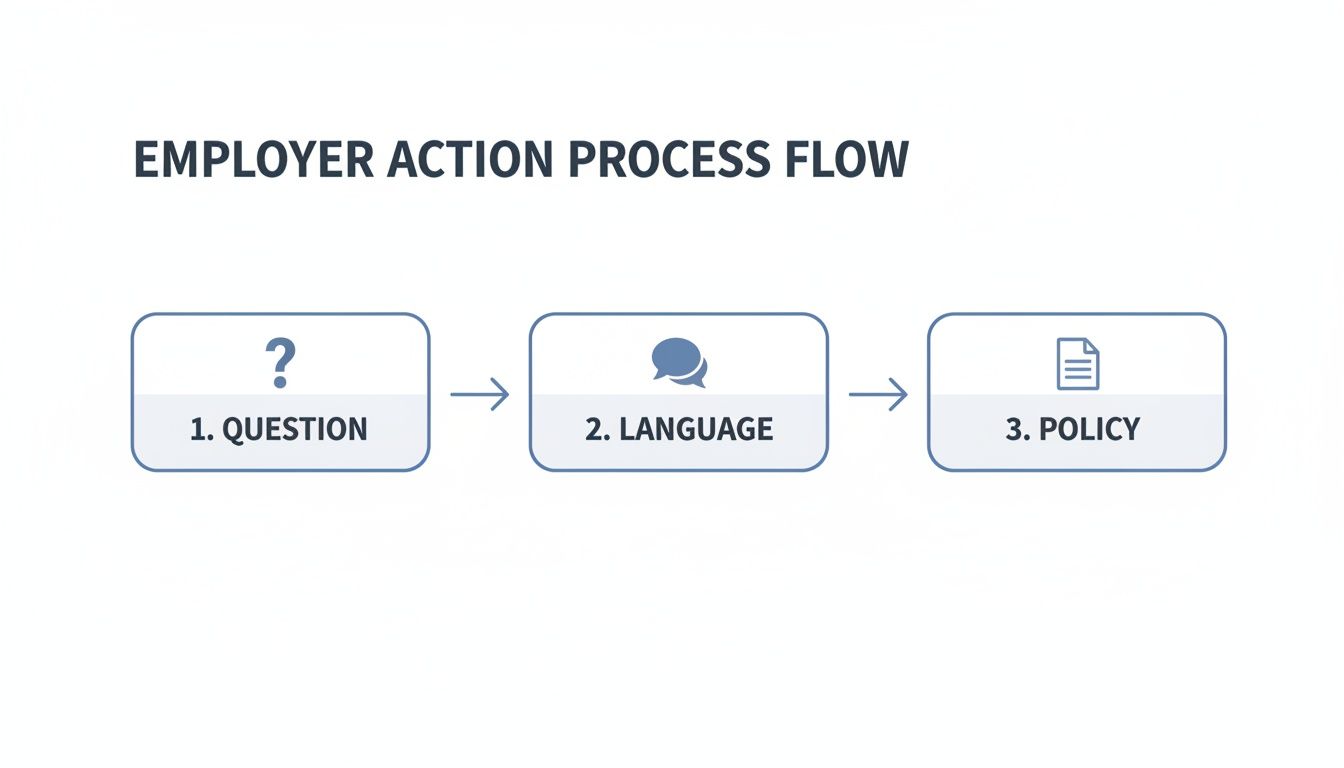
As you can see, an employer's conduct in these three core areas is often the focal point when the EEOC investigates a claim.
And please know, you are not alone in this fight. National origin discrimination is a persistent, ugly problem, and the statistics back that up. In 2021 alone, workers filed over 61,000 discrimination charges with the EEOC. Unfortunately, Mississippi consistently ranks high per capita for these kinds of complaints, showing that what you’re experiencing is part of a much larger, troubling trend.
Crucial Deadline: In Mississippi, you generally have only 180 days from the date the discrimination occurred to file your charge with the EEOC. This is a very strict deadline. If you miss it, you could lose your right to seek justice forever.
The filing process itself can be complicated, and getting every detail right is essential. You can check out our guide on how to file a discrimination complaint for more in-depth information on what to expect. Better yet, working with an experienced attorney ensures your claim is filed correctly and on time, protecting your rights from the very start.
Why a Mississippi Employment Lawyer Is Your Best Ally
Taking on national origin discrimination can feel like you're fighting an impossible battle all by yourself. The laws are complicated, the deadlines are strict, and you can be sure your employer has lawyers ready to defend them. That's where an experienced Mississippi employment attorney comes in—they don't just help; they level the playing field.
Think of an attorney as your guide and champion through this maze. They know how to take your experiences and evidence and build a powerful case. They handle the complex paperwork, manage the deadlines, and deal with your employer's lawyers and the EEOC for you. This frees you up to focus on your life while a professional fights to protect your rights.
Making Legal Help Accessible
One of the first questions people ask is, "How can I possibly afford a lawyer?" It's a valid concern, but the good news is that most employment attorneys work on what's called a contingency fee basis.
So, what does that mean for you? It means you pay no upfront fees. Your lawyer's payment comes from a percentage of the money they recover for you, whether through a settlement or a court verdict. In Mississippi, this fee is typically between 40% to 50% of the final amount. This structure makes top-notch legal help available to everyone, not just those who can write a big check.
A contingency fee arrangement means your lawyer is just as invested in your case as you are. They don't get paid unless you do, which creates a powerful partnership focused on getting you the best possible result.
Your Advocate in a Complex System
Since Mississippi doesn't have its own state-level agency for these claims, everything goes through the federal EEOC system. You need an attorney who lives and breathes this specific area of law. They understand the nuances of federal court procedures and know what it takes to build a winning argument. When you're facing something this serious, knowing how to choose the right employment lawyer is a crucial first step.
Ultimately, your lawyer is your strategist, your negotiator, and your voice. They make sure you are heard and that your rights are fiercely defended, giving you the best shot at justice and holding your employer accountable.
Frequently Asked Questions
When you’re trying to understand your rights at work, it’s natural to have a lot of specific questions. Let's tackle some of the most common ones we hear from employees in Mississippi about national origin discrimination.
What If My Coworkers Make Offensive Jokes?
This is a tough, and unfortunately common, situation. If your coworkers are making jokes about your accent, heritage, or where you're from, start keeping a detailed record. Jot down the date, time, who was there, and exactly what was said for every single incident.
If you feel safe doing so, you can directly tell the person that their comments are not welcome. But the most crucial step is to report the behavior to your manager or HR, following whatever internal process your company has. If the company does nothing and the jokes continue, you may be dealing with illegal harassment that's creating a hostile work environment.
Can My Employer Fire Me for Speaking Another Language?
In most cases, absolutely not. An employer can only legally enforce an "English-only" rule if it’s a genuine business necessity. For instance, requiring English when talking to customers might be justifiable.
But a broad policy that forbids you from speaking your native language to a coworker on your lunch break? That's almost certainly illegal. Getting fired for something like that is a classic example of potential national origin discrimination.
How Much Does It Cost to Hire a Lawyer?
This is a huge concern for most people, but the answer is usually a relief. Nearly all employment attorneys in Mississippi, including our firm, take these cases on a contingency fee basis.
That means you pay nothing out of your own pocket to get started. The lawyer's fee is simply a percentage of the money they recover for you, which is typically between 40-50%. If you don’t win your case, you owe us nothing. This system ensures that anyone can afford to stand up for their rights.
Is It Discrimination If a Boss Only Promotes Their Own Nationality?
It certainly smells like it. When you see a manager repeatedly passing over qualified employees to promote people who share their own national origin, it raises a major red flag for disparate treatment.
To build a case, you'd need to show a clear pattern and gather evidence suggesting that these decisions were based on national origin, not on who was actually best for the job. This kind of favoritism is often a clear sign of illegal discrimination at play.
If you feel that your rights have been trampled on, you don't have to figure this out on your own. At Nick Norris, P.A., we are passionate about defending Mississippi workers and making sure employers answer for their actions.
Reach out to us today for a consultation. We'll listen to your story, explain your options, and show you how we can fight for the justice you deserve. You can learn more about our firm at https://www.nicknorris.law.
This article has been reviewed for legal accuracy by Nick Norris. For employment law matters in Mississippi, consult with an attorney licensed to practice in your state.
Leave a Reply