
Is Verbal Harassment Illegal in Mississippi for Employees?
Yes, verbal harassment can absolutely be illegal in Mississippi. The law draws a critical line between a rude comment and a pattern of abuse that creates a hostile work environment. When that line is crossed, federal laws give you powerful rights.
The Difference Between Insults and Illegal Harassment
Imagine you’ve just started a job you love, but a supervisor constantly makes belittling comments about your age. He calls you "old-timer" in meetings or publicly questions if you can keep up with the new technology.
At first, you brush it off. But the remarks become a daily ritual, and the job you once enjoyed is now a source of constant anxiety. This isn't just unpleasant—it could be illegal.
Understanding Your Protections in Mississippi
While rude or unprofessional behavior is unfortunately common, it crosses into legally actionable verbal harassment when it's both severe or pervasive and directly tied to a protected part of your identity.
In Mississippi, your rights against this kind of workplace abuse are primarily enforced through federal laws. Because Mississippi does not have a human rights commission, the federal Equal Employment Opportunity Commission (EEOC) is the go-to authority for investigating these claims.
The line is crossed when verbal abuse is so persistent or offensive that it fundamentally alters your work conditions, making it difficult or impossible to do your job. This is the heart of what defines a hostile work environment.
Sadly, this kind of abuse is far too common. A landmark 2022 global survey found that nearly 18% of all employees have experienced psychological violence and harassment at work, making it the most prevalent form of workplace abuse. You can explore the full findings on workplace violence and harassment from the UN's International Labour Organization.
The key federal laws that shield you from this behavior include:
- Title VII of the Civil Rights Act of 1964: Prohibits harassment based on race, color, religion, sex, and national origin.
- The Age Discrimination in Employment Act (ADEA): Protects workers who are 40 and older.
- The Americans with Disabilities Act (ADA): Forbids harassment based on a disability.
Knowing these protections exist is the first step toward recognizing when you have a valid claim and deciding what to do next.
Rude Comments vs Illegal Harassment
It can be tough to tell the difference between a jerky boss and illegal behavior. This table helps clarify when isolated rudeness might escalate into something more serious.
| Behavior Type | Generally Not Illegal | Potentially Illegal Harassment |
|---|---|---|
| Comments on Performance | A supervisor gives you harsh, but fair, criticism about your work quality. | Your manager constantly criticizes only the female employees for being "too emotional." |
| Isolated Jokes | A coworker tells a single, off-color joke that makes you uncomfortable but isn't repeated. | A coworker repeatedly tells racist jokes, even after you've asked them to stop. |
| General Rudeness | Your boss is equally abrasive and demanding to everyone on the team. | Your boss singles you out with derogatory names related to your national origin. |
| Teasing | A colleague makes a one-time comment about your favorite sports team losing. | Colleagues constantly mock your religious beliefs, calling them "strange" or "backwards." |
Remember, the context and frequency matter. A single, extremely severe comment could be enough to create a hostile work environment, while a pattern of less severe comments can build up over time to become illegal.
Drawing the Line Between Disrespect and Unlawful Harassment
Let's be realistic: not every rude comment or bad joke at work is illegal. The law gets that workplaces aren't always pleasant. For verbal abuse to cross the line and become unlawful harassment, it has to clear a specific legal hurdle set by the courts and the Equal Employment Opportunity Commission (EEOC).
The legal standard you'll hear about is "severe or pervasive." These two words are everything when it comes to figuring out if offensive behavior is just bad manners or something you can take legal action on.
The Severe or Pervasive Standard Explained
Think of pervasive conduct like a dripping faucet in your kitchen. A single drop is no big deal. But that constant drip, drip, drip over weeks and months can stain the sink and drive you crazy. In the same way, a steady stream of "jokes" about your age, snide remarks about your religion, or constant demeaning comments can wear you down and poison your work environment.
Severe conduct, on the other hand, is more like a lightning strike. It’s a single event so outrageous, threatening, or humiliating that it immediately changes your ability to feel safe and do your job. For instance, a manager dropping a racial slur or making a direct physical threat is almost always severe enough to be considered illegal harassment, even if it only happens once.
The real question the law asks is this: Was the conduct so extreme that a reasonable person in your shoes would find it difficult to do their job? The law isn't a shield against general rudeness, but it is meant to protect you from genuine abuse.
To figure out if the behavior you're facing meets this standard, you have to look at the whole picture:
- How often did it happen? Was it a daily occurrence or a one-off comment?
- How bad was it? Was it a muttered insult or a screamed threat?
- Was it physical? Did the person get in your face, or was it "just words"?
- How did it affect your work? Did the stress make it impossible to concentrate or perform your duties?
This flowchart walks through the basic questions you should ask yourself to see if a comment could be part of an illegal harassment claim.
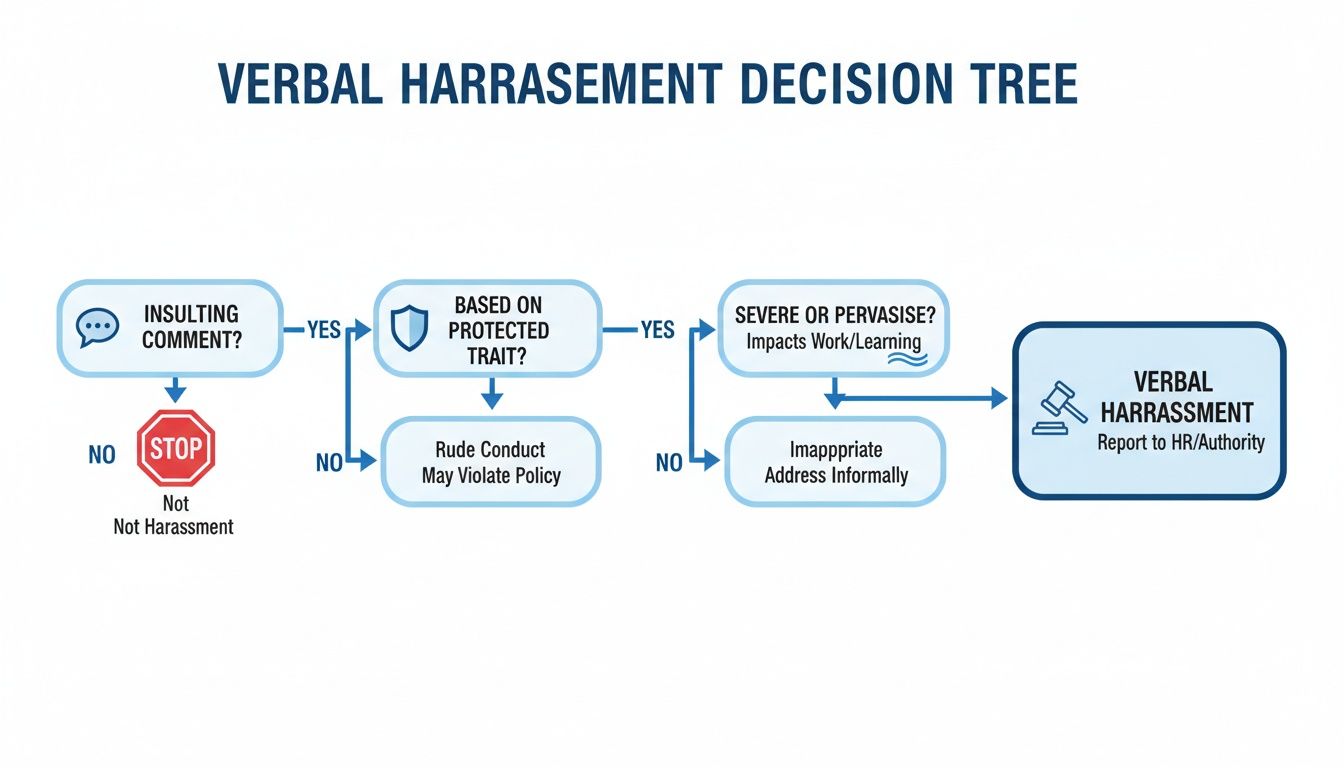
As you can see, the reason for the insult is what separates general workplace bullying from harassment that is actually illegal.
The Crucial Link to Your Protected Status
This is the most critical piece of the puzzle. For verbal abuse to be illegal under federal law, it must be connected to your protected status. This means the harassment is happening because of your race, color, religion, sex (including pregnancy, sexual orientation, and gender identity), national origin, disability, or age (if you're 40 or older).
A boss who is just an "equal-opportunity jerk"—someone who is nasty to everyone on the team, no matter who they are—is probably not breaking the law. It’s bad management, but it’s not illegal harassment.
But a boss who only hurls insults at older employees about being "slow" or "out of touch," or who constantly makes demeaning comments to female colleagues, has crossed the line. Without that direct link to a protected characteristic, even the most awful bullying might not be something you can sue over.
What a Hostile Work Environment Really Means in Mississippi
The term "hostile work environment" is thrown around a lot these days, but from a legal standpoint, it has a very precise meaning. It’s far more than just dealing with a demanding boss or feeling uncomfortable at your desk. For verbal abuse to cross the line and create a legally recognized hostile work environment in Mississippi, it has to be so severe or pervasive that it fundamentally poisons the conditions of your employment.
Think of it like this: A single rude comment is like a whiff of something unpleasant. Annoying, but it passes. But a hostile work environment is like a constant, toxic fume that fills the office. It becomes hard to breathe, difficult to focus, and impossible to do your job. The environment itself shifts from a place of work to a place of dread and intimidation.

This isn't just about how you feel personally. The law evaluates the situation through the lens of a "reasonable person." Essentially, the EEOC or a court will ask: would an objective, average person in the same situation find the environment hostile or abusive? It’s a way of separating isolated incidents of bad manners from a pattern of genuine harassment.
The Reasonable Person Standard in Practice
So what does this look like in the real world? Let’s break down a few scenarios where verbal conduct could absolutely create a hostile work environment:
- Pervasive Sexual Comments: Imagine a supervisor who won't stop making sexually suggestive "jokes," commenting on your appearance, or prying into your personal life. This isn't a one-off slip-up; it's a pattern that makes the workplace feel offensive and unsafe.
- Constant Racial Mockery: A group of coworkers consistently tells racist jokes, uses stereotypes to refer to a colleague of another race, or imitates their accent. This behavior is designed to isolate and demean, creating an undeniably abusive atmosphere.
- Targeted Religious Attacks: A coworker frequently belittles another employee's religious beliefs, calling their faith "weird" and leaving insulting articles on their desk. This goes far beyond a simple disagreement and becomes a targeted campaign of harassment.
The key takeaway is this: the harassment must be unwelcome, based on a protected characteristic (like race, sex, or religion), and severe or pervasive enough to fundamentally change your job and create an abusive working environment. You can get a much deeper dive in our article covering the hostile work environment definition.
This isn't a uniquely American problem, either. A landmark global study by the International Bar Association revealed that a shocking 50% of female lawyers and 33% of male lawyers had been bullied at work, often through relentless verbal attacks and undermining comments.
When you connect these real-world examples to the legal standard, the line between rude behavior and illegal harassment becomes much clearer. If the verbal abuse you're enduring feels constant and is clearly tied to who you are, it's likely more than just a bad day at the office—and it might be time to get help.
Your Step-by-Step Guide to Taking Action Against Harassment
When you're dealing with verbal harassment, it's easy to feel stuck and powerless. But you aren't. There's a clear path forward, and it starts with taking deliberate, documented steps to build your case and protect yourself.
The key is to become your own best advocate, starting right now.
Step 1: Start a Detailed Harassment Log
Think of this as your personal evidence file. It’s the single most powerful tool you have at the beginning. Get a private notebook or create a document on your personal computer—never on company property—and record every single incident.
For each entry, get as specific as you can:
- Date and Time: Pinpoint exactly when it happened.
- Location: Where were you? At your desk? In the breakroom?
- What Was Said: Write down the exact words. If you can't remember them precisely, paraphrase as closely as possible.
- Who Was Involved: Name the harasser and list anyone else who was there and saw or heard it.
- Your Response: How did you react? Just as importantly, how did it make you feel?
This log does something crucial: it turns a fuzzy, awful feeling into a concrete, undeniable pattern of behavior. That’s something an employer can't easily dismiss.
Step 2: Report the Harassment Internally
Your next move is to put your employer on the record. Dig out your employee handbook and find the anti-harassment policy. It will tell you exactly who to report to—it might be your direct supervisor, another manager, or the HR department.
I always recommend putting your report in writing, even if it's just a follow-up email after a verbal conversation. An email creates a timestamped, digital paper trail proving the company was officially notified. This step is critical because the law requires you to give your employer a chance to fix the problem. You can get a more detailed breakdown in our guide on how to report workplace harassment.
Formally reporting harassment isn't just about asking for help; it's a legal necessity that triggers your employer's obligation to take reasonable steps to stop the abuse. Failing to report can seriously weaken a future legal claim.
Step 3: Escalate Your Complaint to the EEOC
What if you report it and nothing happens? Or worse, the harassment continues? Your next step is to take it outside the company by filing a formal complaint, called a "Charge of Discrimination," with the U.S. Equal Employment Opportunity Commission (EEOC).
This is especially important for us here, because Mississippi does not have a human rights commission. The EEOC is the main place for Mississippi workers to file federal harassment claims.
You have a very strict deadline: you must file your charge within 180 days of the last harassing incident. Miss that window, and you could lose your right to pursue a claim. Once you file, the EEOC will investigate your claim by interviewing you, your harasser, and any witnesses before deciding on the next steps.
How to Build a Strong Verbal Harassment Case
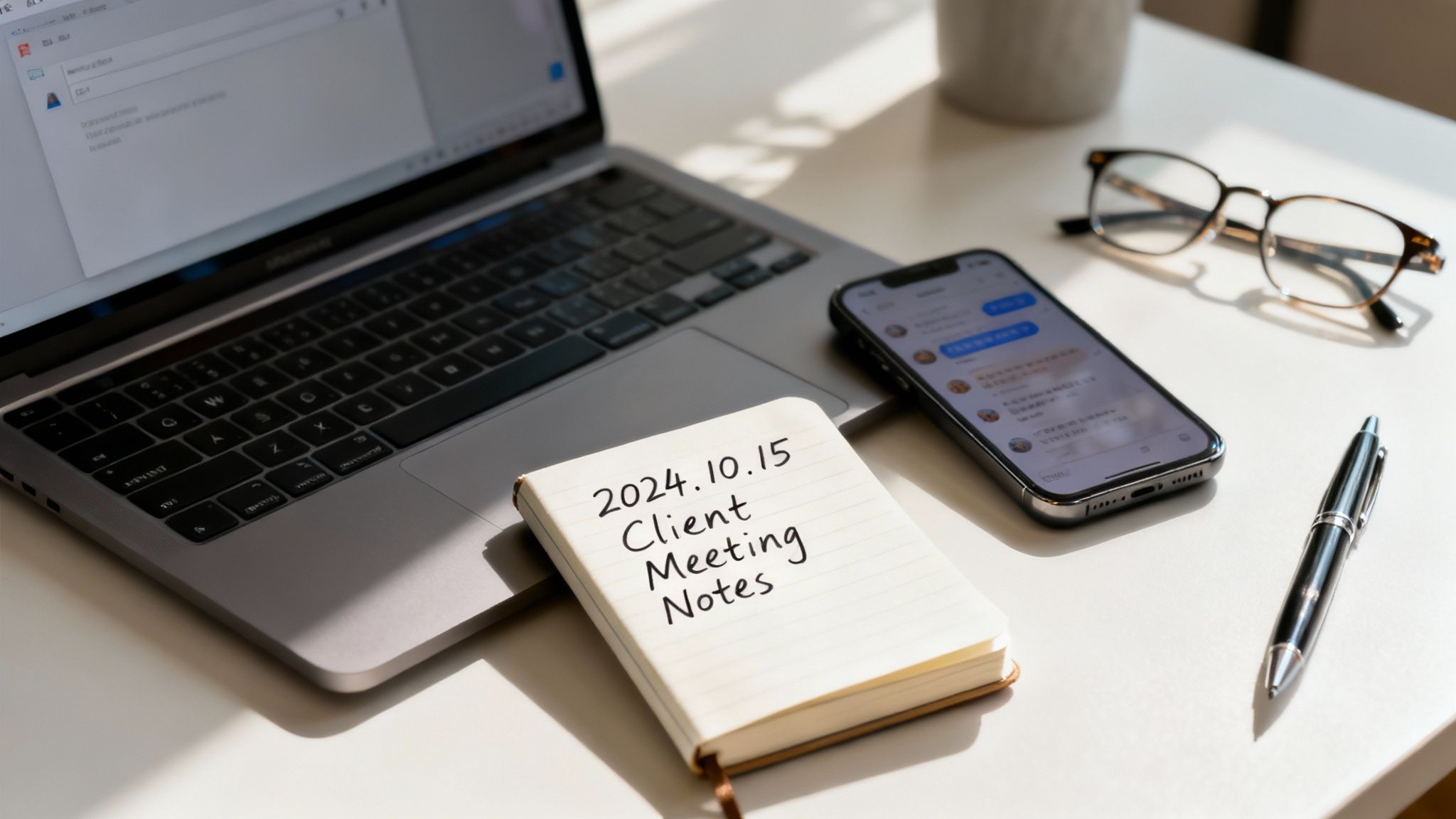
It’s easy to feel like a verbal harassment claim is just your word against theirs. That’s why solid, tangible proof isn't just helpful—it's everything. Since the law requires you to show a pattern of severe or pervasive conduct, your ability to document each incident becomes your most powerful tool.
The very first thing you should do is start a private log. Write down every single incident, no matter how small it seems at the time. This journal is your foundation, but other types of proof can make your case undeniable.
Gathering Digital Proof and Witness Accounts
These days, a lot of workplace harassment happens through a screen. You absolutely must save every digital breadcrumb the harasser leaves behind.
- Emails & Texts: Never delete abusive emails or text messages. Screenshot them immediately and back them up on a personal cloud account or external drive—somewhere you control.
- Voicemails: If you get a nasty voicemail, save it. Then, make a backup file of the audio.
- Social Media: If a coworker or boss is harassing you online, take screenshots of their posts, comments, or direct messages.
Witnesses can also be the key to turning your case around. When a colleague confirms they saw or heard the abuse, your claim instantly transforms from a personal story into a verified pattern of misconduct. Think about who was present during these incidents. Just be careful and discreet when you consider approaching them; you don't want to put their job, or yours, at risk.
Building a verbal harassment case is like assembling a puzzle. Each piece of evidence—your journal entries, saved emails, witness statements—fits together to create a clear picture of what you've endured, replacing uncertainty with a solid legal claim.
It's a sad reality that most people never take that first step. While 52% of U.S. workers have witnessed inappropriate verbal conduct, a huge number of victims never report it. You can learn more about the barriers to reporting from Human Rights Watch.
Using Retaliation to Your Advantage
Sometimes, the most compelling evidence doesn't appear until after you’ve spoken up. Did you report the harassment to HR, only to be hit with a surprise negative performance review? That sudden downturn after you voiced a complaint is a classic sign of illegal retaliation.
An abrupt, negative shift in your job status isn’t just grounds for a separate retaliation claim. It also powerfully supports your original harassment case by revealing your employer's hostility toward you for daring to speak out. You can learn exactly what it takes to prove a hostile work environment in our detailed guide.
When You Should Speak with a Mississippi Employment Lawyer
Dealing with the fallout from workplace harassment can leave you feeling lost and alone. You followed the rules and reported the issue internally, but what happens when that's not enough? Knowing when to bring in professional legal help is key to protecting yourself and your career.
It’s time to seriously consider calling an employment lawyer if your situation sounds like this:
- The Harassment Continues: You went to HR or your manager, you filed a report, but the verbal abuse hasn’t stopped.
- Your Employer Dismisses Your Claim: Management ignores your concerns, tells you you're "overreacting," or simply sweeps the whole thing under the rug.
- You Face Retaliation: Suddenly, after you spoke up, you're fired. Or maybe you're demoted, your hours are slashed, or you're stuck with an awful new assignment.
An experienced employment attorney can look at the facts of your case with a clear, objective eye and lay out your legal options. This is especially important in Mississippi. Since Mississippi does not have its own human rights commission, your path to justice typically goes through the federal EEOC, a process that can be daunting to navigate alone. A lawyer handles all of that for you, making sure every form is filed correctly and every deadline is met.
Taking the Next Step with Confidence
It’s a big decision to talk to a lawyer about something as personal and stressful as verbal harassment. You'll naturally have questions, and you might worry about privacy. A professional attorney is bound by strict ethical rules for maintaining client confidentiality, which should give you the peace of mind to share your story openly.
Worried about the cost? Most employment lawyers, Nick Norris, P.A. included, work on what’s called a contingency fee basis.
This means you don't pay anything out of pocket. There are no upfront retainers or hourly bills. The attorney’s fee is simply a percentage of the money they recover for you, which typically ranges from 40-50%. If they don't win your case, you owe them nothing in fees. It’s that simple.
A consultation is your chance to get a real strategy. You’ll find out if you have a strong legal claim and what kind of outcome you might be able to expect. If you're a worker in Mississippi who has been subjected to verbal harassment, getting a dedicated advocate like the team at Nick Norris, P.A. in your corner can make all the difference.
Frequently Asked Questions About Workplace Harassment
When you're dealing with verbal abuse at work, a lot of questions pop up. Let's tackle some of the most common ones that Mississippi employees ask.
What If the Harassment Isn’t Based on My Race, Gender, or Another Protected Class?
This is a really important question, and the answer can be frustrating. If someone is just a garden-variety bully—mean to everyone, regardless of their background—it might not be illegal harassment under federal law. The law doesn't outlaw being a jerk.
Federal protections are specifically designed to stop discrimination. So, simple teasing or rude comments that aren't connected to your race, sex, age, religion, or another protected status often fall into a legal gray area.
But don't just assume you don't have a case. It's always a good idea to talk it over with an employment lawyer. A legal expert can look at the specifics of what's happening and figure out if the behavior is so extreme that it might cross a different legal line.
An attorney helps you see the difference between a boss who is "just a jerk" and one whose actions are creating an illegally hostile environment. The details and the impact on your ability to do your job are what really matter.
Can I Get Fired for Reporting Verbal Harassment?
Absolutely not. It is 100% illegal for your employer to punish you for reporting harassment in good faith. This kind of punishment is called retaliation, and it can look like a lot of different things: getting fired, being demoted, having your hours cut, or any other negative action.
If you report harassment and then face retaliation, you could have a second, very strong legal claim against your employer. In many situations, proving retaliation is more straightforward than proving the original harassment.
How Much Does It Cost to Hire an Employment Lawyer?
Most people worry about the cost, but there's good news. The vast majority of Mississippi employment lawyers take harassment cases on a contingency fee basis. This system is set up to make sure anyone can get legal help, no matter their financial situation.
Here's how it works: you pay zero attorney's fees upfront. The lawyer only gets paid if they win money for you. Their fee is a percentage of the final settlement or award, which is usually between 40-50%. If you don't win, you don't owe any attorney's fees. It allows you to pursue justice without taking on a huge financial risk.
If you're dealing with verbal abuse at work and don't know what to do next, you don't have to figure it out on your own. At Nick Norris, P.A., we're committed to standing up for the rights of Mississippi workers. Contact us today for a confidential consultation to discuss your situation and get the strong advocacy you deserve.
This article has been reviewed for legal accuracy by Nick Norris. For employment law matters in Mississippi, consult with an attorney licensed to practice in your state.
Leave a Reply