
Is Yelling in the Workplace Harassment in Mississippi?
You got dressed for work, showed up, did your job, and then a supervisor lit into you in front of other people. Maybe it was on the floor, in a meeting, over the phone, or on a video call. Now you're asking a very fair question: is yelling in the workplace harassment in Mississippi?
Sometimes yes. Often no.
That answer frustrates people because it sounds slippery. It isn't. The law draws a real line, and that line usually turns on why the yelling happened, what was said, how often it happened, and what happened after you spoke up. Mississippi workers need to understand that difference because Mississippi does not have a state human rights agency to catch these claims early. In many cases, your path runs through federal law and the EEOC.
You also need to know this upfront. A boss can be rude, unfair, loud, humiliating, and miserable to work for without automatically breaking the law. That doesn't make it acceptable. It means your case depends on facts, not feelings alone.
The Shock and Confusion of Workplace Yelling
When a boss yells at you, your first reaction usually isn't legal analysis. It's survival. You freeze, get embarrassed, replay the moment in your head, and start wondering whether you should quit, report it, or just keep your head down.
That confusion is normal. Most employees don't know whether the law cares about shouting unless someone uses a slur or makes a threat. The legal answer is broader than that, but it's also narrower than many people expect.
What matters more than volume
Yelling by itself isn't automatically illegal in Mississippi. The law doesn't punish every harsh manager or every workplace blowup. The key question is what sits underneath the yelling.
Ask yourself:
- Was it tied to race, sex, religion, national origin, age, or disability?
- Was it part of a repeated pattern instead of one ugly moment?
- Did it start or get worse after you reported discrimination, leave problems, safety issues, wage issues, or other misconduct?
- Did the yelling come with ridicule, intimidation, mockery, or interference with your work?
Those facts move the issue from “my boss is awful” to “my employer may have legal exposure.”
You don't need to prove that yelling hurt your feelings. You need facts showing the shouting crossed a legal line.
Why Mississippi workers need a sharper strategy
Mississippi employees can't rely on a state civil rights agency to sort this out for them. That means your documentation, your timing, and your framing matter from the start. If you call everything “harassment,” you may miss the stronger claim. In some cases, the better theory isn't harassment at all. It's retaliation.
That distinction can change everything.
The Legal Line Between a Bad Boss and Illegal Harassment
Federal law sets the main rule Mississippi workers live under. The EEOC harassment standard says harassment becomes unlawful when it is based on a protected characteristic and is severe or pervasive enough to create a work environment a reasonable person would find intimidating, hostile, or abusive. The EEOC also says isolated incidents or petty slights generally don't meet that threshold. It further notes that employers are automatically liable for supervisor harassment that results in a negative employment action such as termination, demotion, or loss of wages.

Protected traits are the legal trigger
A lot of people miss this point. Illegal harassment usually requires a connection to a protected characteristic. That includes traits covered by federal anti-discrimination law, such as race, color, religion, sex, national origin, age, and disability.
If a manager screams at everyone, that manager may be a destructive fool. But an equal-opportunity jerk usually isn't committing illegal harassment just because he's loud and demeaning.
If that same manager singles out women, mocks an employee's accent, ridicules a worker's age, or repeatedly targets a disabled employee with verbal abuse, now you're in very different territory.
For a broader plain-language explanation of how labor rules vary from place to place, this plain-English Oklahoma labor law guide is a useful example of why state-specific advice matters. Mississippi workers need that same local lens.
A simple way to think about it
Use this distinction:
Bad boss
Loud, impatient, insulting, demanding, inconsistent, unprofessional.Potential illegal harassment
Loud, insulting, or intimidating behavior because of your protected status.
That “because of” element is where cases are won or lost.
If you want a closer look at how courts and lawyers evaluate verbal mistreatment, read this article on whether verbal harassment is illegal.
Practical rule: If the yelling includes slurs, gender-based insults, age-related mockery, disability-related ridicule, or comments about religion or national origin, treat it as a legal issue immediately.
Mississippi reality check
Mississippi doesn't have a general state law safety net that turns every workplace bully into a lawsuit. Employees often assume “hostile work environment” means “my workplace is hostile.” That's not the legal test.
The law cares about motive and pattern. If the motive isn't tied to a protected characteristic, you may still have a serious workplace problem, but not a classic harassment claim.
Understanding a Hostile Work Environment Claim
A hostile work environment claim isn't built on one rude scene. It's built on conduct that is serious enough or frequent enough to change the conditions of your job. That's where many cases fall apart.
One supervisor outburst, even a nasty one, usually isn't enough. A sustained pattern of targeted verbal abuse can be.
The severe or pervasive test in real life
Courts and agencies don't use a stopwatch or decibel meter. They look at context. They ask whether a reasonable person in your position would view the workplace as intimidating, hostile, or abusive.
They also look at practical details:
- Frequency. Did this happen once, occasionally, or constantly?
- Content. Was it criticism about work, or humiliation tied to protected status?
- Severity. Did the person threaten you, ridicule you publicly, or interfere with your ability to do the job?
- Effect on work. Did it undermine your assignments, isolate you, or set you up for discipline?
A supervisor chewing you out over a missed deadline is ugly management. A supervisor repeatedly screaming racial insults, mocking your disability, or humiliating you in front of co-workers because of your sex is something else.
| Potentially Actionable Severe or Pervasive Conduct | Generally Non-Actionable Rude Behavior |
|---|---|
| Repeated yelling tied to race, sex, age, disability, religion, or national origin | A manager who is rude to everyone |
| Public ridicule using protected-class stereotypes | Sharp criticism about work quality |
| Ongoing intimidation that disrupts your ability to perform your job | A single regrettable outburst |
| Verbal abuse paired with humiliation, mockery, or threats | General workplace tension and poor manners |
| Escalating conduct by a supervisor that contributes to demotion or loss of pay | Raised voices during an isolated disagreement |
What a reasonable person standard means
The law doesn't ask only whether you felt upset. It asks whether a reasonable person would see the conduct as hostile or abusive under the circumstances. That's important because employers often try to minimize yelling as personality conflict or “just how management talks.”
That defense gets weaker when the conduct is targeted, repeated, and degrading.
If you're trying to evaluate where your facts land, this guide on how to prove hostile work environment gives a practical framework.
Don't confuse criticism with unlawful abuse
Supervisors are allowed to correct work. They're allowed to be blunt. They're even allowed to be unlikeable. What they can't do is weaponize authority in a way that crosses the legal threshold.
A hostile work environment claim usually rises or falls on pattern, motive, and proof.
If your story is “my manager yelled at me once,” that's probably not enough. If your story is “my manager repeatedly screamed at me, mocked my protected trait, and kept doing it after I objected,” that's worth serious legal review.
When Yelling Is Illegal Retaliation Not Bullying
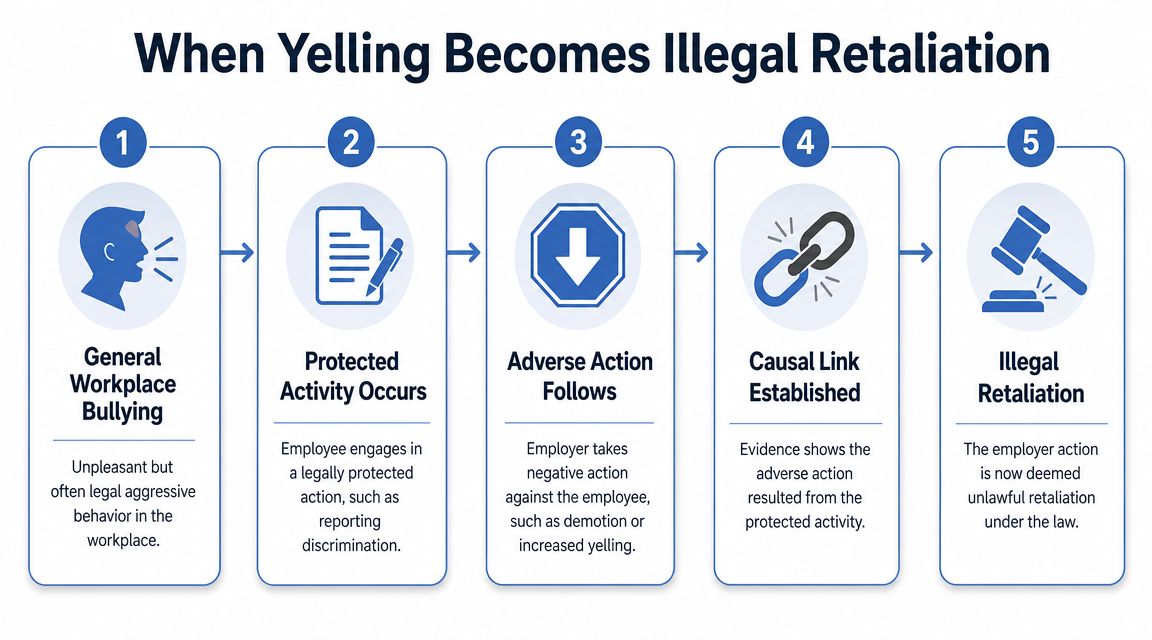
Often, many Mississippi employees miss their strongest claim. Workplace bullying by itself usually isn't a standalone federal claim. But yelling can become illegal when it starts after you engaged in protected activity. As this discussion of yelling, bullying, and retaliation explains, U.S. law often doesn't recognize bullying as a standalone federal claim unless it connects to discrimination or retaliation, and the legal issue can shift to retaliation or constructive discharge when hostile behavior follows protected activity.
The timeline often tells the story
Here is the pattern I watch for:
You report something protected
Discrimination, harassment, unpaid wages, FMLA issues, safety concerns, or misconduct.Management's tone changes
Suddenly you're getting screamed at, singled out, micromanaged, or publicly embarrassed.The employer starts building a record against you
Write-ups appear, meetings get tense, and criticism becomes personal.
That sequence matters. The legal question becomes whether the yelling was part of punishment for speaking up.
Protected activity is the anchor
Examples of protected activity can include:
- Reporting discrimination or harassment
- Participating in an internal investigation
- Requesting FMLA leave
- Complaining about certain wage and hour violations
- Raising certain workplace safety concerns
What is not protected in the way many people assume? In Mississippi, there is no retaliation claim for filing a workers' compensation claim. Don't build your strategy around a right that isn't there.
Why retaliation claims can be stronger
Retaliation cases often make more practical sense than “bullying” arguments because they focus on cause and effect. You did something the law protects. The employer responded with hostility, yelling, discipline, or pressure to push you out.
That can also feed a constructive discharge argument if the employer makes conditions intolerable enough that resignation stops looking voluntary.
If the yelling started after you complained, don't describe it only as bullying. Analyze it as possible retaliation.
Mississippi employees should also think about proof in modern workplaces. A manager may not scream in the hallway anymore. He may do it on Teams, Zoom, speakerphone, or in emails written to intimidate. The format changes. The legal analysis doesn't.
How to Document Workplace Yelling and Harassment
If you're dealing with workplace yelling, start acting like your memory may later be challenged. Because it will be. Documentation wins credibility.
Don't wait for HR to tell you what happened. Write it down yourself, promptly and accurately.
Build a clean incident log
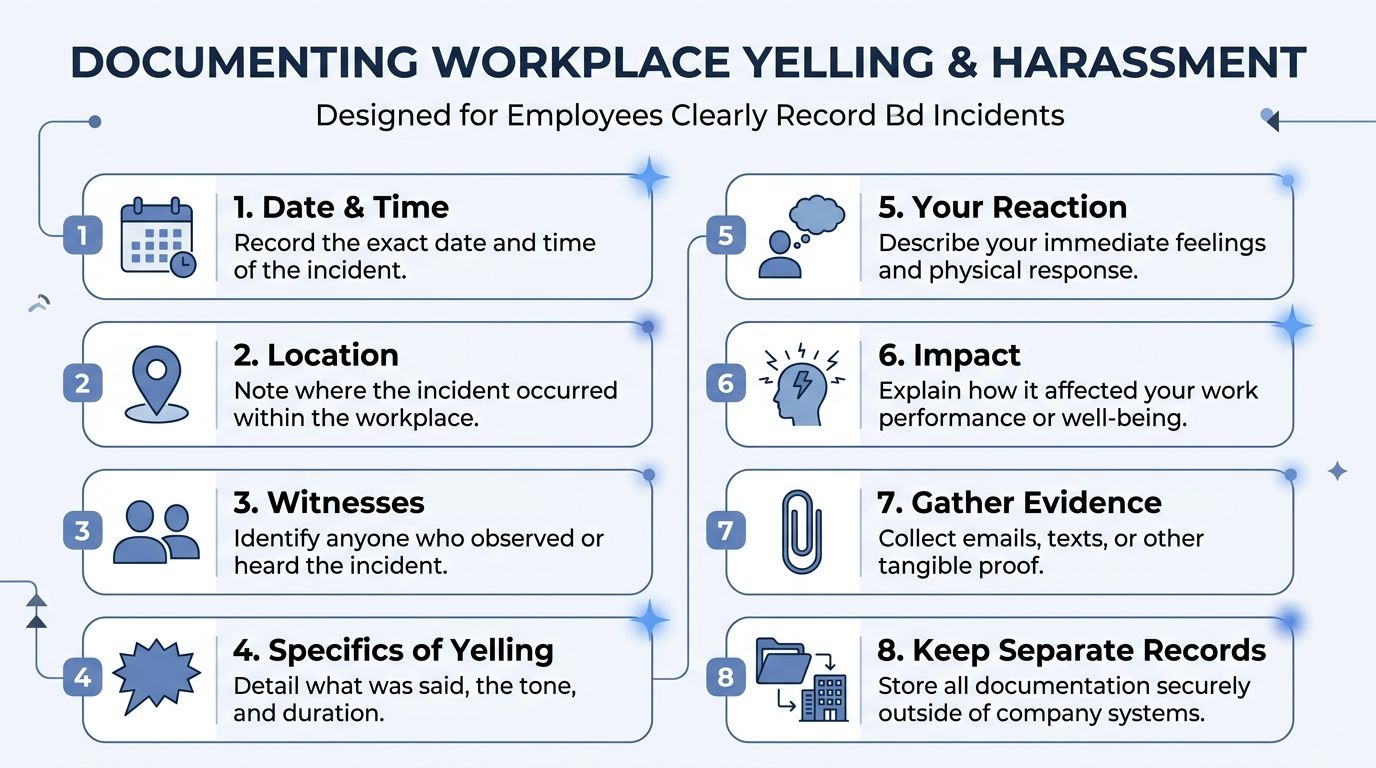
After each incident, record:
Date and time
Be exact if you can.Location
Office, warehouse floor, break room, parking lot, phone call, video meeting.Who was involved
Include full names and job titles if known.Who witnessed it
List everyone who heard or saw it, even partially.What was said
Use the actual words as closely as you can remember them.What happened right before it
This matters. Did it happen after you complained, requested leave, or asked about pay?How it affected your work
Missed meeting, couldn't finish a task, had to leave, lost assignment, got written up.
Store those notes somewhere outside company systems. A personal email, a paper file at home, or a secure personal device is better than a work computer.
Preserve the evidence around the yelling
A lot of verbal abuse cases are proved through surrounding evidence, not a recording. Save:
- Emails that change tone after a complaint
- Texts or chats showing hostility or threats
- Performance reviews that suddenly turn negative
- Calendars and meeting invites that place witnesses there
- Handbook policies on reporting and anti-harassment
For a practical companion piece, this article on workplace verbal abuse can help you think through what facts matter most.
This short video may also help you organize your next steps before you report internally:
What not to do
Don't exaggerate. Don't edit your notes later without marking the update. Don't take company documents you aren't allowed to take. Don't post about the incident on social media if you're considering legal action.
And don't assume HR will preserve evidence for you.
Write your notes like a witness, not like a novelist. Facts first. Adjectives second.
If you want legal guidance while preserving your rights, an employment lawyer can review your timeline, your documents, and your reporting strategy. That can include a Mississippi worker consulting a firm such as Nick Norris, P.A. about harassment, retaliation, leave, wage, or wrongful termination issues.
Your Reporting Options in Mississippi
Mississippi workers need to be practical. Start with your employer's reporting process, but don't stop there if the issue involves discrimination, harassment, or retaliation under federal law.

Start inside the company
Check your employee handbook. Most employers have a policy telling you who to report to, how to report, and whether you can bypass your direct supervisor. Follow that policy unless the accused person is the only reporting route. If that's the setup, report to HR, higher management, ownership, or another listed contact.
Keep your complaint clear and short. State dates, names, what was said, and why you believe the conduct was discriminatory or retaliatory. Ask for the conduct to stop.
A good internal complaint usually includes:
- Specific incidents, not general labels
- Named witnesses
- Any protected trait or protected activity involved
- A written request for investigation and protection from retaliation
Mississippi has no state human rights agency
This is the part generic articles often miss. Mississippi does not have a state fair employment or human rights agency for these claims. For many Mississippi employees, the outside administrative path is the EEOC.
That matters because workers sometimes waste time searching for a state office that doesn't exist. If the issue is federal discrimination, harassment, or retaliation, the EEOC is often your next stop.
One reason this issue deserves serious attention is that yelling and verbal abuse remain a recognizable workplace problem. A 2024 peer-reviewed study on workplace bullying and harassment found 10.6% of employees in England reported past-year workplace bullying or harassment, and among those affected, 42.6% identified shouting or verbal abuse as a common form of mistreatment.
What to do before filing externally
Before contacting the EEOC, gather:
- Your incident log
- Your internal complaint
- Any employer response
- Supporting documents and names of witnesses
Then get legal advice if you can. Filing the right charge matters. A weak description can box you into the wrong theory. Harassment and retaliation overlap, but they aren't the same claim.
Also remember this. If your issue is that your boss is loud and unfair, the law may not help much. If the yelling ties to protected status or follows protected activity, your options improve substantially.
Protecting Your Rights and Your Livelihood
The right answer to “is yelling in the workplace harassment” is this: it depends on motive, pattern, and timing. That's the cleanest way to think about it.
If the yelling is tied to a protected characteristic, it may support a harassment claim. If the yelling starts after you report unlawful conduct or exercise a protected right, it may support a retaliation claim. If it's just general nastiness, the law may not treat it as actionable even though it makes your job miserable.
Don't wait for the situation to fix itself
Most bad workplace situations don't improve because the employee stays quiet. They improve because the employee starts documenting, reporting carefully, and getting strategic advice early.
That doesn't always mean filing a lawsuit. It may mean preserving a claim, preventing termination, responding to discipline, or deciding whether resignation would hurt your position. Timing matters.
Legal help is often more accessible than people think
Many Mississippi employment cases are handled on a contingency fee, and the average contingency fee is 40 to 50%. That means many workers can talk to a lawyer without paying upfront hourly fees. The central issue isn't whether your boss was obnoxious. It's whether the facts support a claim worth pursuing.
While you're dealing with the stress of this, practical coping matters too. This practical guide to work stress may help you manage the immediate pressure while you sort out the legal side.
Your job pays your bills. Protecting your legal position while protecting your income takes discipline, not guesswork.
If your supervisor has been screaming at you, humiliating you, or escalating after a complaint, don't assume it's normal and don't assume it's hopeless. Mississippi workers still have powerful federal rights. The key is using the right legal theory and building proof before the employer rewrites the story.
If you believe yelling at work crossed into discrimination or retaliation, contact Nick Norris, P.A. for a confidential consultation. You can get a direct review of your facts, your documents, and your reporting options under federal law in Mississippi, with advice focused on protecting both your rights and your paycheck.
This article has been reviewed for legal accuracy by Nick Norris. For employment law matters in Mississippi, consult with an attorney licensed to practice in your state.
Leave a Reply