
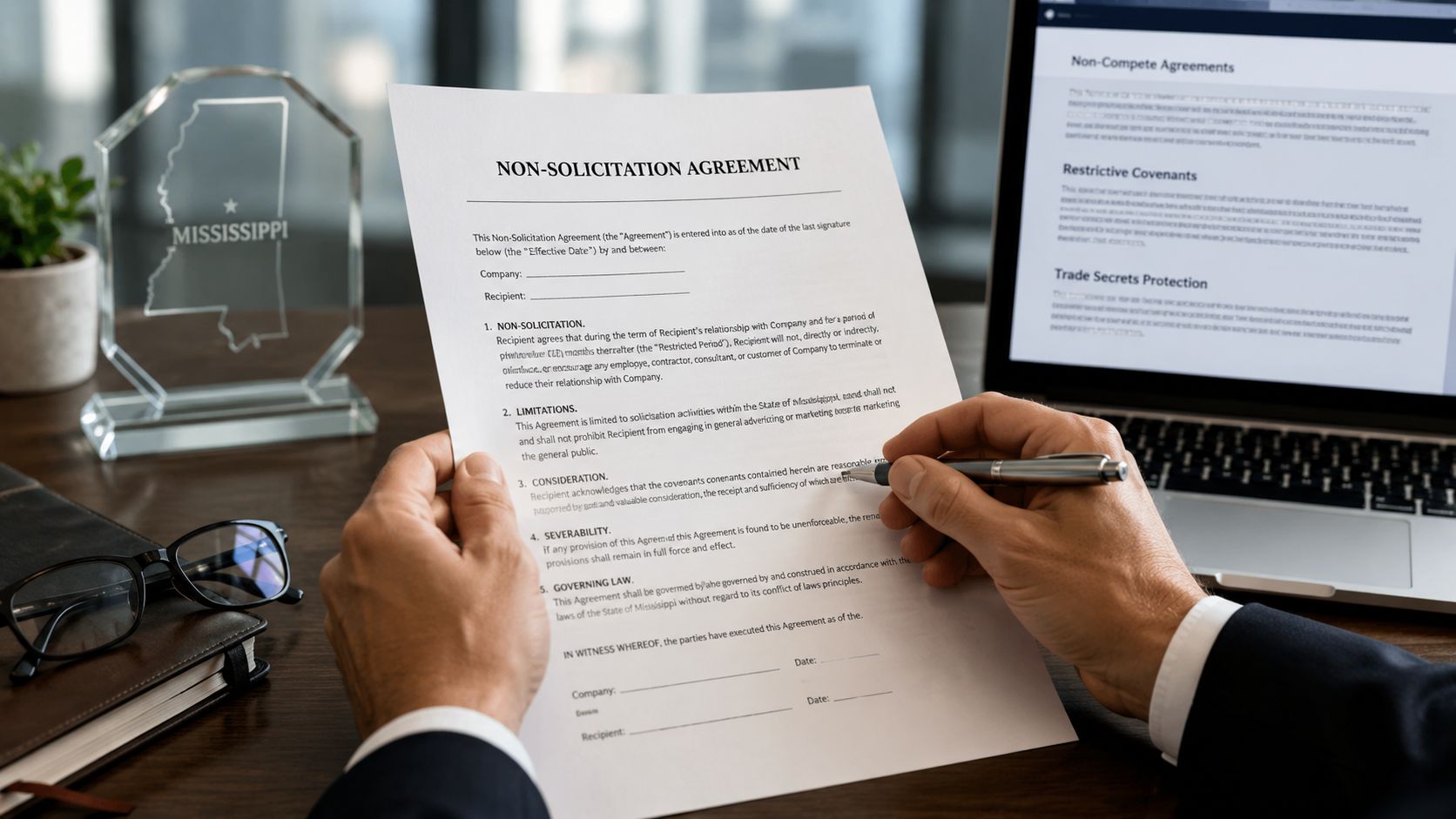
Mississippi Non Solicitation Agreement: Guide 2026
You're excited about a new job, or maybe nervous because your employer slid one more document across the desk after you already gave notice. The heading says Non Solicitation Agreement. Nobody explains it clearly. They just tell you it's standard and ask for your signature.
That's the moment to slow down.
A non solicitation agreement can affect who you contact after you leave, which co-workers you can recruit, and which customers you can approach. In Mississippi, workers often have to figure this out without a state agency stepping in to mediate employment disputes. That makes the contract review stage far more important than generally understood.
You Were Asked to Sign a Non Solicitation Agreement Now What
If an employer hands you a non solicitation agreement, don't treat it like routine paperwork. Treat it like a restriction on your next job.
A lot of workers assume these agreements only matter to executives or salespeople. That's wrong. Roughly one in nine adult workers in the United States is bound by restrictive covenants like non-competes, a category that frequently includes or is legally paired with non-solicitation provisions, according to the Federal Reserve's 2022 Survey of Household Economics and Decisionmaking in this Federal Reserve discussion of restrictive covenant data.
Read it before you sign it
Start with the basics:
- Who can't you contact? Clients, customers, vendors, co-workers, or all of them.
- How long does it last? The length matters.
- What counts as solicitation? That word does a lot of work in these contracts.
- What happens if the employer says you breached it? Look for injunction language, fee-shifting language, and return-of-property terms.
If the agreement is vague, that's a problem. If it says you can't solicit “any customer” or “any employee” without defining those terms, that's another problem. Vague contracts create fear, and employers know that.
Practical rule: If you don't fully understand what conduct is banned, don't sign until someone explains it in plain English.
Ask direct questions
You don't need to argue. You need answers.
Ask the employer:
- Which customers are covered: Only accounts you worked with, or every company customer?
- Which employees are covered: People on your team, or anyone on payroll?
- What activity triggers a violation: Direct outreach, social media posts, or even responding to inbound contact?
- Whether the company will revise it: Many employers will narrow language if you ask early.
If you want a lawyer to review the agreement before you commit, start with a focused employment contract review. That's usually cheaper and smarter than trying to clean up the mess after an accusation.
Decoding the Document What a Non Solicitation Agreement Is
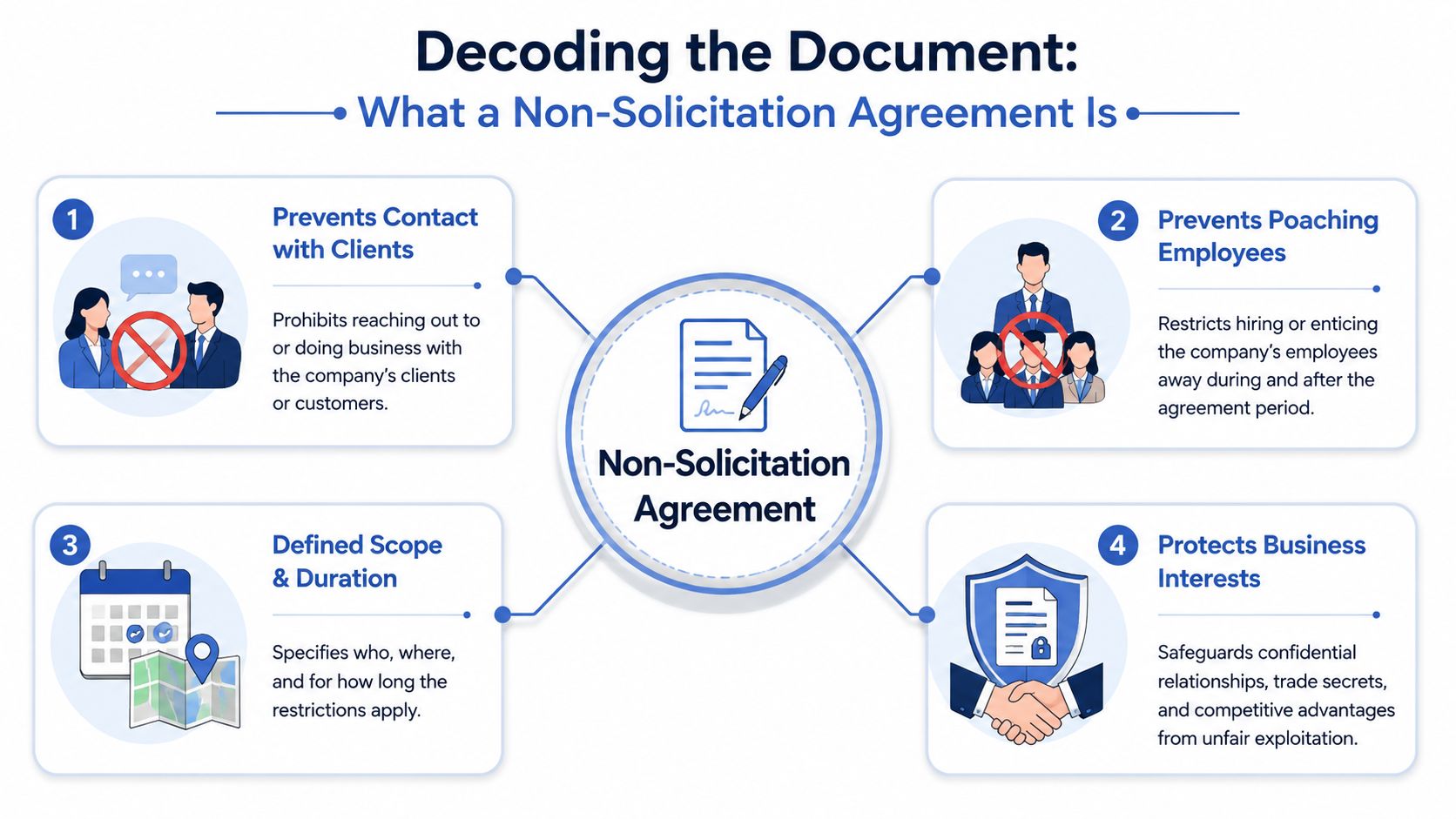
A non solicitation agreement is a promise that after you leave a job, you won't try to take certain business relationships with you. Usually that means customers, clients, or co-workers.
The simplest analogy is this. You leave one team for another, but you agree not to recruit your old teammates or pull your old clients away right after you walk out the door. Employers use these agreements to protect relationships they believe they paid to build.
The two common forms
Most of these agreements fall into two buckets.
- Customer non-solicitation: You agree not to pursue customers or clients you dealt with through the job.
- Employee non-solicitation: You agree not to recruit current employees to join you somewhere else.
Those are different restrictions. Some contracts contain one. Many contain both.
What solicitation actually means
Here, employers often draft aggressively.
In plain terms, solicitation usually means active outreach. Calling a customer and asking for their business is the obvious example. Messaging a former co-worker and urging them to quit and join your new employer is another.
But modern contracts don't stop at phone calls. In the digital age, enforceability often requires agreements to explicitly define “solicitation” across channels like LinkedIn or automated emails, as courts demand specific evidence of active outreach rather than just general professional networking, as discussed in this article on digital definitions of solicitation and modern restrictive covenant enforcement.
That matters because not every online action is the same.
Active outreach versus passive contact
If a former client finds you on their own and contacts you first, that may be very different from you sending a targeted pitch. The line between those two facts can decide the entire dispute.
Keep these examples in mind:
- Likely riskier: Direct messages, targeted email campaigns, personal calls, “bring your account to me” language.
- Potentially less risky: A basic job-change announcement without a sales pitch.
- Fact-sensitive: LinkedIn posts, contact updates, mass announcements, and follow-up replies.
If your work happens remotely or online, contract language should match reality. Employers that already operate across remote teams often need broader policy documents too. A useful example is YayRemote's policy template, because it shows how companies define workplace expectations in writing. Restrictive covenants should be just as precise.
A non solicitation agreement isn't supposed to ban your career. It's supposed to target specific conduct.
Non Solicitation vs Non Compete vs NDA Explained
Workers mix these up all the time. Employers sometimes benefit from that confusion. You shouldn't.
A non solicitation agreement is not the same as a non-compete. And neither is the same as an NDA.
Restrictive Covenants at a Glance
| Agreement Type | What It Restricts | Primary Purpose |
|---|---|---|
| Non Solicitation Agreement | Contacting or recruiting certain customers, clients, or employees after leaving | Protect customer relationships and workforce stability |
| Non-Compete Agreement | Working for a competitor or in a competing role for a period of time | Limit direct competitive employment |
| NDA | Using or disclosing confidential information | Protect trade secrets and private business information |
Why the distinction matters
A non-compete tells you where you can't work.
A non solicitation agreement tells you who you can't pursue.
An NDA tells you what information you can't use or share.
Those differences matter because workers often panic when they receive a threatening letter and assume they're banned from taking a new job at all. Sometimes that's not true. Your new role may be lawful, but your communications with old clients or co-workers may still create risk.
Read the restriction that actually applies
If you're comparing documents, focus on the actual verbs used in the contract.
Look for words like:
- Solicit
- Induce
- Recruit
- Divert
- Disclose
- Compete
Those verbs tell you what the employer thinks it bought from you.
If you want a quick outside primer on how employers frame these issues, this glossary on reviewing non-compete terms is a useful starting point. Then compare it against Mississippi-specific advice from a lawyer who handles these disputes.
You should also understand how courts evaluate broader post-employment restrictions. For that, review this discussion of non-compete agreement enforceability. It helps you spot when an employer is using a non solicitation clause as a disguised non-compete.
If the contract blocks ordinary competition instead of targeted poaching, the employer may have drafted too far.
Is Your Non Solicitation Agreement Enforceable in Mississippi
Signing a contract doesn't automatically make every sentence enforceable. Courts look at whether the restriction is reasonable.
That's the central fight in most non solicitation cases. Not whether the employer dislikes what happened. Whether the agreement goes only as far as the law will tolerate.

Duration matters
A restriction that drags on too long starts to look punitive instead of protective.
To be enforceable, non-solicitation clauses must be “reasonable.” Durations are typically capped between 6 and 24 months, as agreements exceeding two years are often seen as excessive and may be struck down by courts, as explained in this Mintz review of laws affecting restrictive covenants.
That doesn't mean every short agreement is valid. It means time is one of the first pressure points I examine.
Scope matters just as much
A narrow clause might restrict you from contacting customers you personally served in your last stretch of employment.
An overreaching clause might say you can't contact any customer the company has ever done business with, whether you knew them or not. That kind of language is much harder to justify.
Look for these red flags:
- Company-wide customer bans: You can't realistically avoid people you never knew existed.
- No clear definition of covered employees: If “employee” means everyone from executives to maintenance staff, the clause may be sloppy and too broad.
- No tie to real business interests: The employer should be protecting relationships, confidential data, or goodwill. Not trying to punish you for leaving.
- Digital ambiguity: If the contract doesn't explain whether LinkedIn, email newsletters, or inbound replies count, the fight gets messy fast.
Precision wins, vagueness loses
Good drafting is specific. Bad drafting is broad enough to scare you.
If English isn't your first language, or you were given a translated version, accuracy becomes even more important. This overview of certified legal translation for agreements is useful because wording differences can change the meaning of a restriction.
My view is simple. If the employer wants to limit your post-employment conduct, the employer should write a contract that a normal person can understand and follow. If the company didn't bother doing that, you may have strong arguments against enforcement.
Know Your Rights and Defenses as a Mississippi Worker
Employers often act like these agreements are ironclad. They aren't.
A non solicitation agreement can be challenged. Sometimes the problem is the contract itself. Sometimes it's the employer's proof. Sometimes federal labor law creates an entirely different defense that workers never hear about until they talk to counsel.

Common defense themes
Here are the arguments I look for first.
- The restriction is too broad: If the language sweeps in too many people, too much time, or too much conduct, the employer may have overreached.
- There's no legitimate business interest: An employer doesn't get a monopoly on every relationship in the market.
- The wording is unclear: If you can't tell what's forbidden, a court may view the clause with skepticism.
- The employer breached first: In some cases, the employer's own conduct matters.
- You didn't receive meaningful value for signing: That issue can matter, especially when an employer introduces a new restriction after employment has already started.
Federal labor law can matter
This is the overlooked issue.
The National Labor Relations Board (NLRB) General Counsel has argued that overly broad non-solicitation provisions can be unlawful because they “chill” employees' rights under Section 7 of the NLRA to organize and communicate with each other about workplace conditions, as discussed in this piece on the NLRB's expanding scrutiny of non-solicitation agreements.
That matters if the contract could reasonably stop workers from:
- discussing wages,
- communicating about working conditions,
- organizing with co-workers,
- encouraging collective action.
An employer can't solve every business concern by drafting a giant ban on communication.
Key point: If a clause interferes with protected worker communication, the problem may be bigger than state contract law.
Mississippi workers need to be realistic and assertive
Mississippi workers often face these disputes with less institutional support than workers in some other places. That doesn't mean you're powerless. It means your contract language, your facts, and your timing matter more.
One more point that workers need to hear plainly. Mississippi does not provide a retaliation claim for filing a workers' compensation claim. If your dispute overlaps with an injury, keep your legal issues sorted carefully. Don't assume every unfair act by an employer creates the same kind of retaliation case.
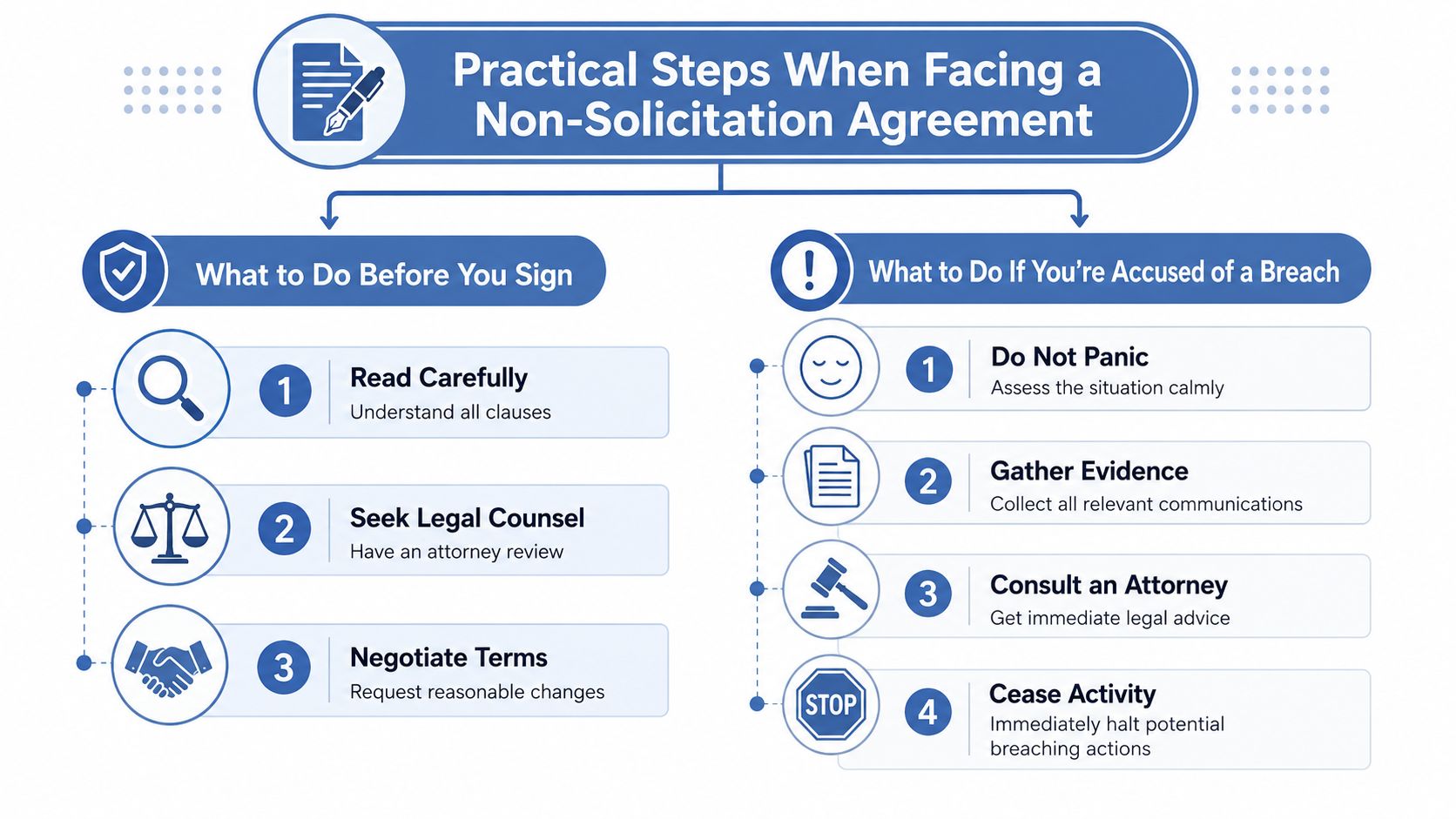
Practical Steps When Facing a Non Solicitation Agreement
You get called into a meeting on a Friday afternoon. HR slides a document across the table and says it is routine. Or a former employer sends a demand letter after you start a new job and claims you violated a non solicitation agreement. In Mississippi, those moments can turn serious fast. Handle them early, and with a plan.
Before you sign
Do not sign in the room. Take the document home and read it when no one is hovering over you.
Focus on the terms that create real risk:
- Get a full copy. You need the entire agreement, not a summary.
- Mark the defined terms. Pay attention to words like customer, client, employee, affiliate, solicitation, and competitive business.
- Ask why it is being added now. If this shows up after you already started working, make the employer explain what changed and what you are getting in return.
- Push for narrower language. Limit it to customers you personally worked with and employees you directly supervised or worked alongside.
- Keep every draft and email. Changes to the wording can matter later.
If a manager says the agreement is standard, treat that as pressure, not an answer. Plenty of standard forms are written too broadly.
If you are accused of breaching it
A demand letter is not something to ignore. It is also not something to answer emotionally.
Start doing these things the same day:
- Preserve your records. Save emails, texts, LinkedIn messages, call logs, offer letters, calendars, and commission documents.
- Pause any contact that could be spun as solicitation. Even harmless outreach can be mischaracterized once a dispute starts.
- Stop talking about the dispute casually. Co-workers, recruiters, and friends can all become witnesses.
- Get the agreement reviewed quickly. Employers sometimes try to create urgency. You need to know what the contract says before they define the story for you.
Mississippi workers need to be more disciplined about documentation than workers in some other states. Mississippi does not have a state human rights commission handling employment claims, so there is no state agency forum to soak up mistakes or delay. Many disputes move straight into an EEOC process or into court. That means your emails, timeline, and written responses matter from the beginning.
Make your decisions based on risk, not pride
Workers get in trouble when they try to win the argument by themselves. The smarter move is to figure out what the employer can prove, what your contract covers, and what conduct needs to stop now.
Ask direct questions about fees before you hire anyone. Contract review, demand-letter response, and litigation are different services, and they are often billed differently.
If this dispute is showing up during a resignation or exit package, read this guide on whether you should sign a severance agreement before you sign more paperwork than necessary.
For Mississippi workers who need legal analysis of restrictive covenants, Nick Norris, P.A. provides counsel on employment agreements and worker-side disputes. The right time to get that review is before you sign or right after an accusation arrives.
Waiting until your new job is under threat is how small contract problems become expensive ones.
Mississippi Non Solicitation Agreement FAQs
Can my employer make me sign a non solicitation agreement after I already started working?
They can ask. That doesn't mean you should sign blindly. If the restriction appears after you've already been working, scrutinize what you're getting in return and whether the new terms are broader than necessary.
If a former client contacts me first, did I violate the agreement?
Not automatically. A key issue is whether you engaged in active solicitation or received inbound contact. The exact contract language and your response both matter.
Can a LinkedIn post get me in trouble?
Yes, potentially. A neutral job update is different from a post that encourages customers or co-workers to follow you, contact you, or move business.
Can a non solicitation agreement stop me from taking a new job?
Usually, that's more of a non-compete issue. But some employers draft non solicitation language so broadly that it interferes with normal work. That's a major red flag.
What if the agreement is vague?
Vagueness helps employers intimidate workers, but it can also weaken enforcement. If the contract doesn't clearly define who is covered or what conduct is banned, get it reviewed.
Is there a retaliation claim in Mississippi for filing a workers' compensation claim?
No. Mississippi does not provide a retaliation claim for filing a workers' compensation claim. Don't rely on assumptions about retaliation law. Get advice based on the specific claim you have.
If you're a Mississippi worker dealing with a non solicitation agreement, don't guess your way through it. A careful review of the contract, the facts, and your next employment move can prevent a costly mistake. Nick Norris, P.A. represents Mississippi employees and provides practical guidance on employment agreements, workplace disputes, and worker-side strategy when the stakes are real.
This article has been reviewed for legal accuracy by Nick Norris. For employment law matters in Mississippi, consult with an attorney licensed to practice in your state.
Leave a Reply