

By Nick Norris, P.A.
Last updated: August 22, 2026
Reviewed by Nick Norris
You were fired shortly after reporting discrimination, requesting medical leave, or challenging something your employer was doing. During the termination meeting, your supervisor mentioned a vague policy violation or suddenly criticized your performance. Your prior reviews don’t match that explanation, and the timing feels too suspicious to ignore.
That suspicion may point to pretextual termination, but timing alone usually won’t carry the claim. In Mississippi, the central question is whether you can show that the employer’s stated reason was false, inconsistent, unsupported, or not the actual reason for the firing. The evidence matters more than the employer’s polished explanation, and more than your understandable belief that the decision was unfair. Pretext is one of the most common ways to prove a Mississippi wrongful termination claim.
What Pretextual Termination Actually Means
Pretextual termination occurs when an employer gives a legitimate-sounding reason for firing someone, but that reason is a cover for an illegal motive, such as discrimination or retaliation. The employer might say the worker violated policy, failed to meet expectations, or was eliminated during restructuring. The legal issue isn’t whether the employer’s decision was harsh or mistaken. It’s whether the stated reason was false or unworthy of belief and whether an unlawful motive better explains what happened.
Consider a Mississippi employee who takes protected medical leave. Before the leave, the employee receives positive feedback and no meaningful discipline. Shortly after returning, management cites a supposedly serious attendance problem, even though the company approved the leave and never previously described it as misconduct. The timing is suspicious, but the stronger evidence would be the gap between the employee’s records and the employer’s new explanation.
Unfair doesn’t always mean illegal
Mississippi generally follows the employment-at-will doctrine. That means an employer can often end employment for a bad business reason, an incorrect assessment, or no stated reason, unless the termination violates a specific legal protection. Mississippi’s employment-at-will doctrine matters because an unfair firing, standing alone, usually isn’t enough.
A pretext claim requires a connection to unlawful discrimination or retaliation. Protected activity can include reporting discrimination, opposing unlawful conduct, or exercising rights protected by applicable federal employment laws. The precise protection depends on what you did, what the employer knew, and which law applies.
The practical test: Don’t ask only whether your employer treated you unfairly. Ask whether its stated reason is contradicted by documents, treatment of other workers, the decision-maker’s statements, or the employer’s own process.
What courts are really examining
The modern legal foundation began with McDonnell Douglas Corp. v. Green, the Supreme Court’s 1973 decision establishing the burden-shifting framework used to evaluate whether an employer’s explanation masks discrimination. The framework was strengthened by Reeves v. Sanderson Plumbing Products, Inc., decided unanimously by the Supreme Court on June 12, 2000. Reeves held that a plaintiff can prevail by proving a prima facie case plus evidence that the employer’s explanation was false or pretextual, allowing a jury in an appropriate case to infer discrimination from falsity alone. This historical overview of the McDonnell Douglas and Reeves framework explains why proving the employer’s story false is so important.
You don’t need a direct admission such as “we fired you because of your complaint.” Most cases rely on circumstantial evidence. But circumstantial evidence must do more than show that the decision felt wrong. It must attack the credibility of the stated reason.
The Burden-Shifting Framework Courts Use
Courts usually analyze discrimination and retaliation claims under the McDonnell Douglas burden-shifting framework. The structure creates a sequence, but the ultimate responsibility for proving unlawful discrimination or retaliation remains with the employee.
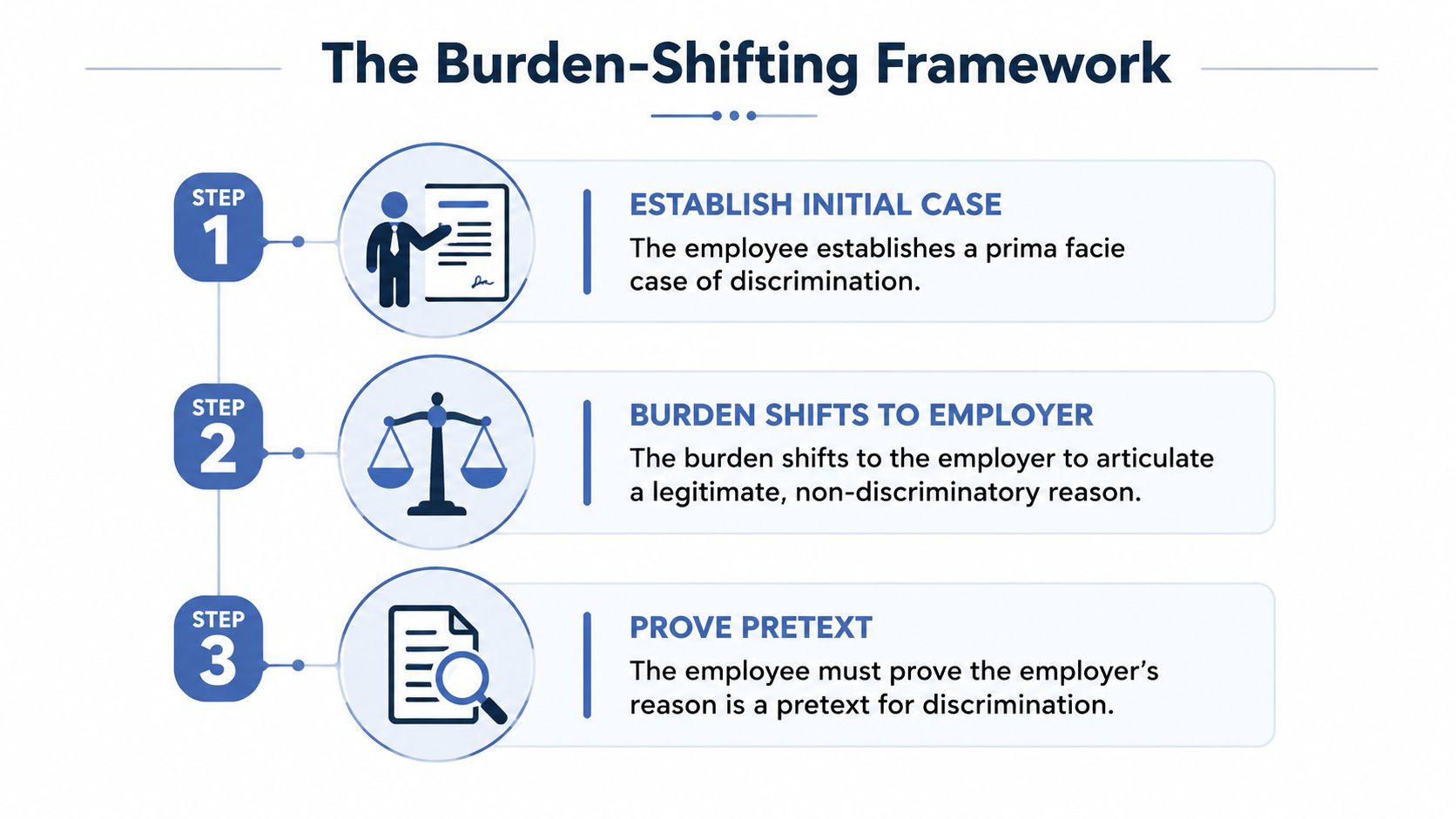
First, establish a prima facie case
The employee begins by presenting enough evidence to support an initial inference of unlawful treatment. The exact elements vary depending on whether the claim involves discrimination, retaliation, leave, disability, or another protected right. Generally, the employee must show that they engaged in protected conduct or belonged to a protected category, suffered an adverse employment action, and can connect the action to the protected conduct or status.
Suppose an employee requested protected medical leave, returned to work, and was then fired. The request, the employer’s knowledge, and the termination may establish the initial foundation. A worker who needs a plain-language explanation of this threshold can review what a prima facie case means.
This first stage doesn’t prove the employer acted illegally. It gets the claim past the initial question of whether the facts could support an inference of unlawful conduct.
Second, the employer gives its explanation
The burden then shifts to the employer to articulate a legitimate, non-discriminatory reason for the termination. The employer might identify a documented policy violation, performance deficiencies, restructuring, attendance concerns, or an investigation into alleged misconduct.
The employer doesn’t have to prove at this stage that its reason was correct. It must identify a lawful explanation that, if believed, could justify the decision. That explanation becomes central because the employee’s next task is to show that it isn’t worthy of belief or wasn’t the actual reason.
Third, show pretext
The employee must then produce evidence that the stated reason is false, inconsistent, manufactured after the fact, or insufficiently supported. Courts in the Eighth Circuit have emphasized that evidence at summary judgment must be specific and substantial enough to create a genuine dispute. General statements that management disliked the employee or acted unfairly usually won’t be enough. This discussion of the Eighth Circuit’s pretext standard explains why concrete contradictions matter.
In practical terms, the employee might show that the employer called an issue severe only after the leave request, ignored the same conduct by other workers, changed its explanation, or lacked any contemporaneous record supporting the decision.
The employee doesn’t need to prove that the employer had no business reason at all. The question is whether the employer’s stated reason was false and whether the protected characteristic or activity played the unlawful role alleged. Reeves makes clear that falsity can support an inference of discrimination in an appropriate case, but the evidence still must fit the facts and withstand the court’s scrutiny.
Key Indicators That Prove Pretext
Courts don’t treat every suspicious circumstance as proof of pretext. They examine the entire record, looking for evidence that weakens the employer’s explanation. Use the following checklist to organize your own records.
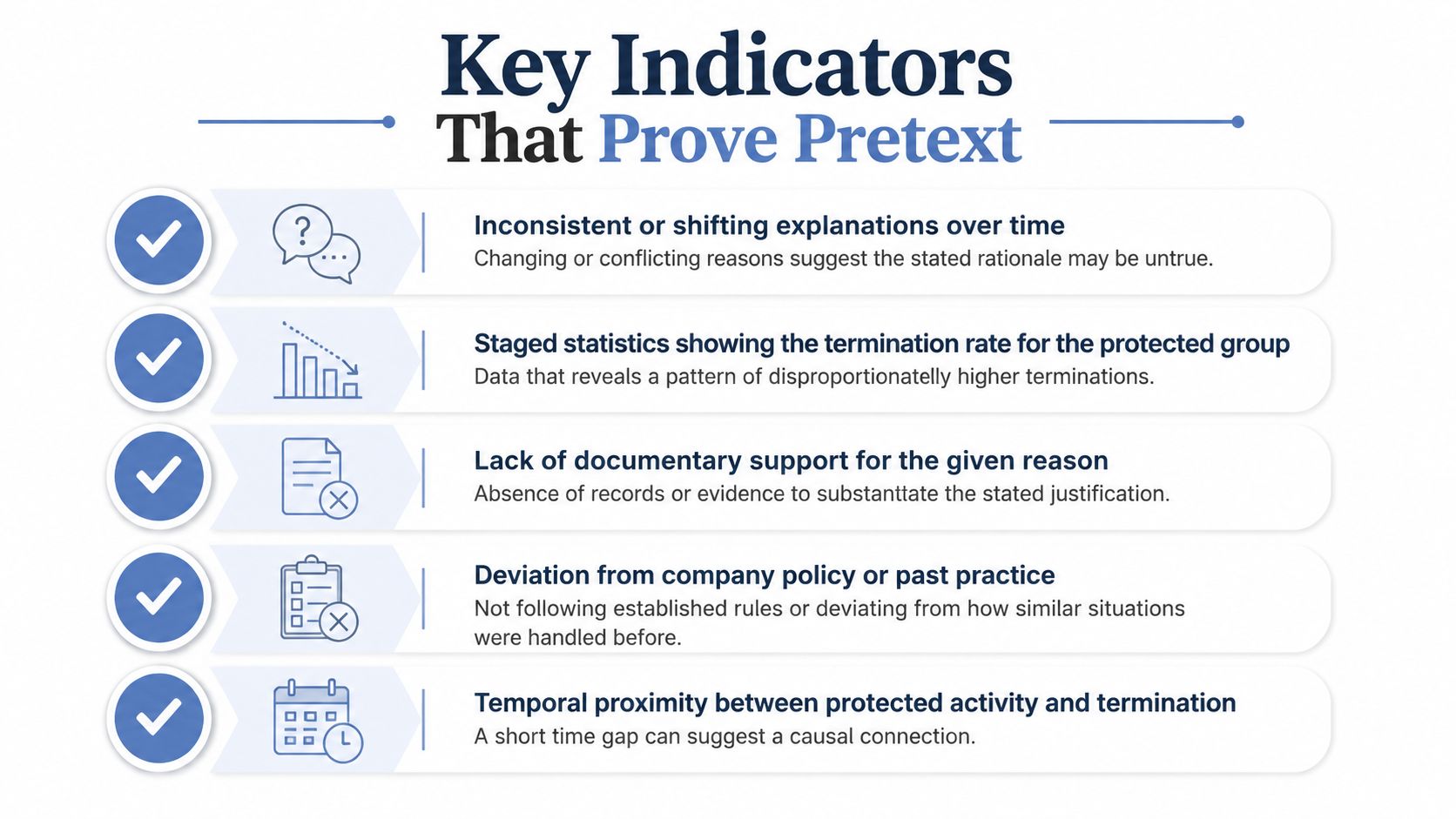
Changing explanations
Write down every reason the employer gave, including comments made in the termination meeting, separation paperwork, unemployment response, and later communications. A manager who first says the position was eliminated, then says performance caused the discharge, has created a credibility problem.
A change doesn’t automatically prove discrimination. Employers can clarify an explanation or learn additional information. But a major shift, especially when the later reason wasn’t documented before termination, can support an argument that the employer built its explanation after the decision.
Missing contemporaneous support
Look for the records that should exist if the stated reason were genuine. A serious performance problem would ordinarily leave some trace in evaluations, coaching notes, written warnings, emails, or a consistent history of criticism. If the employer suddenly describes your conduct as unacceptable but has no contemporaneous documentation, that absence may matter.
This evidence becomes stronger when your file contains positive reviews, commendations, completed work, or messages praising the same performance the employer later attacks. Preserve the records in their original form and don’t alter them.
Comparator evidence
A comparator is another employee who was similarly situated in relevant respects but received better treatment. The comparison must be concrete. Identify the same supervisor, similar job duties, comparable policy issue, and similar decision-making circumstances when those details are available.
For example, if your employer fired you for a first attendance issue but retained another employee who had a similar record, gather the dates, discipline, supervisor information, and policies involved. A general belief that “everyone else got away with it” isn’t as useful as a documented comparison.
Timing combined with other evidence
Close timing between protected activity and termination can support an inference of retaliation, but it works best alongside proof that the employer’s account doesn’t hold together. Pair the timeline with a sudden negative review, a new disciplinary theory, contradictory emails, or a departure from ordinary procedure.
Witnesses and group patterns
Coworkers may have observed discriminatory comments, inconsistent enforcement, the investigation, or the employer’s reaction to your complaint. Preserve names and contact details, but don’t pressure anyone or ask them to create a statement for you.
Statistical patterns may also matter when records show that protected workers were terminated at higher rates. The pattern must be developed from reliable employment data, not assumptions. This overview of common methods for proving pretext identifies shifting explanations, missing documentation, comparator treatment, timing, witness testimony, and statistical patterns as important categories.
No single item usually decides the case. The strongest records show how several pieces fit together and undermine the employer’s version of events.
Why Timing Alone Rarely Wins Pretext Cases
Being fired soon after protected activity is a warning sign, not an automatic verdict. A 2022 First Circuit wrongful-discharge decision held that close temporal proximity alone doesn’t establish pretext when the employer has another legitimate business reason. Although Mississippi claims may arise under different facts and laws, the reasoning reflects the broader McDonnell Douglas and Reeves analysis. The discussion of that modern timing rule explains why proximity must be supported by more.
The same caution applies when an employer can’t identify a specific policy violation. The absence of a particular violation may raise questions, but it doesn’t independently prove that the termination reason was fabricated. You still need evidence attacking the employer’s credibility, such as shifting explanations, unequal discipline, an unfair investigation, or records that contradict the stated reason. A 2025 appellate roundup addressing timing and policy violations highlights this gap between suspicion and legally sufficient proof.
The honest belief rule
An employer may defend a termination by showing that it reasonably believed the facts supporting its decision. The employer doesn’t necessarily have to be correct if it conducted a reasonable decision-making process and relied on the information it had.
That defense isn’t unlimited. An investigation can become evidence of pretext if management ignored obvious contrary evidence, relied on facts it knew were false, treated comparable employees differently, or changed the reason after the firing. The question isn’t whether the investigation was imperfect. It’s whether the employer’s belief and process were reasonable enough to support the stated explanation. Recent appellate summaries discussing honest belief and investigation quality show why this distinction matters.
Don’t build your entire case around the calendar. Use timing to direct attention to the documents, witnesses, and decision-making changes that followed your protected activity.
Evidence You Should Collect Immediately
Evidence disappears quickly after termination. Your company email may be disabled, files may become inaccessible, and coworkers may forget exact conversations. Preserve what you already possess lawfully, and never access company systems after your employment ends.
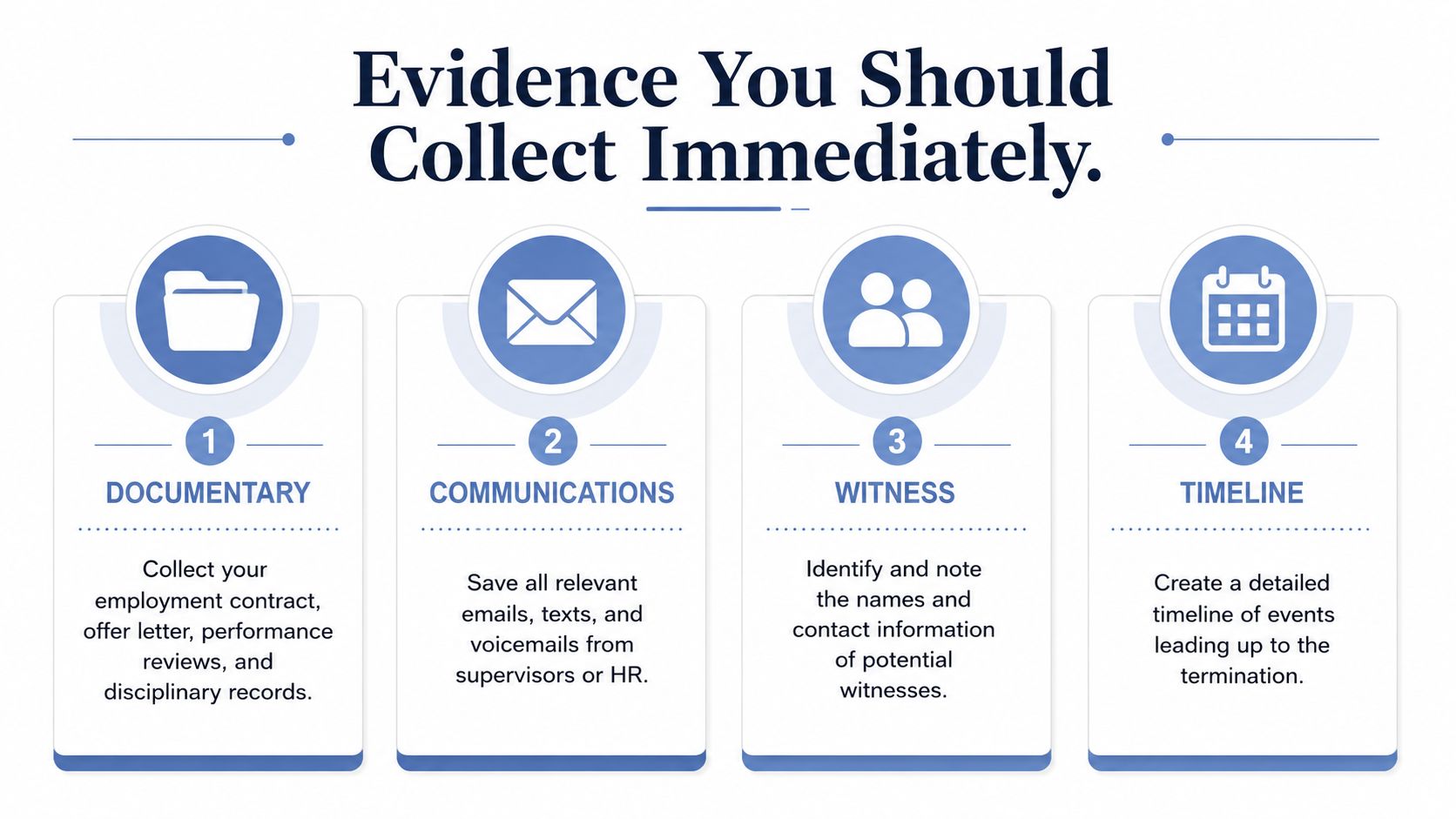
Start with the employment record
Collect your offer letter, employment agreement, handbook, performance reviews, commendations, disciplinary records, attendance records, time sheets, schedules, and termination documents. Save policies that address discipline, investigations, leave, complaints, or attendance. These records let an attorney compare what the employer says happened with what the employer documented at the time.
Preserve the original email files when possible, not only screenshots. Keep a separate copy in an organized folder with clear file names and dates. Don’t remove confidential business information that doesn’t relate to your claim, and don’t take documents you’re not legally entitled to possess.
Preserve communications and witness details
Save texts, emails, voicemails, calendar invitations, and messages with supervisors, human resources, and coworkers. Record the date, participants, subject, and substance of important conversations while your memory is fresh.
Create a witness list with each person’s role and what they may have seen or heard. Don’t coach witnesses or post accusations publicly. A simple factual record is more useful than an angry summary.
Build a timeline
Create a chronological timeline beginning before the protected activity and continuing through termination. Include requests, complaints, responses, performance feedback, investigations, discipline, meetings, and every explanation given for the firing.
For help organizing materials before an attorney review, building court-ready evidence with Casewell offers a structured approach to preparing documents and facts. You can also review how to prove wrongful termination for a broader evidence-focused checklist.
Write facts, not conclusions. “Supervisor changed the reason from restructuring to attendance during the meeting” is more useful than “Supervisor obviously retaliated.”
Keep the timeline private and factual. Don’t delete unfavorable information. Your attorney needs the complete record, including facts that may help the employer, to evaluate the claim thoroughly.
Mississippi-Specific Realities You Must Understand
Mississippi gives workers fewer state-level routes for discrimination complaints. Because the state has no human rights commission, discrimination and related retaliation complaints generally go through the federal EEOC, not a Mississippi agency. That affects where you start and how quickly you must act. The deadline depends on the legal theory and facts, so identify both before assuming timing alone proves pretext.
Mississippi also follows the employment-at-will doctrine, which generally allows either side to end employment unless a law, contract, or recognized public-policy exception applies. This overview of Mississippi’s employment-at-will doctrine helps explain why a suspicious firing still requires evidence connecting the decision to protected conduct.
Get a written fee agreement before hiring counsel. Contingency arrangements can involve a percentage of any recovery, along with separate responsibility for filing costs, expert fees, and other case expenses. This Mississippi employment-law discussion explains the no-win, no-fee structure and reported contingency range describes that arrangement and reported range. Ask specifically whether expenses come out before or after the fee is calculated.
Workers’ compensation retaliation is different
Mississippi does not provide a separate retaliation claim for filing a workers’ compensation claim. Filing or pursuing a workers’ compensation claim alone does not create an ordinary Mississippi retaliation cause of action. This Mississippi employment-law article addresses the limitation directly.
An injury-related termination may still raise other legal issues, depending on the employer’s statements, the timing, and the documents. Workers’ compensation law has its own rules, and a Mississippi employment-law guide describes workers’ compensation retaliation as a separate statutory limitation on at-will employment. Bring counsel the full timeline rather than relying on the firing’s proximity to your claim.
The practical lesson is direct: choose the legal theory and filing route before spending months on a pretext argument.
Your Next Steps and How to Get Help
Act before you sign anything, discard records, or make detailed statements to your former employer. A separation agreement may contain a release of claims, confidentiality language, or other terms that affect your options. Have an employment attorney review it first.
You should also address filing deadlines immediately. Federal employment claims often require an EEOC charge before further legal action, and the applicable deadline can be strict. Mississippi workers should identify the relevant protected activity, the termination date, the employer’s knowledge, and every document supporting the employer’s explanation.
Prepare for an initial evaluation
Bring your termination letter, employment agreement, handbook, performance reviews, disciplinary records, complaint or leave documents, relevant communications, timeline, witness list, and comparator information. Be prepared to explain what protected activity occurred, who knew about it, what reason the employer gave, and why that reason doesn’t fit the record.
An attorney will assess whether the facts support discrimination, retaliation, breach of an agreement, a public-policy theory, or another claim. The evaluation should also address evidence gaps, procedural requirements, likely defenses, fee terms, and whether contacting the EEOC should happen before negotiations with the employer.
Don’t overstate the case
A strong consultation depends on accuracy. Tell counsel about performance concerns, attendance issues, policy violations, prior discipline, and anything else the employer may use. An honest assessment helps separate a legally actionable pretextual termination from an unfair but lawful at-will firing.
As a Mississippi wrongful termination attorney, Nick Norris, P.A. evaluates these and related employment claims for Mississippi workers, including matters involving discrimination and retaliation. Call 601-641-4897 to discuss your situation and preserve your options before the record becomes harder to assemble.
Nick Norris, P.A. offers Mississippi employees case evaluations and representation involving suspected pretextual termination, discrimination, and retaliation. Visit Nick Norris, P.A. to request a confidential consultation and learn what evidence and next steps may fit your circumstances.
Leave a Reply