
You're working a shift in Jackson, Hattiesburg, Meridian, or along the Gulf Coast, and the job has become something you dread. A supervisor keeps making comments about your body. Coworkers use racial jokes and expect you to laugh. You report the problem, then your schedule changes, your hours disappear, or management suddenly starts building a performance file.
Mississippi workers often search for “hostile work environment legal” advice after the damage has already started. The legal question isn't whether your workplace feels awful. It's whether unwelcome conduct tied to a protected characteristic has become severe or pervasive enough to violate federal employment law, and whether you preserved enough evidence to prove it.
What a Hostile Work Environment Looks Like in Mississippi
A Jackson manufacturing employee may begin noticing that coworkers tell jokes about his race on the production floor. At first, management calls it “just shop talk.” Then the jokes become personal, a supervisor joins in, and a discriminatory image appears in the breakroom. The employee starts avoiding certain coworkers, loses sleep before shifts, and worries that complaining will cost him his job.
That situation differs from an ordinary hard day at work. A demanding production quota, a sharp performance critique, or a supervisor who treats everyone impatiently usually isn't a hostile work environment claim. The conduct must connect to a protected trait, such as race, sex, religion, national origin, disability, or age.
The difference between stress and unlawful harassment
Consider a Hattiesburg call center. A manager criticizes an employee's call times and places her on a performance plan. That may feel unfair, but it isn't automatically unlawful. The analysis changes if the manager repeatedly makes sexual comments about her appearance, ignores her objections, and punishes her after she complains.
A Gulf Coast restaurant presents another common pattern. A server asks a manager to stop touching her and commenting on her body. The manager continues, then threatens to cut her shifts if she speaks up. The unwanted sexual conduct, the repeated behavior, and the threat after an objection create facts worth investigating.
Practical rule: A hostile workplace claim is built from conduct, context, witnesses, and the employer's response. “My boss was mean” is rarely enough by itself.
Why the distinction matters
The EEOC harassment guidance focuses on the totality of circumstances. Investigators and courts look at whether conduct was threatening or humiliating, whether it interfered with work, how often it happened, and how the incidents accumulated.
That means repeated low-level conduct can matter. A series of comments, jokes, schedule changes, and humiliating interactions may become legally significant when viewed together, even if management tries to characterize each event as harmless in isolation. Document the pattern, not just the worst incident.
The Federal Legal Definition Most People Get Wrong
The term hostile work environment describes a form of unlawful harassment under federal employment law. Title VII addresses discrimination based on race, color, religion, sex, and national origin. The Americans with Disabilities Act and the Age Discrimination in Employment Act address other protected categories in appropriate circumstances.
The modern federal framework began with Meritor Savings Bank, FSB v. Vinson in 1986. The Supreme Court recognized that workplace harassment can violate Title VII. In Harris v. Forklift Systems, Inc., decided on November 9, 1993, the Court clarified that the environment must be hostile from both perspectives. The employee must personally experience it as abusive, and a reasonable person must also view it as hostile or abusive. The EEOC's federal enforcement materials discuss this continuing framework in its harassment enforcement reference.
Four questions control the analysis
Start with these questions:
- Was the conduct unwelcome? You didn't invite it, consent to it, or willingly participate in it.
- Was it tied to a protected trait? The comments or actions related to race, sex, religion, national origin, disability, age, or another protected category covered by federal law.
- Was it severe or pervasive? One exceptionally serious incident may be enough. Repeated conduct may qualify because its cumulative effect changes the workplace.
- Did it alter the conditions of employment? The environment became abusive, humiliating, threatening, or disruptive to your ability to work.
The law doesn't punish every rude comment. Occasional slights, personality conflicts, general unfairness, unpleasant customers, and legitimate criticism usually fall outside the hostile-work-environment standard. A single offhand remark may also fall short unless the surrounding facts make it extraordinarily serious.
Mississippi's legal route is federal
Mississippi doesn't have a state human rights commission for employment discrimination claims. Workers generally rely on federal law and the EEOC process rather than a state employment-rights agency. That makes the federal definition more than a technical standard. It's the test that usually determines whether a Mississippi worker has a viable discrimination or harassment path.
For a plain-English explanation of the governing concept, review this hostile work environment definition guide. Don't wait to decide whether the facts “feel serious enough.” A Mississippi employment attorney can evaluate the entire pattern before important evidence or deadlines disappear.
The Five Elements You Have to Prove
A federal hostile work environment claim doesn't succeed because an employee had a terrible experience. The worker must connect the experience to a protected category, show that the conduct was unwelcome, establish the required level of severity or repetition, and prove why the employer should be responsible.
Element one, protected status
You must belong to a protected class or be targeted because of one. Common examples include race, sex, religion, national origin, disability, and age.
A Black warehouse worker in Jackson may satisfy this element if coworkers target him with racial language. A worker's protected status can also be obvious from the conduct itself, such as comments about a disability or religious practice.
Element two, unwelcome conduct
The behavior must be unwanted. In Meridian, a dealership employee tells her supervisor to stop touching her shoulder. The supervisor continues doing it during conversations. Her direct objection helps show that the conduct wasn't welcomed.
You don't need perfect words or a formal complaint to dislike harassment. A written message, an objection to the supervisor, avoidance, or a report to HR may help establish the point.
Element three, a connection to the protected category
Rudeness isn't enough. In a Pascagoula shipyard, coworkers may criticize an employee's speed, but slurs about his accent point toward national-origin harassment. The evidence must show that the conduct happened because of, or was connected to, the protected characteristic.
Element four, severe or pervasive conduct
Many cases fall apart here. A single crude joke may be offensive but insufficient. A steady pattern of slurs, sexual touching, threats, humiliating disability-related ridicule, or discriminatory images can create a different legal picture.
Courts consider the entire setting, including frequency, seriousness, physical threats, humiliation, interference with work, and accumulated context. The number of incidents matters, but it isn't the only measure.
Element five, employer responsibility
The final question is whether the employer can legally be held responsible. A supervisor's discriminatory conduct may create direct employer exposure. If coworkers or other third parties are involved, the employer's knowledge and failure to take reasonable corrective action become central.
| Element | What You Must Show | Mississippi Example |
|---|---|---|
| Protected class | You were in a protected category or targeted because of it | Racial comments aimed at a Jackson warehouse worker |
| Unwelcome conduct | You didn't welcome the touching, comments, slurs, or ridicule | A Meridian employee tells her supervisor to stop touching her |
| Protected connection | The conduct related to race, sex, religion, national origin, disability, or age | Accent-based slurs at a Pascagoula shipyard |
| Severe or pervasive conduct | One serious incident or a repeated pattern changed the workplace | Ongoing threats and humiliating comments, not one isolated insult |
| Employer responsibility | A supervisor acted, or the employer knew and failed to respond | HR receives a written complaint and does nothing |
Meeting all five elements is the threshold for a federal hostile work environment claim. The proof requirements for hostile work environment claims provide a useful checklist, but the facts and evidence determine whether the claim can move forward.
Real Mississippi Examples That Cross the Line
A Black warehouse worker in Jackson transfers from a Delta plant and immediately becomes the target of racial slurs. Coworkers mock his accent, and someone posts nooses on the breakroom bulletin board. A manager sees the material, removes it, and tells the worker not to be “so sensitive,” while the comments continue.
Those facts point toward protected-class harassment, unwelcome conduct, a serious and repeated pattern, and notice to the employer. The noose imagery and racial slurs carry a level of intimidation and humiliation that a single ordinary insult usually doesn't.
Sexual harassment at a Gulf Coast casino
A female server at a Gulf Coast casino deals with a manager who repeatedly comments on her body and brushes against her while taking orders. She tells him to stop. He responds by threatening to cut her shifts if she complains again.
The facts matter together. The conduct is sexual, unwanted, repeated, and linked to an employment threat. A manager's power over scheduling can make the threat especially important because it connects the harassment to the worker's job conditions.
Disability harassment in Biloxi
A Biloxi call center employee with multiple sclerosis asks for an ergonomic accommodation. Her supervisor refuses to implement it properly, mocks her tremors in front of coworkers, and moves her to overnight shifts without a legitimate explanation.
The accommodation dispute alone may involve separate disability-law issues. The public ridicule and unexplained schedule change may also support a hostile-environment theory when they are tied to her disability and interfere with her ability to work.
The pattern carries the case
A one-off rude comment from a coworker may not meet the legal standard. A supervisor who is unpleasant to everybody may be difficult, but that conduct doesn't become discrimination merely because it hurts morale.
The stronger cases show a pattern tied to a protected characteristic, evidence that the worker objected or the conduct was plainly unwelcome, and an employer that knew or should have known but failed to correct it. Preserve the words, images, messages, schedules, and names of witnesses. The pattern is often more persuasive than any single incident.
How to Report a Hostile Work Environment in Mississippi
Mississippi workers don't have a state human rights commission that receives private-employment discrimination claims. Start with the employer's internal process, but don't assume an internal complaint replaces the federal filing deadline.
Begin with a written internal report
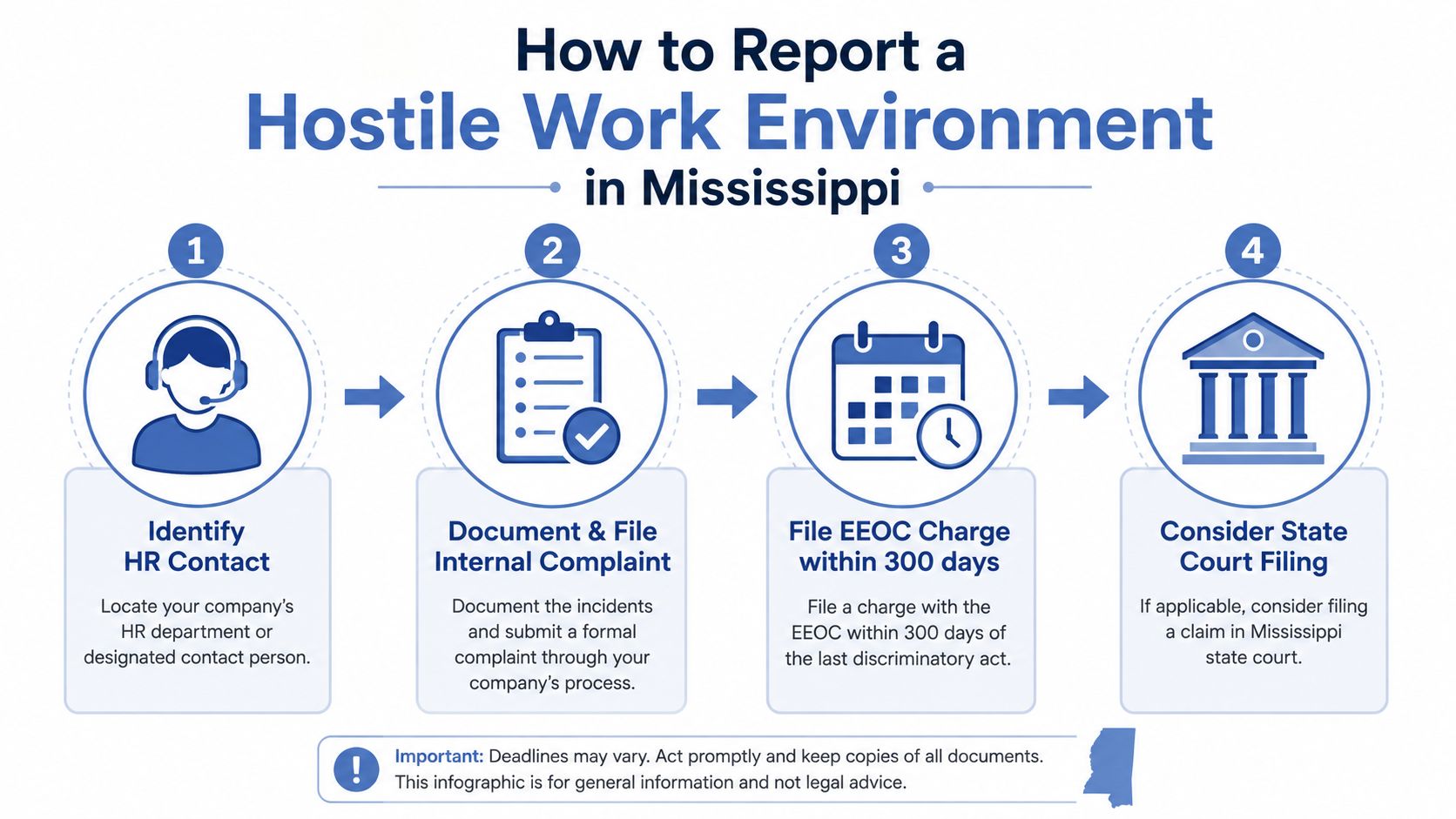
Find the HR contact, compliance office, hotline, or manager identified in the handbook. Submit a factual complaint in writing. State what happened, who did it, when it happened, why it relates to a protected characteristic, and what response you want.
Keep copies of the complaint and every response. Maintain a separate timeline with dates, locations, witnesses, messages, photographs, schedule changes, discipline, and medical or accommodation records. Save copies, not originals, and don't use company systems as your only storage location.
An internal report isn't generally required before contacting the EEOC, but it can show that the employer had notice and an opportunity to act. It also helps separate the underlying harassment from later retaliation.
For practical documentation guidance, use this Mississippi workplace harassment reporting guide.
File through the federal process
Mississippi workers generally pursue discrimination and harassment charges through the Equal Employment Opportunity Commission. For many Mississippi employment claims, the charge deadline is 300 days after the last harassing act, as reflected in federal filing guidance for Mississippi workers. Treat that deadline as firm and calculate it from the last incident, not from the date you finally decide to seek advice.
You can begin through the EEOC's online system or contact the agency's Jackson Field Office. Your charge should identify:
- Dates and sequence: List each significant incident and the most recent event.
- People involved: Name the harasser, supervisors, HR personnel, and witnesses.
- Protected basis: Explain whether the conduct involved race, sex, religion, national origin, disability, age, or another protected category.
- Specific conduct: Describe exact words, touching, images, threats, schedule changes, or discipline.
- Supporting material: Attach copies of relevant records and keep your originals.
Some claims may be dual-filed with another agency, but Mississippi's lack of a state human rights commission means you shouldn't assume a state administrative route exists. Federal employees may have separate procedures, including MSPB-related processes depending on the employment action.
You may eventually pursue a federal lawsuit under federal employment law after satisfying applicable administrative requirements. Don't treat that possibility as a reason to skip the EEOC process or miss the charge deadline.
Retaliation Protections and the Mississippi Gap
Retaliation is separate from the original harassment. Under Title VII, the ADA, and the ADEA, federal law can protect an employee who opposes discrimination, reports harassment, files an EEOC charge, or participates in an investigation.
The retaliatory act doesn't have to be termination. It may include a demotion, schedule reduction, exclusion from training, intensified scrutiny, a fabricated performance plan, undesirable assignments, or discipline that begins soon after the complaint.
Reporting can create protection before the harassment claim is clear
The retaliation standard can be lower than the standard for proving the underlying hostile work environment. Federal materials recognize protection for an employee who reports conduct they reasonably believe is unlawful, even if the conduct later falls short of the severe-or-pervasive test. That rule encourages employees to report early instead of waiting for the workplace to become worse.
Mississippi workers should document what changes after a complaint. Compare schedules, write down new criticisms, preserve disciplinary notices, and identify coworkers who observed the change.
Workers' compensation is the Mississippi misconception
Mississippi doesn't provide a specific state-law retaliation claim for filing a workers' compensation claim. Mississippi-focused legal guidance explains that the Workers' Compensation Act contains no anti-retaliation remedy for that filing, and the Mississippi Supreme Court has declined to create one. A Meridian factory worker fired after filing a workers' compensation claim therefore shouldn't assume the filing alone creates a Mississippi wrongful-termination claim.
That doesn't mean every firing after an injury report is lawful. If the employer also acted because the worker opposed race discrimination, requested a disability accommodation, or engaged in another federally protected activity, federal protections may apply. The key is the reason for the adverse action and the legal protection attached to that reason.
| Conduct | Federal Protection under Title VII, ADA, or ADEA | Mississippi State Law |
|---|---|---|
| Reporting race, sex, religion, national-origin, disability, or age discrimination | Generally protected opposition when the employee reasonably believes the conduct is unlawful | No separate Mississippi human rights commission route |
| Filing an EEOC charge | Protected federal activity | Federal process controls |
| Participating in an investigation | Protected participation | Federal process controls |
| Filing a workers' compensation claim alone | Not automatically protected under Title VII, ADA, or ADEA | Mississippi provides no specific state retaliation claim for that filing |
| Workers' compensation filing plus disability-related opposition | May involve ADA protection if the facts support it | The workers' compensation filing alone remains insufficient |
The safest approach is to analyze the complaint, the protected activity, and the employer's response as separate events. Don't combine them into one vague allegation.
When to Call an Attorney and What It Costs
Call an employment attorney before the situation reaches a crisis. Early advice can help you preserve texts, identify witnesses, write a focused internal complaint, and avoid statements that undermine your position. It also gives you a better chance of addressing the 300-day EEOC deadline before it becomes an emergency.
You should seek advice promptly if your employer fires or demotes you after a complaint, if several coworkers describe the same pattern, if evidence is disappearing, if an attorney for the company pressures you to settle, or if you receive an EEOC notice that affects your next step.
Fees require a direct conversation
Mississippi employment cases are often handled on contingency, meaning the attorney receives an agreed percentage of a recovery rather than charging only an hourly fee. Mississippi employment-law fee discussions commonly place that range at 40% to 50%, depending on the case and its risk, as described in this Mississippi employment lawyer cost guide.
Ask specifically about litigation expenses. Filing fees, deposition transcripts, expert witnesses, records, investigators, travel, and other case costs may be handled separately from the attorney's percentage. Get the fee agreement in writing and ask what happens if there's no recovery.
Fee-shifting may also matter. Federal employment laws can allow a prevailing plaintiff to seek attorney fees, and the Mississippi Employment Protection Act contains fee provisions in appropriate cases. That doesn't mean every worker receives fees or that an attorney will take every claim. It does mean fee structure should be discussed alongside the strength of the evidence and the likely remedy.
Workers who can't afford private representation may also ask Mississippi firms, bar referral services, or legal aid organizations about screening. The University of Mississippi Civil Legal Clinic is one possible resource to investigate, although eligibility and capacity vary.
A checklist for this week
- Create a timeline: Record each incident, date, location, witness, and response.
- Preserve evidence: Save messages, emails, images, schedules, evaluations, and complaints.
- Review policy: Find the employer's harassment, reporting, accommodation, and retaliation procedures.
- Calculate the deadline: Identify the last harassing act and the applicable EEOC filing date.
- Schedule a confidential consultation: Bring your timeline and copies of the strongest records.
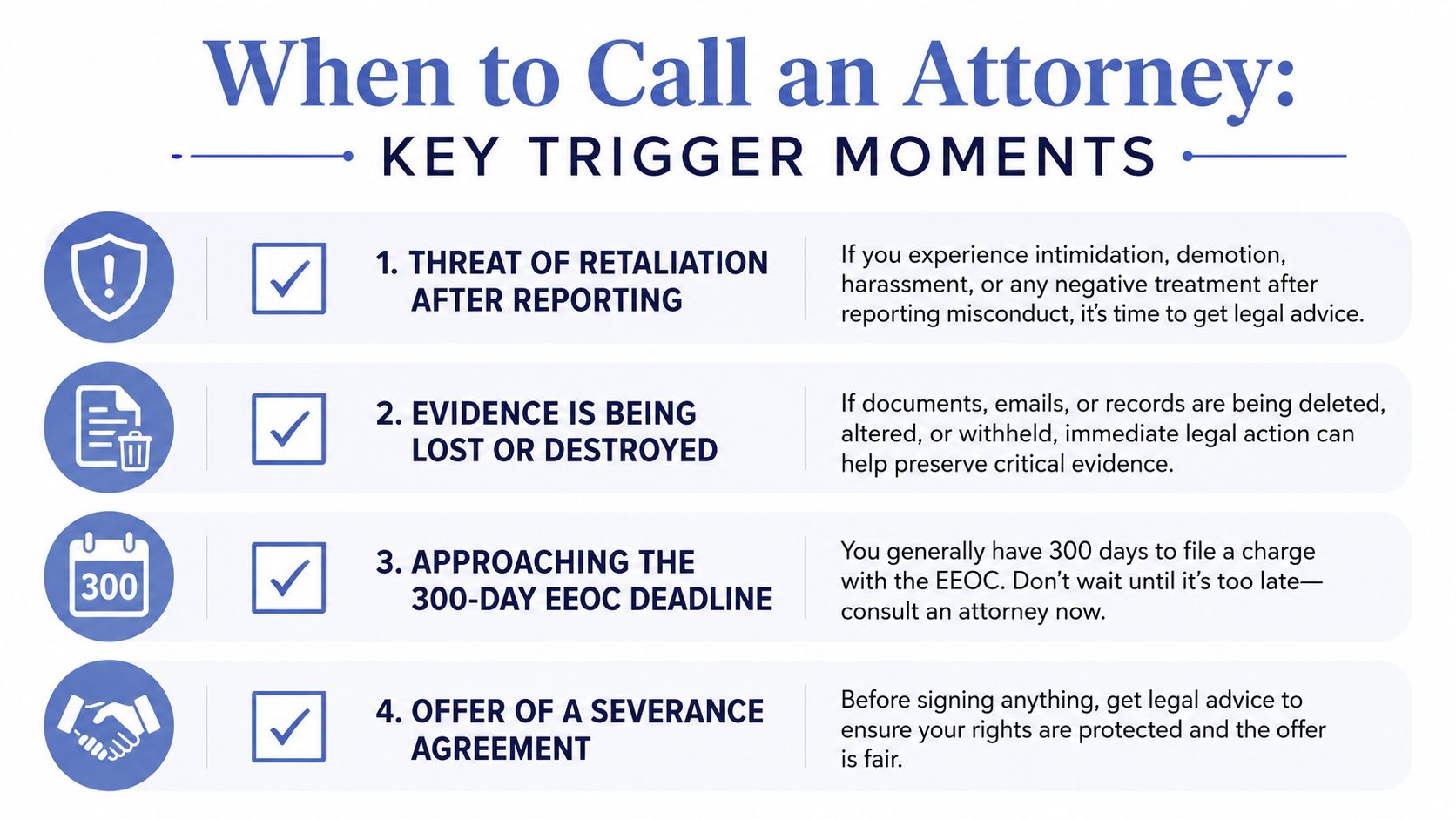
A consultation is especially important before signing severance paperwork or responding to a sudden performance plan. The document may contain deadlines, releases, confidentiality terms, or admissions that affect your options.
Nick Norris, P.A. evaluates Mississippi workplace discrimination, harassment, and retaliation matters, including hostile work environment evidence and EEOC filing strategy. If your job has changed after you reported misconduct, visit Nick Norris, P.A. to request an evaluation before evidence or federal deadlines become harder to manage.
Leave a Reply