

You work a shift in a Jackson restaurant, stay late to close, answer messages before clocking in, and discover that your salary swallowed every hour beyond forty. Or perhaps your employer calls you an independent contractor, pays you a flat amount, and tells you that overtime rules don't apply. If your paycheck doesn't match the work you performed, Fair Labor Standards Act violations may be involved.
Mississippi workers rely primarily on federal protections for wage and hour problems. The state doesn't have a human rights commission, and Mississippi doesn't provide a standalone retaliation claim for filing a workers' compensation claim. That makes the details matter. You need to identify the violation, preserve evidence, understand the federal deadlines, and choose the right federal channel before valuable claims disappear.
What Counts as a Fair Labor Standards Act Violation
The Fair Labor Standards Act, or FLSA, is the federal law that created the modern framework for minimum wage, overtime pay, recordkeeping, and child labor protections when it was enacted in 1938. For a Mississippi employee, an FLSA violation occurs when a covered employer fails to meet one of those baseline duties.
Consider the Jackson restaurant worker who puts in 55 hours but receives the same salary every week. A salary alone doesn't erase overtime rights. The questions are whether the employee is legally exempt, what duties the employee performs, and whether the employer paid the required overtime premium for hours over 40 in a workweek.
The basic duties are straightforward:
- Minimum wage: A covered employee must receive at least the federal minimum wage for compensable work.
- Overtime: Nonexempt employees generally must receive time-and-a-half for hours worked over 40 in a workweek.
- Records: The employer must maintain accurate records of hours, wages, and other required payroll information.
- Child labor: Employers must follow federal limits on minors' work hours and prohibited hazardous duties.
The FLSA is a federal floor, not a ceiling. An employee's agreement to accept a flat salary, cash payment, or contractor label doesn't automatically make an unlawful pay practice legal. You also don't have to complain internally before an employer's payroll practice can violate the Act.
Coverage doesn't depend only on company size
Coverage can arise through enterprise coverage or individual coverage. Enterprise coverage generally concerns employers with at least $500,000 in annual volume or employers engaged in interstate commerce. Individual coverage can apply when the employee personally engages in interstate commerce.
That second route catches people off guard. Handling credit-card transactions, ordering goods from outside Mississippi, communicating across state lines, or working with interstate customers may matter depending on the facts. Don't assume you're exempt because your workplace feels local or because your employer says the business is too small.
For a plain-language overview of the statute and its protections, see this explanation of what the Fair Labor Standards Act covers. Start with your actual duties and hours, not the title printed on your offer letter.
Practical rule: Your employer's label is evidence, not the final answer. The work you performed and the way you were paid usually matter more.
Common Types of FLSA Violations Mississippi Workers See
Mississippi workers often recognize the problem only after comparing their pay practices with the federal rules. The examples below aren't legal conclusions by themselves, but they show how common payroll arrangements can create a claim.

Unpaid overtime
A salaried assistant manager at a Meridian retail chain works 50-hour weeks and receives no additional pay. Salary doesn't automatically mean exemption. If the employee's actual duties don't satisfy an applicable exemption, the employer may owe overtime for the hours above 40.
The same issue appears when a supervisor tells employees to work through closing, prepare inventory before clocking in, or answer work messages after leaving. Employers can't avoid overtime by moving work outside the time clock.
Minimum wage shortfalls
A Gulf Coast hotel housekeeper may receive a tipped credit arrangement that leaves effective pay below the federal minimum wage. A tipped wage system has strict conditions. If the employer takes a tip credit but fails to satisfy those conditions, the employee may have a minimum-wage claim.
Misclassification
A Hattiesburg construction foreman may receive a Form 1099 and be called an independent contractor while following staff schedules, using company tools, and performing work controlled by the business. The label doesn't decide the issue. The economic realities of the relationship deserve examination.
Tip-credit abuses
A Tupelo server may be forced to share tips with dishwashers or managers, or lose money for customer walkouts. Tip pooling and deductions can create violations when the employer uses tips improperly or shifts business costs to employees.
Recordkeeping failures
No time clock, missing hours on paystubs, flat cash payments, and instructions to “just remember” your hours are warning signs. Off-the-clock prep work is still work when the employer requires or allows it.
Child labor breaches
A 16-year-old at a quick-serve restaurant may operate equipment or work late hours that federal child labor rules restrict. Employers must follow both the permitted-hours rules and hazardous-occupation limits.
Retaliation
A worker asks why overtime is missing, then loses scheduled hours or gets fired. The FLSA's anti-retaliation protection comes from Section 15(a)(3), and Section 16(c) provides an enforcement mechanism. The protection is federal. Mississippi doesn't have a state human rights commission that substitutes for that federal wage-and-hour remedy.
If your concern centers on unpaid overtime, review this Mississippi unpaid overtime lawsuit guide before confronting management. Your next conversation can affect the evidence and the timeline.
Statute of Limitations and Damages You Can Recover
The FLSA deadline is unforgiving. A standard claim generally reaches back two years from the date the lawsuit is filed. If the employer's violation was willful, the period extends to three years. The Department of Labor describes willfulness as conduct involving knowledge that the FLSA applied or reckless disregard for whether the pay practice was lawful. See the Department of Labor brief on willfulness and the good-faith defense.
A manager saying, “You're salaried, so you don't get overtime,” can support a willfulness argument when the surrounding facts show the employer knew employees were working overtime. A payroll company that continues classifying drivers as contractors after receiving a warning may create a similar issue. The court still evaluates the evidence, so don't treat a willfulness allegation as automatic.
What the recovery can include
The starting point is unpaid wages. The FLSA can also provide an equal amount as liquidated damages, which is why a successful claim can approach double the unpaid wage component. An employer seeking to avoid liquidated damages faces a demanding good-faith defense. The employer must show both subjective good faith and objectively reasonable grounds for believing the pay practice complied with the law.
The statute can also shift reasonable attorneys' fees and litigation costs to the losing employer. That rule makes representation possible in cases where the unpaid amount alone might not justify paying a lawyer by the hour.
| Violation Type | Lookback Period | Liquidated Damages | Attorneys' Fees |
|---|---|---|---|
| Ordinary FLSA violation | 2 years | Equal amount may be available | May be recoverable |
| Willful FLSA violation | 3 years | Equal amount may be available | May be recoverable |
A settlement can resolve the liquidated-damages dispute. Once you accept a bona fide settlement, you generally give up the chance to continue arguing for a larger liquidated-damages award on the settled claim. Before signing, use this guide to calculating liquidated damages and have counsel review the release language.
What the enforcement record shows
The Wage and Hour Division handled between 23,000 and 30,000 FLSA minimum-wage and overtime cases each year during the decade before fiscal year 2019, and it found minimum-wage or overtime violations in 80% of FLSA cases concluded in FY 2019. Worker complaints initiated 64% of those cases, while the agency initiated 36%, according to the Government Accountability Office review.
In FY 2024, the Department of Labor recovered more than $149.9 million in FLSA back wages for 125,301 workers, including $126,967,097 in overtime back wages for 101,043 employees. The agency reported an average recovery impact of $1,465 per worker in its FLSA enforcement data. Those figures don't tell you what your claim is worth, but they show why a seemingly small payroll error deserves prompt review.
Filing with the DOL versus a Private Federal Lawsuit
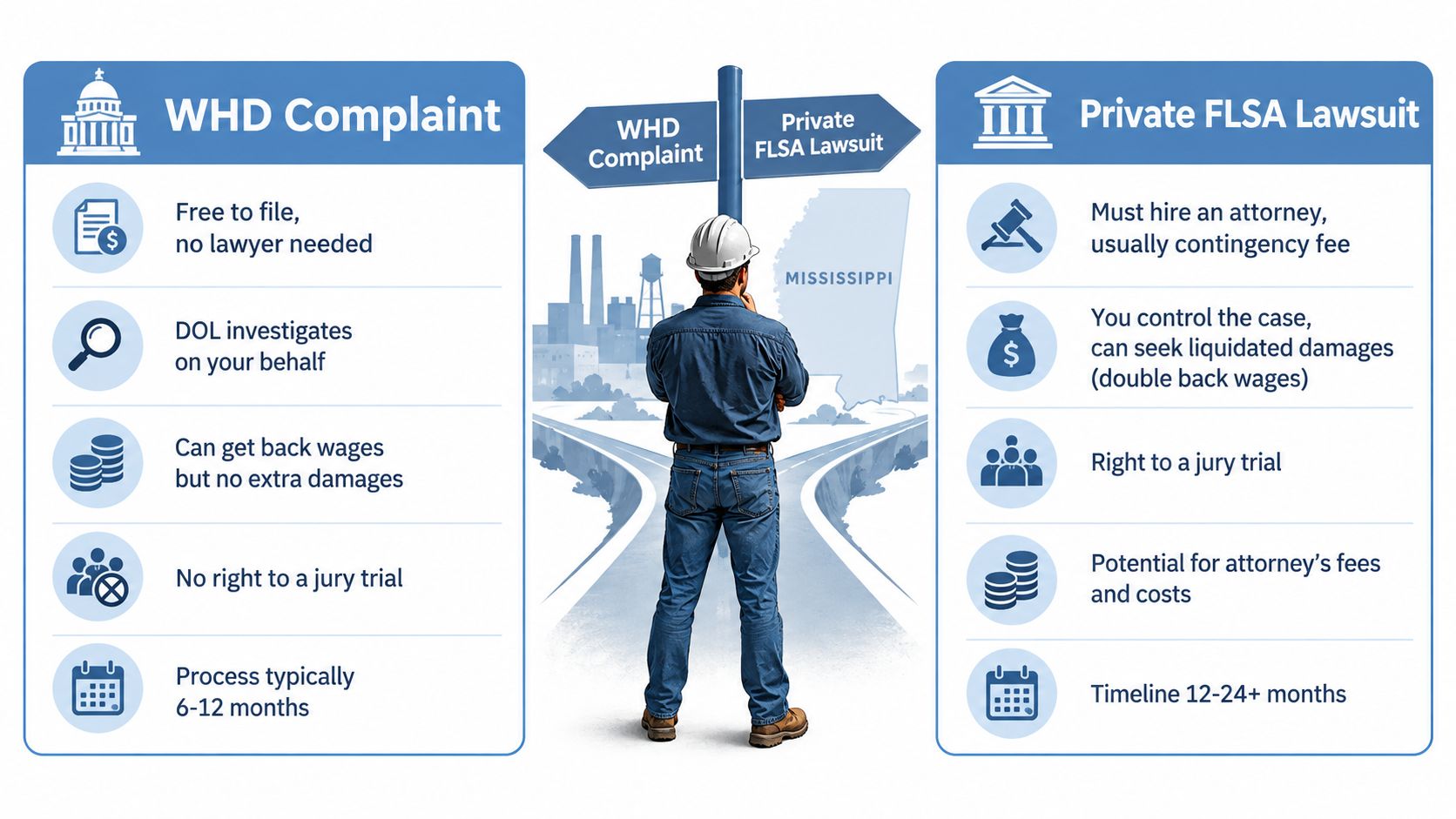
The Wage and Hour Division and a private federal case are different tools. Neither is automatically right for every Mississippi employee.
A WHD complaint is free, and you don't need a lawyer to submit it. The agency investigates, contacts the employer, reviews records, and may recover unpaid wages. It can be a practical choice when you want government involvement without managing litigation yourself. The tradeoff is control. The agency chooses how to prioritize and resolve the matter, and its process may not pursue every remedy or theory available in private litigation.
A private lawsuit puts the worker in control of the claim. The case proceeds in the U.S. District Court for the Southern or Northern District of Mississippi, not in state court. A worker can sue individually or participate in a collective action under 29 U.S.C. § 216(b) when other employees share the same unlawful pay practice.
The practical differences
| Choice | Main advantage | Main limitation |
|---|---|---|
| WHD complaint | No filing fee and agency investigation | Less control over timing and settlement |
| Private federal lawsuit | Control over discovery, settlement, and litigation strategy | Requires legal work, evidence, and patience |
| Collective action | May connect employees with the same pay practice | Each worker generally must opt in with written consent |
Opt-in consent forms matter. Employees don't automatically become part of a federal collective action merely because they work for the same employer. Each participating worker generally must affirmatively consent.
You can contact WHD, speak with a lawyer, or pursue both paths depending on the circumstances. You can't recover the same unpaid wages twice. If an agency payment resolves particular weeks or claims, that recovery must be accounted for in any later case.
The decision comes down to influence, speed, and your tolerance for paperwork. A straightforward underpayment with strong records may fit an agency complaint. A broad off-the-clock policy, retaliation, or a group of similarly affected workers may justify a private federal evaluation.
A private case can include a jury trial and liquidated damages, while an agency investigation may offer a less demanding route. Learn how the process works through this Wage and Hour Division release and enforcement resource, then protect your filing deadline before choosing.
How to Document Evidence Before You Say a Word
Start preserving evidence before you complain. A calm, organized record can show what happened, when it happened, who knew about it, and what changed afterward.
Build your personal file
Save paystubs, direct-deposit records, W-2s, schedules, and any document showing hours or deductions. Keep copies in personal storage, not only on a company device or inside an employer-controlled application.
A personal calendar is useful because it captures the hours you worked, including opening, closing, travel between required work locations, meetings, training, and work performed after clocking out. Add the start time, end time, breaks, and the task performed. Don't alter original records. If you correct a personal note, preserve the original and identify the correction.

Capture the pattern, not just one paycheck
Useful evidence often includes:
- Time records: Save time-clock photos, badge reports, scheduling-app screenshots, and copies of timesheets.
- Written communications: Preserve texts, emails, Slack messages, and group chats about unpaid work, skipped breaks, deductions, or overtime.
- Witness information: Record the names and phone numbers of coworkers who experienced the same practice.
- Company policies: Keep the employee handbook, especially overtime, timekeeping, breaks, and discipline provisions.
A dated internal complaint can become important in a retaliation claim. Write clearly that you believe you're missing wages or that required work isn't being recorded. Keep the response, then record any schedule cut, discipline, termination, or change in treatment that follows.
Your timeline should answer four questions: What did you report? When did you report it? Who received it? What happened afterward?
Keep the file for at least three years. Don't secretly remove confidential customer information, protected medical records, or trade secrets that aren't needed to prove your wage claim. Preserve what concerns your hours, pay, instructions, and retaliation, and ask a lawyer how to handle anything sensitive.
The Mississippi Catch No One Tells You About
Many Mississippi workers believe the absence of a state human rights commission means there is nowhere to go. That conclusion is wrong, but the underlying concern is real. Mississippi doesn't provide a state agency with broad employment enforcement authority that replaces the federal systems workers must use for many wage, discrimination, and retaliation problems.
For FLSA pay disputes, the primary doors are federal. The FLSA itself prohibits retaliation for asking about wages or asserting overtime rights. The EEOC may handle retaliation connected to discrimination complaints. The National Labor Relations Board may protect concerted activity, including group complaints about workplace conditions, even in a non-union workplace.
Those routes don't do the same job. A pay complaint belongs in a wage-and-hour analysis. A complaint tied to race, sex, disability, age, or another protected characteristic may also require an EEOC evaluation. A group effort by employees to discuss pay may raise a separate labor-law issue.
Workers' compensation retaliation is different
Mississippi does not provide a standalone retaliation claim for filing a workers' compensation claim. The Mississippi Workers' Compensation Act contains no anti-retaliation remedy for that conduct, and the Mississippi Supreme Court has declined to recognize such a cause of action, as discussed in this Mississippi workers' compensation retaliation explanation.
That limitation doesn't automatically erase the underlying workers' compensation claim. A terminated employee may still pursue workers' compensation benefits, and termination doesn't automatically shut off medical or disability benefits under the workers' compensation system, according to this Mississippi workers' compensation benefits resource. The compensation claim and a retaliation theory are separate questions.
Federal channels require clean facts
The Southern Poverty Law Center, Mississippi Center for Justice, and Legal Aid of Mississippi sometimes accept wage cases, although their resources are limited. A private federal claim may remain the most direct option when the unpaid amount, group impact, or retaliation evidence supports representation.
Don't assume a missing state agency means your employer can do whatever it wants. It means you must identify the federal statute that fits the conduct and document the facts that support it.
When and How to Hire a Mississippi Employment Attorney
Most Mississippi FLSA cases are evaluated through a contingency-fee model. The attorney's fee comes from the recovery rather than from your pocket at the beginning. A common contingency fee is 40% to 50%, although the written agreement controls.
That percentage changes the practical value of a settlement. A $10,000 recovery with a one-third fee would leave roughly $6,000 before case costs, while a 40% to 50% fee would leave less before costs. Don't rely on a headline settlement amount. Ask what you would receive after fees, costs, taxes if applicable, and any repayment owed for prior agency recovery.
Lawyers also have to decide whether a case makes economic sense. A clear employer-wide practice, multiple affected workers, reliable records, and meaningful retaliation evidence can make a case more workable. A small isolated discrepancy with no records may be harder to investigate and litigate, even if the employer made a mistake.
Prepare before the consultation
Bring a three-year pay history, a written summary of the alleged violations, coworker names, and retaliation evidence. Organize the material by pay period rather than sending a disordered collection of screenshots.
Ask direct questions:
- Experience: How many FLSA cases have you handled?
- Federal practice: Do you regularly file in federal court in Mississippi?
- Costs: Will you advance filing, service, discovery, and other case costs?
- Value: What recovery range is realistic based on the records?
- Staffing: Who will communicate with me and appear at hearings?
Mississippi employment lawyers are a small pool, and out-of-state firms sometimes advertise in Mississippi without regularly appearing in its federal courts. Ask who will handle the case, where that lawyer practices, and whether the firm has litigated wage claims before judges in the Northern or Southern District.
If you're a lawyer building an efficient client-intake process, these guides for lawyers may help with general practice organization. For an employee, the priority is simpler: find counsel who understands federal wage law, Mississippi procedure, and the evidence your claim requires.
Nick Norris, P.A. represents Mississippi employees in unpaid overtime, unpaid wage, misclassification, and related employment disputes. The office evaluates the pay practice, helps preserve the evidence, and develops a strategy suited to whether negotiation, a DOL complaint, or federal litigation makes sense.
If your Mississippi paycheck doesn't reflect the hours you worked, Nick Norris, P.A. can review the records and explain the federal options available for a potential FLSA claim. Gather your paystubs, time records, messages, and retaliation timeline, then visit Nick Norris, P.A. to request an evaluation.
Leave a Reply