

A Friday afternoon termination can leave a Mississippi worker with more questions than answers. A supervisor may say the position has been eliminated, collect the company equipment, and offer no meaningful explanation. Then, days later, the same job may appear online under a slightly different title. The situation feels wrong, but feeling unfair isn't enough by itself to create a wrongful termination case.
Mississippi follows the employment-at-will rule for most private-sector workers. An employer usually doesn't need good cause to end employment, and it may make a poor or harsh business decision without violating the law. The important question is whether the discharge violated a federal employment statute, a written or enforceable implied contract, or a narrow Mississippi public-policy exception.
When a Mississippi Firing Crosses Into a Wrongful Termination Case
Consider a warehouse supervisor in Jackson County who is called into a Friday meeting. Management tells him that his position has been eliminated because of restructuring. He leaves with a termination letter and no warning. The following Monday, he sees an online posting for a warehouse supervisor performing the same duties.
That sequence deserves investigation. It doesn't automatically prove an illegal firing, because an employer can restructure, eliminate a position, or change its staffing model. But the posting may become important evidence if it conflicts with the employer's stated explanation, especially when the supervisor recently complained about discrimination, requested medical leave, reported misconduct, or raised another legally protected concern.
The difference between unfair and unlawful
A wrongful termination case is not a case about a rude manager, an unexpected firing, or an employer's failure to give a reason. Mississippi's at-will rule generally permits an employer to terminate a worker for almost any reason, or no stated reason, unless a legal exception applies. A termination becomes actionable when the employer's decision violates a federal protection, an employment agreement, or recognized public policy.
The difference resembles a landlord-tenant dispute. A landlord may decline to renew a lease for a lawful reason, even if the tenant thinks the decision is unfair. The landlord crosses a legal line, however, if the tenant is locked out because the tenant reported unsafe conditions to an authority. In employment, the protected activity or prohibited motive supplies the legal connection that an ordinary unfair firing lacks.
Mississippi workers often start with an uncomfortable reality. A 2022 just-cause worker survey reported that 40% of U.S. workers had been fired or let go at some point in their lives, while more than two out of three discharged workers said they received no reason or an unfair reason. The report also found that 72% said they were terminated without warning or an opportunity to improve. Those findings help explain why many firings feel wrongful, but they don't convert every termination into a legal claim.
Practical rule: Suspicion starts the review. Evidence of an unlawful reason determines whether the review can become a case.
The rest of the analysis turns on the reason behind the discharge and the proof connecting that reason to the decision. A replacement posting, sudden criticism, a shifting explanation, or close timing may matter, but the complete record matters more than any single fact.
The Legal Foundation Behind Wrongful Termination Claims
Mississippi's legal foundation begins with at-will employment. Most private-sector employment relationships don't require an employer to prove cause before terminating a worker. Mississippi doesn't have a general state statute requiring employers to establish just cause for every discharge, so a worker ordinarily must identify a specific exception before pursuing a wrongful termination theory.
The most useful way to understand the rule is to separate the default from the exceptions. At-will employment is the starting point, not the end of the analysis.
Four paths beyond the at-will default
An express or implied contract can limit the employer's freedom to terminate. A signed agreement may promise employment for a defined period or require specific procedures. An employee handbook may also contain language that creates contractual obligations, although Mississippi courts narrowly examine whether handbook language is definite enough to matter. General statements about fairness or progressive discipline don't automatically guarantee continued employment.
Public policy creates a narrow Mississippi exception. The Mississippi Supreme Court recognized an important public-policy wrongful-discharge theory in McArn v. Allied Bruce-Terminix, particularly where an employee is fired for refusing to participate in an illegal act or for reporting criminal conduct. The exception isn't a broad requirement that employers act fairly in every situation.
Federal retaliation protections apply when an employee engages in activity protected by federal law. Examples include opposing discrimination under Title VII, reporting certain wage violations, using qualifying FMLA rights, or engaging in protected activity covered by another federal statute. The worker still must connect the protected activity to the adverse action.
Federal discrimination laws prohibit termination based on protected characteristics covered by statutes such as Title VII, the Americans with Disabilities Act, the Age Discrimination in Employment Act, and the Equal Pay Act. Coverage depends on the statute and the employer, so the employer's size and the worker's job circumstances can affect the analysis.

Mississippi's enforcement framework makes the public-policy and federal distinction especially important. Mississippi doesn't have a state human rights commission for employment claims, so workers alleging discrimination or retaliation generally rely on federal enforcement through the EEOC and, when necessary, federal court. Mississippi also doesn't recognize a dedicated state-law retaliation claim merely because an employee filed a workers' compensation claim. Filing for workers' compensation benefits remains separate from proving that the termination violated another protected federal right.
The Main Types of Wrongful Termination Cases Workers File
A discharge claim usually becomes clearer when it is tested against its required elements. The same termination can look suspicious in ordinary language but fail legally if the worker can't identify protected conduct, a protected characteristic, a contract term, or a recognized public-policy violation.
Retaliation
Retaliation claims generally require three connected facts:
- Protected activity: The employee complained about discrimination, participated in an investigation, reported conduct protected by a federal statute, or exercised a qualifying legal right.
- Adverse action: The employer fired, demoted, disciplined, or otherwise took materially harmful action.
- Causal link: The evidence supports a conclusion that the protected activity influenced the decision.
A warehouse employee terminated shortly after filing an EEOC charge may have a retaliation theory, but timing alone usually won't carry the claim. The EEOC's retaliation guidance identifies close timing, inconsistent explanations, comparative treatment, and evidence that the stated reason is false as important causation indicators. Emails, HR records, performance reviews, and witness accounts often show whether decision-makers knew about the complaint and whether the employer's explanation changed.
Retaliation may arise under Title VII, the FLSA, the FMLA, or the NLRA, but each statute has its own protected activity and procedural rules.
Discrimination
Discrimination claims focus on whether the employer acted because of race, color, religion, sex, national origin, disability, age, or another characteristic protected by the applicable federal statute. Courts commonly use the McDonnell Douglas burden-shifting framework. The employee first presents facts supporting an initial inference of discrimination. The employer then identifies a legitimate reason, and the employee must show that reason is a pretext for unlawful discrimination.
A replacement employee, better treatment of similarly situated coworkers, discriminatory remarks, inconsistent discipline, and suspicious deviations from normal procedures can all matter. Employer coverage limits also differ among Title VII, the ADA, the ADEA, and the EPA, so an otherwise strong fact pattern may depend on whether the employer falls within the statute's coverage.
Contract and public policy
Contract claims require proof that the employer made an enforceable promise and violated it. A signed employment agreement is easier to evaluate than a handbook, but even a written document may preserve at-will language or reserve broad termination rights.
Public-policy claims require a recognized Mississippi policy and facts that fit the narrow exception. Firing an employee for refusing to commit an illegal act or for reporting criminal conduct to appropriate authorities may support the theory. A complaint that a supervisor is unpleasant, unfair, or incompetent usually doesn't.
| Claim Type | Required Elements | Legal Basis | Employer Coverage |
|---|---|---|---|
| Retaliation | Protected activity, adverse action, causal link | Applicable federal statute | Depends on the statute |
| Discrimination | Protected characteristic, adverse action, discriminatory motive or pretext | Title VII, ADA, ADEA, or EPA | Depends on the statute |
| Contract | Enforceable promise and breach | Written or narrowly recognized implied contract | Agreement-specific |
| Public policy | Protected public policy and discharge connected to it | Mississippi common law | Narrow, fact-specific |
Filing Your Claim Through the EEOC and Federal Court
For most Mississippi discrimination and retaliation claims, the practical route begins with the Equal Employment Opportunity Commission. A worker may contact the EEOC's Jackson office or use the agency's public portal. The filing deadline must be calculated from the discriminatory act, not from the date the worker finishes gathering evidence.
The ordinary federal deadline is 180 days, but the period extends to 300 days when a state agency enforces a similar law. Mississippi's lack of a state human rights commission means workers should not assume a state agency will preserve or process the claim. Deadline calculations are technical, and waiting for the employer's internal process can consume the time needed for an EEOC charge.
What happens after filing
The EEOC receives the charge, notifies the employer, and may request position statements, documents, interviews, or additional information. The agency may offer mediation or attempt conciliation. Those processes can resolve a matter without federal litigation, but the employee must still protect the filing deadlines and respond carefully to requests.
If the EEOC dismisses the charge or otherwise ends its administrative handling, it may issue a right-to-sue notice. The worker then generally has 90 days after receiving that notice to file in the appropriate federal district court, either the Northern or Southern District of Mississippi. This article does not suggest a state-court route because the relevant discrimination claims follow the federal enforcement system.
Title VII, the ADA, the ADEA, and the EPA generally use the EEOC pathway. FMLA and FLSA claims generally bypass the EEOC and proceed directly under their own federal procedures. The EEOC mediation process can be relevant when the agency offers mediation and the worker needs to assess speed, confidentiality, and settlement value against the benefits of continued litigation.
Preserve the termination letter, emails, text messages, handbook, performance reviews, time records, leave approvals, medical documentation, complaint records, and names of witnesses. Don't remove confidential company information that you aren't entitled to possess, but preserve personal communications and lawful copies of documents that show the timeline.
Administrative resolution is far more common than a courtroom trial. The EEOC reported that it resolved 90,743 charges administratively in FY 2025, while 120 merits lawsuits were resolved in federal district court, and it secured $660 million for 17,680 workers. These figures come from the reported FY 2025 employment-law resolution data, and they reinforce a practical point: evidence developed before suit often controls the outcome.
Law offices also need organized intake and client communication systems. A professional services newsletter solution can help a firm share timely employment-law information with prospective clients without replacing individualized legal advice.
Remedies, Settlements, and Contingency Fee Realities
A successful Mississippi wrongful termination case may seek several forms of relief, but the available remedies depend on the statute and the proof. Back pay addresses lost wages and benefits. Front pay may address future losses when reinstatement isn't practical. A court may also consider reinstatement, injunctive relief, compensatory damages, punitive damages, and attorneys' fees where the governing law permits them.
There isn't a reliable settlement range for every claim type, and no responsible lawyer should promise a dollar outcome before reviewing the evidence. Value turns on lost compensation, mitigation, emotional-distress proof, employer size, liability strength, the quality of the comparator evidence, and whether the employer's explanation survives scrutiny. A strong liability record with modest economic loss may resolve differently from a weaker claim with substantial wage loss.
| Claim Type | Available Remedies | Damage Caps | Typical Settlement Range | Contingency Fee % |
|---|---|---|---|---|
| Discrimination | Back pay, front pay, equitable relief, compensatory or punitive damages where allowed | Statutory limits may apply based on employer coverage and size | Must be evaluated from the evidence, not assumed | Confirm the written agreement |
| Retaliation | Lost wages, equitable relief, and other statutory remedies where available | Depends on the governing statute | Depends on proof, damages, and litigation risk | Confirm whether the rate changes after suit |
| FMLA | Job-related relief, lost compensation, and liquidated damages where authorized | Governed by the FMLA | Depends on leave records and the employer's stated reason | Confirm expenses and fee treatment |
| Contract or public policy | Contract damages or available tort remedies | Claim-specific | Depends on the agreement and recognized exception | Confirm the written agreement |
Some Mississippi employment lawyers quote contingency arrangements in the 40% to 50% range, but the exact percentage must appear in the engagement agreement. A Mississippi-oriented fee reference describes 33.33% before suit and 40% after litigation is filed, which is a useful benchmark when reviewing a proposed contract, not a promise that every lawyer uses those rates. The employment-law contingency-fee discussion addresses the questions workers should ask before signing.
Fee-shifting statutes may allow a prevailing employee to seek attorneys' fees, but that possibility doesn't mean every litigation expense disappears. Ask who pays filing costs, depositions, experts, records, and other expenses if the case doesn't resolve successfully.
Real-World Fact Patterns That Become Wrongful Termination Cases
The legal theory often changes after the evidence is collected. A worker may begin with the belief that the firing was punishment for using a benefit, then discover that the facts fit a different federal claim.
The warehouse worker and the workers' compensation filing
A warehouse worker is fired three days after filing a workers' compensation claim. Mississippi doesn't provide a dedicated state retaliation claim for filing that claim, so the timing alone doesn't create a Mississippi retaliation case. The investigation should ask whether the worker also had a serious health condition, requested FMLA leave, or had a disability-related limitation. The medical-condition wrongful termination analysis can help frame the separate federal questions.
The relevant proof may include doctor certifications, leave notices, attendance records, messages about the injury, and the employer's explanation for the discharge. The workers' compensation filing may be part of the timeline without being the protected activity that supplies the legal claim.
The sales manager and the reduction in force
A sales manager in her fifties is selected for a reduction in force, and the employer soon hires a 28-year-old worker for substantially similar duties. That sequence doesn't automatically establish age discrimination. The case becomes stronger if the manager's performance record was solid, younger workers were treated more favorably, the employer used inconsistent selection criteria, or decision-makers made age-related comments.
The replacement evidence must be compared carefully. A new title, different duties, or a reorganized department may support the employer's explanation. A nearly identical role, combined with shifting reasons and comparative evidence, may support an inference of pretext.
The nurse and the complaint to administration
A nurse reports a physician's conduct to hospital administration and is later discharged. The complaint might qualify as protected opposition under Title VII if it addressed sex-based treatment or discrimination, rather than only a general disagreement about clinical judgment or workplace personality.
The connection depends on what the nurse reported, who received it, whether management knew about it, and how the employer treated her afterward. Emails, complaint forms, investigation records, witness statements, and the termination decision can show whether the employer's stated performance reason was genuine or a cover for retaliation.
Next Steps for Mississippi Workers Facing a Wrongful Termination
The first week after termination is a preservation period, not a social-media campaign. Save the termination notice, performance reviews, handbook, leave records, complaint communications, text messages, and witness names. Write a dated timeline while conversations are still clear, including who said what and when.
Calculate the EEOC deadline immediately. The ordinary period is 180 days, with the possible 300-day period tied to a qualifying state agency, but Mississippi workers shouldn't assume that extension applies without legal confirmation. FMLA and FLSA claims follow different federal procedures.
- Preserve documents: Keep lawful copies and don't alter originals.
- Identify witnesses: Record names, job titles, and what each person personally observed.
- Avoid admissions: Don't post about the firing or send angry messages to former coworkers.
- Review releases: Don't sign a severance or release agreement before understanding the rights being waived.
- Arrange an intake: Ask a Mississippi employment lawyer about the theory, deadline, evidence, expenses, and fee percentage.
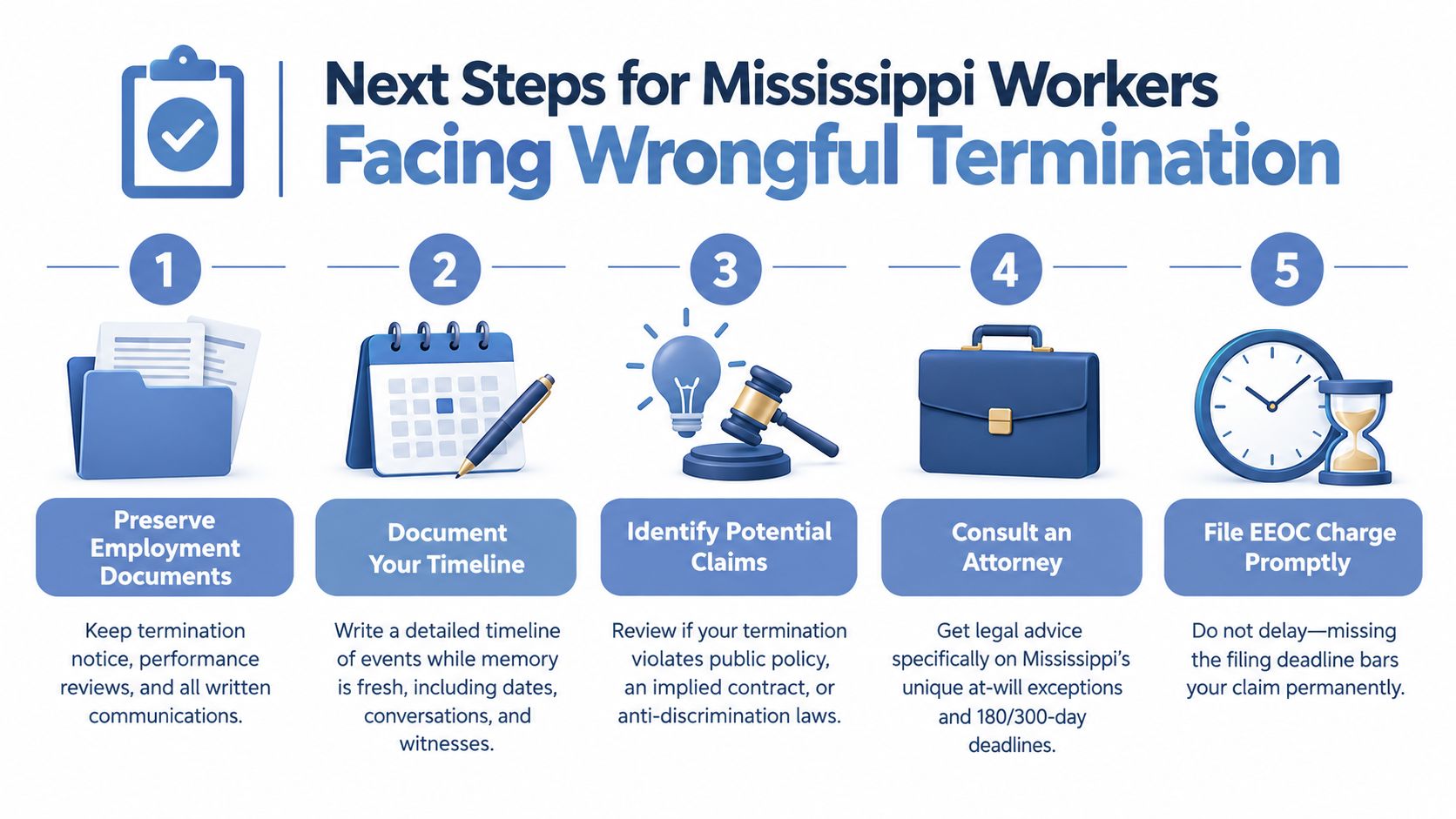
The federal-only enforcement path makes early documentation and prompt filing especially important. A worker who preserves the timeline and gets advice before signing documents gives counsel a better chance to distinguish an unfair firing from a viable wrongful termination case.
Nick Norris, P.A. evaluates Mississippi wrongful termination claims involving discrimination, retaliation, whistleblowing, FMLA issues, and related federal protections. Visit Nick Norris, P.A. to request an evaluation of your termination, evidence, deadlines, and available next steps.
Leave a Reply