

A layoff without notice isn't automatically illegal in Mississippi unless it meets the federal WARN Act thresholds for employer size and employee headcount. A covered employer generally must provide 60 calendar days' written notice, but an ordinary at-will termination can happen without advance warning.
You may have walked into a meeting expecting a routine conversation and walked out with a cardboard box, no paycheck beyond what you've already earned, and no explanation that answers the question bothering you most: Was this legal? The answer depends less on how shocking the termination felt and more on the employer's size, the number of affected workers, the location involved, and whether an unlawful reason drove the decision.
Mississippi workers often make the same mistake at this stage. They assume the lack of notice alone proves wrongdoing. It doesn't. You need to separate an ordinary at-will termination from a mass layoff covered by the federal Worker Adjustment and Retraining Notification Act, or WARN Act, and then examine whether discrimination, retaliation, or another protected-rights violation also played a role.
Understanding What a Layoff Without Notice Actually Means
Being told that your job ends immediately is destabilizing. You may be angry, embarrassed, or too stunned to ask for the documents you'll later need. Those reactions are normal, but the legal analysis starts with a more limited question: What kind of employment action occurred?
Mississippi generally follows the at-will employment doctrine. In practical terms, an employer can usually end employment without advance notice, and an employee can usually leave without giving notice, as long as the termination doesn't violate a specific legal protection. A sudden job loss can therefore be unfair or poorly handled without automatically creating a legal claim. You can review the baseline rule in Mississippi's employment-at-will doctrine.

Start with the facts that control the analysis
Ask yourself these questions before deciding that your employer violated the law:
- Was this an individual termination? A single employee's discharge usually raises different issues from a companywide reduction in force.
- Did several employees lose their jobs at the same location? That fact may point toward WARN review.
- How large was the employer? Federal WARN coverage generally focuses on employers with 100 or more employees, subject to counting rules.
- Was there a protected activity or unlawful motive? Complaints about discrimination, harassment, wage violations, or other protected conduct may matter even when WARN doesn't apply.
The reason for the termination matters, too. An employer may call a decision a “layoff” even when it selected workers because of race, sex, disability, age, protected activity, or another prohibited reason. Conversely, a legitimate reduction in force may still be lawful even when management communicates it poorly.
Practical rule: Don't measure your legal rights by the employer's tone during the meeting. Measure them by the employer's size, the scope of the job losses, the timing, and the evidence surrounding the decision.
The practical damage is real even when no claim exists. While you preserve records and assess your options, use reliable career resources for exploring career options so your legal evaluation and financial recovery efforts can proceed at the same time.
When the WARN Act Actually Requires Advance Notice
The WARN Act creates the main federal baseline for advance notice of large-scale job losses. It became part of the federal labor-law framework in 1988, formalizing advance warning for covered plant closings and mass layoffs. The statute is specific, so use this screening process rather than assuming every sudden termination qualifies.
Apply the employer-size and site rules first
Federal WARN generally covers an employer with 100 or more employees, although certain recent hires and part-time workers may be excluded from the count. The analysis also focuses on a single site of employment, not the employer's total workforce scattered across unrelated locations. The Department of Labor's plant-closing guidance explains the central coverage framework.
Then examine whether the job losses meet either trigger:
- At least 50 employees and at least 33% of the active workforce at one site. If a Mississippi facility loses at least 50 workers and those workers represent at least 33% of the active workforce there, the mass-layoff threshold may be met.
- At least 500 employees regardless of percentage. A larger reduction can trigger WARN even if the affected group represents a smaller share of the site's workforce.
The federal statute requires written notice to affected employees or their representatives, along with state and local officials. The notice generally must arrive 60 calendar days before the first separation in a covered event. If the employer staggers the layoffs, the first termination date starts the notice clock. The statutory language appears in the federal WARN Act provisions.

A Mississippi worker can self-screen quickly by writing down four facts: the employer's approximate employee count, the location where the reduction occurred, the number of people separated, and the first separation date. Don't rely on rumors. Save emails, group messages, public announcements, and anything showing how many people lost their jobs.
For a plain-language review of the trigger analysis, see what triggers a WARN notice.
A WARN review also requires attention to timing. A company can't just announce a covered layoff and assume severance pay solves the notice problem. Notice obligations and the consequences of missing them turn on the statute's requirements, the employer's coverage, and the facts surrounding the reduction.
Why Many Layoffs Without Notice Are Still Legal
The most common misunderstanding is simple: no notice does not equal an automatic WARN violation. An individual termination, a small departmental reduction, or ordinary turnover may fall outside the statute even when the employer gives no warning at all.
That result follows from the difference between at-will employment and a covered mass layoff. At-will employment gives employers broad discretion to end an individual employment relationship. WARN narrows that discretion only when a covered employer conducts a covered plant closing or mass layoff that meets the required site and headcount conditions.
Separate a bad process from an unlawful reason
A supervisor may handle a termination abruptly, refuse to answer questions, or provide an explanation that sounds careless. Those facts may support a closer review, but they don't independently prove discrimination, retaliation, or a WARN violation. You need evidence connecting the job loss to a legal requirement or a prohibited motive.
The same event can involve more than one issue. A mass layoff may require WARN notice, while the selection of a particular employee may also raise discrimination or retaliation concerns. Treat those as separate questions instead of forcing every fact into the WARN framework.
The Department of Labor's materials state that federal WARN does not cover every termination without notice and that the agency doesn't seek damages for workers who received no notice. That distinction prevents false hope, but it shouldn't stop a careful review where the employer and layoff numbers appear to meet the federal thresholds.
A sudden termination deserves an organized legal review, not an automatic conclusion.
Don't let an employer's label settle the issue. “Restructuring,” “position elimination,” and “performance decision” are descriptions, not legal conclusions. Compare what the employer said with payroll records, coworker departures, internal announcements, and the timing of your protected complaints or leave requests.
Mississippi Employment Rights and Legal Pathways
Mississippi does not have a state human rights commission for employment claims. That changes where many workers must look for relief. Discrimination and retaliation matters commonly move through federal processes, including the Equal Employment Opportunity Commission, rather than through a Mississippi state civil-rights agency.
That pathway differs from the WARN analysis. WARN asks whether a covered employer conducted a qualifying mass layoff or plant closing without the required notice. A federal discrimination or retaliation claim asks whether an employer acted because of a protected characteristic or because the worker engaged in protected conduct. One event can raise both issues, but the evidence and administrative process won't be identical.
Identify the reason behind the termination
Look for timing and treatment evidence. Did the layoff follow a complaint about harassment? Did the employer terminate you shortly after you reported discrimination, requested protected leave, participated in an investigation, or raised a wage concern? Did managers apply the reduction criteria inconsistently?
Mississippi workers can review related guidance on protected activity retaliation, hostile work environment retaliation, civil rights in Mississippi, and Mississippi employment law. These topics help distinguish a termination that merely lacked warning from one that followed legally protected conduct.
Mississippi also doesn't provide protection from retaliation for filing workers' compensation claims. Filing such a claim therefore doesn't create a retaliation claim under Mississippi law by itself. That doesn't eliminate every possible issue surrounding a termination, but workers should not treat a workers' compensation filing alone as proof of a protected retaliation case.

Unemployment is a separate practical concern. Review Mississippi unemployment law promptly, because an unemployment application and an employment claim serve different purposes. Don't assume that applying for benefits concedes the employer acted lawfully.
What To Do Immediately After a Sudden Layoff
Your first task isn't to argue with the manager who delivered the news. It's to preserve evidence and create a reliable timeline before access to company systems disappears.
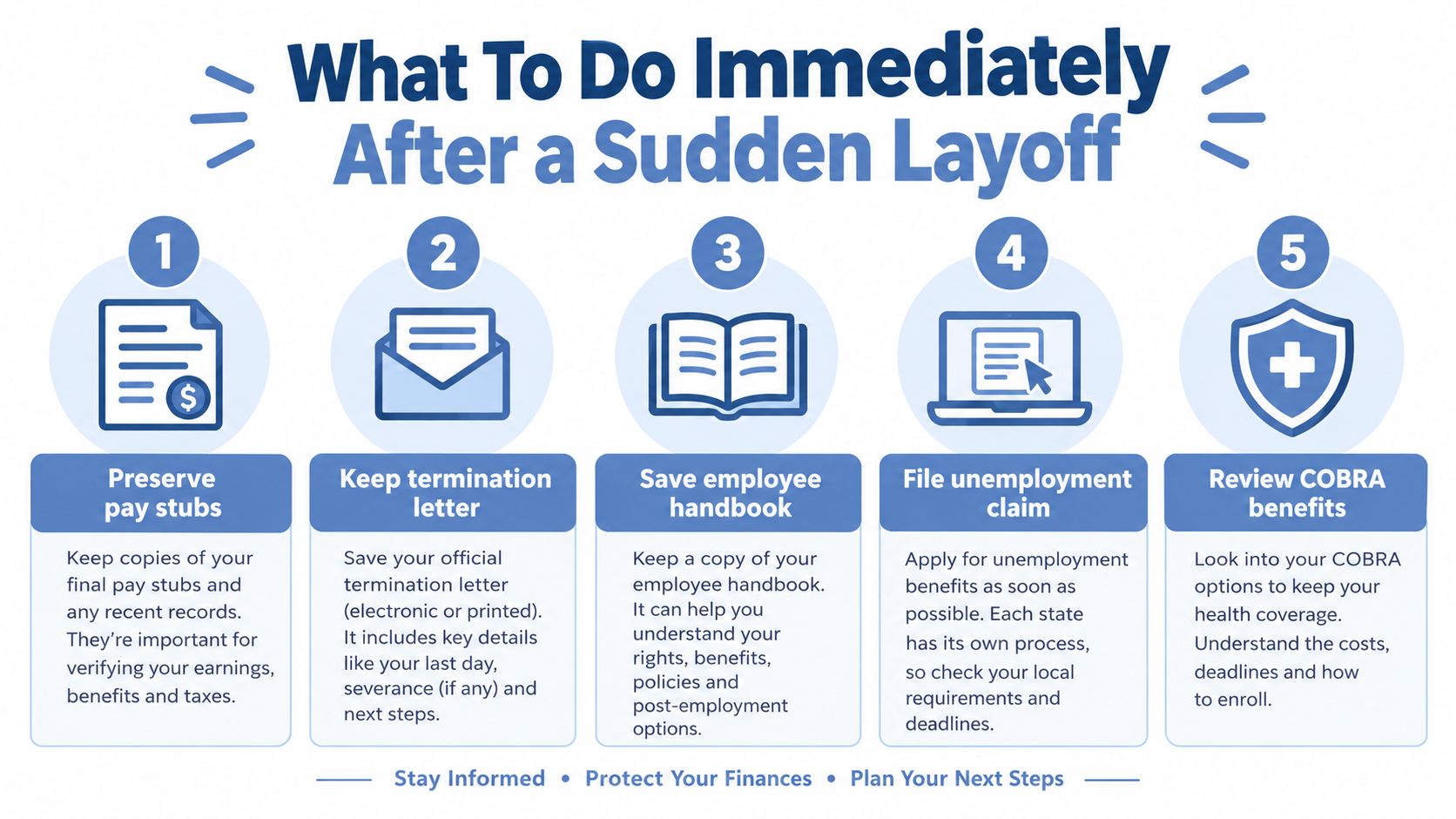
Build your file before memories fade
- Preserve pay stubs: Keep records showing your pay, benefits, job title, worksite, and employment history.
- Keep the termination letter: Save the letter, email, text message, or other communication stating when and why employment ended.
- Save the employee handbook: The handbook may contain layoff procedures, discipline rules, complaint channels, or benefit information.
- File an unemployment claim: Apply promptly and answer questions accurately. The claim addresses income support, not every legal issue.
- Review COBRA benefits: Examine the health-coverage notice and deadlines so a sudden loss of employment doesn't become an avoidable coverage gap.
Write down the names of everyone in the termination meeting and the exact words used as soon as you can. Record when you complained, what you complained about, who received the complaint, and when the employer announced the reduction. Preserve relevant emails and messages lawfully, but don't take confidential customer information, trade secrets, or files you weren't authorized to retain.
Avoid signing a release, severance agreement, or waiver before you understand what rights it affects. You may have limited time to respond, but pressure is not a reason to sign blindly. Ask for a copy, read every provision, and obtain legal advice when the document releases claims or imposes confidentiality and cooperation obligations.
Finally, stay professional. Don't delete records, threaten supervisors, post confidential material, or send angry messages that can later distract from the core facts. A clean chronology is more valuable than a dramatic final exchange.
Recovery Options and Realistic Cost Expectations
If a covered employer violated WARN, each affected employee may recover back pay and benefits for the period of the violation, capped at 60 days, under the Department of Labor's explanation of the law. Local governments may also impose civil penalties of up to $500 per day for notice failures. Those remedies don't guarantee a particular recovery, because the result depends on coverage, proof, the number of affected workers, available records, and the employer's response.
The law also doesn't treat pay-in-lieu as a simple replacement for timely notice. That makes the employer's timeline important. A severance offer may affect the practical value of a claim, but it doesn't erase the need to examine whether the employer complied with its notice obligations.
Understand representation costs before you proceed
Mississippi employment lawyers may handle viable cases through contingency arrangements. Consumer-focused Mississippi employment-law guidance commonly describes an average contingency fee of 40% to 50% of the recovery, while the Mississippi Bar describes contingency fees as a percentage that can vary with the stage of the case. Review the fee agreement carefully for expenses, litigation costs, settlement authority, and what happens if there is no recovery.
You should also ask what the lawyer is evaluating:
- Whether the employer meets the federal coverage rules.
- Whether the affected workers were counted correctly.
- Whether the 60-day notice period ran from the first separation.
- Whether the termination evidence supports discrimination or retaliation concerns.
- Whether a severance agreement changes the available options.
Self-representation can look inexpensive, but a WARN review often requires employer-size information, workforce records, site analysis, notice documents, and careful timing. A consultation can help you decide whether the facts justify further work without promising an outcome that the evidence doesn't support.
Nick Norris, P.A. evaluates Mississippi employment matters involving WARN Act layoffs, sudden terminations, retaliation, discrimination, and related workplace claims. Visit Nick Norris, P.A. to request a case evaluation and discuss what your termination documents and timeline may mean.
Leave a Reply