
A Mississippi worker may be weighing a call right now after discrimination, FMLA trouble, a USERRA concern, unpaid overtime, or a dispute with a federal agency. The first challenge isn't finding any lawyer who offers a federal employment attorney free consultation. It's choosing the right kind of help before a deadline, agency procedure, or fee arrangement creates another problem.
A free consultation is usually an initial screening, not full representation or a complete legal analysis. This list separates Mississippi plaintiff-side firms, nationwide federal-employee specialists, disability-retirement counsel, and a no-cost volunteer network. Use the options according to your actual situation, then confirm the consultation's scope and fees before sharing sensitive details.
This article covers Mississippi employment law and Mississippi workers. It doesn't discuss filing lawsuits in state court, and Mississippi workers shouldn't assume they have a retaliation claim for filing a workers compensation claim. For related reading, see this guide to federal discrimination lawyers and this explanation of whether a federal employee can be fired.
1. Nick Norris, P.A.
Nick Norris, P.A. is the clearest starting point for a Mississippi employee who wants local, employee-side representation with experience involving federal workplace laws. The Greater Jackson-based office represents workers across Mississippi and handles matters involving discrimination, harassment, retaliation, FMLA, unpaid overtime, USERRA, WARN, whistleblower issues, and wrongful termination.
The firm offers a free initial consultation through a phone call or online form. That first contact is useful for organizing the facts, identifying whether the dispute involves federal or Mississippi law, and determining what should happen next. Nick Norris, P.A. represents employees rather than employers, which keeps the consultation focused on the worker's interests.

Best fit for Mississippi workers
Choose this option when your workplace is in Mississippi, your employer is private or public, and you need a lawyer who can evaluate both the facts and the Mississippi-specific path. The office has federal-court admissions and publishes information about employment results, but a published result doesn't predict what will happen in a new matter.
Advantages include:
- Mississippi-specific strategy: The consultation can focus on the facts, records, agency issues, and timing that matter to a Mississippi employee.
- Broad federal-law coverage: The practice addresses federal discrimination, retaliation, FMLA, FLSA, USERRA, WARN, and whistleblower matters.
- Employee-only focus: You won't be contacting a general business firm that regularly represents employers in workplace disputes.
- Contingency availability: Many employment matters may be handled on a contingency basis, subject to the agreement and the type of claim.
The trade-off is capacity. A boutique office may not handle the same volume of simultaneous matters as a large national federal-employee practice. It also isn't limited to federal-agency employees, so a federal worker seeking specialized MSPB or OPM disability-retirement guidance may need a narrower specialist.
For Mississippi workers with a discrimination, harassment, wage, leave, reemployment, or termination concern, this is the most locally aligned first call. Confirm whether the consultation is only a screening and ask about fees before providing confidential records.
2. Watson & Norris, PLLC
Watson & Norris, PLLC is another Mississippi plaintiff-side employment option for workers who want statewide representation and familiarity with federal procedure. The firm advertises a free initial consultation across its employment-law service pages and addresses discrimination, FMLA, wrongful termination, and wage-hour matters.
Its Mississippi presence may matter when the facts involve a workplace, witnesses, employment records, or administrative activity connected to the state. The firm also maintains pages directed at Mississippi cities and has recognition from Chambers for plaintiff employment work, facts readers should verify directly through the firm's current materials at Watson & Norris, PLLC.
A practical choice for broader litigation support
This option fits a Mississippi worker who wants an established firm with experience across several employee claims rather than a practice limited to federal-agency disputes. It can be particularly relevant where the same facts raise discrimination, leave, termination, and wage-hour questions.
The free call still has limits. A consultation page may help determine whether the facts appear worth further review, but it doesn't automatically create an attorney-client relationship or guarantee that the firm will accept the matter. Availability can also change with the firm's litigation load, and the practice isn't focused exclusively on federal employees.
Ask these questions during intake:
- Who will review the facts: Find out whether an employment attorney, intake staff member, or another professional will conduct the first call.
- What claims are being screened: Explain whether the issue concerns discrimination, FMLA, wages, termination, or another federal employment right.
- What happens after the call: Ask whether the firm may investigate, negotiate, represent you in an agency process, or decline the matter.
- How fees work: Confirm whether the matter could involve contingency fees, hourly billing, a retainer, expenses, or another arrangement.
Watson & Norris is a strong comparison point for Mississippi employees deciding between two local employee-side firms. It makes less sense as the first choice for a federal worker whose immediate problem is an MSPB, OPM, or highly specialized federal-agency process.
3. The Devadoss Law Firm, P.L.L.C.
A Mississippi federal employee facing an EEO complaint, MSPB appeal, whistleblower issue, or disciplinary action needs a different type of consultation from a private-sector employee with unpaid overtime. The Devadoss Law Firm, P.L.L.C. is built around that federal-sector distinction.
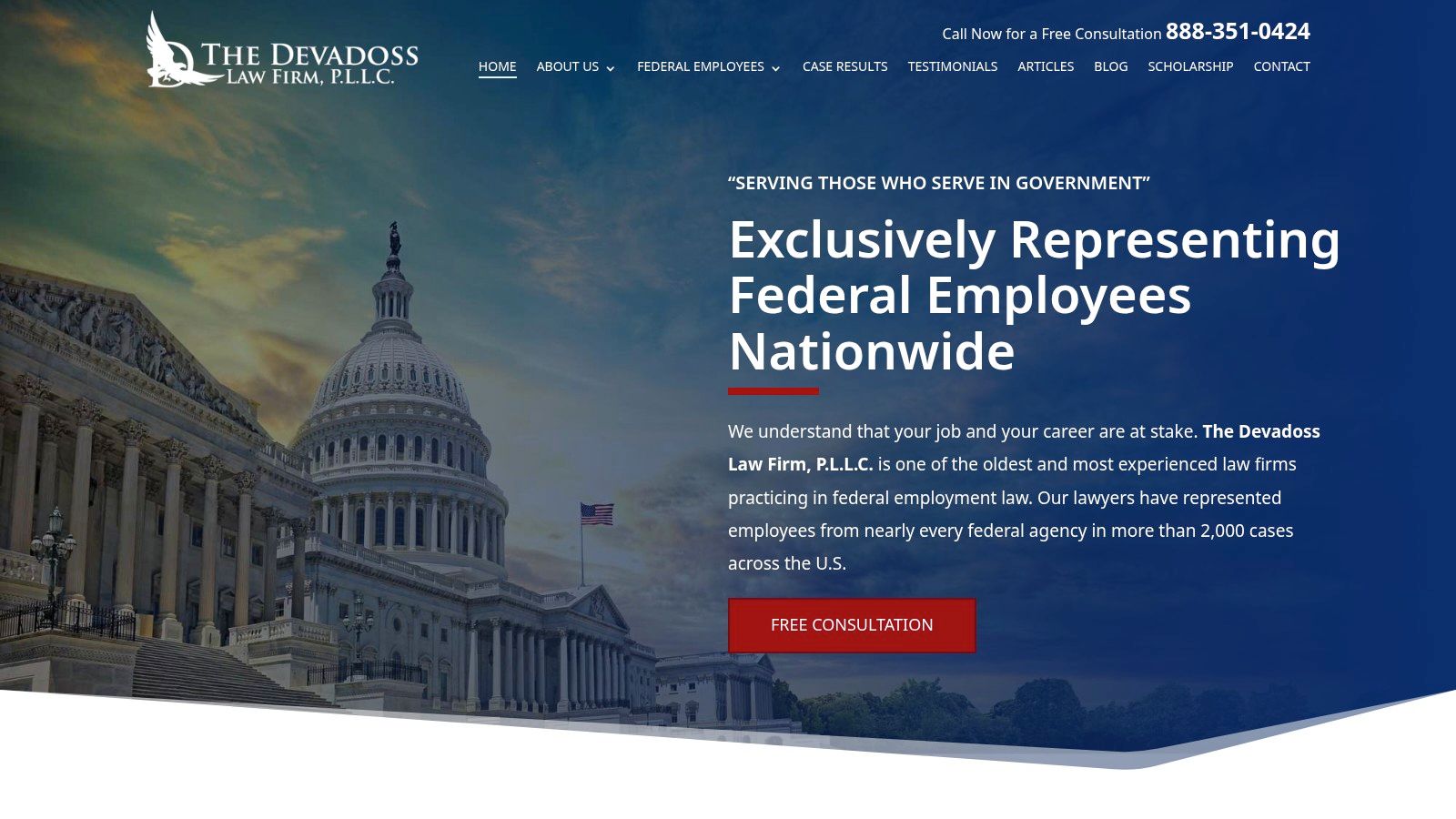
The firm represents federal employees nationwide and focuses on federal EEO matters, MSPB appeals, OSC whistleblower matters, discipline, and removals. It has offices in Dallas, Atlanta, and Washington, DC, and offers remote consultations for clients outside those locations. Mississippi-based federal workers can therefore consider it without treating physical proximity as the main selection factor.
Best fit for federal-agency procedures
The firm advertises a free consultation by phone or contact form. Use that call to identify the agency, employment status, notice received, forum, and deadline. A federal-sector specialist should be able to distinguish an EEO path from an MSPB matter or a whistleblower route, but you still need to ask exactly what the initial call includes.
Practical rule: Bring the notice and its response instructions to the consultation. Don't rely on memory when the document identifies the agency's allegations, process, or deadline.
The biggest advantage is specialization. A Mississippi employee who works for a federal agency may receive more relevant initial issue-spotting from a federal-sector practice than from a firm that mainly handles private employers. The national reach also suits workers employed by agencies such as the Department of Veterans Affairs, TSA, DoD, SSA, or another federal employer.
The cost structure is the main trade-off. Many federal-sector matters proceed through hourly billing and retainers rather than a contingency arrangement. The firm may also have a range of attorneys handling different matters, so ask who will evaluate your facts and who would handle the work if the firm accepts the case.
Choose Devadoss when the employer is a federal agency and the dispute is tied to EEO, MSPB, OSC, discipline, or removal. Choose a Mississippi employee-side firm when the employer is a private Mississippi business or when local employment-law strategy is the central need.
4. Federal Esquire
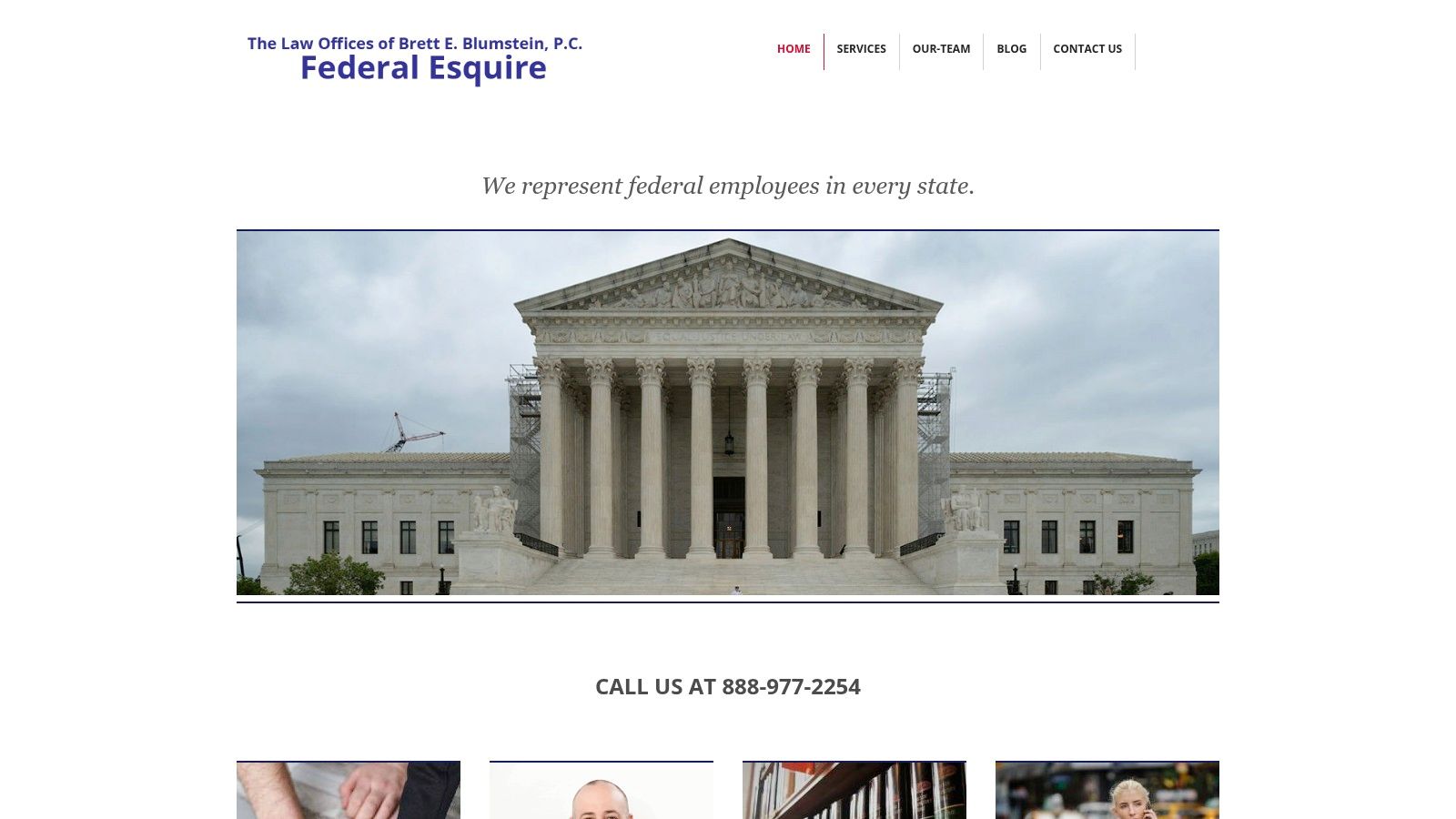
Federal Esquire, the Law Offices of Brett E. Blumstein, P.C., represents federal employees nationwide across several related systems. Its stated practice areas include EEO, MSPB, FECA, and OPM disability retirement. That range suits a federal worker whose employment dispute also involves an injury claim, benefits question, or disability-retirement application.
The firm advertises a free initial phone consultation. Its federal-sector work includes employees connected with USPS, TSA, VA, DoD, and SSA. Use the call to identify the agency, employment action, applicable forum, and desired result. Confirm what the consultation covers, whether the firm checks for conflicts, and what fee arrangement applies before sharing medical or personnel records.
Useful when employment and benefits overlap
Federal Esquire's main advantage is its range. One screening call can address how an agency action may relate to FECA or an OPM disability-retirement issue. Ask whether the same attorney handles each matter, which services fall within the proposed engagement, and whether separate fees or referrals apply.
Mississippi workers should also separate federal-sector advice from local employee representation. Mississippi has no state human rights commission, and employee-side contingency fees commonly fall in the 40–50% range, subject to the agreement. Mississippi also does not provide a retaliation claim merely for filing a workers compensation claim. For a broader Mississippi discrimination overview, read this Mississippi-focused explanation of federal discrimination law.
The trade-offs are straightforward:
- Remote representation: The firm is headquartered in California, so Mississippi clients will generally communicate remotely.
- Wide federal coverage: EEO, MSPB, FECA, and OPM disability retirement are all identified practice areas.
- Limited public pricing: A free initial call does not explain the cost of continued representation.
- Forum-specific work: The attorney must determine which federal process applies before recommending a strategy.
Choose Federal Esquire for nationwide federal-employee screening, especially when disability retirement or FECA issues accompany an employment dispute. Choose a Mississippi employee-side firm for a private employer, local litigation strategy, wage issue, harassment claim, or FMLA matter.
5. The Federal Practice Group
A Mississippi federal employee facing discipline may also have a security-clearance concern or military-law issue. The Federal Practice Group, based in Washington, DC, serves federal employees nationally and handles EEO and MSPB matters alongside security-clearance and military-law concerns. That combination makes it a practical option when one agency action could affect several parts of the worker's career.
The firm advertises a “risk-free consultation.” Treat that as an initial screening offer, not a promise that continued representation will be free. Before sharing sensitive records, confirm what the call covers, whether the firm will check for conflicts, who will review the matter, and whether later work requires hourly billing, a retainer, or separate expenses.
Best fit for complex federal-sector exposure
Choose this firm when the problem extends beyond a routine workplace complaint. A proposed removal, EEO matter, MSPB appeal, clearance issue, or military connection may require careful identification of the governing process. Ask the attorney to distinguish those issues rather than treating them as one general employment dispute.
Prepare a short timeline before calling. List the agency, position, action taken, notice date, response deadline, and records available. Ask whether the firm can evaluate the matter before that deadline and whether the same attorney would handle any later representation.
Review this guide to federal employee termination issues before the consultation. It can help you identify whether the agency has proposed an action, imposed an adverse action, or raised a separate discrimination or retaliation issue.
A “risk-free” intake call does not establish the cost of representation. Get the scope, billing method, retainer requirement, and additional expenses in writing.
Mississippi context: Mississippi has no state human rights commission. Employee-side contingency fees commonly fall within the 40–50% range, subject to the written agreement. Mississippi also does not provide a retaliation claim merely because a worker filed a workers compensation claim. Those rules make a Mississippi employee-side firm a better fit for private-employer disputes, while The Federal Practice Group fits federal-agency matters with clearance, military, or forum concerns.
6. Pines Federal
Pines Federal is the focused choice for a Mississippi federal employee whose primary question concerns OPM disability retirement or SSDI. The Houston-based boutique serves federal employees nationally and explains its intake process in a way that can help a worker determine whether legal assistance is necessary.
The firm offers free consultations for OPM disability-retirement and SSDI matters. Other federal employment issues typically require a paid consultation, so don't assume that a general question about EEO, MSPB, discipline, or removal qualifies for the no-cost call.
Choose it for disability-retirement screening
The narrow scope is an advantage when disability retirement is the actual issue. A worker can focus the conversation on eligibility, documentation, the application process, and whether counsel is needed. The firm also provides practical guidance about when a worker may be able to proceed without a lawyer, which makes the consultation useful even when representation isn't immediately necessary.
Before contacting Pines Federal, separate the issues:
- Disability retirement: Explain the medical and employment circumstances relevant to the OPM question.
- SSDI: Identify whether the concern involves a separate disability-benefits application.
- Agency discipline: Don't assume the disability issue resolves a proposed suspension, removal, or other personnel action.
- Discrimination or retaliation: Ask whether the firm handles that issue or whether you need a separate federal-sector or Mississippi employment lawyer.
A free federal employment attorney consultation is valuable only when the firm actually covers the problem presented. Pines Federal is not the right general-purpose option for every Mississippi worker or every federal workplace complaint. It is the direct option when OPM disability retirement or SSDI is the center of the call.
Other matters generally proceed through a paid consultation and may involve hourly billing or a retainer. Confirm the price before sharing medical records, agency documents, or detailed personal information. If your concern combines disability retirement with discrimination, leave, or discipline, ask whether one lawyer can address the connected issues or whether you need separate counsel.
7. Rise Up Federal Workers Legal Defense Network
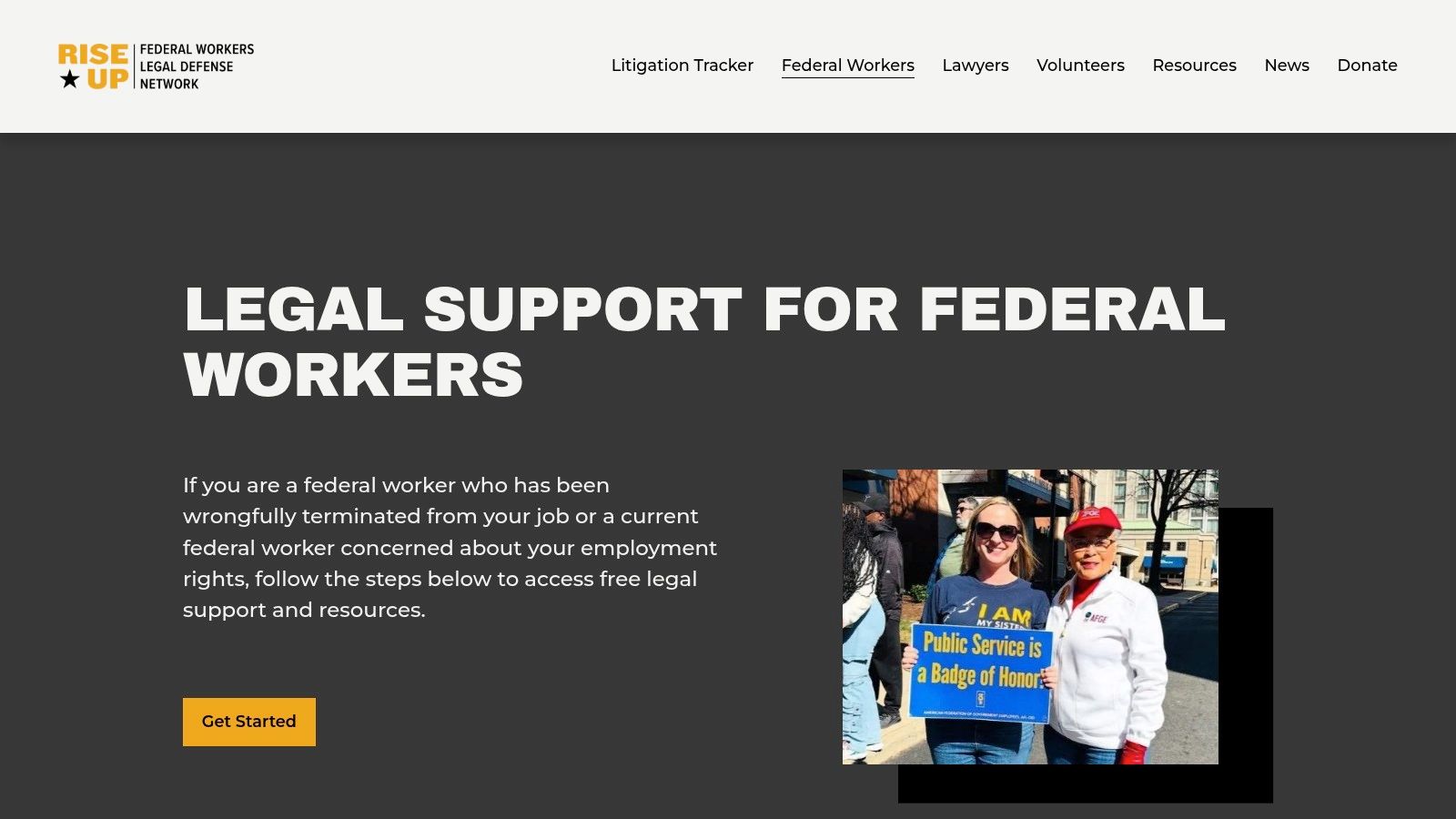
Rise Up, the Federal Workers Legal Defense Network, is not a law firm. It connects federal workers with volunteer attorneys and provides a no-cost entry point for workers who have been fired or are at risk of termination.
The network offers a free 15 to 20 minute screening call and, when available, an additional free consultation of up to one hour. Its online intake also provides resource guides and deadline reminders. Those features make Rise Up particularly useful when a federal employee needs quick triage but can't immediately commit to a private firm's consultation or retainer.
Best fit for no-cost first access
Use Rise Up's federal worker intake resources when the urgent question is whether you need help with an EEO issue, reduction in force, MSPB matter, or possible termination. The screening can help you organize the issue and learn whether a volunteer match may be available.
The trade-off is availability. A match before a deadline isn't guaranteed, and the network isn't a law firm that can promise ongoing representation. Further legal services depend on volunteer attorney availability and a separate arrangement.
For a federal employee with no-cost access as the immediate priority, Rise Up is the best fit on this list. For a worker who already knows the matter requires sustained representation, contact a dedicated federal-employee firm at the same time rather than waiting for a volunteer match.
A whistleblower should also understand that the legal path may depend on the allegations, agency, disclosures, and employment action involved. This Mississippi-focused overview of False Claims Act whistleblower retaliation can provide related context, but it doesn't replace a case-specific federal consultation.
Free Consults: Top 7 Federal Employment Attorneys
| Provider | Complexity 🔄 | Resources ⚡ | Expected outcomes 📊 | Ideal use cases 💡 | Key advantages ⭐ |
|---|---|---|---|---|---|
| Nick Norris, P.A. | Moderate, boutique plaintiff-side workflow with contingency intake | Local Mississippi team; limited simultaneous case capacity | Strong for state & federal employee claims in MS; reported verdicts/settlements | Mississippi employees seeking plaintiff representation for discrimination, FLSA, FMLA, retaliation | ⭐⭐ Mississippi-specific strategy, contingency fee availability, free consult |
| Watson & Norris, PLLC | Moderate, established processes for federal-court work | Multiple offices/pages across Mississippi; larger firm capacity but availability varies | Reliable courtroom experience in discrimination, FMLA, wage-hour matters | MS clients needing courtroom-ready plaintiff counsel statewide | ⭐⭐ Established firm, Chambers-recognized, statewide presence |
| The Devadoss Law Firm, P.L.L.C. | High, specialized federal EEO/MSPB procedures and strict deadlines | National reach with offices in Dallas, Atlanta, DC; remote consults; often hourly/retainer billing | Strong outcomes for federal-sector appeals, EEO/MSPB, whistleblower matters | Federal employees nationwide needing EEO, MSPB, OSC whistleblower or adverse action representation | ⭐⭐⭐ Niche federal expertise, nationwide coverage, deep knowledge of federal deadlines |
| Federal Esquire (Brett E. Blumstein, P.C.) | High, comprehensive federal forums including disability retirement | Nationwide representation from CA HQ; remote-first model; limited public pricing | Broad federal-employee coverage (EEO, MSPB, OPM, FECA); good for disability retirement claims | Federal employees needing one-stop EEOC/MSPB/OPM/FECA help, including disability retirement | ⭐⭐⭐ Comprehensive federal coverage, clear intake call-to-action, free initial phone consult |
| The Federal Practice Group | High, deep DC bench strength and multi-forum federal practice | DC-based team with national reach; 'risk-free' screening but ongoing billed work common | Strong federal-sector outcomes, including security clearance and military law matters | Federal employees needing DC counsel, security clearance representation, or national counsel | ⭐⭐⭐ Deep DC bench, federal-sector specialization, security-clearance experience |
| Pines Federal | Moderate, focused complexity around OPM disability/SSDI processes | Houston-based boutique with national reach; free consult limited to OPM/SSDI | Very good for OPM disability and SSDI intake; other matters usually paid consults | Clients whose primary issue is OPM disability retirement or SSDI | ⭐⭐ Specialist for OPM disability/SSDI, clear intake guidance on DIY vs. lawyer |
| Rise Up: Federal Workers Legal Defense Network | Low initial complexity, quick screening then variable follow-up | Volunteer attorney network; guaranteed free screening call; availability variable | Free triage and referrals; possible additional free consults when volunteers available | Federal workers needing no-cost, rapid screening before EEO/MSPB/RIF deadlines | ⭐⭐ No-cost initial access to attorneys, deadline-focused triage and referral network |
Turn a Free Call Into a Useful Next Step
A free consultation works best when you arrive with a short, organized record. Start with the employer and your role. State whether you work for a private Mississippi employer, a state-related workplace, or a federal agency, then identify the action that concerns you.
Write the timeline before calling. Include hiring, relevant complaints, leave requests, schedule or pay problems, agency notices, discipline, termination, and any response you've already made. Preserve relevant messages and personnel records, including emails, texts, pay records, performance documents, leave paperwork, agency notices, and communications with supervisors. Don't alter originals, delete messages, or forward sensitive material to people who don't need it.
Prepare the questions that control the call
Write down every internal or agency deadline you know about. If you received a notice, keep the complete document and its instructions available. Federal employment matters can involve different systems, including EEO, MSPB, agency procedures, FECA, OPM, or whistleblower channels, so ask the lawyer to identify the likely forum and the immediate action.
State the outcome you want. You may be seeking continued employment, a response to discipline, unpaid wages, leave protection, a disability-retirement application, a correction of records, or a negotiated resolution. A lawyer can't assess fit efficiently if the desired result remains unclear.
Ask each provider:
- Consultation scope: Is this call limited to screening, or will the attorney provide a substantive legal assessment?
- Representation availability: If the matter appears viable, can the firm represent you, and who would handle it?
- Fee calculation: Is the work hourly, contingency-based, flat-fee, retainer-based, or another arrangement?
- Separate costs: Which filing fees, records expenses, experts, travel, or other costs aren't included?
- Confidentiality and conflicts: Can you safely discuss the facts, and will the provider check for conflicts before reviewing sensitive details?
Legal-aid demand helps explain why intake screening matters. U.S. Department of Justice materials state that about 63 million Americans, roughly 1 in 5 people, qualified for free civil legal assistance, while more than 50% of people who seek help are turned away because resources are limited. See the Department of Justice explanation of civil legal aid for that context. A free call is therefore an access point, not a promise that every caller will receive representation.
Mississippi rules require careful framing
Mississippi does not have a state human rights commission. Workers generally must rely on federal channels such as the EEOC for discrimination-related complaints rather than using a Mississippi human-rights agency. Read a Mississippi-specific disability discrimination and EEOC process guide for related information, and confirm the current process with counsel.
Fee expectations also need to be stated precisely. Mississippi employment-law discussions commonly place contingency fees in the 40% to 50% range, with one Mississippi-focused source describing a 45% contingency fee in most of its cases and noting that Mississippi contingency fees often average 40% to 50%. Review the Mississippi employment lawyer cost and fee guide and ask the individual firm how its agreement works. That range isn't a quote for any particular lawyer.
Mississippi also doesn't provide a retaliation claim for filing a workers compensation claim. The Workers' Compensation Act has no anti-retaliation provision for the filing itself, and the Mississippi Supreme Court has declined to create that state-law cause of action, as explained in this Mississippi workers compensation retaliation overview. The injury claim may continue, but filing it alone doesn't create a standalone retaliation claim under Mississippi workers compensation law.
The Mississippi Workers' Compensation Act applies to employers with five or more employees and is administered by the Mississippi Workers' Compensation Commission, according to this Mississippi employment-law guide. That coverage rule and the absence of a workers compensation retaliation claim are separate from other possible federal employment issues. Don't describe a termination as workers compensation retaliation without asking a Mississippi employment attorney to examine the actual facts and any other protected activity.
The right choice depends on the worker's decision. Contact Nick Norris, P.A. or Watson & Norris for Mississippi employee-side representation. Contact Devadoss, Federal Esquire, or Federal Practice Group for a federal-agency process. Contact Pines Federal for OPM disability retirement or SSDI. Contact Rise Up for no-cost federal-worker triage. Before sharing sensitive records, confirm the scope, conflicts, deadlines, and fee terms.
For readers comparing legal-service costs, this information on attorney new client discounts may provide general background, but discounts don't replace a written fee agreement or a case-specific consultation.
Nick Norris, P.A. offers free initial consultations for Mississippi employment matters involving discrimination, harassment, retaliation, FMLA, unpaid overtime, USERRA, WARN, whistleblower issues, and wrongful termination. If you need a Mississippi employee-side assessment of a federal workplace concern, visit Nick Norris, P.A. to start the intake process and discuss the appropriate next step.
Leave a Reply