

You got called into an office, told your position was ending, and handed paperwork before you'd even processed what happened. Maybe you were escorted to your locker. Maybe your login stopped working before you reached your car. That shock is normal, and so is the urge to either argue your case right then or put the whole thing out of your mind for a few weeks.
Don't do either. A wrongful termination timeline in Mississippi starts running on the day you're fired, not on the day you feel ready to deal with it. What you preserve in the first days, and which federal track your claim belongs on, will shape every option you have later.
The First 48 Hours After Termination
A worker in Jackson gets fired on a Friday afternoon after recently complaining about harassment. By Monday, her work email is disabled, the supervisor who heard the complaint has changed shifts, and she can't remember whether the warning she received came before or after she went to HR. The facts didn't get weaker over the weekend. Her access to proof did.
That's why the first two days are about preservation, not arguments with your former employer. You aren't trying to win the case in 48 hours. You're trying to keep a later lawyer or agency from having to reconstruct it from memory.
What to Secure Before Access Disappears
Start with anything you lawfully have in your possession. Keep the termination letter, separation notice, final pay stub, and any document stating a reason for the firing. If nobody gave you a reason in writing, write down the exact words used, who said them, and who else was in the room.
- Termination paperwork: Save originals and photograph each page so you've got a backup copy.
- Witness contacts: List full names and personal phone numbers for coworkers who saw key events, while you still remember who was present.
- Personal files: Collect your own copies of reviews, schedules, and pay records. Don't take confidential company documents you aren't entitled to keep.
- Dates that anchor the story: Note your hire date, last day worked, and the date you were told the decision was final. Those dates may differ, and the difference matters.
What Not to Do Right Away
Don't sign a separation agreement or severance release at the exit meeting just to get out of the room. Those documents often waive claims in exchange for payment, and you need time to read what you'd be giving up. Ask for a copy to take home, note any signing deadline written in it, and get it reviewed before the deadline passes.
Don't post about the firing on social media. Angry posts create admissions, alert witnesses to take sides, and give the employer a cleaner story about attitude. Don't send a long farewell email making accusations either. A short, neutral request for your personnel documents serves you better.
You also need a practical plan for income, insurance, and bills while a claim is evaluated, and My Policy Quote job loss advice covers that household side of a sudden job loss. Legal deadlines move slowly compared with rent due dates, so handle both tracks at once.
Write your account tonight, while names, sequence, and exact wording are still fresh. A dated note you made for yourself carries more weight than a polished summary written months later.
End the second day with one page that lists, in date order, the complaint or protected activity, any change in treatment after it, and the firing itself. That single page becomes the spine of everything that follows.
Documenting Your Case the Right Way
Collecting paper isn't the same as building a file someone can evaluate. A lawyer reviewing your wrongful termination timeline needs to see sequence at a glance, who knew what, and which document proves each step. A box of unsorted screenshots forces guesswork. A dated file invites action.
Build One Chronological File
Create one folder, physical or digital, and put everything in date order. Name files by date first, then content, so the folder sorts itself. Keep originals untouched and work from copies when you add notes.
- Record the firing event: Date, time, location, decision maker, stated reason, and witnesses.
- Add the protected activity: Your discrimination complaint, leave request, wage complaint, or other legally protected step, with the date you made it.
- Insert what changed after: New discipline, schedule cuts, write ups, or a sudden drop in evaluation scores.
- Attach the paper behind each entry: Emails, memos, text messages, attendance records, and policy pages.

Performance reviews deserve special attention because employers often defend a firing as performance based. A strong review shortly before a complaint, followed by harsh discipline after it, tells a different story than years of documented problems. Save both kinds. Hiding an unfavorable review doesn't remove it from your personnel file, and surprises hurt credibility.
Preserve Originals and Metadata
Don't edit screenshots, rename files in ways that strip context, or retype text messages into a clean document and delete the originals. Metadata, the date and sender information attached to electronic files, can confirm when a message was sent. Keep the phone, the email account, and the original file intact.
If you're managing several versions of a timeline as new documents surface, Eztrackr's version management guide explains practical habits for keeping drafts organized without overwriting earlier ones. Label each revision with its date so nobody mistakes a later edit for a note you wrote at the time.
Separate Proof From Background
Write a short contemporaneous journal for events that have no paper trail. For each entry, give the date, time, people present, and direct quotes where you remember them. Mark clearly what's a quote, what's a close paraphrase, and what's your interpretation.
Then sort ruthlessly. Evidence that connects a protected activity to the firing belongs at the front. General complaints about a rude supervisor or an unfair schedule belong behind it. Lawyers and investigators work faster, and take a file more seriously, when the connection is easy to follow.
Understanding EEOC Filing Deadlines
Mississippi workers often look for a state office where they can file a workplace discrimination complaint. There isn't one that does this job, so the federal U.S. Equal Employment Opportunity Commission, or EEOC, is the starting point for many discrimination and retaliation terminations. The timeline therefore begins with an administrative charge, not a lawsuit.
The 180 Day and 300 Day Windows
The EEOC time limits for filing a charge state that a charge generally must be filed within 180 calendar days after the alleged discriminatory act. That period can extend to 300 calendar days when a state or local agency enforces an anti-discrimination law covering the same conduct.
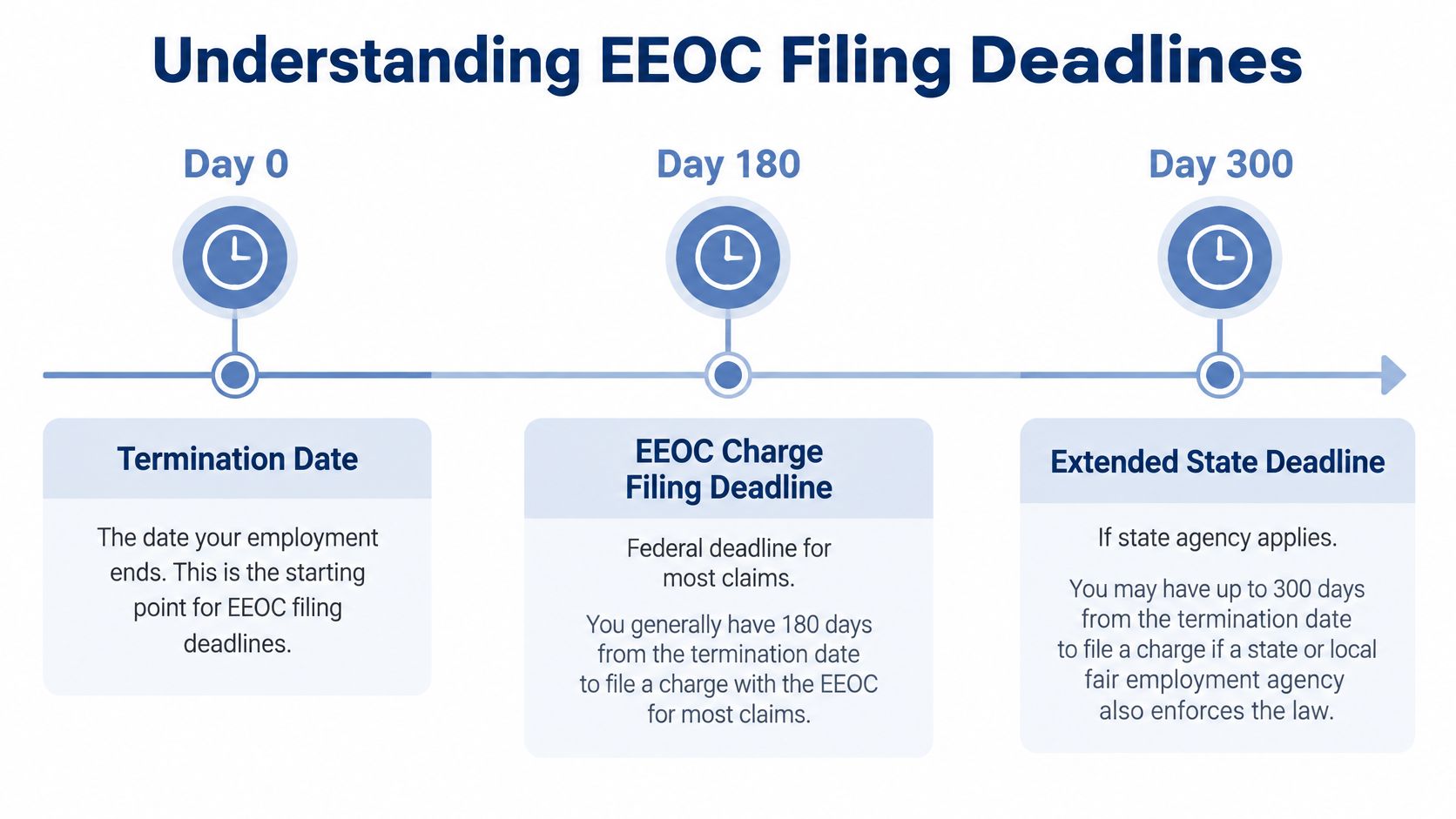
Count carefully. The clock runs from the date of the alleged violation, which may be the termination date or another discrete employment action, such as a demotion that came first. Weekends and holidays count toward the total. If the final day falls on a weekend or holiday, filing generally moves to the next business day.
| Starting point | What starts the clock | Practical risk |
|---|---|---|
| Termination date | The day the firing decision took effect | Waiting to see if the employer reconsiders |
| Earlier adverse action | A demotion, pay cut, or discipline before firing | Assuming only the last day of work counts |
| Federal employment | The alleged discriminatory act | A much shorter contact window applies |
Federal employees and applicants ordinarily face a shorter 45-day period to contact an agency equal employment counselor, as described in the EEOC time limits guidance linked above. If your employer was a federal agency, don't plan around the longer private sector window.
Why Waiting Costs More Than Time
Workers lose strong claims by spending the first months job hunting, then trying to document events after witnesses have scattered. By the time they identify the protected activity and talk with counsel, the administrative remedy may already be gone. The deadline doesn't pause because you were upset, unemployed, or hoping HR would fix things.
You can review how these limits interact with other claims in this guide to the employment discrimination statute of limitations. Separate statutes covering wages, leave, whistleblowing, or contracts may impose different deadlines, so don't assume one filing protects every possible claim.
Practical rule: Calendar the earliest plausible deadline first, then work backward. Filing early preserves options. Filing on the last day leaves no room for a wrong date.
Treat the charge itself seriously. Name the protected category or protected activity, identify the decision makers, and give dates that match your documents. A vague charge can narrow what gets investigated later, so accuracy at this stage protects the rest of your wrongful termination timeline.
WARN and FMLA Timeline Tracks
Not every firing belongs on the EEOC track. Two federal laws create their own timelines, and they work in opposite directions. One imposes a duty on the employer before jobs end. The other concerns how quickly you act after protected leave leads to punishment.
WARN Notice Before Mass Job Loss
The federal WARN Act generally requires covered employers planning a qualifying plant closing or mass layoff to provide 60 calendar days of advance written notice to affected workers, the state, and relevant local government, according to the Department of Labor WARN guidance. Congress enacted WARN in 1988, and the notice duty arises before the employment loss, not after it.
Coverage is narrower than many workers expect. The Department of Labor WARN regulatory preamble explains that WARN generally applies to employers with 100 or more workers. A covered mass layoff can involve 50 to 499 employees during a 30 day period at one site when they represent at least 33% of the workforce, and related layoffs may be aggregated over 90 days.
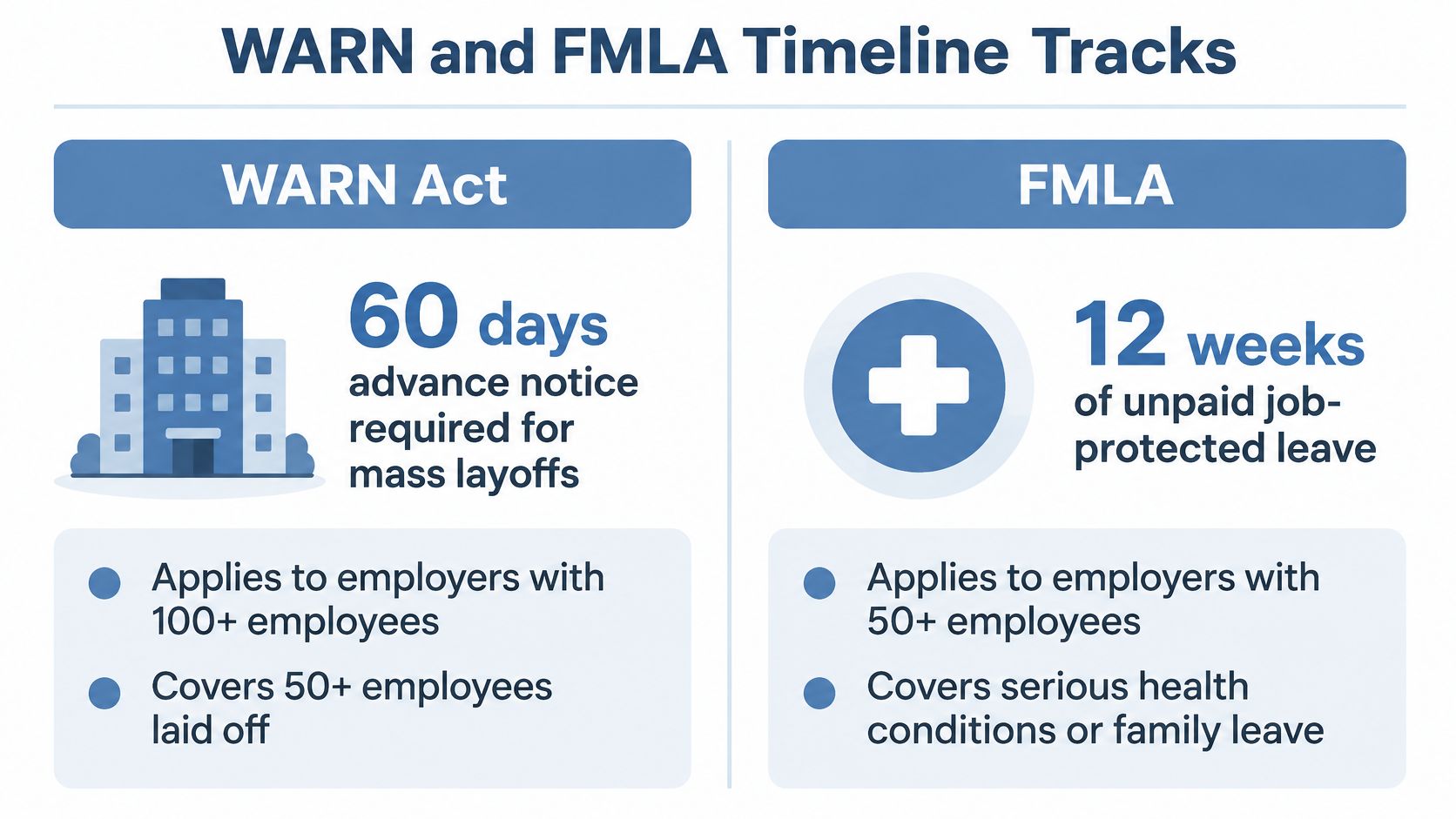
A sudden individual firing isn't automatically a WARN violation, and staggering dismissals doesn't automatically avoid one. For a Mississippi plant closing, gather the announcement date, planned closing date, your termination date, and the headcount at your site. This overview of the Worker Adjustment and Retraining Notification Act walks through those coverage questions in more detail.
FMLA Complaints After Protected Leave
The Family and Medical Leave Act track starts with your leave activity. Document the leave request, eligibility and certification communications, attendance records, supervisor statements, discipline, and the termination decision in date order. Then evaluate a complaint to the U.S. Department of Labor's Wage and Hour Division or a private action promptly.
The Department of Labor FMLA guidance on prohibited acts advises filing a complaint within a reasonable time after discovering the violation, and it identifies reduced hours after exercising FMLA rights as an example of prohibited retaliation. No single universal administrative deadline in that guidance means you should move faster, not slower.
Test causation document by document. Compare pre leave evaluations with post leave discipline, check how attendance points were applied, and identify who knew about the leave when the firing decision was made. Close timing between leave and discharge helps, but timing alone rarely carries a case. Don't confuse interference, blocking leave you were entitled to take, with retaliation, punishing you for taking it. They require different proof.
What Happens After You File a Charge
Filing an EEOC charge starts an administrative process. It doesn't put you in front of a judge, and it usually doesn't produce a fast answer. Knowing the stages helps you respond well instead of treating every agency letter as either a victory or a defeat.
The photograph below shows the kind of preparation that happens on the legal side while an agency reviews documents and employer responses.

Review, Mediation, and Investigation
The EEOC first reviews the charge and notifies the employer. In many cases the agency offers mediation, a voluntary and confidential attempt to settle before a full investigation. Mediation can resolve a case sooner, but you shouldn't accept a low offer just because it's the first one. Know your lost wages and what a release would require you to give up.
If the charge proceeds, an investigator may request documents from both sides, interview witnesses, and ask the employer for a written position statement. Your job is to answer requests on time, correct factual errors with documents, and avoid adding new theories that contradict your charge. This walkthrough of the EEOC investigation process explains what those requests typically look like from the employee side.
Keep your contact information current with the agency. Missed mail is a mundane problem that derails otherwise viable charges.
Possible Outcomes
The agency may find reasonable cause, may try to conciliate a settlement, or may dismiss the charge and issue a notice of your right to pursue the claim yourself. A dismissal isn't a court ruling that nothing happened. It often reflects agency resources and the limits of a paper investigation, and it still preserves the next step if you act within the new deadline stated in the notice.
The video below offers additional context on how employment lawyers evaluate what happens at this stage of a case.
Whatever arrives, read the notice twice and calendar every date on it. The shift from agency process to court process creates a fresh, short window in your wrongful termination timeline, and it isn't forgiving of delay.
Litigation and Appeal Milestones
Cases that move beyond the agency stage enter federal court litigation, where the pace changes completely. You're no longer waiting for an investigator. Both sides now build a record under court deadlines, and preparation you did in the first week either pays off or its absence becomes obvious.
From Complaint to Resolution
Litigation begins with a complaint that states the facts, the legal claims, and the relief requested. The employer answers, and the court sets a schedule. From there, the major milestones tend to follow a predictable order, even though the time each one takes varies with the court's docket and the complexity of the case.
- Discovery: Both sides exchange documents, answer written questions, and take depositions under oath. Your early journal and file get tested against employer records here.
- Motions: Employers commonly ask the court to decide the case without a trial, arguing the evidence doesn't support the claim. Surviving that stage requires admissible proof, not just a believable story.
- Settlement efforts: Negotiation and mediation can happen at almost any point, often after depositions clarify what witnesses will say.
- Trial: If the case doesn't settle, a judge or jury hears the evidence and decides liability and damages.
Many employment cases settle before trial because both sides can see the cost and risk more clearly after discovery. Settlement isn't surrender. It's a decision point where you weigh a certain outcome against more time, more expense, and an uncertain verdict. Your lawyer should explain that trade off in concrete terms tied to your lost wages and the strength of the record.
Appeals and Finality
A trial result isn't always the end. The losing side may ask an appellate court to review legal errors, but an appeal isn't a second trial with new witnesses. Appellate courts work from the existing record and apply deferential standards to many trial court findings, so preserving objections and evidence during the case matters long before an appeal is filed.
Appeal deadlines are strict and short compared with the years a full case can take. If a judgment goes against you, that conversation with counsel needs to happen immediately, not after you've had a month to think it over.
Litigation rewards the party whose documents match its testimony. Build the record you'd want an appellate judge to read, starting on day one.
Pull the whole wrongful termination timeline together on one calendar: termination date, charge deadline, agency notices, and court dates. When a decision point arrives, you should already know what it is and how much time you've got to make it.
Common Questions About Mississippi Termination Timelines
Where do I file a discrimination complaint in Mississippi? Mississippi does not operate a state-level human rights commission or comparable agency that processes workplace discrimination complaints, so employees generally use federal administrative channels, particularly the EEOC. Don't spend your filing window looking for a state commission that doesn't exist. The deadline runs whether you've found the right agency or not.
Does filing for workers' compensation protect me from being fired? Mississippi law does not provide a general retaliation claim merely because an employee filed a workers' compensation claim. Termination after an injury may still be unlawful under a different legal theory, such as disability discrimination or FMLA retaliation. The workers' compensation filing alone doesn't create that protection, so the facts need to fit another recognized source of law.
What does an employment lawyer cost? Many Mississippi employment cases are handled on contingency, and fees in these cases commonly fall in the 40-50% range, as discussed in this explanation of employment law contingency fees. What that percentage covers, and how litigation expenses factor in, is laid out in this overview of how much an employment lawyer costs in Mississippi. Ask how case expenses are handled and get the arrangement in writing before work begins.
When should I contact a lawyer? Early enough that the lawyer can still choose the strategy, not merely react to a deadline. Bring your one-page timeline, termination paperwork, and best supporting documents to the first conversation. A focused review at that stage can confirm which track, EEOC, WARN, FMLA, or another federal theory, fits your facts.
If you've been fired and you're unsure which deadline applies to your situation, Nick Norris, P.A. can review your termination dates, documents, and protected activity and map out the timeline that fits your claim. Reach out before your filing window closes so your options are evaluated while they're still available.
Leave a Reply