

You're looking at your paycheck after another long week in Greater Jackson. You stayed late, worked through what payroll called a meal break, or answered work messages after clocking out, but the check shows only straight-time pay. Before you accept an explanation about being salaried or needing overtime approval, compare the hours you worked with what your employer paid you.
Why a Short Paycheck Can Still Be Overtime
A short paycheck can be a federal wage problem, not just a payroll disagreement. Mississippi doesn't have its own broad overtime statute, so an unpaid overtime claim usually depends on the federal Fair Labor Standards Act, or FLSA. That makes federal coverage, exemption status, and workweek records central to the analysis, rather than a separate Mississippi overtime standard, as reflected in the Labor Department's Mississippi wage-enforcement information.
A paycheck can look consistent and still be wrong. An employer might pay every recorded hour but leave out required work performed before clock-in. Another might record all the hours yet pay only the ordinary rate when an overtime premium is due.
The federal rule behind the paycheck
President Franklin D. Roosevelt signed the FLSA on June 25, 1938, and it became effective on October 24, 1938; its overtime framework requires covered, nonexempt employees to receive one-and-one-half times their regular rate for hours beyond 40 in a workweek, with 46 hours creating six overtime hours even when the following week contains only 34, under the Labor Department's FLSA history and framework.
That workweek distinction matters when payroll covers a longer period. Your employer can't balance a demanding week against a lighter one and treat the combined schedule as the answer. The question is what happened during each applicable workweek.
Practical rule: Start with the work performed and the compensation received, not the employer's description of the paycheck.
Job titles don't decide eligibility. Calling someone a manager or supervisor doesn't replace an examination of the applicable exemption requirements. Payroll records, schedules, timecards, messages, and testimony help establish what the employee did and what the employer paid.
Don't confuse a wage claim with a discrimination charge
Mississippi does not have a state human-rights commission. State guidance identifies the Equal Employment Opportunity Commission, or EEOC, as the agency enforcing federal workplace-discrimination protections involving race, color, religion, national origin, sex, age 40 or older, disability, and genetic information, and warns that charge deadlines are generally 180 or 300 days, depending on jurisdiction and circumstances, according to Mississippi's workplace-rights guidance.
An overtime complaint and a discrimination charge answer different questions. If your paycheck problem also involves discriminatory treatment, identify both issues early. Don't assume that sending a wage complaint somewhere automatically addresses a separate discrimination deadline.
Finding the Hours Your Employer Never Paid
Rebuild the workweek before arguing about the total. A complaint that you always worked late is a starting point, not a usable audit. Write down when work began, when it ended, what happened during deducted breaks, and which tasks never appeared on the time record.
Use this checklist to organize the review.

Compare the recorded day with the actual day
Start with a week you remember clearly. Match the posted schedule to messages, job assignments, dispatch information, and the paystub covering that period. Record the reason for each difference rather than entering a larger total without explanation.
Focus on discrepancies that someone else can understand:
- Before the shift: Identify setup, loading, system access, or instructions completed before the recorded start.
- During deducted breaks: Note whether you stopped working or continued answering calls, serving customers, or completing assignments.
- After clock-out: Identify cleanup, reports, required messages, and other unfinished work.
- Other disputed time: Flag travel, training, remote logins, and rounding for legal review instead of assuming every disputed minute qualifies.
Describe the task, who required it, and what supports your recollection. Travel and training questions need their own factual review. An automatic deduction also deserves scrutiny when it doesn't match what happened.
The related guide to working off the clock can help you recognize work that disappears between the schedule and payroll. Your objective is a list of identifiable omissions, not a collection of general complaints about the job.
A salary isn't an automatic exemption
Consider a hypothetical Mississippi field technician paid a salary. The boss controls assignments and the daily schedule, and the technician performs hands-on service work rather than directing the business. Those facts warrant an exemption review, even if the paycheck says salary.
The Labor Department reported recovering $101,690 for 31 employees of a plumbing contractor that paid salaries without the required overtime premiums for work above 40 hours in a workweek, according to its overtime-enforcement releases. That result illustrates why salary labels deserve examination, not automatic acceptance.
Write down your actual duties, decision-making authority, pay structure, and any deductions or fluctuating payments. Don't substitute a job description for the work you really performed.
If there's no official timecard, gather calendars, texts, schedules, job-site records, paystubs, and coworker names. Mark which entries come from documents and which come from memory. Finish with a manageable list of suspect weeks and the unpaid tasks within each.
Turning Each Workweek into a Dollar Figure
Price the missing work without counting the same wages twice. An employee who received straight-time pay for every hour has a different calculation from an employee whose employer omitted hours entirely. Your spreadsheet must show which problem occurred.
The regular rate also deserves attention. Qualifying nondiscretionary bonuses or other compensation can affect it, so the printed base wage isn't always the correct starting point. Use the related explanation of how to calculate overtime pay to organize the inputs before treating an estimate as a demand.
Separate the wage components
For hours already paid at straight time, calculate the additional overtime premium still owed. For hours omitted entirely, account for the missing straight-time component and the applicable overtime premium. Then subtract compensation already received for those same obligations.
That distinction prevents an inflated demand. It also prevents an understated one when the employer paid an overtime premium on recorded hours but left additional work off the time sheet.
One Workweek Overtime Damages Sketch
The example below is a worksheet structure, not a typical award or a statement that the worker necessarily qualifies.
| Workweek | Hours over 40 | Regular rate | Unpaid premium | Omitted straight time | Possible liquidated damages |
|---|---|---|---|---|---|
| Illustrative disputed week | Actual qualifying overtime hours | Rate after reviewing included compensation | Required premium minus premium already paid | Unpaid ordinary-rate component of omitted hours | Potential additional amount matching recoverable unpaid overtime, subject to defenses |
Add a notes field to your working spreadsheet. Identify the paystub, bonus record, or schedule supporting each entry. If the regular rate remains uncertain, flag it rather than choosing the number that produces the largest demand.
Keep possible additional damages separate
A private FLSA action generally seeks unpaid overtime plus an equal additional amount in liquidated damages, subject to the employer's good-faith and reasonable-grounds defense; the Labor Department's discussion also identifies enforcement results of $226,068,160 in overtime back wages for 192,651 employees in a reported period, figures that show scale rather than an individual probability of recovery, in its FLSA enforcement bulletin.
Don't fold possible liquidated damages into the wages column. Show unpaid compensation and the potential additional amount separately so anyone reviewing the file can see the underlying calculation.
A useful damages estimate explains what the employer failed to pay before it explains what additional relief might be available.
Avoid monthly averaging, missing before-clock or after-clock tasks, and accepting an exemption label without examining duties. Those mistakes can distort the calculation before anyone discusses settlement. A defensible estimate should let another person follow the records, understand the assumptions, and identify the remaining questions.
Keeping Proof Before Older Weeks Disappear
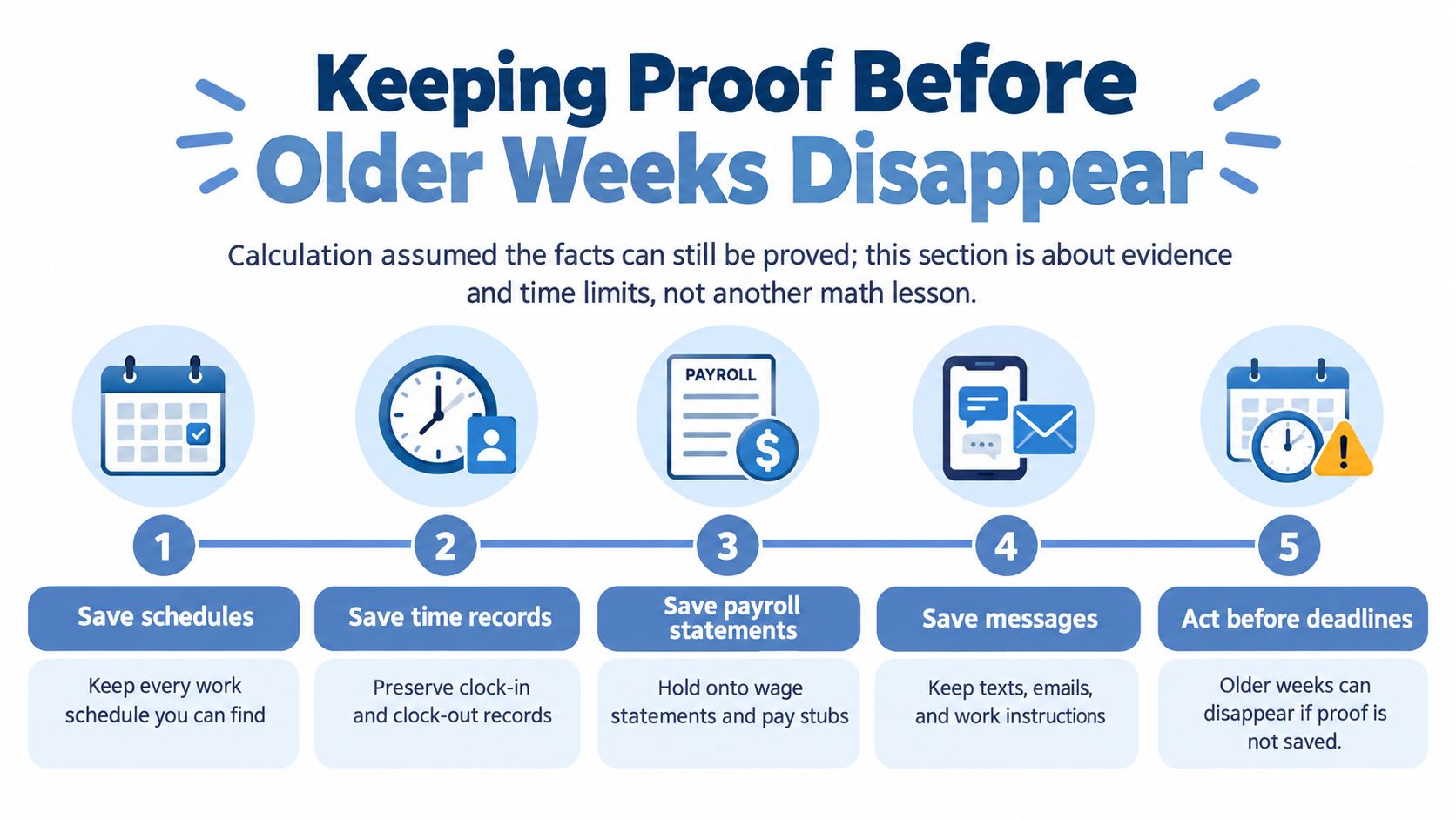
Save the records now, not after payroll finishes reviewing your complaint. Keep copies you can lawfully access in a location you control. Don't alter messages, replace originals with edited summaries, or collect unrelated confidential material just because you're preparing a claim.
Preserve context as well as totals. A message showing who assigned a task can be more useful than a calendar entry saying you worked late. A dispatch record may connect your recollection to a particular job and date.
Use this evidence timeline to keep preservation and deadlines together.
Make a dated evidence file
Preserve schedules, time records, payroll statements, messages, work-system logs, access logs, dispatch records, customer communications, and instructions to stay off the clock. Keep a separate note identifying coworkers who observed the disputed work.
Incomplete employer records don't automatically end the claim. A reasonable, specific recollection can help establish hours, but an estimate becomes easier to evaluate when it connects to a calendar, recurring assignment, or identifiable witness.
Use a deadline worksheet with these fields:
- Affected paycheck: Record the pay date and corresponding workweek.
- Disputed time: Enter the overtime hours and the evidence supporting them.
- Complaint history: Preserve when you raised the problem, whom you contacted, and the response.
- Limitations cutoff: Have the applicable filing deadline and look-back period evaluated promptly.
Federal overtime claims ordinarily have a two-year limitations period, extended to three years for willful violations, making prompt preservation and review important under the Mississippi overtime regulation and FLSA framework. Don't assume informal discussions preserve older weeks. Ask specifically what action is necessary to protect the claim while negotiations continue.
Keep evidence of threats, changed assignments, discipline, or other treatment after a complaint separate from the hours spreadsheet. That allows a lawyer to evaluate the conduct without confusing it with the wage calculation.
Workers' compensation is a different legal issue
Filing a Mississippi workers' compensation claim does not itself create a state retaliation claim. In Kelly v. Mississippi Valley Gas Co., 397 So. 2d 874 (Miss. 1981), the Mississippi Supreme Court declined to recognize that public-policy tort; later authority reaffirmed the result, and the Workers' Compensation Act contains no separate anti-retaliation provision, as summarized in this Mississippi employment-law discussion.
The benefits deadline is distinct: when no compensation other than medical treatment or burial expense is paid and no application is filed, failure to apply within two years after injury or death bars compensation under the Mississippi workers' compensation quick-reference guidance. Don't confuse pursuing those benefits with preserving an overtime claim or establishing a separate retaliation theory.
Comparing a Labor Complaint with Private Counsel
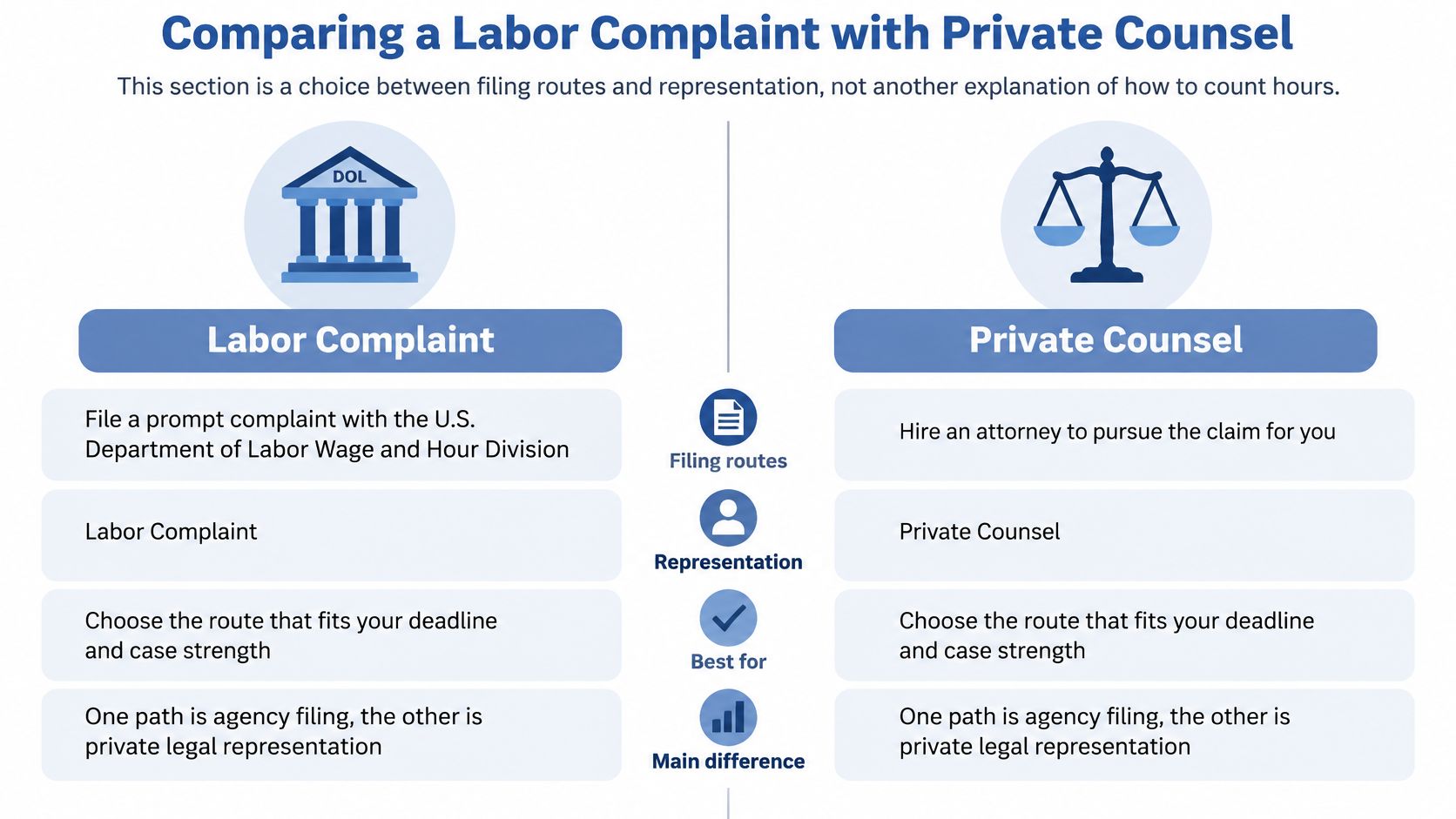
If your overtime calculation shows unpaid weeks, choose a route that fits your deadline, evidence, and legal issues. A complaint to the U.S. Department of Labor's Wage and Hour Division asks the agency to investigate. Private counsel can assess and pursue a federal claim on your behalf. Mississippi has no state overtime statute, so focus on the federal process rather than a state-court overtime lawsuit.
This chart summarizes the two routes.
Compare the route with the problem
A prompt agency complaint can be a practical way to bring a documented pay problem to investigators. Speak with private counsel when the case involves a disputed exemption, complicated compensation, a deadline concern, or other workplace conduct that needs legal assessment. You can review how to report unpaid wages to prepare for an agency complaint.
Use the same week-by-week records whichever route you consider. A complaint and a private case are not interchangeable, and contacting the agency does not necessarily preserve every deadline or produce the same relief. Ask what action your situation requires before relying on either route.
The Labor Department's national figures provide context, not a prediction for your claim. In fiscal year 2024, the Wage and Hour Division recovered $126,967,097 in overtime back wages for 101,043 employees, approximately $1,257 per affected employee. Those overtime recoveries were about 85% of $149,957,029 in total FLSA back-wage recoveries. In fiscal year 2023, the division recovered $130,686,461 for 106,759 employees, according to the Labor Department's FLSA enforcement data.
The totals exclude unreported disputes and private resolutions. They do not measure every violation or establish what you might recover. Use them as background, not as a reason to choose one route without reviewing your own evidence and deadlines.
The accompanying video offers another resource as you prepare questions about your dispute.
Read the contingency agreement before signing
A commonly described contingency-fee range for Mississippi employment matters is approximately 40% to 50% of the recovery. The percentage may depend on the agreement, case stage, risk, and extent of litigation, according to this Mississippi employment-lawyer fee explanation. Treat the range as a prompt to ask questions. The written agreement controls.
Before signing, confirm:
- The percentage: What applies at the start, and can it change later?
- The recovery definition: Which payments or other proceeds count toward the fee?
- Litigation expenses: Who advances costs, who ultimately pays them, and when are they deducted?
- An unsuccessful outcome: Do any financial obligations remain if there is no recovery?
A contingency fee ordinarily depends on obtaining a recovery, but the contract sets your obligations. Ask how it treats unpaid wages and any possible additional damages.
Nick Norris, P.A. is a Greater Jackson employment office representing Mississippi employees in unpaid overtime and other wage-and-hour disputes. The office offers employees a personalized plan for pursuing an agency complaint with private representation, from case evaluation through negotiation, litigation, or appeal.
What to Gather Before You Ask for Help
If a paycheck is short and you cannot tell which hours went unpaid, write down what happened before contacting a lawyer or the Labor Department. A concise summary helps identify the disputed workweeks, your pay arrangement, and any deadline concerns. You do not need to make the legal argument yourself.
Start with the basics: employer, work location, actual duties, pay method, and whether you still work there. Describe the paycheck problem plainly. Mississippi has no state overtime statute, so focus your records on the federal overtime claim and the specific weeks involved.
Build a packet someone can evaluate
Keep the summary short and arrange copies so a reviewer can check each estimate against its records.
- Suspect workweeks: List each affected week separately. Mark estimates and uncertainties clearly instead of presenting them as exact records.
- Pay records: Include relevant paystubs and compensation details, including bonuses or other payments that could affect the calculation.
- A rough damages total: Separate unpaid wages from possible liquidated damages, and identify any compensation already paid for the disputed work.
- Duty information: Describe what you did, who assigned or controlled the work, and what authority you exercised. A salary or supervisory title does not settle whether an exemption applies.
- Witness information: Name coworkers who saw your schedule or unpaid tasks, and note what each person can confirm.
Keep originals. Send organized copies when requested. Make it easy to match each disputed entry with a pay record, schedule, message, or other supporting document.
Make the unanswered questions visible
Keep complaint messages separate from your hour estimates. If you want later workplace treatment reviewed, list what happened and when, but do not assume that every adverse action proves retaliation. A workers' compensation filing concerns benefits and has its own deadline. It does not create a Mississippi workers' compensation retaliation claim.
Put the limitations question near the top of your summary. Ask which deadline governs, which older workweeks may still be recoverable, and what action preserves the claim. An employer's promise to investigate does not stop you from addressing the deadline.
If records are missing, explain what you tried to obtain and what you can still reconstruct. Do not delay asking for help while trying to make the packet perfect.
Before the consultation: Identify what you want reviewed, your overtime eligibility, missing hours, the calculation, the filing route, or all of them.
The practical choice is usually a Labor Department complaint or a private federal case, not a state-court overtime lawsuit. Your goal is to preserve the facts and get a clear assessment before delay puts older weeks at risk.
Leave a Reply