

Severance pay is generally a voluntary benefit, not a legal requirement in Mississippi or under federal law, except for mass layoffs covered by WARN. Employees shouldn't assume they're automatically entitled to severance unless a contract, policy, collective bargaining agreement, or specific law creates that right.
You're sitting in a termination meeting that appeared on your calendar without explanation. Your manager says the position has been eliminated, slides a document across the table, and points to one number. You may have minutes to decide whether to sign, but that number could affect your income, benefits, legal claims, and ability to work for a competitor.
Mississippi employees face an especially important distinction. An employer may offer severance as part of a separation agreement, but the offer doesn't necessarily mean the company believes it owes you money. Often, the employer wants a release of potential claims in exchange for payment. Before accepting, you need to understand both sides of that trade.
What Severance Pay Is
A Mississippi employer tells you your position is eliminated, then hands you a separation agreement offering several weeks of salary. The offer raises two practical questions: what does the payment cover, and what does the employer expect in return?
Severance pay is money an employer agrees to provide because the employment relationship is ending, commonly after a layoff or another involuntary separation. It may be calculated using length of service, salary, job level, company policy, or terms negotiated in a written agreement. The Department of Labor's explanation of severance pay describes the federal treatment of severance and confirms that the Fair Labor Standards Act does not require it.

What severance is not
Severance is separate from compensation you have already earned. Your final paycheck may include wages for work completed before termination. Accrued vacation, commissions, bonuses, and other earned compensation may be controlled by different policies, agreements, or wage rules. Treating every post-termination payment as severance can hide the difference between money the employer owes and money it is offering voluntarily.
An employer might offer severance as a goodwill payment, under an established plan, or in exchange for a release of certain claims. The trade-off matters. The agreement may include confidentiality, non-disparagement, a release of legal claims, or restrictions affecting future employment.
The payment may also depend on signing by a stated deadline. Do not sign solely because the amount would help with immediate expenses. Confirm whether the offer is separate from earned wages, how health benefits are handled, when payment will be made, and which rights you would give up. In Mississippi, where state administrative protections differ from federal enforcement routes, the release language deserves careful review before you surrender a potential claim.
Practical rule: Treat severance as a contract offer, not as a gift or automatic payment.
Is Severance Pay Required by Law in Mississippi
Mississippi generally does not require a private employer to provide severance pay. Federal wage law also creates no general entitlement, and the Fair Labor Standards Act does not require severance. Whether an employee receives anything usually depends on an employment contract, handbook, severance plan, collective bargaining agreement, or negotiated separation document.
That answer changes when a federal law or enforceable promise applies. A written policy may create obligations, although its language and terms control. An employer that has consistently followed a severance plan may also face questions about whether it departed from that plan without a valid reason.
A narrow federal exception can arise under the WARN Act. Covered mass layoffs and plant closures may trigger notice obligations. An employer that fails to provide required notice may face liability for pay and benefits connected to the violation. WARN coverage depends on facts including the employer's operations, the number of affected employees, and the nature and timing of the shutdown or layoff. A routine termination is not automatically a WARN event.
Why Mississippi's administrative structure matters
Mississippi does not have a state human rights commission. Discrimination and retaliation complaints generally proceed through the federal Equal Employment Opportunity Commission rather than a Mississippi state agency, as explained in this Mississippi employment-law resource on the absence of a state human rights commission.
That structure matters when a severance agreement follows a termination involving discrimination, harassment, or retaliation. The absence of a state commission does not remove federal protections. It does mean that workers must understand the federal administrative process and applicable deadlines. Mississippi also does not provide a workers' compensation retaliation claim merely because a worker filed for benefits, so the facts and legal theory behind a termination require careful review.
A release may affect claims that have not yet been investigated, subject to limits imposed by law. Before signing, identify what rights the agreement addresses and what it leaves untouched.
Ask these questions:
- Written promise: Does a contract, handbook, or severance plan contain an enforceable commitment?
- WARN issue: Do the facts suggest a covered mass layoff or plant closing?
- Potential claim: Does the termination involve discrimination, retaliation, unpaid wages, leave rights, or another protected issue?
- Exchange: What claims, benefits, or future opportunities does the employer want you to surrender?
If no contract or legal exception applies, the employer may offer nothing. The absence of a legal entitlement does not establish that the first offer is fair, and it does not make negotiation pointless.
How Severance Pay Is Typically Calculated
Employers often use a formula based on salary and tenure. A common informal approach is one or two weeks of pay for each year of service, although companies may use a different policy or negotiate a separate amount.
For example, an employee who earns $60,000 annually and has worked for the company for five years earns approximately $1,153.85 in weekly gross pay. A one-week-per-year formula would produce roughly $5,000, while a two-week-per-year formula would produce roughly $10,000. Those figures are illustrations of the formula, not a Mississippi legal standard or an entitlement.
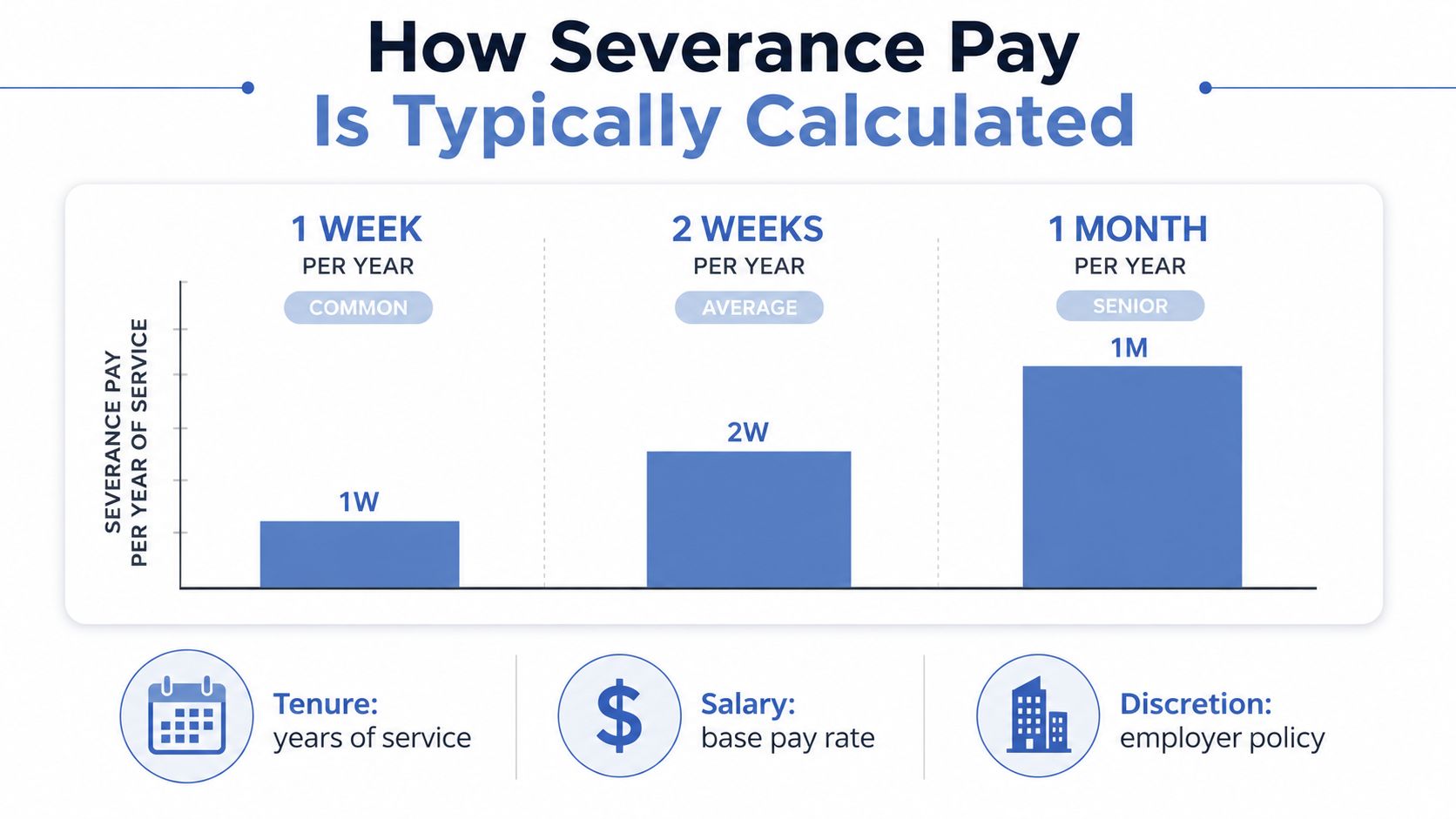
Formula versus actual market practice
A tenure formula is only a starting point. Job level, industry, reason for separation, bargaining power, restrictive covenants, health coverage, bonus eligibility, and the strength of potential claims can change the package. An executive plan may use a different formula from a frontline employee plan, and a negotiated agreement may not resemble the employer's ordinary policy.
Current benchmarking also shows why a simple formula can mislead. Challenger, Gray & Christmas reported that average severance across industries reached 19.3 weeks in 2025, compared with 15.6 weeks the prior year. Its reported industry range ran from about 10 weeks in retail to 35.3 weeks in chemicals. Review the 2025 severance benchmarking analysis from Challenger, Gray & Christmas for that context.
A low formula offer may be normal under an employer's policy, but “normal” doesn't answer whether it adequately compensates you for the rights you're releasing.
The OECD and World Bank materials also show that severance rules vary dramatically internationally. The World Bank working paper on severance pay and employment protection reports that severance transfers account for almost 50% of cross-country variation in the OECD strictness index for employment protection legislation for regular workers. That comparison isn't a Mississippi formula, but it reinforces the practical point: severance can be a central economic protection, not a minor add-on.
Federal employees evaluating a voluntary departure incentive face a separate set of rules, so workers in that system may find the federal employee buyout details useful for comparison.
Tax Implications and Benefit Impacts of Severance
Severance is generally treated as taxable wage income. Employers typically report it through payroll and include it on the employee's W-2, with applicable federal and state withholding. The amount withheld from the check isn't necessarily the same as your final tax liability, so keep the paystub and review the withholding treatment before assuming the net amount is correct.
A lump-sum payment can create a painful short-term cash-flow problem because payroll withholding may be substantial. It doesn't automatically mean every dollar is taxed at a permanently higher rate, but the payment can increase total taxable income for the year. Installments may spread income across payroll periods and make budgeting easier, although the agreement's wording and payment schedule control the actual treatment.
Questions about unemployment and health coverage
Severance and unemployment benefits don't always interact the same way in every jurisdiction. Mississippi workers should confirm with the Mississippi Department of Employment Security whether the payment affects the timing or amount of unemployment benefits, particularly when the agreement describes the money as salary continuation rather than a one-time separation payment. Don't assume that signing the agreement or receiving the first payment answers that question.
Health insurance creates a separate deadline problem. Employer-sponsored coverage may end under the plan's terms, and COBRA or another continuation option may carry its own election and payment requirements. Ask whether the employer will pay or reimburse premiums, when coverage ends, and whether the severance agreement changes any portion of that arrangement.

Before signing, request a written breakdown of:
- Gross amount: Confirm the total before withholding and whether it includes earned wages.
- Payment schedule: Determine whether payment is a lump sum, installments, or salary continuation.
- Benefits: Identify health coverage, life insurance, retirement contributions, and outplacement support.
- Unemployment: Ask how the employer characterizes the payment, then verify the effect with the appropriate Mississippi agency.
- Tax paperwork: Confirm how payroll will report the payment and whether any deductions apply.
A tax professional can address withholding and filing questions. An employment lawyer can focus on whether the financial terms justify the rights you're being asked to release.
Common Severance Agreement Terms and What They Mean
The severance check usually comes with conditions. The central provision is a release of claims, which may require you to give up employment-related claims against the company and sometimes its officers, affiliates, benefit plans, or agents. The scope matters more than the heading. A release that covers only known wage disputes differs from one that reaches unknown claims arising from the entire employment relationship.
The provisions that deserve close reading
A non-compete may limit where or for whom you can work after leaving. Mississippi courts generally assess restrictive covenants through factors such as legitimate business interests, geographic and temporal scope, and whether the restriction is reasonable under the circumstances. The precise wording and facts determine risk, so don't assume a clause is enforceable or unenforceable just because it appears in a company template.
Confidentiality language can protect legitimate trade secrets and private business information. It becomes more concerning when it is vague enough to cover ordinary workplace facts, prevent communications with government agencies, or interfere with protected rights. Non-disparagement provisions can restrict public statements, references, or private communications, depending on their wording and legal limits.

| Term | What the employer gains | What the employee should examine |
|---|---|---|
| Release of claims | Greater certainty against employment-related claims | Which claims, parties, dates, and unknown claims are covered |
| Non-compete | Reduced competition from a departing worker | Whether the restriction blocks reasonable future employment |
| Confidentiality | Protection for legitimate confidential information | Definitions, exceptions, agency communications, and duration |
| Non-disparagement | Limits on damaging statements | Whether it is mutual and whether it affects truthful reports |
| No-rehire clause | Prevents future employment with the company | Whether it extends to affiliates or future applications |
The release may preserve certain rights, including the ability to file or participate in an agency investigation, but the agreement should state those limits clearly. Federal law can also restrict an employer's ability to waive particular rights. For a closer look at the documents Mississippi workers commonly receive, review this guide to a separation and release agreement.
How to Negotiate Severance and Spot Red Flags
The first offer is often built for administrative convenience. It may follow a standard formula, use a fixed deadline, and include a broad release drafted entirely for the employer's protection. You don't need to reject it immediately, but you also don't need to treat it as final.
Ask for time to review the document. Then negotiate the parts that have practical value, not just the headline payment. Additional salary may matter, but continued health coverage, a neutral reference, a narrower release, removal of a non-compete, and a clear payment date can be just as important.
Compare the offer with the leverage
| Term | Typical First Offer | Realistic Negotiated Outcome |
|---|---|---|
| Severance amount | Fixed company formula | More pay justified by tenure, role, transition time, or disputed facts |
| Health coverage | Employee handles continuation alone | Employer-paid or reimbursed coverage for an agreed period |
| Release | Broad release covering many employment claims | Narrower language with clear preserved rights |
| Restrictive covenant | Existing or expanded non-compete | Removal, narrowing, or written confirmation of no restriction |
| Reference | No promise or informal assurance | Agreed reference language and designated contact |
| Deadline | Short signing window | Additional review time in writing |
The strongest requests connect directly to the employer's interest. If the company wants confidentiality, ask for a defined scope. If it wants a release, explain why the amount should reflect the claims being waived. If it wants a non-compete, ask how you'll earn a living while complying.
Red flags include a release broader than the payment justifies, confidentiality terms that prevent ordinary legal communications, a non-compete that effectively bars work in your field, and a clause allowing the employer to stop payment based on an undefined breach.
Legal advice can be expensive relative to a modest package. In Mississippi employment matters, the average contingency fee is 40 to 50 percent, although representation terms vary by case and service. That figure is relevant when evaluating a potential claim, but severance review and negotiation may be handled under a different fee arrangement. Consider this Mississippi guide to negotiating a severance agreement before deciding whether to sign.
What to Do After Receiving a Severance Offer in Mississippi
Don't sign during the termination meeting. Save the agreement, ask for the deadline in writing, and request additional review time if the employer is pressing for an immediate signature. A short delay can give you the chance to identify missing wages, benefit problems, or a release that reaches much further than expected.
Use a practical review sequence
- Preserve documents: Keep the agreement, termination email, handbook, employment contract, compensation plans, performance records, pay records, and relevant messages. Store personal copies lawfully and don't remove confidential company information.
- Write a timeline: Record who delivered the termination, what reasons were given, prior complaints, leave requests, accommodation discussions, wage concerns, and events leading to the separation.
- Separate payment categories: Identify final wages, accrued leave, commissions, bonuses, severance, benefit payments, and any stock or retirement issues.
- Read the release: Mark every claim, person, company, affiliate, agency exception, deadline, and repayment provision.
- Check future restrictions: Look for non-compete, non-solicitation, confidentiality, non-disparagement, cooperation, and no-rehire clauses.
Ask the employer precise questions before responding. When will each payment arrive? Does the agreement cover health insurance or only cash? What reference will the company provide? Is the release mutual? Which rights remain available? What happens if the employer claims you violated the agreement?
Mississippi workers' compensation retaliation
Mississippi doesn't provide a specific state-law retaliation claim merely because an employee filed a workers' compensation claim. Mississippi legal materials describe that gap directly, and this Mississippi workers' compensation resource explains why filing a claim, by itself, doesn't create a dedicated Mississippi anti-retaliation cause of action.
That limitation doesn't mean every termination involving an injured worker is lawful. Other facts may matter, including discrimination, interference with another protected right, wage issues, or a different retaliatory motive. Don't let an employer use a severance release to rush past those distinctions.
Contact a Mississippi employment lawyer when the agreement follows a disputed termination, contains a broad release, threatens your ability to work, or appears designed to silence complaints about discrimination, harassment, retaliation, leave, or wages. You can also review this guide addressing whether you should sign a severance agreement before making a final decision.
Nick Norris, P.A. reviews and negotiates severance agreements for Mississippi employees, including releases, payment terms, benefits, and restrictive covenants. Visit Nick Norris, P.A. to request guidance on the offer in front of you and the employment claims you may be giving up.
Leave a Reply