
You were fired in Mississippi, and the explanation still doesn't make sense. Maybe your supervisor praised your work until you complained about discrimination, requested medical leave, reported harassment, or raised a workplace problem. Then, shortly afterward, the employer ended your job and called it “performance.” You're now searching for a wrongful termination demand letter sample because you want to respond before the employer's version becomes the only version in the file.
A demand letter can create a serious opportunity for negotiation, but it can't repair a missing legal theory or replace evidence. The strongest letter is a concise, litigation-ready settlement proposal. It identifies what happened, explains why the termination may violate federal law or a recognized Mississippi public policy, calculates the loss, preserves evidence, and offers a specific path to resolution.
Introduction to Wrongful Termination Demand Letters in Mississippi
In Mississippi, an employee alleging discrimination generally proceeds through the EEOC because Mississippi doesn't have a state human rights commission. That federal administrative route affects how a demand letter should be timed and drafted. Preserve the option of filing an administrative charge while presenting the employer with a clear basis to resolve the dispute.
The EEOC's fiscal year 2024 enforcement data reports 88,531 workplace discrimination charges, a 9% increase from the prior year. Retaliation accounted for 42,301 charges, or 47.8% of all filings, and remained the leading allegation for the seventeenth consecutive year. Those figures do not establish an individual claim. They do show why the letter should connect the protected activity, the termination, the decision-maker, and the timing without forcing the reader to reconstruct the case.
An employer's initial review is usually quick. Put the employee's position, termination date, protected complaint or activity, stated reason, supporting records, and requested resolution near the front. A detailed account can help, but an emotional narrative that buries those facts is easier to dismiss.
Practical rule: Write for the employer's lawyer, not only for the manager who hurt you.
Use the sample below as a working draft. Replace each bracketed prompt with verified facts, organize the records by date, and decide whether to request money, reinstatement, restored benefits, a neutral reference, or a combination. Do not cite retaliation resources twice in the article. Save retaliation in the workplace for the later discussion of that claim.
Mississippi Wrongful Termination Demand Letter Sample You Can Customize

Use this wrongful termination demand letter sample as a drafting framework, not as a form to send unchanged. Accuracy matters more than legal-sounding language.
[Your name]
[Address]
[City, Mississippi ZIP code]
[Email]
[Telephone]
[Date]
Via certified mail and email
[Employer name]
[Employer address]
[City, Mississippi ZIP code]
Attn: [Owner, human resources director, or counsel]
Re
Wrongful termination, retaliation, and discrimination claims involving [your name]
Dear [recipient]:
I worked for [employer] as [job title] from [start date] until [termination date]. On [date], [decision-maker] told me that my employment was ending because [employer's stated reason]. That explanation conflicts with the documented events described below.
On [date], I [reported discrimination, complained about harassment, requested protected medical or family leave, participated in an investigation, opposed unlawful conduct, or engaged in another protected activity]. I made that report to [name and title] by [email, text, meeting, hotline, or other method]. [Witness name and title] was present or received the communication.
After that activity, [identify changed treatment, discipline, investigation, schedule change, criticism, or other event] occurred on [date]. My employment ended on [termination date], approximately [describe the time relationship without exaggeration] after the protected activity. Before then, [summarize performance reviews, awards, positive feedback, lack of discipline, or comparable facts]. The employer's stated reason is inconsistent with [specific document, witness, or prior treatment].
These facts support claims under [identify the applicable federal statute, such as Title VII, the Americans with Disabilities Act, the Age Discrimination in Employment Act, the Family and Medical Leave Act, or another applicable law]. The theory is that I engaged in protected activity or possessed a protected characteristic, the employer took adverse action, and the surrounding facts support a connection between those events. I reserve all rights under applicable federal law and Mississippi law.
My current losses include:
- Back pay from [termination date] through [current date]: $[amount].
- Lost benefits, including [health insurance, retirement contributions, bonuses, or other benefits]: $[amount].
- Front pay or expected future loss: $[amount or explain calculation].
- Emotional-distress damages: $[amount or explain basis].
- Other recoverable losses: $[amount].
To resolve this dispute without further administrative or legal proceedings, I demand [specific settlement amount] in exchange for an appropriate written settlement agreement and release. Alternatively, I request [reinstatement to the prior or an equivalent role, restoration of benefits, correction of personnel records, and a neutral reference]. If reinstatement isn't accepted, my alternative demand is back pay, benefits, and other documented damages.
Please respond by [date, usually 10 to 14 days after receipt]. Please preserve all documents and electronically stored information relating to my employment, complaints, performance, discipline, termination, payroll, benefits, communications, and similarly situated employees. This includes emails, text messages, personnel records, calendars, system messages, and relevant phone data.
Nothing in this letter waives any claim, deadline, administrative remedy, or right. I'm willing to discuss resolution through counsel or an appropriate mediation process.
Sincerely,
[Your name]
The facts section should read like a timeline. Identify witnesses by name and role, but don't label someone a witness if you haven't confirmed what they observed. Tie each legal theory to facts rather than listing every statute you can find.
If you're adapting structure from a broader personal-injury format, this demand letter example for personal injury claims can help with organization, exhibits, and settlement presentation. Its purpose differs from an employment letter, so keep the Mississippi employment-law analysis separate.
Place the video after the written sample, not in place of it.
How to Build Your Facts Damages and Evidence Package
A persuasive demand letter turns a workplace story into a file an employer can evaluate. Build the facts as a timeline. For each event, record the date, people involved, document supporting it, and what each person personally observed. If the source is uncertain, verify it before including the fact.
Connect each legal theory to specific conduct. A complaint, discipline decision, or termination date matters because of what happened around it, not because a letter lists every statute that might apply. Review how to prove wrongful termination while organizing the chronology and exhibits.
Calculate damages line by line. Use pay records for lost wages, benefit statements for lost coverage or contributions, and job-search records for mitigation efforts. Describe emotional distress through concrete effects, such as treatment, disrupted sleep, anxiety, damaged relationships, or changes in daily functioning. Keep the description accurate and proportional to the proof.
Fee exposure affects the settlement number. Mississippi-focused legal guidance states that employment contingency fees commonly fall within 40% to 50% of any recovery. This Mississippi employment fee and administrative-path discussion explains that context. Account for fees, costs, taxes, and the amount required to resolve the dispute instead of choosing a demand solely because it sounds forceful.
Damages and relief options
| Demand Element | What to Specify | When to Use It |
|---|---|---|
| Back pay | Wages lost from termination through the demand date, supported by pay records | Use in nearly every monetary demand |
| Benefits | Health coverage, retirement contributions, bonuses, and other identifiable losses | Use when benefits had measurable value |
| Emotional distress | Symptoms, treatment, and documented effects | Use when the facts support a genuine non-economic claim |
| Reinstatement | Prior or equivalent position, pay, benefits, reporting structure, and return date | Use when returning is realistic and genuinely desired |
| Records correction | Removal or correction of inaccurate termination or discipline records | Use when the file may harm future employment |
| Preservation request | Personnel files, emails, texts, calendars, payroll, and investigation materials | Use whenever relevant evidence may be deleted or overwritten |
Attach only relevant, readable documents. Label exhibits clearly and keep the originals. Do not send privileged communications, unrelated coworker records, or material obtained unlawfully. Identify people by name and role only after confirming what they observed. A clean exhibit package helps counsel and the employer test the facts without searching through unrelated material.
Reinstatement requires a separate decision. Specify the requested role, return date, pay, benefits, and reporting structure. Keep a monetary alternative, such as back pay and benefits, if the employer refuses. This option can fit an employee who wants the job, restored benefits, or a neutral reference more than a lump-sum exit. If returning would be impractical or unsafe, a monetary demand and records correction may better match the employee's objective.
Timing, Delivery, and Response Deadlines That Strengthen Your Position
Send the letter soon after termination, once the core facts and documents are verified. A fresh chronology is easier to support, and prompt delivery gives the employer an opportunity to assess resolution before positions harden. Private negotiations do not extend an administrative deadline. A demand letter does not automatically preserve an EEOC deadline.
Use delivery methods that create a reliable record. Certified mail with a return receipt, email to an identified decision-maker or counsel, and a saved PDF provide stronger proof than an untracked message. Keep the sent email, attachments, receipt, and exact final version together.
The EEOC's fiscal year 2024 mediation evaluation reports that 8,543 of 11,998 mediated charges resolved successfully, roughly 71.2%, with $243.2 million in monetary benefits to complainants. The EEOC mediation evaluation supports presenting the letter as a documented settlement proposal, not a general complaint.
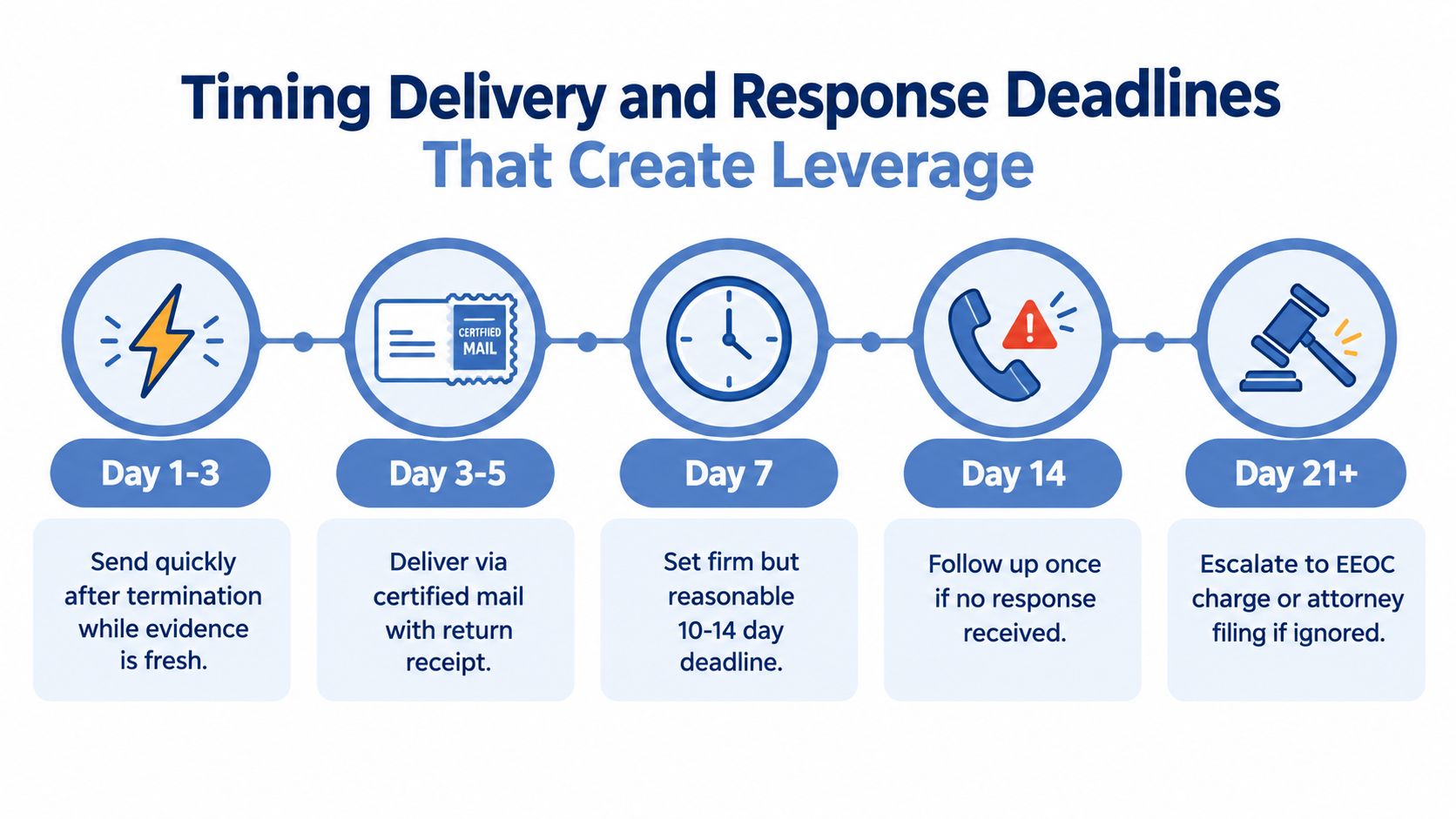
A practical sequence is:
- Confirm the termination date, protected activity, decision-maker, and core documents.
- Prepare the letter, damages schedule, exhibit list, and preservation request.
- Send it through trackable delivery and save proof.
- Set a response date, commonly 10 to 14 days, as the infographic reflects.
- Follow up once if the employer does not respond. Avoid arguing by text or telephone.
- Protect the EEOC path independently.
Only about 31% of employers invited to mediation accept, according to EEOC testimony, while mediated matters resolve in about 85 days on average, compared with 160 days for investigations. The EEOC meeting transcript shows why the letter should anticipate noncooperation and include the liability theory, damages calculation, exhibits, and deadline-backed offer.
Review Mississippi-specific information about the employment discrimination statute of limitations before allowing private negotiations to determine your filing schedule.
Common Pitfalls That Weaken Your Demand Letter
A demand letter can fail even when the underlying facts are serious. The usual causes are a wrong legal theory, unsupported damages, or a tone that makes settlement harder.

Don't use workers' compensation retaliation as the legal theory
Mississippi does not provide a specific state-law retaliation claim for filing a workers' compensation claim, and Mississippi courts have declined to recognize that cause of action under the workers' compensation system. Mississippi guidance on workers' compensation retaliation explains the distinction.
You can still pursue workers' compensation benefits for a workplace injury. Do not describe the termination as violating a Mississippi workers' compensation retaliation statute. If the facts also involve discrimination or retaliation for a separate protected complaint, analyze that theory separately.
Don't threaten state-court litigation
Identify the appropriate federal administrative path or another legally supported route. A threat to sue in Mississippi state court weakens the letter when that is not the intended forum or the legal theory does not support the claim.
Don't send a grievance instead of a claim
“Management treated me unfairly” gives the employer little to evaluate. State the dates, decision-makers, exact complaint language, comparable employees, and the reason the employer gave for termination. Connect those facts to the legal theory.
Don't inflate damages
An unsupported demand damages credibility. Show the calculation, separating back pay, lost benefits, emotional distress, and any front-pay request. Explain the assumptions behind each amount.
Don't omit preservation language
Ask the employer to preserve texts, emails, calendars, personnel records, timekeeping data, and relevant electronic files. If the employer later claims that records disappeared, the earlier request may matter. Keep delivery proof, attachments, and the final letter together in one file.
Next Steps After Sending Your Demand Letter in Mississippi
The response usually falls into one of three categories: acceptance of discussion, a counteroffer, or silence. Treat a counteroffer as information, not an insult. Compare its amount and terms against documented back pay, benefits, emotional distress, tax treatment, release language, reference terms, and the strength of your evidence.
Don't make informal admissions after sending the letter. Route substantive communications through counsel when possible, preserve new messages, and avoid discussing the dispute on social media. If the employer ignores the deadline, protect the EEOC process rather than sending repeated threats.
EEOC mediation can offer an earlier resolution path, but employer participation isn't guaranteed. The prior EEOC figures show both the potential value of mediation and the need to prepare for an investigation or other formal administrative step if negotiation fails.
A lawyer can also help determine whether reinstatement is practical, whether the employer's stated reason creates an inference of pretext, and whether your damages calculation is defensible. Mississippi employment contingency fees commonly fall within 40% to 50% of any recovery, so ask about the fee percentage, litigation costs, administrative work, and how a settlement would be allocated before signing an agreement. This guide to finding an employment lawyer offers practical questions for that conversation.
Before the deadline arrives, complete this checklist:
- Save the termination notice and all related communications.
- Build a dated chronology with witnesses.
- Gather pay, benefits, performance, complaint, and leave records.
- Select monetary relief, reinstatement, or both.
- Confirm the EEOC timing separately.
- Send the final letter with proof of delivery.
- Don't sign a release without understanding every term.
Nick Norris, P.A. evaluates Mississippi wrongful termination, discrimination, retaliation, FMLA, WARN, USERRA, and wage disputes, including the evidence and EEOC-path issues that affect a demand letter. Visit Nick Norris, P.A. to request a case evaluation and discuss a practical strategy for your termination.
Leave a Reply